Canonical Optimization for MIMO MAC Design
Pith reviewed 2026-05-08 17:12 UTC · model grok-4.3
The pith
The MIMO MAC admits canonical convex formulations with four solvers that characterize its capacity region.
A machine-rendered reading of the paper's core claim, the machinery that carries it, and where it could break.
Core claim
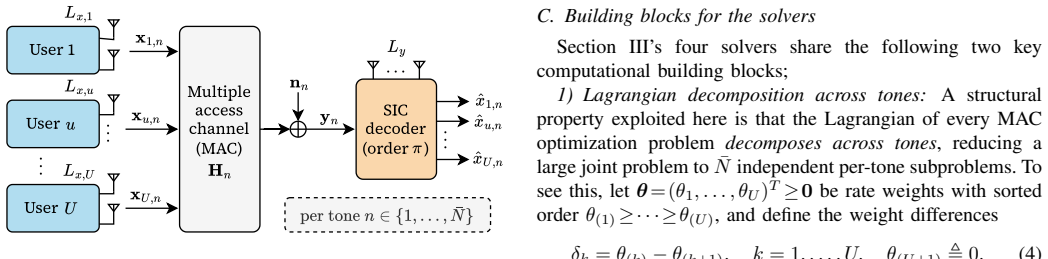
The MIMO MAC admits canonical convex formulations, and the four solvers maxRMAC, minPMAC, maxRESMAC, and admMAC together characterize its capacity region. They exploit the polymatroid structure of the MAC rate region and the separability of the dual Lagrangian across frequency tones to reduce each problem to parallel per-tone covariance optimizations solved via L-BFGS over Cholesky-like factors. The resulting algorithms match commercial convex solvers in solution quality, run up to two orders of magnitude faster, scale to regimes where commercial solvers time out, and extend via BC-MAC duality to optimal precoder design for the MIMO broadcast channel.
What carries the argument
Polymatroid structure of the MAC rate region together with separability of the dual Lagrangian across frequency tones, which reduces the optimization to independent per-tone covariance problems solved by L-BFGS over Cholesky-like covariance factors.
If this is right
- The four solvers achieve solution quality identical to commercial convex solvers while running up to two orders of magnitude faster.
- They remain tractable on problem sizes where commercial solvers exceed time limits.
- The same four algorithms, via broadcast-to-MAC duality, yield optimal precoders for the MIMO broadcast channel.
- Open-source code makes the methods directly usable on realistic spatially correlated OFDM channels.
Where Pith is reading between the lines
- The per-tone reduction may allow parallel hardware implementations for real-time adaptation in frequency-selective channels.
- Similar polymatroid-plus-separability arguments could apply to other multiuser MIMO settings that share the same structural features.
- The explicit convex forms reduce the need for machine-learning approximations once the canonical reduction is recognized.
Load-bearing premise
The MIMO MAC rate region possesses a polymatroid structure and its dual Lagrangian separates across frequency tones.
What would settle it
A spatially correlated MIMO OFDM channel instance where one of the four proposed solvers returns a noticeably different rate-energy point from a commercial interior-point solver, or where the proposed methods fail to finish while the commercial solver succeeds.
Figures


read the original abstract
Resource allocation in the multiple-input multiple-output (MIMO) multiple access channel (MAC) is a fundamental problem in multiuser communications, yet it is increasingly treated as non-convex and computationally intractable. This has motivated a large body of heuristic machine learning and successive-approximation methods. Results here show that the MIMO MAC admits canonical convex formulations and present four solvers that together characterize its capacity region. maxRMAC performs weighted sum-rate maximization under per-user energy constraints, minPMAC finds the minimum weighted energy required to support target rates, maxRESMAC performs weighted sum-rate maximization under a total energy constraint, and admMAC tests rate-region feasibility. The solvers exploit the polymatroid structure of the MAC rate region and the separability of the dual Lagrangian across frequency tones, which reduces the problem to parallel per-tone covariance optimizations solved via limited-memory Broyden-Fletcher-Goldfarb-Shanno (L-BFGS) over Cholesky-like covariance factors. Experiments on spatially correlated MIMO orthogonal frequency-division multiplexing (OFDM) channels show that the proposed solvers match a commercial convex solver in solution quality while running up to two orders of magnitude faster and scaling to regimes where the commercial solver times out. Through broadcast channel (BC) to MAC duality, the same solvers also enable optimal precoder design for the MIMO BC. All solvers are open-sourced and available at https://github.com/muhd-umer/canonical-mac.
Editorial analysis
A structured set of objections, weighed in public.
Referee Report
Summary. The manuscript claims that the MIMO MAC admits canonical convex formulations via its polymatroid structure and the separability of the dual Lagrangian across OFDM frequency tones. It introduces four solvers (maxRMAC for weighted sum-rate maximization under per-user energy constraints, minPMAC for minimum weighted energy to meet target rates, maxRESMAC for weighted sum-rate under total energy, and admMAC for feasibility testing) that reduce to parallel per-tone covariance optimizations solved by L-BFGS on Cholesky factors. Experiments on spatially correlated MIMO-OFDM channels demonstrate that these solvers match a commercial convex solver in solution quality while running up to two orders of magnitude faster and scaling to larger regimes. The approach extends to MIMO BC precoder design via duality, with all code open-sourced.
Significance. If the results hold, the work is significant because it establishes that MIMO MAC resource allocation admits exact convex formulations and efficient solvers, countering the trend toward heuristics and successive approximations. The explicit use of polymatroid properties and dual separability, combined with reproducible open-source implementations and demonstrated scalability on realistic correlated channels, provides practical tools for capacity region characterization and BC design. This could reduce reliance on approximate methods in multiuser communications.
minor comments (3)
- Abstract: The statement that solvers 'match a commercial convex solver in solution quality' would be clearer if it referenced the specific metric (e.g., rate error or duality gap) and the commercial solver name used in the experiments section.
- The description of the L-BFGS implementation over Cholesky-like factors in the solvers section would benefit from an explicit statement of the variable substitution and any projection steps to enforce positive-semidefiniteness.
- Experiments section: Timing comparisons would be more informative with details on the hardware platform, number of Monte Carlo trials, and the precise commercial solver configuration (e.g., CVXPY with MOSEK or SDPT3).
Simulated Author's Rebuttal
We thank the referee for the positive and accurate summary of our work, the recognition of its significance in providing exact convex formulations and scalable solvers for the MIMO MAC, and the recommendation for minor revision. The referee's description correctly captures the polymatroid structure, dual separability, L-BFGS-based per-tone optimizations, experimental results on correlated channels, BC duality extension, and open-source release.
Circularity Check
No significant circularity detected
full rationale
The derivation rests on the standard polymatroid structure of the MIMO MAC rate region (subset mutual-information inequalities) and the additive separability of the dual Lagrangian over OFDM tones once per-user energy multipliers are fixed. These are classical results from multiuser information theory, not self-derived or fitted within the paper. The four solvers reduce to independent per-tone convex covariance optimizations solved by L-BFGS on Cholesky factors; no step renames a fitted input as a prediction, imports uniqueness via self-citation, or smuggles an ansatz. BC-MAC duality is likewise external. The chain is therefore self-contained against external benchmarks with no load-bearing reduction to its own inputs.
Axiom & Free-Parameter Ledger
axioms (2)
- domain assumption The MIMO MAC rate region is a polymatroid.
- domain assumption The dual Lagrangian separates across frequency tones in OFDM.
Reference graph
Works this paper leans on
-
[1]
D. Tse and S. Hanly, “Multiaccess fading channels. I. Polymatroid structure, optimal resource allocation and throughput capacities,”IEEE Trans. Inf. Theory, vol. 44, no. 7, pp. 2796–2815, 1998
work page 1998
-
[2]
Iterative water-filling for gaussian vector multiple-access channels,
W. Yu, W. Rhee, S. Boyd, and J. Cioffi, “Iterative water-filling for gaussian vector multiple-access channels,”IEEE Trans. Inf. Theory, vol. 50, no. 1, pp. 145–152, 2004
work page 2004
-
[3]
Optimized transmission for fading multiple-access and broadcast channels with multiple antennas,
M. Mohseni, R. Zhang, and J. Cioffi, “Optimized transmission for fading multiple-access and broadcast channels with multiple antennas,”IEEE J. Sel. Areas Commun., vol. 24, no. 8, pp. 1627–1639, 2006
work page 2006
-
[4]
On the duality of Gaus- sian multiple-access and broadcast channels,
N. Jindal, S. Vishwanath, and A. Goldsmith, “On the duality of Gaus- sian multiple-access and broadcast channels,”IEEE Trans. Inf. Theory, vol. 50, no. 5, pp. 768–783, 2004
work page 2004
-
[5]
Sum capacity of Gaussian vector broadcast channels,
W. Yu and J. Cioffi, “Sum capacity of Gaussian vector broadcast channels,”IEEE Trans. Inf. Theory, vol. 50, no. 9, pp. 1875–1892, 2004
work page 2004
-
[6]
M. Wang, X. Liu, F. Wang, Y . Liu, T. Qiu, and M. Jin, “Spectrum- efficient user grouping and resource allocation based on deep reinforce- ment learning for mmWave massive MIMO-NOMA systems,”Sci. Rep., vol. 14, no. 1, p. 8884, 2024
work page 2024
-
[7]
S. A. H. Mohsan, Y . Li, A. V . Shvetsov, J. Varela-Ald´as, S. M. Mostafa, and A. Elfikky, “A survey of deep learning based NOMA: State of the art, key aspects, open challenges and future trends,”Sensors, vol. 23, no. 6, p. 2946, 2023
work page 2023
-
[8]
Weighted sum-rate maximization using weighted MMSE for MIMO- BC beamforming design,
S. S. Christensen, R. Agarwal, E. de Carvalho, and J. M. Cioffi, “Weighted sum-rate maximization using weighted MMSE for MIMO- BC beamforming design,” inIEEE Int. Conf. Commun. (ICC), pp. 1–6, 2009
work page 2009
-
[9]
An iterative water-filling algorithm for maximum weighted sum-rate of gaussian MIMO-BC,
M. Kobayashi and G. Caire, “An iterative water-filling algorithm for maximum weighted sum-rate of gaussian MIMO-BC,”IEEE J. Sel. Areas Commun., vol. 24, no. 8, pp. 1640–1646, 2006
work page 2006
-
[10]
On the limited memory BFGS method for large scale optimization,
D. C. Liu and J. Nocedal, “On the limited memory BFGS method for large scale optimization,”Math. Program., vol. 45, no. 1, pp. 503–528, 1989
work page 1989
-
[11]
S. Boyd and L. Vandenberghe,Convex Optimization. Cambridge Uni- versity Press, 2004
work page 2004
-
[12]
Q. Zhu, C.-X. Wang, B. Hua, K. Mao, S. Jiang, and M. Yao, “3GPP TR 38.901 channel model,” inThe Wiley 5G Ref.: The Essent. 5G Ref. Online, pp. 1–35, Wiley Press, 2021
work page 2021
-
[13]
J. M. Cioffi,Data Transmission Theory. Stanford University, 2026. Book chapters available at:cioffi-group.stanford.edu
work page 2026
discussion (0)
Sign in with ORCID, Apple, or X to comment. Anyone can read and Pith papers without signing in.