A Recursive Polynomial Chaos Evolution Method for Stochastic Differential Equations
Pith reviewed 2026-05-07 14:16 UTC · model grok-4.3
The pith
A recursive polynomial chaos method for SDEs keeps a fixed low-dimensional representation by dynamically updating bases and preserves Wasserstein-1 convergence.
A machine-rendered reading of the paper's core claim, the machinery that carries it, and where it could break.
Core claim
The distributions generated by the recursive polynomial chaos evolution method preserve convergence in the Wasserstein-1 distance through a dynamic updating strategy that constructs orthogonal polynomial bases adapted to the current probability measure and projects the one-step-ahead solution together with new Brownian increments onto this new basis.
What carries the argument
The dynamic basis update, which at each time step constructs orthogonal polynomial bases for the current probability measure and projects the forward solution onto the new basis along with the incoming Brownian increments.
If this is right
- Long-time SDE simulations become feasible with bounded computational dimension.
- No Monte Carlo sampling is required because the evolution stays inside the polynomial chaos representation.
- The fixed low-dimensional structure remains accurate for complex dynamical behaviors over extended intervals.
Where Pith is reading between the lines
- The same recursive update could be applied to other Markovian stochastic processes whose transition kernels admit polynomial chaos representations.
- Hybrid schemes that combine this basis-update step with existing time-stepping methods for SDEs might further reduce cost.
- Scalability tests on systems with higher-dimensional noise would reveal whether the dimension reduction remains effective.
Load-bearing premise
The stochastic differential equation and the projection method satisfy conditions that allow the dynamic basis update to preserve Wasserstein-1 convergence.
What would settle it
An explicit SDE and projection choice where the Wasserstein-1 distance between the true law and the method's output fails to go to zero as the time step size decreases or the polynomial degree increases.
Figures




read the original abstract
Numerical simulation of stochastic differential equations over long time intervals poses significant computational challenges. In this paper, we propose a novel recursive polynomial chaos evolution method that achieves model reduction without sampling by exploiting the Markov property to maintain a fixed low-dimensional representation throughout the time evolution. At each time step, we construct orthogonal polynomial bases adapted to the current probability measure, and project the one-step-ahead solution onto this new basis together with the new Brownian increments. This dynamic updating strategy effectively reduces the dimension of the random variables during long-time evolution. Under appropriate assumptions, we prove the convergence of the method, specifically that the distributions generated by the method preserve convergence in the Wasserstein-1 distance. We present numerical results demonstrating that the method can accurately capture complex dynamical behaviors with high accuracy and low computational cost.
Editorial analysis
A structured set of objections, weighed in public.
Referee Report
Summary. The manuscript introduces a recursive polynomial chaos evolution (RPCE) method for long-time numerical simulation of SDEs. It exploits the Markov property to keep a fixed low-dimensional representation by dynamically constructing orthogonal polynomial bases adapted to the current probability measure at each step and projecting the one-step-ahead solution (including fresh Brownian increments) onto this basis. Under appropriate assumptions on the SDE and the projection operator, the authors prove that the push-forward measures generated by the method converge to the law of the true SDE solution in the Wasserstein-1 metric. Numerical examples are given to illustrate accuracy and efficiency on long intervals.
Significance. If the W1 convergence result holds under the stated assumptions, the work would provide a sampling-free, dimensionally stable alternative to standard polynomial chaos or Monte Carlo methods for long-horizon SDE integration. The dynamic basis update directly addresses the curse of dimensionality that arises when fixed bases are used over extended time, and the choice of W1 as the convergence metric is appropriate for capturing weak convergence of distributions. The numerical demonstrations of complex dynamics at low cost add practical value.
major comments (2)
- [§3.2, Theorem 3.3] §3.2, Theorem 3.3: The induction step that controls the accumulated W1 error after k steps relies on a one-step projection bound (presumably Eq. (3.8)) being uniform in the adapted basis. It is not shown whether the constant in this bound remains independent of the time step size when the measure evolves; an explicit Gronwall-type estimate or a counter-example under relaxed Lipschitz assumptions would clarify the long-time stability.
- [§4.1, Assumption 4.1] §4.1, Assumption 4.1: The growth and regularity conditions imposed on the drift and diffusion coefficients are listed, but the numerical examples in §5 use SDEs (e.g., the stochastic Lorenz system) whose coefficients violate the global Lipschitz requirement. A remark explaining why the local version still guarantees the W1 convergence claimed in Theorem 3.3 is needed.
minor comments (2)
- [§2.3] Notation for the adapted orthogonal polynomials (p_n^{(t)}) is introduced in §2.3 but reused without re-definition in the projection formula (3.5); a short reminder sentence would improve readability.
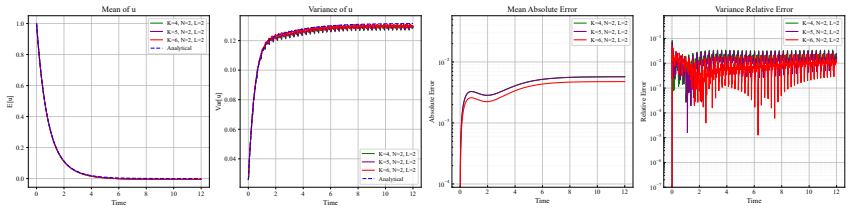
- [Figure 3] Figure 3 caption states 'W1 error versus time' but the y-axis label is missing the factor 10^{-3}; please correct for consistency with the plotted data.
Simulated Author's Rebuttal
We thank the referee for the careful reading of our manuscript and the constructive comments. We address each major comment point by point below, indicating the revisions we will make to strengthen the presentation and proof.
read point-by-point responses
-
Referee: [§3.2, Theorem 3.3] The induction step that controls the accumulated W1 error after k steps relies on a one-step projection bound (presumably Eq. (3.8)) being uniform in the adapted basis. It is not shown whether the constant in this bound remains independent of the time step size when the measure evolves; an explicit Gronwall-type estimate or a counter-example under relaxed Lipschitz assumptions would clarify the long-time stability.
Authors: We agree that the uniformity of the one-step projection bound with respect to the evolving measure should be made explicit for the induction argument in Theorem 3.3. The bound in Eq. (3.8) follows from the Lipschitz assumption on the coefficients together with the fact that the orthogonal projection onto the adapted polynomial basis is a contraction in the Wasserstein-1 metric for measures possessing uniformly bounded second moments (which is preserved by the SDE under our assumptions). To clarify the long-time behavior, we will insert a discrete Gronwall estimate immediately after the induction step, showing that the accumulated error grows at most exponentially in the number of steps with a prefactor depending only on the global Lipschitz constant and the time horizon, independent of the particular sequence of adapted bases. This addition will be included in the revised version. revision: yes
-
Referee: [§4.1, Assumption 4.1] The growth and regularity conditions imposed on the drift and diffusion coefficients are listed, but the numerical examples in §5 use SDEs (e.g., the stochastic Lorenz system) whose coefficients violate the global Lipschitz requirement. A remark explaining why the local version still guarantees the W1 convergence claimed in Theorem 3.3 is needed.
Authors: The referee is correct that the stochastic Lorenz system used in §5 fails to satisfy the global Lipschitz condition of Assumption 4.1. In the revised manuscript we will add a short remark immediately after Assumption 4.1 stating that the W1 convergence result of Theorem 3.3 extends to locally Lipschitz coefficients that satisfy a linear growth bound (preventing finite-time explosion). Under these conditions the proof proceeds by localization: one applies the global result on a sequence of stopping times that exhaust the time interval with high probability, then passes to the limit using tightness of the approximating measures in the Wasserstein-1 metric. We will also cite standard references on weak convergence for locally Lipschitz SDEs to support the argument. revision: yes
Circularity Check
No significant circularity; convergence proof is independent
full rationale
The paper constructs a new recursive polynomial chaos evolution method that exploits the Markov property for fixed low-dimensional updates via adapted orthogonal bases and one-step projections. The central result is a convergence proof showing that the generated distributions preserve Wasserstein-1 distance to the true SDE solution, under explicitly stated assumptions on the SDE and projection. This proof structure does not reduce by construction to fitted parameters, self-definitions, or load-bearing self-citations; the method and its error analysis are presented as self-contained with independent mathematical content. No renaming of known results or smuggled ansatzes appear in the derivation chain.
Axiom & Free-Parameter Ledger
axioms (1)
- domain assumption Appropriate assumptions on the SDE and the projection operator
Reference graph
Works this paper leans on
- [1]
-
[2]
[5]M. Branicki and A. Majda,Fundamental limitations of polynomial chaos for uncertainty quantifi- cation in systems with intermittent instabilities, Communications in mathematical sciences, 11 (2013), pp. 55–103. [6]R. E. Caflisch,Monte carlo and quasi-monte carlo methods, Acta Numerica, 7 (1998), p. 1–49. [7]Y. Cao and J. Lu,Stochastic dynamical low-rank...
work page 2013
-
[3]
[14]L. Einkemmer and C. Lubich,A low-rank projector-splitting integrator for the vlasov–poisson equa- tion, SIAM Journal on Scientific Computing, 40 (2018), pp. B1330–B1360. [15]O. G. Ernst, A. Mugler, H.-J. Starkloff, and E. Ullmann,On the convergence of generalized polynomial chaos expansions, ESAIM: Mathematical Modelling and Numerical Analysis, 46 (20...
work page 2018
-
[4]
35 [18]M. Gerritsma, J.-B. van der Steen, P. Vos, and G. Karniadakis,Time-dependent generalized polynomial chaos, Journal of Computational Physics, 229 (2010), pp. 8333–8363. [19]B. Gershgorin, J. Harlim, and A. Majda,Test models for improving filtering with model errors through stochastic parameter estimation, Journal of Computational Physics, 229 (2010)...
work page 2010
-
[5]
[21]M. B. Giles,Multilevel monte carlo methods, Acta numerica, 24 (2015), pp. 259–328. [22]V. Heuveline and M. Schick,A hybrid generalized polynomial chaos method for stochastic dynamical systems, International Journal for Uncertainty Quantification, 4 (2014). [23]D. J. Higham, X. Mao, and A. M. Stuart,Strong convergence of euler-type methods for nonlinea...
work page 2015
-
[6]
[27]Y. Kazashi, F. Nobile, and E. Vidli ˇckov´a,Stability properties of a projector-splitting scheme for dynamical low rank approximation of random parabolic equations, Numerische Mathematik, 149 (2021), pp. 973–1024. [28]Y. Kazashi, F. Nobile, and F. Zoccolan,Dynamical low-rank approximation for stochastic differ- ential equations, Mathematics of Computa...
work page 2021
-
[7]
[30]O. Koch and C. Lubich,Dynamical low-rank approximation, SIAM Journal on Matrix Analysis and Applications, 29 (2007), pp. 434–454. [31]W. KONG and G. VALIANT,Spectrum estimation from samples, The Annals of Statistics, 45 (2017), pp. 2218–2247. [32]U. K ¨uchler and E. Platen,Strong discrete time approximation of stochastic differential equations with ti...
work page 2007
-
[8]
[33]M. Lacour, G. Bal, and N. Abrahamson,Dynamic stochastic finite element method using time- dependent generalized polynomial chaos, International Journal for Numerical and Analytical Methods in Geomechanics, 45 (2021), pp. 293–306. [34]X. Li, W. Liu, Q. Luo, and X. Mao,Stabilisation in distribution of hybrid stochastic differen- tial equations by feedba...
work page 2021
-
[9]
[40]A. J. Majda, D. Qi, and T. P. Sapsis,Blended particle filters for large-dimensional chaotic dynamical systems, Proceedings of the National Academy of Sciences, 111 (2014), pp. 7511–7516. [41]X. Mao,The truncated euler–maruyama method for stochastic differential equations, Journal of Com- putational and Applied Mathematics, 290 (2015), pp. 370–384. [42...
work page 2014
-
[10]
[45]H. C. Ozen and G. Bal,A dynamical polynomial chaos approach for long-time evolution of spdes, Journal of Computational Physics, 343 (2017), pp. 300–323. [46]A. Papanicolaou,Introduction to stochastic differential equations (sdes) for finance,
work page 2017
-
[11]
[48]L. Petersen,On the relation between the multidimensional moment problem and the one-dimensional moment problem, Mathematica Scandinavica, (1982), pp. 361–366. [49]G. M. Phillips,Bernstein polynomials, in Interpolation and Approximation by Polynomials, Springer, 2003, pp. 247–290. [50]H. Risken,Fokker-planck equation, in The Fokker-Planck equation: met...
work page 1982
-
[12]
[54]X. Wan and G. E. Karniadakis,Multi-element generalized polynomial chaos for arbitrary probability measures, SIAM Journal on Scientific Computing, 28 (2006), pp. 901–928. [55]L. Weng and W. Liu,Invariant measures of the milstein method for stochastic differential equations with commutative noise, Applied Mathematics and Computation, 358 (2019), pp. 169...
work page 2006
discussion (0)
Sign in with ORCID, Apple, or X to comment. Anyone can read and Pith papers without signing in.