Recognition: unknown
MiniMind-O Technical Report: An Open Small-Scale Speech-Native Omni Model
Pith reviewed 2026-05-09 15:31 UTC · model grok-4.3
The pith
A 0.1B-scale open omni model processes text, speech and images into text and streaming speech via frozen encoders and middle-layer bridging.
A machine-rendered reading of the paper's core claim, the machinery that carries it, and where it could break.
Core claim
MiniMind-O uses a complete MiniMind model as its Thinker and attaches an independent four-layer Talker built from the same blocks. Speech and image features from frozen SenseVoice-Small and SigLIP2 encoders are projected by MLPs and inserted at modality placeholders in the sequence. The Talker consumes a middle-layer hidden state from the Thinker along with an autoregressive buffer of eight-layer Mimi audio codes, incorporating speaker information through dedicated tokens and precomputed embeddings. This architecture produces average CERs of 0.0897 for the dense variant and 0.0900 for the MoE variant in Thinker-Talker consistency tests, with voice-cloning similarities of 0.5995 and 0.5937.
What carries the argument
Middle-layer semantic bridging from the Thinker to the independent Talker, paired with the parameter-efficient eight-codebook Mimi audio interface and modality-placeholder injection from frozen encoders.
If this is right
- Small omni models can achieve cross-modal consistency without any fine-tuning of the input encoders.
- The Thinker-Talker split lets the main language model handle reasoning while the Talker specializes in speech from intermediate states.
- Speaker control via tokens, reference prompts and embeddings can be handled inside the audio-code context rather than a separate module.
- Releasing the Parquet datasets for text-to-audio, image-to-text and audio-to-audio training makes the complete multimodal loop directly replicable.
- Dense and MoE variants of the Talker deliver nearly identical CER and voice-similarity results at this scale.
Where Pith is reading between the lines
- The same middle-layer bridging pattern could be applied to other small language model backbones to add speech output with minimal extra cost.
- The released datasets open the possibility of community experiments that test longer multi-turn conversations or noisier inputs.
- Extending the placeholder mechanism with an additional video encoder could be tested directly on the open code base.
- Adopting the eight-codebook interface in other speech generation systems might lower parameter counts while preserving quality.
Load-bearing premise
Frozen SenseVoice-Small and SigLIP2 encoders plus lightweight MLP projectors supply sufficient features for coherent cross-modal behavior when injected at placeholders and bridged at a middle Thinker layer.
What would settle it
A substantial rise in Thinker-Talker CER above 0.15 when the bridging layer is shifted to the final Thinker layer or when the encoders are replaced with randomly initialized ones would indicate the current design is not sufficient.
Figures




read the original abstract
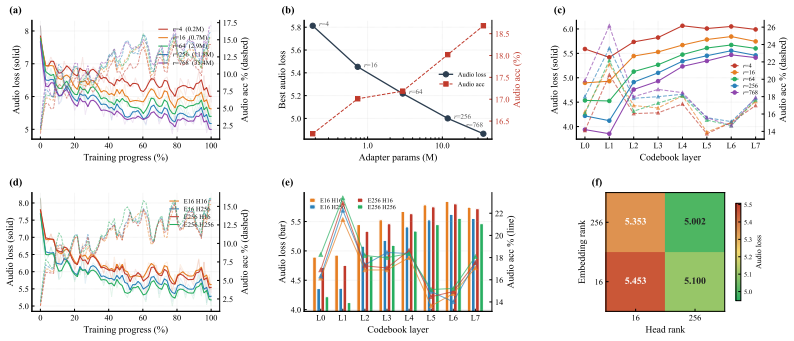
MiniMind-O is an open 0.1B-scale omni model built on the MiniMind language model. It accepts text, speech, and image inputs, and returns both text and streaming speech. The release includes model code, checkpoints, and the main Parquet training datasets for text-to-audio, image-to-text, and audio-to-audio training, making the complete interaction loop directly inspectable. The model uses a full MiniMind backbone as the Thinker and an independent four-layer Talker made from MiniMind blocks. Frozen SenseVoice-Small and SigLIP2 encoders provide speech and image features, which are mapped by lightweight MLP projectors and injected at modality-placeholder positions. The Talker reads a middle-layer Thinker state together with an autoregressive eight-layer Mimi-code buffer. Speaker control is handled by a dedicated speaker token, right-aligned reference codec prompts, and precomputed CAM++ speaker embeddings, so voice conditioning remains part of the audio-code context rather than a separate TTS module. With a 768-dimensional Talker, the dense and MoE variants reach average CERs of 0.0897 and 0.0900 in Thinker--Talker consistency evaluation, with overall voice-cloning similarities of 0.5995 and 0.5937. Beyond reporting a working system, the paper identifies three scale-critical design choices for small omni models: middle-layer semantic bridging, a released multimodal sequence format, and a parameter-efficient eight-codebook interface.
Editorial analysis
A structured set of objections, weighed in public.
Referee Report
Summary. MiniMind-O is an open 0.1B-scale omni model built on the MiniMind language model backbone. It accepts text, speech, and image inputs and produces text plus streaming speech outputs. The architecture uses frozen SenseVoice-Small and SigLIP2 encoders with lightweight MLP projectors injected at modality placeholders, a full MiniMind Thinker, and an independent four-layer Talker that reads middle-layer Thinker states plus an autoregressive eight-codebook Mimi buffer. Speaker conditioning uses dedicated tokens, right-aligned reference prompts, and CAM++ embeddings. The paper reports average CERs of 0.0897 (dense) and 0.0900 (MoE) for Thinker-Talker consistency and voice-cloning similarities of 0.5995 and 0.5937. It releases code, checkpoints, and Parquet datasets for text-to-audio, image-to-text, and audio-to-audio training, and identifies three empirical design choices: middle-layer semantic bridging, a multimodal sequence format, and a parameter-efficient eight-codebook interface.
Significance. If the reported metrics hold, the work is significant because it delivers a fully open, inspectable 0.1B-scale speech-native omni model together with reproducible code, checkpoints, and the main training datasets. This lowers barriers for research on efficient cross-modal systems and provides concrete evidence that frozen encoders plus lightweight projectors and middle-layer bridging can yield functional consistency (CER ~0.09) and voice similarity (~0.59) at small scale. The emphasis on practical, parameter-efficient choices derived from building the system offers useful guidance for similar open omni efforts.
minor comments (2)
- [Abstract] Detailed training hyperparameters and full evaluation protocols are only sketched; expanding these in the methods or appendix would strengthen the technical report's reproducibility even with the artifact release.
- [Results] The voice-cloning similarity scores (~0.59) would benefit from explicit comparison to baseline systems or random-chance levels to better contextualize performance.
Simulated Author's Rebuttal
We thank the referee for their positive assessment of MiniMind-O and for recommending acceptance. We appreciate the recognition of the model's open release of code, checkpoints, and training datasets as a meaningful contribution to accessible research on small-scale speech-native omni systems.
Circularity Check
No circularity: empirical model report with direct measurements
full rationale
The paper is a technical report describing the architecture, training, and evaluation of a 0.1B-scale omni model. It reports concrete empirical metrics (CER ~0.09, voice similarity ~0.59) obtained after training the described system with frozen encoders and lightweight projectors. The three design choices are presented as observations from the implemented and released artifact rather than as quantities derived from equations or self-referential fits. No derivation chain, first-principles predictions, or load-bearing self-citations appear; performance numbers are direct training outcomes, not quantities that reduce to their own inputs by construction.
Axiom & Free-Parameter Ledger
free parameters (3)
- Talker dimension
- Talker layers
- Codebook buffer depth
axioms (2)
- domain assumption Frozen pre-trained encoders (SenseVoice-Small and SigLIP2) supply adequate features for multimodal understanding when projected via MLPs.
- domain assumption Middle-layer Thinker state contains sufficient semantic information for coherent Talker generation.
Reference graph
Works this paper leans on
-
[1]
Keyu An et al. Funaudiollm: V oice understanding and generation foundation models for natural interaction between humans and llms. arXiv preprint arXiv:2407.04051,
-
[2]
Qwen-VL: A Versatile Vision-Language Model for Understanding, Localization, Text Reading, and Beyond
Jinze Bai, Shuai Bai, Shusheng Yang, Shijie Wang, Sinan Tan, Peng Wang, Junyang Lin, Chang Zhou, and Jingren Zhou. Qwen-vl: A frontier large vision-language model with versatile abilities. arXiv preprint arXiv:2308.12966,
work page internal anchor Pith review arXiv
-
[3]
High Fidelity Neural Audio Compression
Alexandre Défossez, Jade Copet, Gabriel Synnaeve, and Yossi Adi. High fidelity neural audio compression.arXiv preprint arXiv:2210.13438,
work page internal anchor Pith review arXiv
-
[4]
Moshi: a speech-text foundation model for real-time dialogue
Alexandre Défossez, Laurent Mazaré, Manu Orsini, Amélie Royer, Patrick Pérez, Hervé Jégou, Edouard Grave, and Neil Zeghidour. Moshi: a speech-text foundation model for real-time dialogue. arXiv preprint arXiv:2410.00037,
work page internal anchor Pith review arXiv
-
[5]
Qingkai Fang, Shoutao Guo, Yan Zhou, Zhengrui Ma, Shaolei Zhang, and Yang Feng. Llama-omni: Seamless speech interaction with large language models.arXiv preprint arXiv:2409.06666,
-
[6]
Vita: Towards open-source interactive omni multimodal llm
Chaoyou Fu, Haojia Lin, Zuwei Long, Yunhang Shen, Meng Zhao, Yifan Zhang, Xiong Wang, Di Yin, Long Ma, Xiawu Zheng, et al. Vita: Towards open-source interactive omni multimodal llm.arXiv preprint arXiv:2408.05211,
-
[7]
10 Yitian Gong, Kuangwei Chen, Zhaoye Fei, Xiaogui Yang, Ke Chen, Yang Wang, Kexin Huang, Mingshu Chen, Ruixiao Li, Qingyuan Cheng, et al. Moss-audio-tokenizer: Scaling audio tokenizers for future audio foundation models.arXiv preprint arXiv:2602.10934,
-
[8]
Step-audio: Unified understanding and generation in intelligent speech interaction, 2025
Ailin Huang, Boyong Wu, Bruce Wang, Chao Yan, Chen Hu, Chengli Feng, Fei Tian, Feiyu Shen, Jingbei Li, Mingrui Chen, et al. Step-audio: Unified understanding and generation in intelligent speech interaction.arXiv preprint arXiv:2502.11946,
-
[9]
Baichuan-audio: A unified framework for end-to-end speech interaction
Tianpeng Li, Jun Liu, Tao Zhang, Yuanbo Fang, Da Pan, Mingrui Wang, Zheng Liang, Zehuan Li, Mingan Lin, Guosheng Dong, et al. Baichuan-audio: A unified framework for end-to-end speech interaction.arXiv preprint arXiv:2502.17239,
-
[10]
Michael Tschannen, Alexey Gritsenko, Xiao Wang, Muhammad Ferjad Naeem, Ibrahim Alabdul- mohsin, Nikhil Parthasarathy, Talfan Evans, Lucas Beyer, Ye Xia, Basil Mustafa, Olivier Hénaff, Jeremiah Harmsen, Andreas Steiner, and Xiaohua Zhai. SigLIP 2: Multilingual vision-language encoders with improved semantic understanding, localization, and dense features.a...
work page internal anchor Pith review arXiv
-
[11]
Neural Codec Language Models are Zero-Shot Text to Speech Synthesizers
Chengyi Wang, Sanyuan Chen, Yu Wu, Ziqiang Zhang, Long Zhou, Shujie Liu, Zhuo Chen, Yanqing Liu, Huaming Wang, Jinyu Li, et al. Neural codec language models are zero-shot text to speech synthesizers.arXiv preprint arXiv:2301.02111, 2023a. Hui Wang, Siqi Zheng, Yafeng Chen, Luyao Cheng, and Qian Chen. Cam++: A fast and efficient network for speaker verific...
work page internal anchor Pith review arXiv
-
[12]
Zhifei Xie and Changqiao Wu. Mini-omni: Language models can hear, talk while thinking in streaming.arXiv preprint arXiv:2408.16725, 2024a. Zhifei Xie and Changqiao Wu. Mini-omni2: Towards open-source gpt-4o with vision, speech and duplex capabilities.arXiv preprint arXiv:2410.11190, 2024b. Jin Xu, Zhifang Guo, Jinzheng He, Hangrui Hu, Ting He, Shuai Bai, ...
-
[13]
Module and Evaluation Details This appendix collects the detailed tables referenced in the main text
12 Appendices A. Module and Evaluation Details This appendix collects the detailed tables referenced in the main text. Table 6 enumerates every module in the current MiniMind-O implementation together with its concrete model, key hyperpa- rameters, and parameter count. The trainable counts deduplicate the tied MiniMind token embedding and textlm_head; fro...
2048
discussion (0)
Sign in with ORCID, Apple, or X to comment. Anyone can read and Pith papers without signing in.