Near-field channel estimation via wavefront parameterization
Pith reviewed 2026-05-08 18:04 UTC · model grok-4.3
The pith
Approximating the spherical wavefront as a polynomial recasts near-field channel estimation as a multidimensional polynomial phase problem.
A machine-rendered reading of the paper's core claim, the machinery that carries it, and where it could break.
Core claim
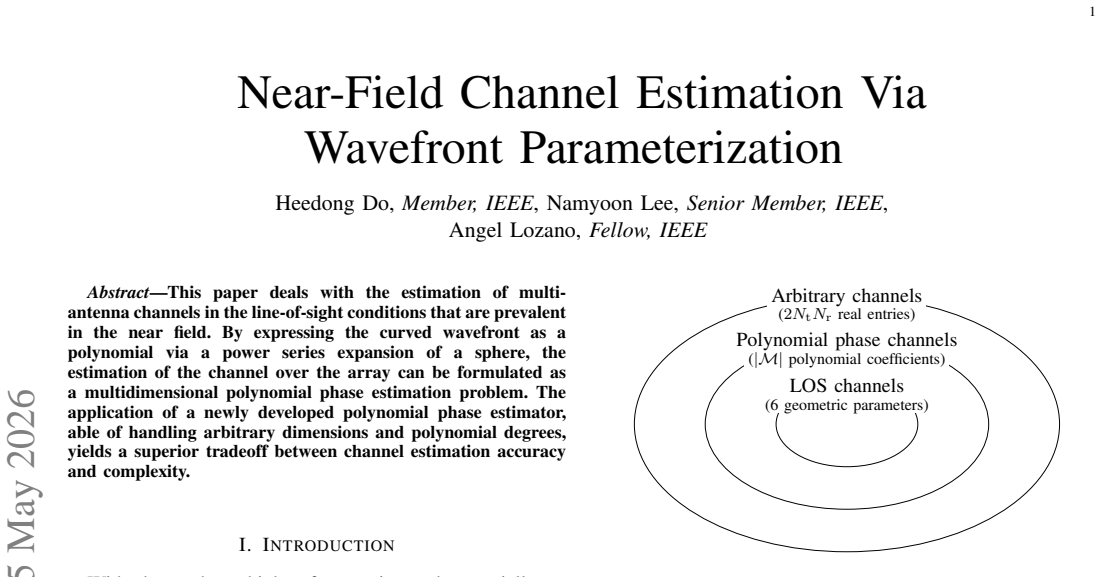
By expressing the curved wavefront as a polynomial via a power series expansion of a sphere, the estimation of the channel over the array can be formulated as a multidimensional polynomial phase estimation problem. The application of a newly developed polynomial phase estimator, able of handling arbitrary dimensions and polynomial degrees, yields a superior tradeoff between channel estimation accuracy and complexity.
What carries the argument
Power series expansion of the spherical wavefront into a polynomial phase function, which reformulates near-field channel estimation as multidimensional polynomial phase estimation solved by a custom estimator for any dimension and degree.
Load-bearing premise
The power series expansion of the spherical wavefront approximates true near-field propagation closely enough for estimation purposes, and the new polynomial phase estimator performs as stated for the relevant dimensions and degrees.
What would settle it
A set of channel measurements or simulations in which the polynomial-based estimates show higher error than standard near-field methods, or where the estimator fails to maintain its claimed accuracy-complexity tradeoff at higher polynomial orders.
Figures


read the original abstract
This paper deals with the estimation of multiantenna channels in the line-of-sight conditions that are prevalent in the near field. By expressing the curved wavefront as a polynomial via a power series expansion of a sphere, the estimation of the channel over the array can be formulated as a multidimensional polynomial phase estimation problem. The application of a newly developed polynomial phase estimator, able of handling arbitrary dimensions and polynomial degrees, yields a superior tradeoff between channel estimation accuracy and complexity.
Editorial analysis
A structured set of objections, weighed in public.
Referee Report
Summary. The paper proposes a near-field LOS channel estimation technique for multi-antenna arrays. It approximates the spherical wavefront distance via a power-series (Taylor) expansion around the array center, converting the phase term into a low-degree multivariate polynomial in the element indices. Channel estimation is then recast as a multidimensional polynomial-phase estimation problem solved by a newly introduced estimator that accommodates arbitrary array dimensions and polynomial orders, with the central claim being an improved accuracy-complexity tradeoff relative to existing methods.
Significance. If the truncation error remains negligible relative to noise across the operating regime and the new estimator attains its stated performance, the parameterization could yield a computationally attractive alternative for near-field channel acquisition in large-array or high-frequency systems. The reformulation connects classical array signal processing with polynomial-phase techniques in a manner that may generalize beyond the specific LOS case examined.
major comments (3)
- [§3.2, Eq. (7)] §3.2, Eq. (7): the power-series truncation is fixed at order 3 without an explicit remainder bound expressed in terms of array aperture, carrier wavelength, and minimum distance; the central accuracy claim therefore rests on an unverified assertion that model mismatch is dominated by noise rather than truncation.
- [§5.3, Fig. 4] §5.3, Fig. 4: the reported MSE curves compare the proposed estimator only against far-field and approximate near-field baselines; an additional curve using the exact spherical distance model (with the same number of parameters) is needed to isolate whether gains arise from the polynomial parameterization or from the estimator itself.
- [§4.2, Algorithm 1] §4.2, Algorithm 1: the complexity scaling O(D^K) for K-dimensional arrays of polynomial degree D is derived under ideal phase-unwrapping assumptions that are not stress-tested for the near-field geometry when the Fresnel number exceeds 1; the claimed complexity advantage may therefore be overstated for the largest arrays considered.
minor comments (2)
- [Abstract] The abstract contains the phrasing 'able of handling'; this should be corrected to 'able to handle'.
- [§4] Notation for the array-element indices (m,n) is introduced in §2 but reused without redefinition in the multidimensional estimator of §4; a brief reminder would improve readability.
Simulated Author's Rebuttal
We thank the referee for the constructive and detailed comments. We address each major point below and indicate the revisions we will make to strengthen the manuscript.
read point-by-point responses
-
Referee: [§3.2, Eq. (7)] the power-series truncation is fixed at order 3 without an explicit remainder bound expressed in terms of array aperture, carrier wavelength, and minimum distance; the central accuracy claim therefore rests on an unverified assertion that model mismatch is dominated by noise rather than truncation.
Authors: We agree that an explicit remainder bound would provide stronger theoretical justification for the chosen truncation order. In the revised manuscript we will derive the Lagrange-form remainder for the Taylor expansion of the spherical distance and express it in terms of array aperture, carrier wavelength, and minimum distance, showing that the truncation error lies below the noise floor throughout the operating regime considered in the paper. revision: yes
-
Referee: [§5.3, Fig. 4] the reported MSE curves compare the proposed estimator only against far-field and approximate near-field baselines; an additional curve using the exact spherical distance model (with the same number of parameters) is needed to isolate whether gains arise from the polynomial parameterization or from the estimator itself.
Authors: We concur that a direct comparison against the exact spherical model is necessary to isolate the benefit of the polynomial parameterization. We will add this curve to Figure 4, performing maximum-likelihood estimation under the exact distance model while keeping the number of parameters identical to that used by the polynomial estimator. revision: yes
-
Referee: [§4.2, Algorithm 1] the complexity scaling O(D^K) for K-dimensional arrays of polynomial degree D is derived under ideal phase-unwrapping assumptions that are not stress-tested for the near-field geometry when the Fresnel number exceeds 1; the claimed complexity advantage may therefore be overstated for the largest arrays considered.
Authors: The O(D^K) scaling is obtained under the assumption of successful phase unwrapping, which holds for the SNR and geometry ranges examined in the main simulations. To address the referee’s concern we will include additional Monte-Carlo results that explicitly measure phase-unwrapping success rate and realized complexity for Fresnel numbers greater than one, thereby verifying that the claimed scaling remains valid in the regimes of interest. revision: partial
Circularity Check
No significant circularity; derivation remains self-contained
full rationale
The paper formulates near-field channel estimation by rewriting the spherical wavefront distance via power series expansion into a multivariate polynomial phase model, then applies a polynomial phase estimator. No equations in the provided text reduce the claimed superior accuracy-complexity tradeoff to a fitted parameter by construction, a self-definitional loop, or a load-bearing self-citation whose validity depends on the present work. The expansion and estimator application constitute an independent modeling choice whose performance can be externally validated against the exact spherical model or other estimators, satisfying the criteria for a non-circular derivation.
Axiom & Free-Parameter Ledger
axioms (1)
- domain assumption The spherical wavefront can be accurately approximated by a low-order power series expansion for channel estimation purposes.
invented entities (1)
-
Newly developed polynomial phase estimator for arbitrary dimensions and degrees
no independent evidence
Lean theorems connected to this paper
-
Cost.FunctionalEquation (Jcost = ½(x+x⁻¹)−1)washburn_uniqueness_aczel unclear?
unclearRelation between the paper passage and the cited Recognition theorem.
By expressing the curved wavefront as a polynomial via a power series expansion of a sphere, the estimation of the channel over the array can be formulated as a multidimensional polynomial phase estimation problem.
-
Foundation/AlphaCoordinateFixation.lean (cosh expansion of CostAlphaLog)cost_alpha_one_eq_jcost unclear?
unclearRelation between the paper passage and the cited Recognition theorem.
√(1+2xt+t²) = 1 + xt + ½(1−x²)t² − ½(x−x³)t³ − (1/8)(1−6x²+5x⁴)t⁴ + ··· (Legendre/ultraspherical expansion)
What do these tags mean?
- matches
- The paper's claim is directly supported by a theorem in the formal canon.
- supports
- The theorem supports part of the paper's argument, but the paper may add assumptions or extra steps.
- extends
- The paper goes beyond the formal theorem; the theorem is a base layer rather than the whole result.
- uses
- The paper appears to rely on the theorem as machinery.
- contradicts
- The paper's claim conflicts with a theorem or certificate in the canon.
- unclear
- Pith found a possible connection, but the passage is too broad, indirect, or ambiguous to say the theorem truly supports the claim.
Reference graph
Works this paper leans on
-
[1]
Estimation of near-field line-of-sight channels: a multidimensional polynomial phase approach,
H. Do, N. Lee, and A. Lozano, “Estimation of near-field line-of-sight channels: a multidimensional polynomial phase approach,” inAsilomar Conf. Signals Syst. Comput., 2024, pp. 152–157
work page 2024
-
[2]
Terahertz line-of-sight MIMO communication: Theory and practical challenges,
H. Do, S. Cho, J. Park, H.-J. Song, N. Lee, and A. Lozano, “Terahertz line-of-sight MIMO communication: Theory and practical challenges,” IEEE Commun. Mag., vol. 59, no. 3, pp. 104–109, 2021
work page 2021
-
[3]
6G wireless communications: From far-field beam steering to near-field beam focusing,
H. Zhang, N. Shlezinger, F. Guidi, D. Dardari, and Y . C. Eldar, “6G wireless communications: From far-field beam steering to near-field beam focusing,”IEEE Commun. Mag., vol. 61, no. 4, pp. 72–77, 2023
work page 2023
-
[4]
Exploiting the depth and angular domains for massive near-field spatial multiplexing,
P. Ramezani, A. Kosasih, A. Irshad, and E. Bj ¨ornson, “Exploiting the depth and angular domains for massive near-field spatial multiplexing,” IEEE BITS Inform. Theory Mag., vol. 3, no. 1, pp. 14–26, 2023
work page 2023
-
[5]
Wide-aperture MIMO via reflection off a smooth surface,
A. Pizzo, A. Lozano, S. Rangan, and T. L. Marzetta, “Wide-aperture MIMO via reflection off a smooth surface,”IEEE Trans. Wireless Commun., vol. 22, no. 8, pp. 5229–5239, 2023
work page 2023
-
[6]
P. F. Driessen and G. Foschini, “On the capacity formula for multiple input-multiple output wireless channels: A geometric interpretation,” IEEE Trans. Commun., vol. 47, no. 2, pp. 173–176, 1999
work page 1999
-
[7]
Spherical-wave model for short-range MIMO,
J.-S. Jiang and M. A. Ingram, “Spherical-wave model for short-range MIMO,”IEEE Trans. Commun., vol. 53, no. 9, pp. 1534–1541, 2005
work page 2005
-
[8]
Construction and capacity analysis of high-rank line-of-sight MIMO channels,
F. Bøhagen, P. Orten, and G. Øien, “Construction and capacity analysis of high-rank line-of-sight MIMO channels,” inIEEE Wireless Commun. Netw. Conf., 2005, pp. 432–437
work page 2005
-
[9]
I. Sarris and A. R. Nix, “Design and performance assessment of high-capacity MIMO architectures in the presence of a line-of-sight component,”IEEE Trans. Veh. Technol., vol. 56, no. 4, pp. 2194–2202, 2007
work page 2007
-
[10]
Design of optimal high-rank line- of-sight MIMO channels,
F. Bøhagen, P. Orten, and G. Øien, “Design of optimal high-rank line- of-sight MIMO channels,”IEEE Trans. Wireless Commun., vol. 6, no. 4, pp. 1420–1425, 2007
work page 2007
-
[11]
Optimal design of uniform rectangular antenna arrays for strong line-of-sight MIMO channels,
——, “Optimal design of uniform rectangular antenna arrays for strong line-of-sight MIMO channels,”EURASIP J. Wireless Commun. Netw., vol. 2007, pp. 1–10, 2007
work page 2007
-
[12]
On spherical vs. plane wave modeling of line-of-sight MIMO channels,
——, “On spherical vs. plane wave modeling of line-of-sight MIMO channels,”IEEE Trans. Commun., vol. 57, no. 3, pp. 841–849, 2009
work page 2009
-
[13]
Indoor millimeter wave MIMO: Feasibility and performance,
E. Torkildson, U. Madhow, and M. Rodwell, “Indoor millimeter wave MIMO: Feasibility and performance,”IEEE Trans. Wireless Commun., vol. 10, no. 12, pp. 4150–4160, 2011
work page 2011
-
[14]
On spatial multiplexing of strong line-of- sight MIMO with 3D antenna arrangements,
X. Song and G. Fettweis, “On spatial multiplexing of strong line-of- sight MIMO with 3D antenna arrangements,”IEEE Wireless Commun. Lett., vol. 4, no. 4, pp. 393–396, Apr. 2015
work page 2015
-
[15]
Capacity of line-of-sight MIMO channels,
H. Do, N. Lee, and A. Lozano, “Capacity of line-of-sight MIMO channels,” inIEEE Int’l Symp. Inform. Theory, 2020, pp. 2044–2048
work page 2020
-
[16]
Reconfigurable ULAs for line-of-sight MIMO transmission,
——, “Reconfigurable ULAs for line-of-sight MIMO transmission,” IEEE Trans. Wireless Commun., vol. 20, no. 5, pp. 2933–2947, 2021
work page 2021
-
[17]
On Landau’s eigenvalue theorem for line-of- sight MIMO channels,
A. Pizzo and A. Lozano, “On Landau’s eigenvalue theorem for line-of- sight MIMO channels,”IEEE Wireless Commun. Lett., vol. 11, no. 12, pp. 2565–2569, 2022
work page 2022
-
[18]
L. Ding, E. G. Str ¨om, and J. Zhang, “Degrees of freedom in 3D linear large-scale antenna array communications—a spatial bandwidth approach,”IEEE J. Sel. Areas Commun., vol. 40, no. 10, pp. 2805–2822, 2022
work page 2022
-
[19]
Line-of-sight MIMO via intelligent reflecting surface,
H. Do, N. Lee, and A. Lozano, “Line-of-sight MIMO via intelligent reflecting surface,”IEEE Trans. Wireless Commun., vol. 22, no. 6, pp. 4215–4231, 2023
work page 2023
-
[20]
Near-field sparse channel representation and estimation in 6G wireless communications,
X. Zhang, H. Zhang, and Y . C. Eldar, “Near-field sparse channel representation and estimation in 6G wireless communications,”IEEE Trans. Commun., vol. 72, no. 1, pp. 450–464, 2023
work page 2023
-
[21]
Near-field communications: A comprehensive survey,
Y . Liu, C. Ouyang, Z. Wang, J. Xu, X. Mu, and A. L. Swindlehurst, “Near-field communications: A comprehensive survey,”IEEE Commun. Surv. & Tut., vol. 27, no. 3, pp. 1687–1728, 2024
work page 2024
-
[22]
S. Yang, H. Chen, W. Liu, X.-P. Zhang, and C. Yuen, “Near-field channel estimation and localization: Recent developments, cooperative integration, and future directions,”IEEE Signal Process. Mag., vol. 42, no. 1, pp. 60–73, 2025
work page 2025
-
[23]
Training-based channel estimation for continuous flat fading BLAST,
Q. Sun, D. Cox, A. Lozano, and H. C. Huang, “Training-based channel estimation for continuous flat fading BLAST,” inIEEE Int’l Conf. Commun., 2002, pp. 325–329
work page 2002
-
[24]
Massive MIMO channel estimation taking into account spherical waves,
L. Le Magoarou, A. Le Calvez, and S. Paquelet, “Massive MIMO channel estimation taking into account spherical waves,” inIEEE Int’l Workshop Signal Process. Advances Wireless Commun., 2019, pp. 1–5
work page 2019
-
[25]
Adaptive joint sparse Bayesian approaches for near-field channel estimation,
Z. Zhu, R. Yang, C. Li, Y . Huang, and L. Yang, “Adaptive joint sparse Bayesian approaches for near-field channel estimation,”IEEE Trans. Wireless Commun., vol. 24, no. 3, pp. 2590–2605, 2025
work page 2025
-
[26]
A one-snapshot lo- calization algorithm for mixed far-field and near-field sources,
Z. Huang, W. Wang, F. Dong, and D. Wang, “A one-snapshot lo- calization algorithm for mixed far-field and near-field sources,”IEEE Commun. Lett., vol. 24, no. 5, pp. 1010–1014, 2020
work page 2020
-
[27]
Channel estimation for extremely large-scale MIMO: Far-field or near-field?
M. Cui and L. Dai, “Channel estimation for extremely large-scale MIMO: Far-field or near-field?”IEEE Trans. Commun., vol. 70, no. 4, pp. 2663–2677, 2022
work page 2022
-
[28]
Near-field sparse channel representation and estimation in 6G wireless communications,
X. Zhang, H. Zhang, and Y . C. Eldar, “Near-field sparse channel representation and estimation in 6G wireless communications,”IEEE Trans. Commun., vol. 72, no. 1, pp. 450–464, 2024
work page 2024
-
[29]
Near-field channel esti- mation for ultra-massive MIMO antenna array with hybrid architecture,
A. Hussain, A. Abdallah, and A. M. Eltawil, “Near-field channel esti- mation for ultra-massive MIMO antenna array with hybrid architecture,” inIEEE Wireless Commun. Netw. Conf., 2024
work page 2024
-
[30]
Multipath parameters estimation of near-field spatial-wideband systems,
S. Das, D. Sen, and E. Viterbo, “Multipath parameters estimation of near-field spatial-wideband systems,”IEEE Commun. Lett., vol. 28, no. 7, pp. 1649–1653, 2024
work page 2024
-
[31]
MBPD: A robust algorithm for polar-domain channel estimation in near-field wideband XL-MIMO systems,
H. Wang, P. Guo, X. Li, F. Wen, X. Wang, and A. Nallanathan, “MBPD: A robust algorithm for polar-domain channel estimation in near-field wideband XL-MIMO systems,”IEEE Internet Things J., vol. 12, no. 12, pp. 18 461–18 470, 2025
work page 2025
-
[32]
Near field dictionary design and channel estimation using discrete Fresnel transform,
Z. Xu, S. Wang, and Y .-J. A. Zhang, “Near field dictionary design and channel estimation using discrete Fresnel transform,” inAsilomar Conf. Signals Syst. Comput., 2024, pp. 1690–1694
work page 2024
-
[33]
Ringwise codebook for precoding in unified near and far-field communication,
H. Wu, L. Lu, Y . Wang, Z. Wang, and Z. Han, “Ringwise codebook for precoding in unified near and far-field communication,”IEEE Trans. Wireless Commun., vol. 25, pp. 13 698–13 712, 2026
work page 2026
-
[34]
Efficient near- field channel feature estimation: Criteria and algorithms,
H. Chung, H. Kim, S. Kim, A. Conti, and M. Z. Win, “Efficient near- field channel feature estimation: Criteria and algorithms,”IEEE J. Sel. Areas Inform. Theory, 2025
work page 2025
-
[35]
Parametric near-field channel estimation for extremely large aperture arrays,
A. Kosasih, ¨O. T. Demir, and E. Bj ¨ornson, “Parametric near-field channel estimation for extremely large aperture arrays,” inAsilomar Conf. Signals Syst. Comput., 2023, pp. 162–166
work page 2023
-
[36]
Near-field localization and channel reconstruction for ELAA systems,
Z. Lu, Y . Han, S. Jin, and M. Matthaiou, “Near-field localization and channel reconstruction for ELAA systems,”IEEE Trans. Wireless Commun., vol. 23, no. 7, pp. 6938–6953, 2024
work page 2024
-
[37]
Y . Li and A. S. Madhukumar, “Hybrid near-and far-field THz UM-MIMO channel estimation: A sparsifying matrix learning-aided Bayesian approach,”IEEE Trans. Wireless Commun., vol. 24, no. 3, pp. 1881–1897, 2024
work page 2024
-
[38]
Scalable near- field localization based on partitioned large-scale antenna array,
X. Yuan, M. Zhang, Y . Zheng, B. Teng, and W. Jiang, “Scalable near- field localization based on partitioned large-scale antenna array,”IEEE Trans. Wireless Commun., vol. 24, no. 3, pp. 2203–2217, 2025
work page 2025
-
[39]
Parametric channel estimation for LoS dominated holographic massive MIMO systems,
M. Ghermezcheshmeh and N. Zlatanov, “Parametric channel estimation for LoS dominated holographic massive MIMO systems,”IEEE Access, vol. 11, pp. 44 711–44 724, 2023
work page 2023
-
[40]
C. Chen, J. Sun, X. Jiang, S. Yao, W. Zhang, and C.-X. Wang, “Near-field channel estimation for uniform planar arrays based on an end-to-end spherical wavefront channel model,”IEEE Trans. Wireless Commun., vol. 25, pp. 7065–7082, 2026. 13
work page 2026
-
[41]
Near-field channel estimation in mixed LoS/NLoS environments for extremely large-scale MIMO systems,
Y . Lu and L. Dai, “Near-field channel estimation in mixed LoS/NLoS environments for extremely large-scale MIMO systems,”IEEE Trans. Commun., vol. 71, no. 6, pp. 3694–3707, 2023
work page 2023
-
[42]
Channel estimation for near-field line-of-sight XL-MIMO communications using geometric prior,
Y . Guo, X. Guo, and Y . Wang, “Channel estimation for near-field line-of-sight XL-MIMO communications using geometric prior,”IEEE Commun. Lett., vol. 29, no. 4, pp. 779–783, 2025
work page 2025
-
[43]
Line-of-sight MIMO systems: Near-field boundaries and channel es- timation,
R. Song, H. Yuan, Z. Zhang, X. Gao, M. Shi, Y . Liu, and K. Yang, “Line-of-sight MIMO systems: Near-field boundaries and channel es- timation,”IEEE Trans. Commun., vol. 73, no. 11, pp. 12 070–12 086, 2025
work page 2025
-
[44]
Double-sided near-field XL-MIMO: Beamfocusing codeword selection and channel estimation,
X. Shi, J. Wang, X. Wang, C. You, and J. Song, “Double-sided near-field XL-MIMO: Beamfocusing codeword selection and channel estimation,” IEEE Trans. Commun., vol. 73, no. 5, pp. 3441–3455, 2025
work page 2025
-
[45]
X. Zhang, Z. Wang, H. Zhang, and L. Yang, “Near-field channel estimation for extremely large-scale array communications: A model- based deep learning approach,”IEEE Commun. Lett., vol. 27, no. 4, pp. 1155–1159, 2023
work page 2023
-
[46]
Channel estimation for XL-MIMO systems with polar-domain multi- scale residual dense network,
H. Lei, J. Zhang, H. Xiao, X. Zhang, B. Ai, and D. W. K. Ng, “Channel estimation for XL-MIMO systems with polar-domain multi- scale residual dense network,”IEEE Trans. Veh. Technol., vol. 73, no. 1, pp. 1479–1484, 2024
work page 2024
-
[47]
Neural network-aided near-field channel estimation for hybrid beamforming systems,
S. Jang and C. Lee, “Neural network-aided near-field channel estimation for hybrid beamforming systems,”IEEE Trans. Commun., vol. 72, no. 11, pp. 6768–6782, 2024
work page 2024
-
[48]
Near-field channel esti- mation and sparse reconstruction for FDD XL-MIMO systems,
Z. Wang, G. Zhang, J. Wang, and H. Xu, “Near-field channel esti- mation and sparse reconstruction for FDD XL-MIMO systems,”IEEE Commun. Lett., pp. 1–1, 2025
work page 2025
-
[49]
X. Zheng, F. Chen, C. Yang, and Y . Ai, “Model-driven iterative super- resolution channel estimation for wideband near-field extremely large- scale MIMO systems,”IEEE Wireless Commun. Lett., pp. 1–1, 2024
work page 2024
-
[50]
Bayes-optimal unsupervised learning for channel estimation in near- field holographic MIMO,
W. Yu, H. He, X. Yu, S. Song, J. Zhang, R. Murch, and K. B. Letaief, “Bayes-optimal unsupervised learning for channel estimation in near- field holographic MIMO,”IEEE J. Sel. Topics Signal Process., vol. 18, no. 4, pp. 714–729, 2024
work page 2024
-
[51]
M. Tao, J. Fan, H. Xie, and J. Luo, “Deep reinforcement learning-based near-field channel estimation for extremely large-scale MIMO systems,” IEEE Trans. Wireless Commun., 2026
work page 2026
-
[52]
An adaptive and robust deep learning framework for THz ultra-massive MIMO channel estimation,
W. Yu, Y . Shen, H. He, X. Yu, S. Song, J. Zhang, and K. B. Letaief, “An adaptive and robust deep learning framework for THz ultra-massive MIMO channel estimation,”IEEE J. Sel. Topics Signal Process., vol. 17, no. 4, pp. 761–776, 2023
work page 2023
-
[53]
Near-field channel estimation for XL-MIMO via IDiT-based variance exploding SDE generator,
Y . Fang, S. Xu, P. Fang, J. Zhang, Y . Huang, and L. Yang, “Near-field channel estimation for XL-MIMO via IDiT-based variance exploding SDE generator,”IEEE Trans. Wireless Commun., vol. 25, pp. 3559– 3574, 2026
work page 2026
-
[54]
Y . Chen, L. Yan, and C. Han, “Hybrid spherical- and planar-wave modeling and DCNN-powered estimation of Terahertz ultra-massive MIMO channels,”IEEE Trans. Commun., vol. 69, no. 10, pp. 7063– 7076, 2021
work page 2021
-
[55]
Deep compressed sensing for terahertz ultra-massive MIMO channel estimation,
G. Lin, M. Erdem, and M.-S. Alouini, “Deep compressed sensing for terahertz ultra-massive MIMO channel estimation,”IEEE Open J. Commun. Society, vol. 6, pp. 1747–1762, 2025
work page 2025
-
[56]
Parabolic wavefront model for line-of- sight MIMO channels,
H. Do, N. Lee, and A. Lozano, “Parabolic wavefront model for line-of- sight MIMO channels,”IEEE Trans. Wireless Commun., vol. 22, no. 11, pp. 7620–7634, 2023
work page 2023
-
[57]
Multidimensional polynomial phase estimation,
——, “Multidimensional polynomial phase estimation,”IEEE Open J. Signal Process., vol. 6, pp. 651–681, 2025
work page 2025
-
[58]
R. L. Graham, D. E. Knuth, and O. Patashnik,Concrete mathematics: a foundation for computer science, 2nd ed. Addison Wesley, 1994
work page 1994
-
[59]
R. W. Heath, Jr. and A. Lozano,Foundations of MIMO Communication. Cambridge University Press, 2018
work page 2018
-
[60]
T. J. Moore, B. M. Sadler, and R. J. Kozick, “Maximum-likelihood estimation, the Cram ´er–Rao bound, and the method of scoring with parameter constraints,”IEEE Trans. Signal Process., vol. 56, no. 3, pp. 895–908, 2008
work page 2008
- [61]
-
[62]
Cram ´er-Rao bounds on sparse–diffuse channel estimation,
L. Lyu, M. F. Da Costa, and U. Mitra, “Cram ´er-Rao bounds on sparse–diffuse channel estimation,” inIEEE Int’l Conf. Acoust. Speech Signal Process., 2026
work page 2026
-
[63]
Sinusoidal frequency estimation by gradient descent,
B. Hayes, C. Saitis, and G. Fazekas, “Sinusoidal frequency estimation by gradient descent,” inIEEE Int’l Conf. Acoust. Speech Signal Pro- cess., 2023, pp. 1–5
work page 2023
-
[64]
C.-C. Chen and K. Khee-Meng,Principles and techniques in combina- torics. World Scientific, 1992
work page 1992
-
[65]
C. A. Balanis,Antenna theory: analysis and design. John wiley & sons, 2016
work page 2016
-
[66]
How to differentiate between near field and far field: Revisiting the Rayleigh distance,
S. Sun, R. Li, C. Han, X. Liu, L. Xue, and M. Tao, “How to differentiate between near field and far field: Revisiting the Rayleigh distance,”IEEE Commun. Mag., vol. 63, no. 1, pp. 22–28, 2025
work page 2025
-
[67]
Polynomial phase estimation by least squares phase unwrapping,
R. G. McKilliam, B. G. Quinn, I. V . L. Clarkson, B. Moran, and B. N. Vellambi, “Polynomial phase estimation by least squares phase unwrapping,”IEEE Trans. Signal Process., vol. 62, no. 8, pp. 1962– 1975, 2014
work page 1962
-
[68]
Near-field channel interpolation for pilot overhead reduction in XL-MIMO,
H. Do, N. Lee, and A. Lozano, “Near-field channel interpolation for pilot overhead reduction in XL-MIMO,” inEuropean Signal Process. Conf., 2025
work page 2025
-
[69]
Near-field spatial-domain channel extrapolation for XL-MIMO systems,
J. Lu, J. Zhang, H. Lei, H. Xiao, B. Ai, and D. W. Kwan Ng, “Near-field spatial-domain channel extrapolation for XL-MIMO systems,”IEEE Trans. Wireless Commun., vol. 25, pp. 4343–4357, 2026
work page 2026
-
[70]
Localization of signals in the near-field of an antenna array,
B. Friedlander, “Localization of signals in the near-field of an antenna array,”IEEE Trans. Signal Process., vol. 67, no. 15, pp. 3885–3893, 2019
work page 2019
-
[71]
Wireless channel sparsity: Measurement, analysis, and exploitation in estima- tion,
R. He, B. Ai, G. Wang, M. Yang, C. Huang, and Z. Zhong, “Wireless channel sparsity: Measurement, analysis, and exploitation in estima- tion,”IEEE Wireless Commun., vol. 28, no. 4, pp. 113–119, 2021
work page 2021
-
[72]
F. Dunn and I. Parberry,3D math primer for graphics and game development. CRC Press, 2011
work page 2011
-
[73]
J. M. Steele,The Cauchy-Schwarz master class: an introduction to the art of mathematical inequalities. Cambridge University Press, 2004
work page 2004
-
[74]
Single tone parameter estimation from discrete-time observations,
D. Rife and R. Boorstyn, “Single tone parameter estimation from discrete-time observations,”IEEE Trans. Inform. Theory, vol. 20, no. 5, pp. 591–598, 1974
work page 1974
-
[75]
M. Abramowitz and I. A. Stegun,Handbook of mathematical functions with formulas, graphs, and mathematical tables. US Government printing office, 1948, vol. 55
work page 1948
discussion (0)
Sign in with ORCID, Apple, or X to comment. Anyone can read and Pith papers without signing in.