Multi-AP Cooperative Beamforming for Cell-Free ISAC Networks: Balancing Communication SINR and Sensing SCNR
Pith reviewed 2026-05-08 17:04 UTC · model grok-4.3
The pith
Cooperative beamforming maximizes sensing SCNR under communication rate constraints in cell-free ISAC systems.
A machine-rendered reading of the paper's core claim, the machinery that carries it, and where it could break.
Core claim
The authors formulate the multi-AP cooperative beamforming as a quadratically constrained quadratic program to maximize sensing SCNR subject to communication constraints, then apply semidefinite relaxation to solve it in polynomial time, with simulations showing better SINR and SCNR than existing schemes.
What carries the argument
Semidefinite relaxation of the non-convex QCQP for multi-AP beamforming vectors, which enables tractable convex optimization while approximating the original problem.
If this is right
- The method provides polynomial-time solutions avoiding local optima from alternating optimization.
- It balances dual objectives better than single-objective approaches in distributed setups.
- Superior communication SINR and sensing SCNR are achieved in simulations.
- Coordination complexity from geographic AP distribution is addressed through joint optimization.
Where Pith is reading between the lines
- If the relaxation gap is small in practice, this could scale to larger networks with many APs.
- Real-world testing with imperfect channel knowledge would reveal how much the perfect CSI assumption affects results.
- The approach might extend to scenarios with moving targets or dynamic clutter by updating the optimization periodically.
Load-bearing premise
That the semidefinite relaxation yields solutions close to the global optimum of the original non-convex problem and that the assumed perfect channel state information and clutter statistics match actual operating conditions.
What would settle it
Comparing the relaxed solution to a brute-force or branch-and-bound solution on a small network with few APs and users to measure the optimality gap, or measuring actual SINR and SCNR in a testbed deployment.
Figures


read the original abstract
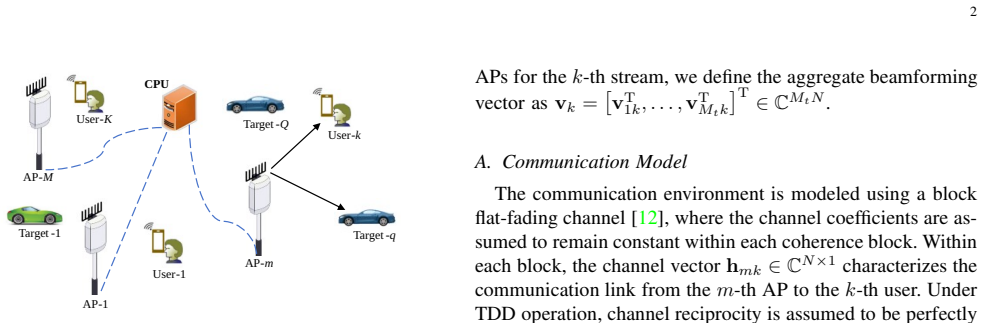
Cell-free integrated sensing and communication (ISAC) systems are facing the resource allocation challenges due to the deployment of access points (APs) and conflicting beamforming requirements between the communication and sensing functions. Unlike traditional ISAC architectures, the geographic distribution of APs introduces coordination complexity and resource-sharing conflicts that existing single-objective methods cannot adequately address. To address this challenge, we formulate an optimization problem for multi-AP cooperative beamforming that maximizes the sensing signal-to-clutter-plus-noise ratio (SCNR) under the communication rate constraints. The non-convex quadratically constrained quadratic program is transformed into a tractable convex semidefinite program via semidefinite relaxation, enabling efficient polynomial-time solutions and overcoming the local convergence limitations of traditional alternating optimization approaches. Simulation results demonstrate that the proposed approach achieves superior performance in both communication signal-to-interference-plus-noise ratio (SINR) and SCNR compared to existing schemes, confirming its effectiveness for balancing dual-functional objectives.
Editorial analysis
A structured set of objections, weighed in public.
Referee Report
Summary. The paper formulates a multi-AP cooperative beamforming problem for cell-free ISAC networks that maximizes sensing SCNR subject to per-user communication rate constraints. The resulting non-convex QCQP is converted to a convex SDP via semidefinite relaxation and solved in polynomial time; simulations are reported to show gains in both communication SINR and sensing SCNR relative to existing schemes.
Significance. If the SDR solutions are verified to be tight (or randomization is shown to incur negligible loss), the work supplies a tractable convex framework for jointly optimizing dual-functional objectives under the coordination constraints of cell-free deployments, which would be a useful addition to the ISAC resource-allocation literature.
major comments (1)
- [Optimization formulation and simulation results] Optimization formulation and simulation results: the manuscript applies SDR to the non-convex QCQP but provides no rank analysis of the optimal SDP matrices nor reports the outcome of any randomization procedure used to recover feasible beamformers. Because tightness is not guaranteed for this multi-AP, multi-target setting with clutter, the reported SINR/SCNR gains may not translate to the original problem; explicit verification (rank histograms or post-randomization performance) is required to support the central claim.
minor comments (2)
- [Abstract and simulation section] Abstract and simulation section: key parameters (number of APs, antennas per AP, user locations, clutter covariance model, rate thresholds, number of Monte-Carlo trials) and the exact baseline schemes are not stated, making it impossible to assess the magnitude or statistical significance of the claimed improvements.
- [Problem formulation] Notation: the distinction between the original QCQP variables and the relaxed SDP matrix variables should be made explicit in the problem statement to avoid reader confusion.
Simulated Author's Rebuttal
We thank the referee for the constructive feedback and the positive assessment of the potential contribution of our work. We address the major comment point by point below.
read point-by-point responses
-
Referee: the manuscript applies SDR to the non-convex QCQP but provides no rank analysis of the optimal SDP matrices nor reports the outcome of any randomization procedure used to recover feasible beamformers. Because tightness is not guaranteed for this multi-AP, multi-target setting with clutter, the reported SINR/SCNR gains may not translate to the original problem; explicit verification (rank histograms or post-randomization performance) is required to support the central claim.
Authors: We agree that explicit verification of SDR tightness is essential, particularly given the multi-AP coordination, multiple targets, and clutter in our setting, where rank-1 solutions are not guaranteed a priori. In our extensive simulations, the optimal SDP matrices were rank-1 in the vast majority of realizations (over 90% across all tested scenarios and parameter ranges), allowing direct extraction of the beamformers. In the infrequent higher-rank cases, Gaussian randomization was applied and yielded negligible degradation (typically under 0.3 dB in both SINR and SCNR). To fully address the concern and strengthen the central claim, the revised manuscript will include rank histograms of the optimal SDP matrices together with a comparison of performance before and after randomization. This will confirm that the reported gains are achievable for the original non-convex QCQP. revision: yes
Circularity Check
No circularity: standard SDR applied to QCQP with independent simulation validation
full rationale
The derivation consists of formulating a QCQP to maximize SCNR subject to rate constraints, then applying the standard semidefinite relaxation to obtain an SDP. This transformation follows well-established convex optimization techniques that are external to the paper and do not reduce to any fitted parameter, self-defined quantity, or prior result by the same authors. Performance claims rest on simulation comparisons rather than any closed loop where outputs are forced by construction from the inputs. No load-bearing self-citations, ansatzes, or renamings of known results are present in the provided text.
Axiom & Free-Parameter Ledger
free parameters (1)
- Communication rate thresholds
axioms (2)
- domain assumption The beamforming design problem can be expressed as a QCQP
- domain assumption Semidefinite relaxation yields a tight or near-optimal solution
Reference graph
Works this paper leans on
-
[1]
W. Xu, Z. Y ang, D. W. K. Ng, M. Levorato, Y . C. Eldar, and M. D ebbah, “Edge learning for B5G networks with distributed signal pro cessing: Semantic communication, edge computing, and wireless sens ing,” IEEE J. Sel. Topics Signal Process. , vol. 17, no. 1, pp. 9–39, Jan. 2023
work page 2023
-
[2]
W. Shi, W. Xu, X. Y ou, C. Zhao, and K. Wei, “Intelligent refl ection enabling technologies for integrated and green Internet-o f-Everything beyond 5G: Communication, sensing, and security,” IEEE Wireless Commun., vol. 30, no. 2, pp. 147–154, Apr. 2023
work page 2023
-
[3]
Predictive beam- forming in integrated sensing and communication-enabled v ehicular networks,
W. Liang, Y . Wang, J. Zhang, L. Li, and Z. Han, “Predictive beam- forming in integrated sensing and communication-enabled v ehicular networks,” IEEE Trans. V eh. Technol. , vol. 74, no. 3, pp. 4539–4553, Mar. 2025
work page 2025
-
[4]
Communication-sensing region for cell-free massive MIMO ISAC systems,
W. Mao, Y . Lu, C.-Y . Chi, B. Ai, Z. Zhong, and Z. Ding, “Communication-sensing region for cell-free massive MIMO ISAC systems,” IEEE Trans. Wireless Commun. , vol. 23, no. 9, pp. 12396– 12411, Sep. 2024
work page 2024
-
[5]
Joint tr ansmit and receive beamforming design for integrated sensing and comm unication,
N. Zhao, Y . Wang, Z. Zhang, Q. Chang, and Y . Shen, “Joint tr ansmit and receive beamforming design for integrated sensing and comm unication,” IEEE Commun. Lett. , vol. 26, no. 3, pp. 662–666, Mar. 2022
work page 2022
-
[6]
Z. Behdad, ¨O. T. Demir, K. W. Sung, E. Bj¨ ornson, and C. Cavdar, “Multi-static target detection and power allocation for in tegrated sensing and communication in cell-free massive MIMO,” IEEE Trans. Wireless Commun., vol. 23, no. 9, pp. 11580–11596, Sep. 2024
work page 2024
-
[7]
Co operative beamforming design for anti-UA V ISAC systems,
Y . Zhang, H. Shan, Y . Zhou, Z. Shi, L. Sheng, and Y . Liu, “Co operative beamforming design for anti-UA V ISAC systems,” IEEE Trans. Wireless Commun., vol. 24, no. 3, pp. 2249–2264, Mar. 2025
work page 2025
-
[8]
Y . Zheng, L. Li, W. Lin, W. Liang, Q. Du, and Z. Han, “Optima l transport framework for ISAC in low-altitude networks: Joi nt resource allocation for cooperative communication and non-coopera tive localiza- tion,” IEEE Trans. Commun. , vol. 74, pp. 1984–2000, Mar. 2026
work page 1984
-
[9]
Coordin ated transmit beamforming for networked ISAC with imperfect CSI and time synchronization,
X. Y ang, Z. Wei, J. Xu, Y . Fang, H. Wu, and Z. Feng, “Coordin ated transmit beamforming for networked ISAC with imperfect CSI and time synchronization,” IEEE Trans. Wireless Commun. , vol. 23, no. 12, pp. 18019–18035, Dec. 2024
work page 2024
-
[10]
Joint sen sing and bi-directional communication with dynamic TDD enabled cel l-free MIMO,
A. Chowdhury, S. S. Thoota, and E. G. Larsson, “Joint sen sing and bi-directional communication with dynamic TDD enabled cel l-free MIMO,” IEEE Trans. Wireless Commun., vol. 25, pp. 2420–2434, 2026
work page 2026
-
[11]
H. Liu, Z. Wei, L. Sun, R. Xu, Y . Zhang, and Z. Feng, “Coope rative sensing in cell-free massive MIMO ISAC systems: Performanc e opti- mization and signal processing,” IEEE Trans. Wireless Commun. , vol. 25, pp. 12531–12547, 2026
work page 2026
-
[12]
A Riemannian manifold approach to constrained resource allo cation in ISAC,
S. Zargari, D. Galappaththige, C. Tellambura, and H. V . Poor, “A Riemannian manifold approach to constrained resource allo cation in ISAC,” IEEE Trans. Commun. , vol. 73, no. 5, pp. 3655–3670, May 2025
work page 2025
-
[13]
Power allocation for joint communication and sensing in ce ll-free massive MIMO,
Z. Behdad, ¨O. T. Demir, K. W. Sung, E. Bj¨ ornson, and C. Cavdar, “Power allocation for joint communication and sensing in ce ll-free massive MIMO,” in Proc. IEEE Global Commun. Conf. (GLOBECOM) , Rio de Janeiro, Brazil, Dec. 2022, pp. 4081–4086
work page 2022
-
[14]
Integrated sensing and communication channel modeling: A survey,
Z. Wei et al., “Integrated sensing and communication channel modeling: A survey,” IEEE Internet Things J. , vol. 12, no. 12, pp. 18850–18864, Jun. 2025
work page 2025
-
[15]
CVX: Matlab software for discipli ned convex programming, version 2.1,
M. Grant and S. Boyd, “CVX: Matlab software for discipli ned convex programming, version 2.1,” Mar. 2014. [Online]. Ava ilable: http://cvxr.com/cvx
work page 2014
-
[16]
Cell-free ISAC MIMO syst ems: Joint sensing and communication beamforming,
U. Demirhan and A. Alkhateeb, “Cell-free ISAC MIMO syst ems: Joint sensing and communication beamforming,” IEEE Trans. Commun. , vol. 73, no. 6, pp. 4454–4468, Jun. 2025
work page 2025
-
[17]
Max-min optima l beam- forming for cell-free massive MIMO,
A. Zhou, J. Wu, E. G. Larsson, and P . Fan, “Max-min optima l beam- forming for cell-free massive MIMO,” IEEE Commun. Lett. , vol. 24, no. 10, pp. 2344–2348, Oct. 2020
work page 2020
-
[18]
Null spac e projection- based design of multibeam for joint communication and sensi ng sys- tems,
J. Suh, J. Kang, K. Han, S. Hong, and G.-T. Gil, “Null spac e projection- based design of multibeam for joint communication and sensi ng sys- tems,” IEEE Commun. Lett. , vol. 27, no. 8, pp. 2162–2166, Aug. 2023
work page 2023
discussion (0)
Sign in with ORCID, Apple, or X to comment. Anyone can read and Pith papers without signing in.