The average distance of spanning trees in terms of independence number
Pith reviewed 2026-05-08 16:33 UTC · model grok-4.3
The pith
Any connected graph with independence number α has a spanning tree with average pairwise distance less than α + 1.
A machine-rendered reading of the paper's core claim, the machinery that carries it, and where it could break.
Core claim
We prove that every connected graph G with independence number α admits a spanning tree T satisfying μ(T) < α + 1. Moreover, when α ≥ 7 we establish the stronger inequality μ(T) < α + 1/2 + 4(α − 1)/α². These upper bounds on the minimum average distance among spanning trees are asymptotically sharp.
What carries the argument
A spanning tree built from a maximum independent set of size α whose edge connections limit long paths and thereby keep the average of all pairwise distances below α + 1.
If this is right
- The minimum-average-distance spanning tree problem admits an explicit upper bound expressed solely in terms of the independence number.
- The earlier vertex-order condition n > 2α − 1 is no longer required.
- For large α the average distance of the chosen tree is forced to lie asymptotically at most α from above.
- The result supplies a uniform guarantee for all connected graphs, independent of their total size.
Where Pith is reading between the lines
- The construction may supply practical heuristics for low-cost spanning trees in networks whose maximum independent sets are large.
- Similar distance-control arguments could be examined for other graph invariants such as clique number or chromatic number.
- Explicit checks on families such as bipartite graphs or threshold graphs would test how close the bound comes to being achieved.
Load-bearing premise
A maximum independent set of size α can always be used to construct a spanning tree in which most vertex pairs remain close enough on average.
What would settle it
A connected graph with independence number α in which every spanning tree has average distance at least α + 1.
Figures
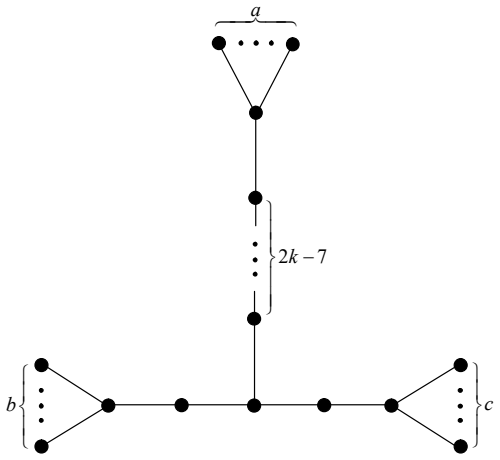
read the original abstract
Let $G$ be a connected graph with vertex set $V(G)$, and denote by $d_G(u,v)$ the distance from $u$ to $v$ in $G$, for any $u,v \in V(G)$. The average distance of an $n$-vertex connected graph $G$, denoted by $\mu(G)$, is defined to be the average of all distances between all pairs of vertices in $G$, i.e., $\mu (G) = \binom{n}{2}^{-1} \sum_{\{u,v\} \subset V(G)}d_G(u,v)$. The problem of finding a spanning tree of minimum average distance is known to be NP-hard, so establishing an upper bound for the minimum average distance among all spanning trees is of particular interest. Mukwembi (J. Graph Theory, 2014) showed that if $G$ is a connected graph of order $n$ with independence number $\alpha$, where $n > 2 \alpha - 1$, then $G$ has a spanning tree $T$ such that $\mu(T) \le \alpha + 2$. In this paper, we first improve the upper bound to $\mu(T) < \alpha + 1$ for $\alpha \ge 1$, and then we find the bound could be further improved when $\alpha$ becomes larger, so a better upper bound \[ \mu(T) < \left\{ \begin{array}{ll} \alpha+1 & \hbox{if } 1\le\alpha\le 6,\\ \alpha+\frac12+\frac{4(\alpha-1)}{\alpha^2} & \hbox{if } \alpha\ge 7, \end{array} \right. \] is established later. In the end, we give a remark to indicate our new upper bound is best possible in the sense of asymptotics (when $n$ and $\alpha$ are large enough).
Editorial analysis
A structured set of objections, weighed in public.
Referee Report
Summary. The paper claims that every connected graph G with independence number α ≥ 1 admits a spanning tree T with average distance μ(T) < α + 1. For α ≥ 7 the bound is sharpened to μ(T) < α + 1/2 + 4(α−1)/α². These results improve Mukwembi’s 2014 theorem (which required n > 2α − 1 and obtained μ(T) ≤ α + 2). The authors also assert that the new upper bound is asymptotically tight for large n and α.
Significance. If the proofs are valid, the work supplies a cleaner and quantitatively stronger upper bound on the minimum average distance of any spanning tree, expressed only in terms of α. The asymptotic-optimality remark is a useful addition, as it indicates that the leading term cannot be improved.
major comments (1)
- [Main theorem and its proof] The main theorem (stated in the abstract and proved in the body) asserts the bound μ(T) < α + 1 for every connected G with independence number α, without the hypothesis n > 2α − 1 that appeared in Mukwembi’s result. The standard construction selects a maximum independent set S and attaches the components of G − S to S. When n ≤ 2α − 1 the number of such components can reach α − 1, and the resulting tree distances between vertices in distinct components are at most 2 or 3; the paper does not explicitly verify that the claimed additive constants remain valid in this regime.
Simulated Author's Rebuttal
We thank the referee for the careful reading and for highlighting the need to explicitly address the regime n ≤ 2α − 1. We agree that a dedicated verification strengthens the presentation and will incorporate it in the revision.
read point-by-point responses
-
Referee: The main theorem (stated in the abstract and proved in the body) asserts the bound μ(T) < α + 1 for every connected G with independence number α, without the hypothesis n > 2α − 1 that appeared in Mukwembi’s result. The standard construction selects a maximum independent set S and attaches the components of G − S to S. When n ≤ 2α − 1 the number of such components can reach α − 1, and the resulting tree distances between vertices in distinct components are at most 2 or 3; the paper does not explicitly verify that the claimed additive constants remain valid in this regime.
Authors: The proof of Theorem 1 in Section 3 proceeds by selecting a maximum independent set S of size α and constructing a spanning tree T by attaching each component of G − S to a distinct vertex of S (possible because G is connected). This construction is valid for all n ≥ α + 1 without any further restriction on n. When n ≤ 2α − 1, G − S has at most α − 1 vertices, so at most α − 1 components; the resulting distances in T between vertices in distinct components are indeed at most 3. Because the total number of pairs is binomial(n,2) and n is linear in α, the contribution of these longer pairs to the average is bounded by a quantity strictly less than 1. Consequently μ(T) < α + 1 continues to hold. We acknowledge that the original manuscript did not isolate this short case for explicit verification. In the revised version we will insert a short paragraph immediately after the main construction that carries out the (straightforward) calculation for n ≤ 2α − 1, confirming the strict inequality. This change does not alter the theorem statement or the asymptotic tightness remark. revision: yes
Circularity Check
No significant circularity; bounds from explicit constructions
full rationale
The paper derives its upper bounds on μ(T) via combinatorial constructions: select a maximum independent set S of size α, then attach components of G-S to S while controlling tree distances. These steps produce the stated inequalities (μ(T) < α+1, and the refined form for α≥7) directly from distance counting in the resulting tree, without reducing to fitted parameters, self-definitions, or load-bearing self-citations. The asymptotic optimality remark is supported by explicit examples rather than circular renaming. The extension beyond Mukwembi's n>2α−1 hypothesis is handled by case analysis on component attachments, keeping the argument self-contained against the graph inputs.
Axiom & Free-Parameter Ledger
axioms (1)
- standard math Standard definitions of connected graph, distance d_G(u,v), spanning tree, independence number α, and average distance μ(G).
Reference graph
Works this paper leans on
-
[1]
R.A. Beezer, J.E. Riegsecker, B.A. Smith, Using minimum degree to bound average distance, Discrete Math. 226 (2001) 365–371
work page 2001
- [2]
-
[3]
Y.-Z. Chen, X. Li, X.-D. Zhang, The extremal average distance of cubic graphs, J. Graph Theory 103 (2023) 713–739
work page 2023
-
[4]
Chung, The average distance and the independence number, J
F.R.K. Chung, The average distance and the independence number, J. Graph Theory 12 (1988) 229–235
work page 1988
-
[5]
Dankelmann, Average distance and independence number, Discrete Appl
P. Dankelmann, Average distance and independence number, Discrete Appl. Math. 51 (1994) 75–83
work page 1994
-
[6]
Dankelmann, Average distance and domination number, Discrete Appl
P. Dankelmann, Average distance and domination number, Discrete Appl. Math. 80 (1997) 21–35
work page 1997
-
[7]
Dankelmann, Average distance in weighted graphs, Discrete Math
P. Dankelmann, Average distance in weighted graphs, Discrete Math. 312 (2012) 12–20
work page 2012
-
[8]
P. Dankelmann, R. Entringer, Average distance, minimum degree, and spanning trees, J. Graph Theory 33 (2000) 1–13
work page 2000
-
[9]
P. Dankelmann, S. Mukwembi, H.C. Swart, Average distance and vertex-connectivity, J. Graph Theory 62 (2009) 157–177
work page 2009
-
[10]
P. Dankelmann, O.R. Oellermann, J.-L. Wu, Minimum average distance of strong orientations of graphs, Discrete Appl. Math. 143 (2004) 204–212
work page 2004
-
[11]
E. DeLaVi˜ na, R. Pepper, B. Waller, A note on dominating sets and average distance, Discrete Math. 309 (2009) 2615–2619
work page 2009
-
[12]
A.A. Dobrynin, R. Entringer, I. Gutman, Wiener index of trees: Theory and appli- cations, Acta Appl. Math. 66 (2001) 211–249
work page 2001
-
[13]
Du, Wiener indices of trees and monocyclic graphs with given bipartition, Int
Z. Du, Wiener indices of trees and monocyclic graphs with given bipartition, Int. J. Quantum. Chem. 112 (2013) 1598–1605
work page 2013
-
[14]
Z. Du, A. Ili´ c, L. Feng, Further results on the distance spectral radius of graphs, Linear Multilinear Algebra 61 (2013) 1287–1301. 19
work page 2013
-
[15]
Z. Du, B. Zhou, Minimum Wiener indices of trees and unicyclic graphs of given matching number, MATCH Commun. Math. Comput. Chem. 63 (2010) 101–112
work page 2010
-
[16]
Entringer, Bounds for the average distance-inverse degree product in trees, In: Y
R.C. Entringer, Bounds for the average distance-inverse degree product in trees, In: Y. Alavi, D.R. Lick, A.J. Schwenk (eds), Combinatorics, Graph Theory, and Algorithms, New Issues Press, Kalamazoo, 1999, pp. 335–352
work page 1999
-
[17]
R.C. Entringer, D.J. Kleitman, L.A. Sz´ ekely, A note on spanning trees with minimum average distance, Bull. Inst. Combin. Appl. 17 (1996) 71–78
work page 1996
-
[18]
S. Fajtlowicz, W. Waller, On two conjectures of Graffiti I, Congr. Numer. 55 (1986) 51–56
work page 1986
-
[19]
S. Fajtlowicz, W. Waller, On two conjectures of Graffiti II, Congr. Numer. 60 (1987) 187–197
work page 1987
-
[20]
I. Gutman, O.E. Polansky, Mathematical Concepts in Organic Chemistry, Springer– Verlag, Berlin, 1986
work page 1986
- [21]
-
[22]
Hendry, Existence of graphs with prescribed mean distance, J
G.R.T. Hendry, Existence of graphs with prescribed mean distance, J. Graph Theory 10 (1986) 173–175
work page 1986
-
[23]
Hu, Optimum communication spanning trees, SIAM J
T.C. Hu, Optimum communication spanning trees, SIAM J. Comput. 3 (1974) 188– 195
work page 1974
-
[24]
D.S. Johnson, J.K. Lenstra, A.H.G.R. Kan, The complexity of the network design problem, Networks 8 (1978) 279–285
work page 1978
-
[25]
M. Kouider, P. Winkler, Mean distance and minimum degree, J. Graph Theory 25 (1997) 95–99
work page 1997
-
[26]
Mukwembi, Average distance, independence number, and spanning trees, J
S. Mukwembi, Average distance, independence number, and spanning trees, J. Graph Theory 76 (2014) 194–199
work page 2014
-
[27]
Mukwembi, Average distance, minimum degree, and irregularity index, Discrete Math
S. Mukwembi, Average distance, minimum degree, and irregularity index, Discrete Math. 347 (2024) 113671
work page 2024
-
[28]
S. Nikoli´ c, N. Trinajsti´ c, Z. Mihali´ c, The Wiener index: Development and applica- tions, Croat. Chem. Acta 68 (1995) 105–128
work page 1995
-
[29]
Plesn´ ık, On the sum of all distances in a graph or digraph, J
J. Plesn´ ık, On the sum of all distances in a graph or digraph, J. Graph Theory 8 (1984) 1–21
work page 1984
-
[30]
Shi, The average distance of trees, System Sci
R. Shi, The average distance of trees, System Sci. Math. Sci. 6 (1993) 18–24. 20
work page 1993
-
[31]
Wiener, Structural determination of paraffin boiling points, J
H. Wiener, Structural determination of paraffin boiling points, J. Am. Chem. Soc. 69 (1947) 17–20
work page 1947
-
[32]
Y.-N. Yeh, I. Gutman, On the sum of all distances in composite graphs, Discrete Math. 135 (1994) 359–365. 21
work page 1994
discussion (0)
Sign in with ORCID, Apple, or X to comment. Anyone can read and Pith papers without signing in.