The maximum number of triangles in graphs without vertex disjoint friendship graphs
Pith reviewed 2026-05-08 16:12 UTC · model grok-4.3
The pith
The maximum number of triangles in n-vertex graphs without t+1 vertex-disjoint friendship graphs F_k is determined exactly, with the extremal graphs characterized.
A machine-rendered reading of the paper's core claim, the machinery that carries it, and where it could break.
Core claim
The paper determines the value of ex(n, K_3, (t+1)F_k) for integers t ≥ 1 and k, and characterizes the extremal graphs. In contrast to the extremal graphs for a single F_k, those for (t+1)F_k undergo a fundamental structural change. This structure is also different from those arising in previous similar problems on generalized Turán numbers.
What carries the argument
The generalized Turán number ex(n, K_3, (t+1)F_k), which records the maximum number of K_3 copies in an n-vertex graph free of t+1 vertex-disjoint F_k copies; the argument turns on identifying the new optimal constructions that achieve this maximum.
Load-bearing premise
The extremal graphs for avoiding t+1 disjoint copies of F_k undergo a fundamental structural change from the single F_k case, and the proposed construction is optimal for every t ≥ 1 and every k.
What would settle it
An n-vertex (t+1)F_k-free graph whose number of triangles exceeds the claimed value for ex(n, K_3, (t+1)F_k) would falsify the determination of the extremal number.
Figures
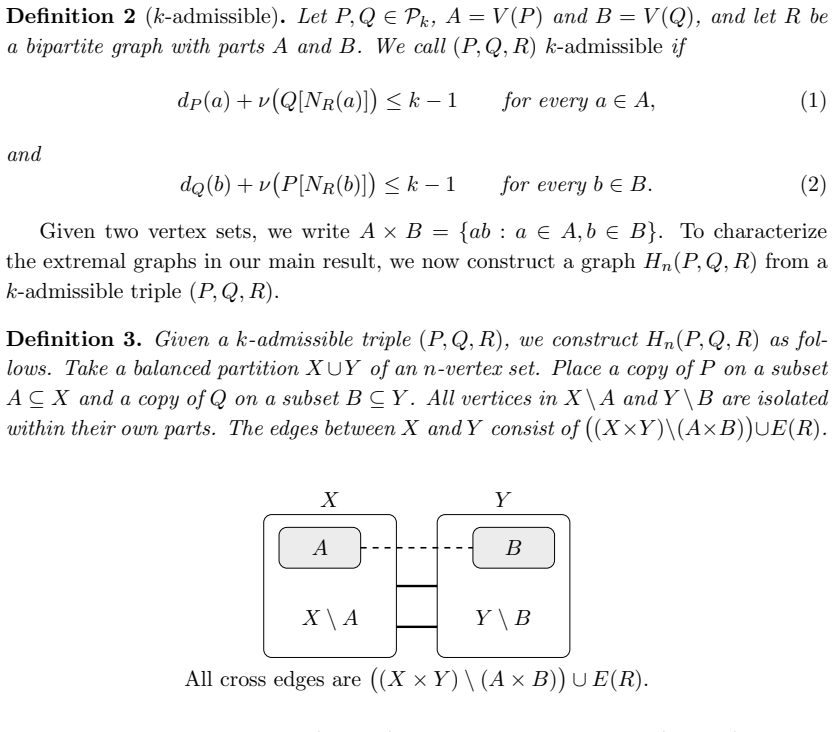
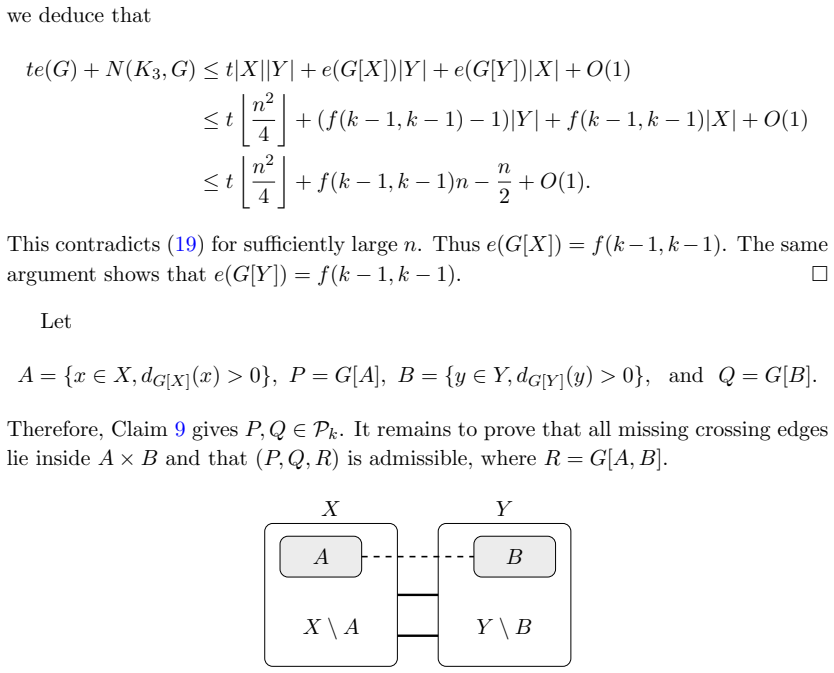
read the original abstract
Given graphs $H$ and $F$, the generalized Tur\'an number $\mathrm{ex}(n,H,F)$ is the maximum number of copies of $H$ among all $n$-vertex $F$-free graphs. The friendship graph $F_k$ consists of $k$ triangles sharing a common vertex. In this paper, we determine the value of $\mathrm{ex}(n,K_3,(t+1)F_k)$, where $K_3$ is a triangle, $t\geq 1$ is an integer, and $(t+1)F_k$ denotes a union of $(t+1)$ pairwise vertex-disjoint copies of $F_k$. Moreover, we characterize the extremal structure. Our result can be viewed as a generalization of the result of Zhu, Chen, Gerbner, Gy\H{o}ri, and Hama Karim, as well as of the remaining case left open by Wang, Ni, Liu, and Kang. In contrast to the extremal graphs of $F_k$, the extremal graphs of $(t+1)F_k$ undergo a fundamental change. This structure is also different from those of previous similar problems.
Editorial analysis
A structured set of objections, weighed in public.
Referee Report
Summary. The manuscript determines the exact value of the generalized Turán number ex(n, K_3, (t+1)F_k) for all integers t ≥ 1 and k ≥ 1, where F_k is the friendship graph consisting of k triangles sharing a vertex, and (t+1)F_k denotes t+1 vertex-disjoint copies. It also characterizes the extremal n-vertex graphs that maximize the number of triangles while remaining free of (t+1)F_k. The result is presented as a generalization of the single-F_k case settled by Zhu et al. and as resolving the remaining open case from Wang et al., with the key observation that the extremal construction undergoes a fundamental structural change when forbidding multiple disjoint copies.
Significance. If the exact determination and characterization hold, the paper supplies a complete solution to this family of generalized Turán problems. It identifies how the extremal graphs shift from the single-F_k regime to a new construction that remains optimal across all t ≥ 1 and all k, thereby extending the known results on ex(n, K_3, F) for friendship graphs and their disjoint unions. The work is grounded in combinatorial arguments without introducing fitted parameters or ad-hoc quantities.
major comments (1)
- [Main theorem and proof] The central claim that the new construction is optimal for every t ≥ 1 and every k rests on a full case analysis and stability argument whose details are not verifiable from the abstract alone; the load-bearing step is the verification that no other graph exceeds the stated bound in the regime where the structural change occurs (presumably §4 or the proof of the main theorem).
minor comments (2)
- [Introduction] The abstract states that the result 'can be viewed as a generalization' of Zhu et al. and the open case of Wang et al.; the introduction should include explicit statements of those prior theorems (with equation or theorem numbers) to make the precise improvement clear.
- [Abstract and §1] Notation for the forbidden graph is given as '(t+1)F_k' for the disjoint union; a brief sentence confirming that this is the standard vertex-disjoint union (rather than edge-disjoint) would remove any possible ambiguity for readers.
Simulated Author's Rebuttal
We thank the referee for their careful review and for recognizing the paper as a complete solution to this family of generalized Turán problems. We address the single major comment below.
read point-by-point responses
-
Referee: [Main theorem and proof] The central claim that the new construction is optimal for every t ≥ 1 and every k rests on a full case analysis and stability argument whose details are not verifiable from the abstract alone; the load-bearing step is the verification that no other graph exceeds the stated bound in the regime where the structural change occurs (presumably §4 or the proof of the main theorem).
Authors: The complete proof, including the full case analysis and stability arguments, appears in Sections 3 and 4 of the manuscript (not the abstract). Section 3 establishes the upper bound via a stability lemma showing that any graph with more triangles than the proposed extremal construction must be structurally close to a blow-up of a complete bipartite graph augmented by a controlled number of triangles; this is proved by analyzing maximum-degree vertices, common-neighborhood counts, and triangle distributions. Section 4 then performs the case analysis for the regime of the structural change, verifying by exhaustive enumeration of possible edge and triangle configurations that exceeding the bound forces the appearance of (t+1) vertex-disjoint copies of F_k. The arguments are self-contained combinatorial arguments extending the single-copy techniques of Zhu et al. and the open case of Wang et al. All calculations and lemmas are written out explicitly, so the verification is available in the full text. We are happy to add a short proof outline to the introduction if the referee believes it would improve readability. revision: no
Circularity Check
No significant circularity; minor self-citation not load-bearing
full rationale
The derivation determines ex(n, K_3, (t+1)F_k) and characterizes the extremal graphs via direct combinatorial arguments that generalize prior independent results on F_k without reducing the extremal value to any fitted parameter, self-defined quantity, or ansatz imported from overlapping-author citations. The abstract and structure explicitly note a fundamental change from the single-F_k case, and the optimality claim rests on the new forbidden-subgraph analysis rather than on any equation or prior result that is equivalent to the target by construction. No load-bearing step collapses to a self-citation chain or renaming of known patterns.
Axiom & Free-Parameter Ledger
axioms (1)
- standard math Standard definitions of graphs, subgraphs, vertex-disjoint unions, and the generalized Turán function ex(n,H,F).
Reference graph
Works this paper leans on
-
[1]
H. L. Abbott, D. Hanson and H. Sauer, Intersection theorems for systems of sets, J. Combin. Theory Ser. A12(1972) 381-389
work page 1972
-
[2]
N. Alon and C. Shikhelman, ManyTcopies inH-free graphs,J. Combin. Theory Ser. B121(2016) 146-172
work page 2016
-
[3]
B. Bollob´ as and E. Gy˝ ori, Pentagons vs. triangles,Discrete Math.308(2008) 4332- 4336
work page 2008
-
[4]
Chase, The maximum number of triangles in a graph of given maximum degree, Adv
Z. Chase, The maximum number of triangles in a graph of given maximum degree, Adv. Comput.(2020) paper (10) 5
work page 2020
-
[5]
G. Chen, R. J. Gould, F. Pfender and B. Wei, Extremal graphs for intersecting cliques,J. Combin. Theory, Ser. B89(2003) 159-171
work page 2003
-
[6]
G. Chen, X. Lei and S. Li, The exact Tur´ an number of disjoint graphs—a gen- eralization of Simonovits’ theorem, and beyond,European J. Combin.130(2025) 104226
work page 2025
-
[7]
Y.-H. Chen, J.-B. Yang, L.-T. Yuan and P. Zhang, Exact generalized Tur´ an numbers for even linear forests,Discrete Math.347(2024) 113974
work page 2024
-
[8]
V. Chv´ atal and D. Hanson, Degrees and matchings,J. Combin. Theory Ser. B20 (1976) 128-138
work page 1976
-
[9]
P. Erd˝ os, On some new inequalities concerning extremal properties of graphs, in: Theory of Graphs, Proceedings of the Colloquium Held at Tihany, 1966, pp. 77-81
work page 1966
-
[10]
Erd˝ os, On the number of complete subgraphs contained in certain graphs, Magy
P. Erd˝ os, On the number of complete subgraphs contained in certain graphs, Magy. Tud. Akad. Mat. Kut. Int´ ez. K¨ ozl.7(1962) 459-464
work page 1962
-
[11]
P. Erd˝ os, Some recent results on extremal problems in graph theory, in: Results, Theory of Graphs, International Symposium, Rome, 1966, 1967, pp. 117-123
work page 1966
-
[12]
P. Erd˝ os, Z. F¨ uredi, R. Gould and D. Gunderson, Extremal graphs for intersecting triangles,J. Combin. Theory Ser. B64(1995) 89-100. 23
work page 1995
-
[13]
P. Erd˝ os and T. Gallai, On maximal paths and circuits of graphs,Acta Math. Acad. Sci. Hungar.10(1959) 337-356
work page 1959
-
[14]
Z. F¨ uredi and D.S. Gunderson, Extremal numbers for odd cycles,Combin. Probab. Comput.24(4) (2015) 641-645
work page 2015
-
[15]
Grzesik, On the maximum number of five-cycles in a triangle-free graph,J
A. Grzesik, On the maximum number of five-cycles in a triangle-free graph,J. Combin. Theory Ser. B102(2012) 1061-1066
work page 2012
- [16]
-
[17]
J. Hou, H. Li and Q. Zeng, Extremal graphs for the suspension of edge-critical graphs,Electron. J. Combin.31(4) (2024) P4.55
work page 2024
-
[18]
Luo, The maximum number of cliques in graphs without long cycles,J
R. Luo, The maximum number of cliques in graphs without long cycles,J. Combin. Theory, Ser. B128(2017) 219-226
work page 2017
-
[19]
Simonovits, Extremal graph problems with symmetrical extremal graphs
M. Simonovits, Extremal graph problems with symmetrical extremal graphs. Ad- ditional chromatic conditions,Discrete Math.7(1974) 349-376
work page 1974
-
[20]
Tur´ an, On an extremal problem in graph theory (in Hungrarian),Mat
P. Tur´ an, On an extremal problem in graph theory (in Hungrarian),Mat. es Fiz. Lapok.48(1941) 436-452
work page 1941
-
[21]
Y. Wang, Z. Ni, Y. Liu and L. Kang, Generalized Tur´ an results for edge blow-up of star forests,Discrete Math.347(2024) 114149
work page 2024
-
[22]
J.-B. Yang and L.-T. Yuan, A note on the stability results of the number of cliques in graphs with given matching number,Discrete Appl. Math.356(2024) 343-349
work page 2024
-
[23]
X. Zhu, Y. Chen, D. Gerbner, E. Gy˝ ori and H. Hama Karim, The maximum number of triangles inF k-free graphs,European J. Combin.111(2023) 103793. 24
work page 2023
discussion (0)
Sign in with ORCID, Apple, or X to comment. Anyone can read and Pith papers without signing in.