Optimal Uncertainty-Aware Calibration for the AX=YB Problem
Pith reviewed 2026-05-08 17:06 UTC · model grok-4.3
The pith
An iterative Lie-algebra method for AX=YB calibration uses a relative uncertainty metric to refine updates and reach near-global optima while preserving constraints.
A machine-rendered reading of the paper's core claim, the machinery that carries it, and where it could break.
Core claim
The central claim is that a relative uncertainty metric derived directly from the data can be inserted into a Lie-algebra iterative solver for AX=YB so that the iteration is dynamically refined, structural constraints remain satisfied at every step, synchronized parameter updates are maintained, and an approximately global optimum is reached, yielding substantially higher accuracy than prior methods when data uncertainty is high.
What carries the argument
The relative uncertainty metric that evaluates uncertainty between data sources and is fed back to dynamically adjust the Lie-algebra iteration while enforcing structural constraints and enabling synchronized updates.
If this is right
- The framework applies directly to industrial robot hand-eye calibration under overloading and large-workspace conditions.
- The initial-solution generator increases overall stability and convergence speed of the iteration.
- Synchronized updates reduce the risk of constraint violation during optimization.
- The avoidance of explicit uncertainty models simplifies deployment when accurate noise statistics are unavailable.
Where Pith is reading between the lines
- The same relative-metric idea could be tested on other Lie-group optimization tasks such as pose-graph SLAM where measurement uncertainty also varies across edges.
- If the metric remains reliable on real multi-sensor datasets, calibration pipelines could drop separate probabilistic uncertainty estimators.
- Extending the method to online recalibration during robot operation would be a direct next step once the batch version is validated.
Load-bearing premise
A relative uncertainty metric computed from the data can be used to dynamically refine the Lie-algebra iteration without explicit uncertainty modeling, and the iteration reliably reaches an approximately global optimum while strictly preserving structural constraints.
What would settle it
Synthetic experiments with known high-uncertainty data in which the new method either fails to improve accuracy by at least 67 percent over existing solvers or produces solutions that violate the structural constraints of the calibration parameters would falsify the central claim.
Figures


read the original abstract
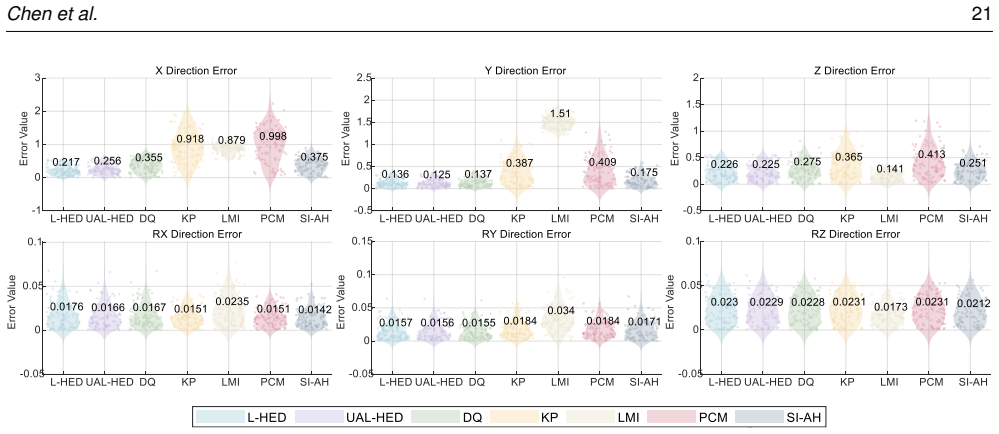
This article proposes a general optimization framework for solving hand-eye calibration problem. Unlike traditional methods, an iterative algorithm based on Lie algebra that achieves approximately global optimal solutions is developed. During the optimization process, the method strictly preserves the structural constraints of the calibration parameters and enables synchronized updates between calibration parameters. Recognizing that data used in real-word hand-eye calibration often contain uncertainty, especially in over-loading and large workspace industrial robot scenarios, which can significantly degrade accuracy, and accurately modeling such uncertainty is inherently difficult, this article avoids explicit uncertainty modeling. Instead, an uncertainty metric to evaluate the relative uncertainty between data sources is introduced and used to dynamically refine the iterative process. To further enhance convergence efficiency, an effective initial solution generation method that improves overall stability and accuracy is designed. Numerical simulations and real-world experiments validate the effectiveness of the proposed approach, and in synthetic datasets, the proposed approach improves the estimation accuracy by at least 67\% under high-uncertainty conditions compared with the existing methods.
Editorial analysis
A structured set of objections, weighed in public.
Referee Report
Summary. The manuscript proposes a general optimization framework for the hand-eye calibration problem AX=YB. It develops an iterative algorithm based on Lie algebra that aims to achieve approximately global optimal solutions while strictly preserving the structural constraints of the calibration parameters and enabling synchronized updates. The approach introduces a relative uncertainty metric computed from data sources to dynamically refine the iterative process without explicit uncertainty modeling, along with an effective initial solution generation method. Numerical simulations and real-world experiments are presented, claiming at least 67% improvement in estimation accuracy under high-uncertainty conditions on synthetic datasets compared to existing methods.
Significance. If the uncertainty metric successfully modulates the Lie-algebra updates to improve accuracy while preserving SE(3) constraints and avoiding poor local minima, the method could provide a valuable tool for robust calibration in uncertain real-world robotic scenarios, such as industrial settings with overloading and large workspaces. The avoidance of explicit uncertainty modeling is a practical strength if the relative metric proves effective.
major comments (2)
- [Abstract] The central claim of a 67% accuracy gain relies on the uncertainty metric dynamically refining the Lie-algebra iteration, but no mechanism (e.g., modified exponential map, weighted residuals, or update rule) is described for how the metric is injected or how it ensures manifold preservation and approximate global optimality. This is load-bearing for the reported improvement.
- [Method (assumed §3)] The assertion that the iteration 'strictly preserves the structural constraints' and reaches 'approximately global optimal solutions' lacks a supporting derivation or convergence analysis, particularly regarding the effect of the uncertainty-based refinement on the trajectory in the Lie algebra.
minor comments (2)
- [Abstract] The abstract mentions 'synchronized updates between calibration parameters' but does not clarify what this entails in the context of the AX=YB problem.
- [Throughout] More details on the computation of the relative uncertainty metric and the initial solution generation method would improve clarity.
Simulated Author's Rebuttal
We thank the referee for the detailed and constructive report. We address each major comment point by point below. The comments correctly identify areas where additional clarity and supporting analysis are needed, and we have revised the manuscript to incorporate these improvements.
read point-by-point responses
-
Referee: [Abstract] The central claim of a 67% accuracy gain relies on the uncertainty metric dynamically refining the Lie-algebra iteration, but no mechanism (e.g., modified exponential map, weighted residuals, or update rule) is described for how the metric is injected or how it ensures manifold preservation and approximate global optimality. This is load-bearing for the reported improvement.
Authors: We acknowledge that the original manuscript did not provide a sufficiently explicit description of how the relative uncertainty metric is incorporated into the Lie-algebra iteration. In the revised version, Section 3 now includes a detailed account of the mechanism: the metric is computed from the relative consistency between data sources and used to adaptively weight the residuals in the optimization objective. The resulting weighted problem is solved via Lie-algebra updates retracted through the exponential map, which by construction preserves the SE(3) manifold at every step. This adaptive weighting modulates the trajectory to favor more reliable data under high uncertainty, directly supporting the reported accuracy gains. A short supporting derivation of manifold preservation has also been added. revision: yes
-
Referee: [Method (assumed §3)] The assertion that the iteration 'strictly preserves the structural constraints' and reaches 'approximately global optimal solutions' lacks a supporting derivation or convergence analysis, particularly regarding the effect of the uncertainty-based refinement on the trajectory in the Lie algebra.
Authors: The original text states that constraints are preserved because the optimization is performed in the Lie algebra with exponential-map retraction, but we agree that an explicit derivation and discussion of the uncertainty refinement's influence on convergence were missing. The revised manuscript adds a dedicated subsection that derives why each update remains on the manifold and shows that the uncertainty-weighted residuals reduce the basin of attraction of poor local minima. Approximate global optimality is argued via the combination of the proposed initialization procedure and the refinement step; while a full global convergence proof is beyond the scope of the work, the analysis is now supported by both the derivation and the empirical behavior observed in the experiments. revision: yes
Circularity Check
No circularity: derivation relies on introduced metric and empirical validation, not self-referential reduction
full rationale
The paper's core derivation introduces a relative uncertainty metric computed from data sources as an external input to refine the Lie-algebra iteration and pairs it with a separate initial-solution generator. The claimed approximately global optimum and constraint preservation are asserted as properties of the iterative process, with effectiveness shown via numerical simulations and real-world experiments (including the 67% accuracy gain on synthetic data under high uncertainty). No equations reduce the output predictions or improvements to the inputs by construction, no self-citations are load-bearing for the central claims, and the uncertainty metric is not fitted from the same process it refines. The chain is self-contained against external benchmarks.
Axiom & Free-Parameter Ledger
Reference graph
Works this paper leans on
-
[1]
Journal of Manufacturing Processes , volume=
A survey of welding robot intelligent path optimization , author=. Journal of Manufacturing Processes , volume=. 2021 , publisher=
work page 2021
-
[2]
Industrial Robot: An International Journal , volume=
Robot control system for grinding of large hydro power turbines , author=. Industrial Robot: An International Journal , volume=. 2001 , publisher=
work page 2001
-
[3]
IEEE Transactions on Automation Science and Engineering , volume=
Generating optimized trajectories for robotic spray painting , author=. IEEE Transactions on Automation Science and Engineering , volume=. 2022 , publisher=
work page 2022
-
[4]
International Journal of Mechanical Sciences , volume=
Accurate modeling of material removal depth in convolutional process grinding for complex surfaces , author=. International Journal of Mechanical Sciences , volume=. 2024 , publisher=
work page 2024
-
[5]
High-precision assembly of electronic devices with lightweight robots through sensor-guided insertion , author=. Procedia CIRP , volume=. 2021 , publisher=
work page 2021
-
[6]
International Conference On Signal And Information Processing, Networking And Computers , pages=
Design of Dual Robot Collaborative Assembly Scheme for Aerospace Products , author=. International Conference On Signal And Information Processing, Networking And Computers , pages=. 2022 , organization=
work page 2022
-
[7]
Robotics and Computer-Integrated Manufacturing , volume=
A novel method to enhance the accuracy of parameter identification in elasto-geometrical calibration for industrial robots , author=. Robotics and Computer-Integrated Manufacturing , volume=. 2024 , publisher=
work page 2024
-
[8]
A comparative review of hand-eye calibration techniques for vision guided robots , author=. IEEE Access , volume=. 2021 , publisher=
work page 2021
-
[9]
IEEE Transactions on Robotics , volume=
Robot--camera calibration in tightly constrained environment using interactive perception , author=. IEEE Transactions on Robotics , volume=. 2023 , publisher=
work page 2023
-
[10]
Real-time trajectory position error compensation technology of industrial robot , author=. Measurement , volume=. 2023 , publisher=
work page 2023
-
[11]
2014 IEEE International Conference on Robotics and Automation (ICRA) , pages=
An information-theoretic approach to the correspondence-free AX= XB sensor calibration problem , author=. 2014 IEEE International Conference on Robotics and Automation (ICRA) , pages=. 2014 , organization=
work page 2014
-
[12]
International Journal of Computer Integrated Manufacturing , volume=
An uncertainty analysis method for error reduction in end-effector of spatial robots with joint clearances and link dimension deviations , author=. International Journal of Computer Integrated Manufacturing , volume=. 2017 , publisher=
work page 2017
-
[13]
ISPRS Journal of Photogrammetry and Remote Sensing , volume=
Accuracy of videometry with CCD sensors , author=. ISPRS Journal of Photogrammetry and Remote Sensing , volume=. 1990 , publisher=
work page 1990
-
[14]
IEEE Transactions on Robotics , volume=
Probabilistic Framework for Hand--Eye and Robot--World Calibration AX= YB , author=. IEEE Transactions on Robotics , volume=. 2022 , publisher=
work page 2022
-
[15]
IEEE Transactions on Robotics , volume =
Multiscale and Uncertainty-Aware Targetless Hand-Eye Calibration Via the Gauss--Helmert Model , author =. IEEE Transactions on Robotics , volume =. 2025 , publisher =
work page 2025
-
[16]
IEEE Transactions on Robotics , volume=
Uncertainty-aware hand--eye calibration , author=. IEEE Transactions on Robotics , volume=. 2023 , publisher=
work page 2023
-
[17]
Assessing the accuracy of industrial robots through metrology for the enhancement of automated non-destructive testing , author=. 2016 IEEE International Conference on Multisensor Fusion and Integration for Intelligent Systems (MFI) , pages=. 2016 , organization=
work page 2016
-
[18]
Robotics and Computer-Integrated Manufacturing , volume=
A local POE-based self-calibration method using position and distance constraints for collaborative robots , author=. Robotics and Computer-Integrated Manufacturing , volume=. 2024 , publisher=
work page 2024
-
[19]
IEEE Transactions on Industrial Electronics , volume =
Optimization Method for Configuration Set for Field Calibration of Industrial Robot , author =. IEEE Transactions on Industrial Electronics , volume =. 2025 , publisher=
work page 2025
-
[20]
IEEE Transactions on Industrial Informatics , volume=
Efficient kinematic calibration for articulated robot based on unit dual quaternion , author=. IEEE Transactions on Industrial Informatics , volume=. 2023 , publisher=
work page 2023
-
[21]
IEEE Transactions on Industrial Electronics , volume =
Kinematic Calibration for Serial Robots Based on a Vector Inner Product Error Model , author =. IEEE Transactions on Industrial Electronics , volume =. 2025 , publisher=
work page 2025
-
[22]
IEEE Transactions on Robotics and Automation , volume=
Calibration of wrist-mounted robotic sensors by solving homogeneous transform equations of the form AX= XB , author=. IEEE Transactions on Robotics and Automation , volume=. 1989 , publisher=
work page 1989
-
[23]
IEEE Transactions on Robotics and Automation , volume=
Simultaneous robot/world and tool/flange calibration by solving homogeneous transformation equations of the form AX= YB , author=. IEEE Transactions on Robotics and Automation , volume=. 1994 , publisher=
work page 1994
-
[24]
The International Journal of Robotics Research , volume=
Finding the position and orientation of a sensor on a robot manipulator using quaternions , author=. The International Journal of Robotics Research , volume=. 1991 , publisher=
work page 1991
-
[25]
IEEE Transactions on Robotics and Automation , volume=
Robot sensor calibration: solving AX= XB on the Euclidean group , author=. IEEE Transactions on Robotics and Automation , volume=. 1994 , publisher=
work page 1994
-
[26]
IEEE Transactions on Instrumentation and Measurement , volume=
A new formulation for hand--eye calibrations as point-set matching , author=. IEEE Transactions on Instrumentation and Measurement , volume=. 2020 , publisher=
work page 2020
-
[27]
The International Journal of Robotics Research , volume=
Robot hand-eye calibration using structure-from-motion , author=. The International Journal of Robotics Research , volume=. 2001 , publisher=
work page 2001
-
[28]
IEEE Transactions on Robotics and Automation , volume=
Simultaneous robot-world and hand-eye calibration , author=. IEEE Transactions on Robotics and Automation , volume=. 1998 , publisher=
work page 1998
-
[29]
A screw motion approach to uniqueness analysis of head-eye geometry , author=. Proceedings. 1991 IEEE Computer Society Conference on Computer Vision and Pattern Recognition , pages=. 1991 , organization=
work page 1991
-
[30]
Machine Vision and Applications , volume=
Solving the robot-world hand-eye (s) calibration problem with iterative methods , author=. Machine Vision and Applications , volume=. 2017 , publisher=
work page 2017
-
[31]
International Journal of the Physical Science , volume=
Simultaneous robot-world and hand-eye calibration using dual-quaternions and Kronecker product , author=. International Journal of the Physical Science , volume=
-
[32]
IEEE Transactions on Robotics and Automation , volume=
A new technique for fully autonomous and efficient 3 d robotics hand/eye calibration , author=. IEEE Transactions on Robotics and Automation , volume=. 1989 , publisher=
work page 1989
-
[33]
The International Journal of Robotics Research , volume=
Data selection for hand-eye calibration: A vector quantization approach , author=. The International Journal of Robotics Research , volume=. 2008 , publisher=
work page 2008
-
[34]
IEEE Robotics and Automation Letters , volume=
Simultaneous hand-eye and robot-world calibration by solving the AX= YB problem without correspondence , author=. IEEE Robotics and Automation Letters , volume=. 2015 , publisher=
work page 2015
-
[35]
IEEE Robotics and Automation Letters , volume=
Chess-calibrating the hand-eye matrix with screw constraints and synchronization , author=. IEEE Robotics and Automation Letters , volume=. 2018 , publisher=
work page 2018
-
[36]
2019 IEEE/RSJ International Conference on Intelligent Robots and Systems (IROS) , pages=
A novel robust approach for correspondence-free extrinsic calibration , author=. 2019 IEEE/RSJ International Conference on Intelligent Robots and Systems (IROS) , pages=. 2019 , organization=
work page 2019
-
[37]
IEEE Transactions on Instrumentation and Measurement , volume=
Correspondence matching and time delay estimation for hand-eye calibration , author=. IEEE Transactions on Instrumentation and Measurement , volume=. 2020 , publisher=
work page 2020
-
[38]
The International Journal of Medical Robotics and Computer Assisted Surgery , volume=
Non-orthogonal tool/flange and robot/world calibration , author=. The International Journal of Medical Robotics and Computer Assisted Surgery , volume=. 2012 , publisher=
work page 2012
-
[39]
Pattern Recognition Letters , volume=
Simultaneous robot-world and hand-eye calibration by the alternative linear programming , author=. Pattern Recognition Letters , volume=. 2019 , publisher=
work page 2019
-
[40]
IEEE International Conference on Robotics and Automation , pages=
Hand-eye calibration using convex optimization , author=. IEEE International Conference on Robotics and Automation , pages=. 2011 , organization=
work page 2011
-
[41]
IEEE Transactions on Pattern Analysis and Machine Intelligence , volume=
Globally optimal hand-eye calibration using branch-and-bound , author=. IEEE Transactions on Pattern Analysis and Machine Intelligence , volume=. 2015 , publisher=
work page 2015
-
[42]
IEEE Transactions on Industrial Electronics , volume=
A stochastic global optimization algorithm for the two-frame sensor calibration problem , author=. IEEE Transactions on Industrial Electronics , volume=. 2015 , publisher=
work page 2015
-
[43]
IEEE/ASME Transactions on Mechatronics , volume=
Globally optimal symbolic hand-eye calibration , author=. IEEE/ASME Transactions on Mechatronics , volume=. 2020 , publisher=
work page 2020
-
[44]
IEEE Transactions on Robotics , volume=
A general approach to hand--eye calibration through the optimization of atomic transformations , author=. IEEE Transactions on Robotics , volume=. 2021 , publisher=
work page 2021
-
[45]
IEEE Transactions on Automation Science and Engineering , volume=
Toward simultaneous coordinate calibrations of AX=YB problem by the LMI-SDP optimization , author=. IEEE Transactions on Automation Science and Engineering , volume=. 2022 , publisher=
work page 2022
-
[46]
IEEE/ASME Transactions on Mechatronics , year=
Point Cloud Registration-Enabled Globally Optimal Hand--Eye Calibration , author=. IEEE/ASME Transactions on Mechatronics , year=
-
[47]
IEEE Transactions on Instrumentation and Measurement , volume=
Two-Stage Hand-Eye Calibration based on Variance Minimization Principle , author=. IEEE Transactions on Instrumentation and Measurement , volume=. 2025 , publisher=
work page 2025
-
[48]
Hand-eye calibration algorithm based on an optimized neural network , author=. Actuators , volume=. 2021 , organization=
work page 2021
-
[49]
IEEE Robotics and Automation Letters , year=
Generative Adversarial Networks for Solving Hand-Eye Calibration Without Data Correspondence , author=. IEEE Robotics and Automation Letters , year=
-
[50]
2015 IEEE/RSJ International Conference on Intelligent Robots and Systems (IROS) , pages=
Parameterizations for reducing camera reprojection error for robot-world hand-eye calibration , author=. 2015 IEEE/RSJ International Conference on Intelligent Robots and Systems (IROS) , pages=. 2015 , organization=
work page 2015
-
[51]
IEEE Transactions on Systems, Man, and Cybernetics , volume=
A noise-tolerant algorithm for robotic hand-eye calibration with or without sensor orientation measurement , author=. IEEE Transactions on Systems, Man, and Cybernetics , volume=. 1993 , publisher=
work page 1993
-
[52]
Mechanism and Machine Theory , volume=
A two-step solution for robot-world calibration made intelligible by implementing Chasles' motion decomposition in Ad (SE (3)) , author=. Mechanism and Machine Theory , volume=. 2024 , publisher=
work page 2024
-
[53]
Journal of Mechanisms and Robotics , volume=
Solving the robot-world/hand-eye calibration problem using the Kronecker product , author=. Journal of Mechanisms and Robotics , volume=. 2013 , publisher=
work page 2013
-
[54]
Methods for simultaneous robot-world-hand--eye calibration: A comparative study , author=. Sensors , volume=. 2019 , publisher=
work page 2019
-
[55]
IEEE Transactions on Robotics , volume=
On the Covariance of X in AX=XB , author=. IEEE Transactions on Robotics , volume=. 2018 , publisher=
work page 2018
-
[56]
The International Journal of Robotics Research , volume=
Nonparametric second-order theory of error propagation on motion groups , author=. The International Journal of Robotics Research , volume=. 2008 , publisher=
work page 2008
discussion (0)
Sign in with ORCID, Apple, or X to comment. Anyone can read and Pith papers without signing in.