Fast Full-Wave Simulation of Indoor RSS Maps for Pre-Measurement Validation in Device-Free Localization
Pith reviewed 2026-05-08 15:41 UTC · model grok-4.3
The pith
Compact full-wave electromagnetic simulations generate two-dimensional RSS attenuation maps to validate device-free indoor localization models.
A machine-rendered reading of the paper's core claim, the machinery that carries it, and where it could break.
Core claim
A compact full-wave electromagnetic simulation setup generates two-dimensional attenuation maps from received signal strength in controlled indoor environments. These maps reproduce the main spatial features of real measurements, including attenuation statistics and interference patterns, while serving as a practical baseline for validating simplified propagation models such as diffraction-based descriptions. The approach thereby reduces reliance on extensive measurement campaigns for device-free localization system design.
What carries the argument
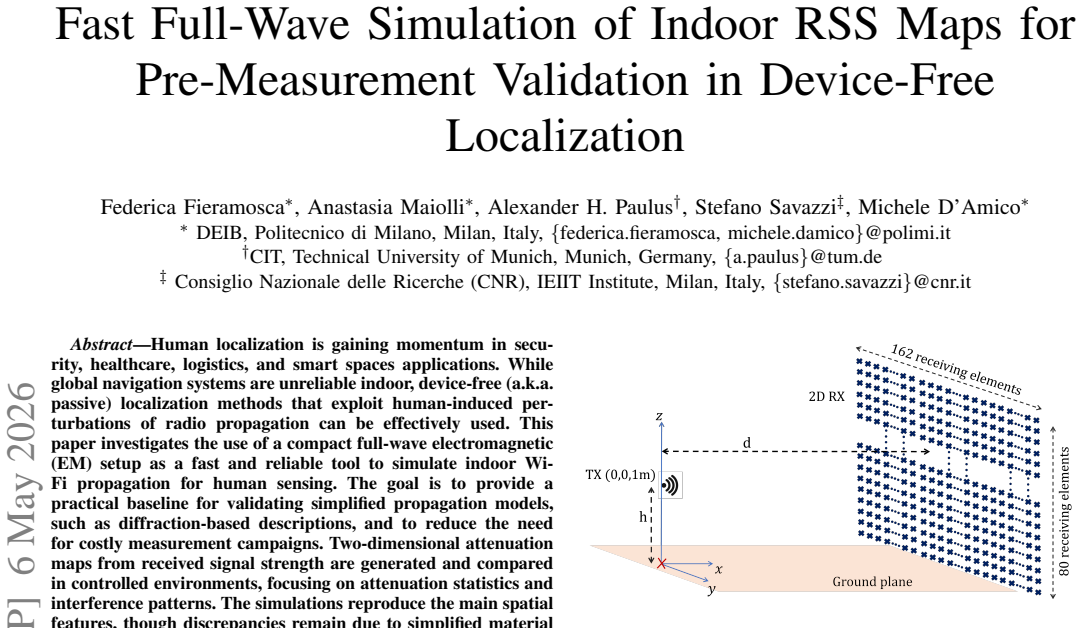
The compact full-wave electromagnetic (EM) simulation setup that models Wi-Fi signal propagation to output two-dimensional RSS attenuation maps.
If this is right
- The simulated maps provide an efficient pre-measurement reference that supports device-free system design and experimental planning.
- Diffraction-aware refinements can reduce discrepancies between simulated and measured attenuation patterns.
- The method lowers the need for costly physical measurement campaigns in security, healthcare, logistics, and smart-space applications.
Where Pith is reading between the lines
- Better material databases could extend the simulation's accuracy to more cluttered indoor layouts with multiple walls and furniture.
- The same setup might help optimize transmitter and receiver placements for passive sensing before any physical installation occurs.
- Hybrid models that combine this full-wave approach with faster ray-tracing methods could balance speed and detail for larger spaces.
Load-bearing premise
Simplified material properties in the electromagnetic simulation capture enough of the real propagation physics to match observed attenuation statistics and spatial patterns.
What would settle it
A side-by-side comparison in a controlled indoor room where the simulated RSS attenuation maps fail to reproduce the main spatial features seen in actual measured data beyond what material simplifications can explain.
Figures



read the original abstract
Human localization is gaining momentum in security, healthcare, logistics, and smart spaces applications. While global navigation systems are unreliable indoor, device-free (a.k.a. passive) localization methods that exploit human-induced perturbations of radio propagation can be effectively used. This paper investigates the use of a compact full-wave electromagnetic (EM) setup as a fast and reliable tool to simulate indoor Wi-Fi propagation for human sensing. The goal is to provide a practical baseline for validating simplified propagation models, such as diffraction-based descriptions, and to reduce the need for costly measurement campaigns. Two-dimensional attenuation maps from received signal strength are generated and compared in controlled environments, focusing on attenuation statistics and interference patterns. The simulations reproduce the main spatial features, though discrepancies remain due to simplified material characterization. Diffraction-aware refinements are proposed to mitigate these effects. Overall, the approach provides an efficient pre-measurement reference to support device-free system design and to guide experimental planning.
Editorial analysis
A structured set of objections, weighed in public.
Referee Report
Summary. The manuscript proposes using a compact full-wave electromagnetic simulation setup to rapidly generate 2D RSS attenuation maps in indoor environments for device-free (passive) human localization. These maps are positioned as a practical baseline to validate simplified propagation models such as diffraction-based descriptions, with the simulations shown to reproduce main spatial features of attenuation and interference patterns despite noted discrepancies from simplified material characterization; diffraction-aware refinements are suggested to improve fidelity and reduce reliance on costly physical measurement campaigns.
Significance. If the simulation errors can be shown to be smaller than the model-to-model differences under test, the approach would offer a reproducible, low-cost pre-measurement tool for guiding device-free localization system design in applications such as security and smart spaces. The use of standard full-wave methods in a compact setup is a practical strength that supports simulation-based reproducibility.
major comments (2)
- [Abstract] Abstract: The central claim that the compact full-wave setup provides a 'practical baseline' for validating diffraction-based models is load-bearing but unsupported by quantitative evidence. The abstract states that 'simulations reproduce the main spatial features, though discrepancies remain due to simplified material characterization' without providing error metrics, sensitivity analysis on material parameters, error bars, or direct comparison to measurements; this leaves open whether simulation artifacts could be mistaken for model accuracy.
- [Abstract] Abstract: The assumption that simplified material characterization yields a sufficiently accurate reference is unverified. Without an explicit error budget demonstrating that simulation discrepancies are smaller than the propagation-model differences being validated, the setup cannot reliably distinguish true model performance from material-induced artifacts, directly undermining the goal of reducing measurement campaigns.
Simulated Author's Rebuttal
We thank the referee for the constructive feedback on our manuscript. The comments highlight important aspects of how the abstract supports the central claim of providing a practical simulation-based baseline. We address each point below and will revise the manuscript accordingly to strengthen the presentation of quantitative support and scope clarification.
read point-by-point responses
-
Referee: [Abstract] Abstract: The central claim that the compact full-wave setup provides a 'practical baseline' for validating diffraction-based models is load-bearing but unsupported by quantitative evidence. The abstract states that 'simulations reproduce the main spatial features, though discrepancies remain due to simplified material characterization' without providing error metrics, sensitivity analysis on material parameters, error bars, or direct comparison to measurements; this leaves open whether simulation artifacts could be mistaken for model accuracy.
Authors: We agree that the abstract would benefit from explicit quantitative metrics to support the claim. The manuscript body reports comparisons of attenuation statistics and interference patterns, including average absolute deviations in RSS (in dB) and qualitative/quantitative agreement on spatial features such as null positions. We will revise the abstract to incorporate these specific metrics (e.g., mean deviation values and pattern correlation indicators) drawn from the results. We will also add a clarifying statement that the work is simulation-focused as a pre-measurement tool and does not include direct experimental measurements, which aligns with the goal of guiding rather than replacing measurement campaigns. revision: yes
-
Referee: [Abstract] Abstract: The assumption that simplified material characterization yields a sufficiently accurate reference is unverified. Without an explicit error budget demonstrating that simulation discrepancies are smaller than the propagation-model differences being validated, the setup cannot reliably distinguish true model performance from material-induced artifacts, directly undermining the goal of reducing measurement campaigns.
Authors: This observation is correct, and the current manuscript does not present a dedicated error budget or sensitivity analysis on material parameters. We will revise by adding a concise sensitivity study in the results section, varying permittivity and conductivity values over literature-based ranges for common indoor materials and reporting the induced variations in RSS maps. We will then compare these variations quantitatively to the differences between full-wave and diffraction-based model outputs to show that material-induced discrepancies do not exceed the model-to-model differences under consideration. This addition will be summarized briefly in the revised abstract. revision: yes
Circularity Check
No significant circularity detected; simulation outputs are independent of fitted inputs or self-referential definitions
full rationale
The paper applies a standard compact full-wave EM simulation to generate indoor 2D RSS attenuation maps, then compares the resulting spatial features and interference patterns against expected behaviors in controlled environments. Central claims rest on these simulation outputs and noted discrepancies from simplified material models, with proposed refinements. No equations, parameter fits, or self-citations are shown to reduce the results to their own inputs by construction; the approach is self-contained against external simulation benchmarks and does not invoke uniqueness theorems or ansatzes from prior author work as load-bearing justification.
Axiom & Free-Parameter Ledger
axioms (1)
- domain assumption Simplified material characterization in the EM model is adequate to reproduce main spatial features of indoor RSS attenuation despite known discrepancies.
Reference graph
Works this paper leans on
-
[1]
Challenges: Device-free passive localization for wireless environments,
M. Youssef, M. Mah, and A. Agrawala, “Challenges: Device-free passive localization for wireless environments,” inProceedings of the 13th Annual ACM International Conference on Mobile Computing and Networking (MobiCom ’07), pp. 222–229, Sept. 2007
2007
-
[2]
RF sensor networks for device-free localiza- tion: Measurements, models, and algorithms,
N. Patwari and J. Wilson, “RF sensor networks for device-free localiza- tion: Measurements, models, and algorithms,”Proceedings of the IEEE, vol. 98, pp. 1961–1973, Nov. 2010
1961
-
[3]
Radio tomographic imaging with wireless networks,
J. Wilson and N. Patwari, “Radio tomographic imaging with wireless networks,”IEEE Transactions on Mobile Computing, vol. 9, pp. 621– 632, May 2010. doi: 10.1109/TMC.2010.43
-
[4]
Ubiquitous Localization (UbiLoc): A survey and taxonomy on device free localization for Smart World,
R.C. Shit, et al., “Ubiquitous Localization (UbiLoc): A survey and taxonomy on device free localization for Smart World,” IEEE Commu. Surveys & Tut., vol. 21, no. 4, pp. 3532–3564, Fourthquarter 2019
2019
-
[5]
Accuracy map of an optical motion capture system with 42 or 21 cameras in a large measurement volume,
A. M. Aurand, J. S. Dufour, and W. S. Marras, “Accuracy map of an optical motion capture system with 42 or 21 cameras in a large measurement volume,”Journal of Biomechanics, vol. 58, pp. 237–240,
-
[6]
doi: 10.1016/j.jbiomech.2017.05.006
-
[7]
HTC Vive Tracker: Accuracy for indoor localization,
J. Lwowski, A. Majumdar, P. Benavidez, J. J. Prevost, and M. Jamshidi, “HTC Vive Tracker: Accuracy for indoor localization,”IEEE Systems, Man, and Cybernetics Magazine, vol. 6, no. 4, pp. 15–22, 2020
2020
-
[8]
J. Kulozik and N. Jarrass ´e, “Evaluating the precision of the HTC VIVE Ultimate Tracker with robotic and human movements under varied environmental conditions,”arXiv, 2024. doi: 10.48550/arXiv.2409.01947
-
[9]
D. R. Philips, E. Salami, H. Ramiah, and J. Kanesan, “Location accuracy optimization in bluetooth low energy (BLE) 5.1-based indoor positioning system (IPS)—A machine learning approach,”IEEE Access, vol. 11, pp. 140186–140201, 2023. doi: 10.1109/ACCESS.2023.3338358
-
[10]
A. Ulku, “The next generation in personnel/people tracking: Active RFID technology has allowed for enhanced security and safety,”IEEE Consumer Electronics Magazine, vol. 6, no. 4, pp. 122–124, 2017. doi: 10.1109/MCE.2017.2714418
-
[11]
A non-line-of-sight mitigation method for indoor ultra-wideband localization with multiple walls,
M. Dong, Y . Qi, X. Wang, and Y . Liu, “A non-line-of-sight mitigation method for indoor ultra-wideband localization with multiple walls,”IEEE Transactions on Industrial Informatics, vol. 19, no. 7, pp. 8183–8195,
-
[12]
doi: 10.1109/TII.2022.3217533
-
[13]
RF sensing with dense IoT network graphs: An EM-informed analy- sis,
F. Fieramosca, V . Rampa, M. D’Amico, and S. Savazzi, “RF sensing with dense IoT network graphs: An EM-informed analy- sis,”IEEE Internet of Things Journal, early access, 2025, pp. 1–1, doi: 10.1109/JIOT.2025.3643133
-
[14]
Synthetic generation of radio maps for device-free passive localization,
A. Eleryan, M. Elsabagh, and M. Youssef, “Synthetic generation of radio maps for device-free passive localization,” inProc. IEEE Global Telecommunications Conference (GLOBECOM), pp. 1–5, Nov. 2011. doi: 10.1109/GLOCOM.2011.6134120
-
[15]
Born and E
M. Born and E. Wolf,Principles of Optics: Electromagnetic Theory of Propagation, Interference and Diffraction of Light, 7th ed. Pergamon Press, 1999
1999
-
[16]
Diffraction in mm and sub-mm wave indoor propagation channels,
M. Jacob, S. Priebe, R. Dickhoff, T. Kleine-Ostmann, T. Schrader, and T. Kurner, “Diffraction in mm and sub-mm wave indoor propagation channels,”IEEE Transactions on Microwave Theory and Techniques, vol. 60, pp. 833–844, Mar. 2012. doi: 10.1109/TMTT.2011.2178851
-
[17]
J. Boersma and Y . Rahmat-Samii, “Comparison of two leading uniform theories of edge diffraction with the exact uniform asymptotic solution,” Radio Science, vol. 21, Nov. 1980. doi: 10.1029/RS021i006p01013
-
[18]
Modelling of the floor effects in device-free radio localization applications,
F. Fieramosca, V . Rampa, S. Savazzi, and M. D’Amico, “Modelling of the floor effects in device-free radio localization applications,” inProc. 17th European Conference on Antennas and Propagation (EuCAP), pp. 1– 5, 2023. doi: 10.23919/EuCAP57121.2023.10133359
-
[19]
Full-wave EM simulation analysis of human body blockage by dense 2D antenna arrays,
F. Fieramosca, V . Rampa, M. D’Amico, and S. Savazzi, “Full-wave EM simulation analysis of human body blockage by dense 2D antenna arrays,” 2024 IEEE-APS APWC, Lisbon, Portugal, 2024
2024
-
[20]
NanoVNA 6000,
“NanoVNA 6000,” online resource, 17 Feb. 2025. Available: https:// nanorfe.com/vna6000.html
2025
-
[21]
J. M. Jin,Theory and Computation of Electromagnetic Fields, 2nd ed. Piscataway, NJ and Hoboken, NJ: IEEE Press and Wiley, 2015. ISBN 978- 1119108047
2015
-
[22]
Altair ® Feko® 2024,
Altair Engineering Inc., “Altair ® Feko® 2024,” Troy, MI, 2024. Avail- able: https://www.altair.com/feko/
2024
-
[23]
On the accuracy of simulation models for holographic indoor imaging,
A. H. Paulus, F. Fieramosca, M. D’Amico, and S. Savazzi, “On the accuracy of simulation models for holographic indoor imaging,”Authorea Preprints, Authorea
discussion (0)
Sign in with ORCID, Apple, or X to comment. Anyone can read and Pith papers without signing in.