Recognition: unknown
The one and the only: the pulsar - white dwarf system in NGC 6749
Pith reviewed 2026-05-08 16:00 UTC · model grok-4.3
The pith
The pulsar PSR J1905+0154A coincides with a helium white dwarf of 0.17-0.19 solar masses in NGC 6749.
A machine-rendered reading of the paper's core claim, the machinery that carries it, and where it could break.
Core claim
Combining 20 years of radio timing data, the authors obtain a phase-coherent solution for PSR J1905+0154A that separates the intrinsic period derivative from the cluster acceleration contribution. The position of the pulsar matches a candidate white dwarf in Hubble Space Telescope observations, whose location in the color-magnitude diagram is consistent with a helium white dwarf companion of 0.17 to 0.19 solar masses. The cooling age of this white dwarf (0.4 to 0.7 Gyr) and the pulsar's characteristic age imply that the neutron star had a spin period of roughly 2.7 milliseconds at the onset of white dwarf cooling. The measured velocity of the binary system is 4.5 sigma above the cluster mean
What carries the argument
The 20-year phase-coherent timing solution combined with astrometric coincidence to a rare HST white dwarf candidate.
If this is right
- The binary evolution can be reconstructed with the initial spin period of the pulsar at ~2.7 ms.
- Typical MSP properties in the field are reproduced despite the cluster environment.
- The lack of other pulsars confirmed in the search limits the pulsar population in NGC 6749.
- The high relative velocity raises questions about the formation and ejection of such systems in globular clusters.
Where Pith is reading between the lines
- Optical follow-up could measure the white dwarf's radial velocity to confirm association or lack thereof.
- This system provides a test case for helium white dwarf cooling models in old stellar populations.
- If unbound, it adds to the population of high-velocity millisecond pulsars in the Galactic halo.
Load-bearing premise
The positional match between the pulsar and the white dwarf candidate is not due to chance alignment, and the narrow range of possible accelerations in the cluster allows accurate subtraction to find the intrinsic spin-down rate.
What would settle it
Deeper or higher-resolution imaging that shows the candidate object is not at the exact position of the pulsar or is not a white dwarf, or a precise proper motion measurement demonstrating the system shares the cluster's motion.
Figures


read the original abstract
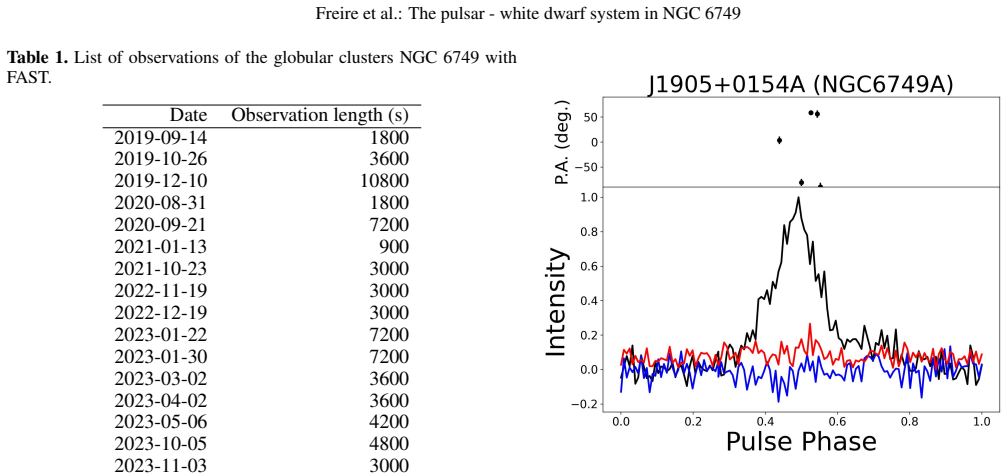
PSR J1905+0154A is a binary millisecond pulsar located in the globular cluster (GC) NGC 6749. It was discovered in 2004 in a search for pulsars in GCs carried out with the Arecibo 305-m radio telescope. The pulsar has a spin period of 3.2 ms, an orbital period of 0.81 days, and is in a low-eccentricity orbit with a low-mass WD companion. Combining early Arecibo and latter Five Hundred meter Aperture Spherical Telescope (FAST) data, we were able to derive a phase-coherent timing solution for this pulsar, which now spans 20 years. This includes a precise measurement of the astrometric, spin and orbital parameters of the system. The small range of predicted accelerations expected from the gravitational field of this GC allows an estimate of the intrinsic spin-down: the inferred magnetic field at the surface (2.2 - 2.4 * 10^8 G) and characteristic age (2.8 - 3.5 Gyr) are typical of what one finds among MSPs in the Galactic field. The position of this pulsar coincides with the position of one of the very few candidate white dwarfs (WDs) in the whole HST dataset on this GC. The position of the companion in the colour-magnitude diagram is consistent with a Helium WD with a mass of 0.17 - 0.19 M_sun, a cooling age of 0.4 - 0.7 Gyr, and a surface temperature of 11,600 - 14,800 K. A comparison with the characteristic age of the pulsar indicates that at the start of the WD cooling the latter had a spin period of ~2.7 ms. The velocity of the system relative to the GC, which is 4.5-sigma significant and an order of magnitude larger than the escape velocity, raises the possibility that, despite its location close to the centre of the GC, the pulsar might not be associated with it. Finally, our effort to confirm a second pulsar candidate in this GC did not yield a positive confirmation, nor the discovery of any additional pulsar in this GC.
Editorial analysis
A structured set of objections, weighed in public.
Referee Report
Summary. The manuscript reports a 20-year phase-coherent timing solution for the binary millisecond pulsar PSR J1905+0154A in NGC 6749, combining Arecibo and FAST observations. It derives precise astrometric, spin, and orbital parameters, estimates the intrinsic spin-down rate after correcting for the cluster gravitational acceleration (yielding B = 2.2–2.4 × 10^8 G and characteristic age 2.8–3.5 Gyr), and identifies a candidate helium white dwarf companion via positional coincidence with HST data whose CMD location implies mass 0.17–0.19 M⊙, cooling age 0.4–0.7 Gyr, and T_eff = 11,600–14,800 K. The paper explicitly notes a 4.5σ velocity offset relative to the cluster (an order of magnitude above escape velocity) that questions membership despite the central location.
Significance. If cluster membership holds, the work adds a well-timed MSP–He WD system to the sparse GC sample, with the long baseline enabling reliable parameter extraction and the WD cooling age providing an evolutionary cross-check. The use of standard timing and photometry methods is a strength, as is the explicit flagging of the velocity discrepancy. However, the membership uncertainty propagates directly into the intrinsic spin-down and distance-dependent WD parameters, limiting the robustness of the central claims.
major comments (2)
- [Abstract (velocity paragraph) and timing-results section] The acceleration correction that isolates the intrinsic period derivative (and thereby the quoted B-field and characteristic age) presupposes that the pulsar is bound within the cluster potential; the reported 4.5σ velocity offset directly violates this prerequisite and renders the allowed acceleration range unbounded. The manuscript must either (a) present the intrinsic parameters as conditional on membership with explicit bounds excluding the correction or (b) demonstrate that the offset is consistent with cluster membership after accounting for measurement uncertainties and cluster velocity dispersion.
- [WD identification and CMD analysis] The WD mass, cooling age, and temperature are derived by placing the candidate at the cluster distance in the CMD; the same velocity discrepancy converts the reported positional coincidence into a possible chance alignment. The probability of such an alignment within the HST field of NGC 6749 should be quantified, and the derived WD parameters should be presented with and without the cluster-distance assumption.
minor comments (2)
- [Title and Abstract] The title and abstract frame the object as 'the pulsar–white dwarf system in NGC 6749' without qualification, while the text raises membership doubts; revise phrasing to reflect the tentative association.
- [Timing and astrometric results] Clarify whether the 4.5σ velocity offset is derived solely from the timing proper motion or includes a radial-velocity component, and state the cluster systemic velocity and escape velocity values used for comparison.
Simulated Author's Rebuttal
We thank the referee for their careful and constructive review of our manuscript on PSR J1905+0154A. We address each major comment below and have made revisions to clarify the conditional nature of the results given the membership uncertainty.
read point-by-point responses
-
Referee: [Abstract (velocity paragraph) and timing-results section] The acceleration correction that isolates the intrinsic period derivative (and thereby the quoted B-field and characteristic age) presupposes that the pulsar is bound within the cluster potential; the reported 4.5σ velocity offset directly violates this prerequisite and renders the allowed acceleration range unbounded. The manuscript must either (a) present the intrinsic parameters as conditional on membership with explicit bounds excluding the correction or (b) demonstrate that the offset is consistent with cluster membership after accounting for measurement uncertainties and cluster velocity dispersion.
Authors: We agree that the 4.5σ velocity offset undermines the assumption of cluster membership required for the acceleration correction. The manuscript already highlights this discrepancy and questions the association with NGC 6749. We will revise the abstract and timing-results section to present the intrinsic spin-down rate, magnetic field, and characteristic age explicitly as conditional on membership. We will report both the corrected range (assuming cluster membership and using the expected acceleration bounds) and the observed values without correction, noting that if unbound the intrinsic parameters equal the observed ones. This implements option (a). We do not pursue option (b), as the offset is statistically significant and an order of magnitude above the escape velocity, rendering consistency with membership unlikely. revision: yes
-
Referee: [WD identification and CMD analysis] The WD mass, cooling age, and temperature are derived by placing the candidate at the cluster distance in the CMD; the same velocity discrepancy converts the reported positional coincidence into a possible chance alignment. The probability of such an alignment within the HST field of NGC 6749 should be quantified, and the derived WD parameters should be presented with and without the cluster-distance assumption.
Authors: We agree that the velocity offset raises the possibility of a chance alignment. We will quantify the probability by estimating the surface density of WD candidates in the HST field of NGC 6749 and the area corresponding to the positional coincidence. We will also present the WD mass, cooling age, and temperature assuming the cluster distance, and separately discuss the parameters if the system is not at the cluster distance (in which case absolute magnitude and derived quantities would differ and require additional assumptions). We will update the WD identification and CMD analysis section with these additions. revision: yes
Circularity Check
No significant circularity; direct timing and photometry with external cluster model
full rationale
The paper reports a 20-year phase-coherent timing solution yielding direct measurements of astrometric, spin, and orbital parameters. Intrinsic spin-down (and thus B-field and characteristic age) is obtained by subtracting a small, externally predicted line-of-sight acceleration range taken from the known gravitational potential of NGC 6749; this range is not fitted from the pulsar data itself. White-dwarf mass, cooling age, and temperature follow from HST photometry placed at the cluster distance, with the paper explicitly flagging the 4.5-sigma velocity offset as a possible challenge to membership. No equation or step defines a quantity in terms of itself, renames a fit as a prediction, or relies on a load-bearing self-citation chain. The derivation chain remains independent of its own outputs.
Axiom & Free-Parameter Ledger
axioms (2)
- standard math Standard pulsar timing model (spin, orbital, astrometric parameters) accurately describes the observed pulse times of arrival.
- domain assumption Helium white-dwarf cooling tracks and mass-radius relations from prior literature apply to the observed color-magnitude position.
Reference graph
Works this paper leans on
-
[1]
2018, MNRAS, 481, 627
Abbate, F., Possenti, A., Ridolfi, A., et al. 2018, MNRAS, 481, 627
2018
-
[2]
D., et al
Abbate, F., Ridolfi, A., Barr, E. D., et al. 2022, Monthly Notices of the Royal Astronomical Society, 513, 2292
2022
-
[3]
Abbate, F., Ridolfi, A., Freire, P. C. C., et al. 2023, A&A, 680, A47
2023
-
[4]
& Hilker, M
Baumgardt, H. & Hilker, M. 2018, MNRAS, 478, 1520
2018
-
[5]
R., et al
Bellini, A., Anderson, J., Bedin, L. R., et al. 2017, ApJ, 842, 6
2017
-
[6]
2024, A&A, 685, A158
Cadelano, M., Dalessandro, E., & Vesperini, E. 2024, A&A, 685, A158
2024
-
[7]
R., Istrate, A
Cadelano, M., Ferraro, F. R., Istrate, A. G., et al. 2019, ApJ, 875, 25
2019
-
[8]
2023, ApJ, 948, 84
Chen, J., Cadelano, M., Pallanca, C., et al. 2023, ApJ, 948, 84
2023
-
[9]
Cordes, J. M. & Lazio, T. J. W. 2002, arXiv e-prints, astro
2002
-
[10]
2024, ApJ, 972, 198
Corongiu, A., Ridolfi, A., Abbate, F., et al. 2024, ApJ, 972, 198
2024
-
[11]
2025, Research in Astronomy and Astrophysics, 25, 071001
Dai, Y ., Pan, Z., Qian, L., et al. 2025, Research in Astronomy and Astrophysics, 25, 071001
2025
-
[12]
& Deruelle, N
Damour, T. & Deruelle, N. 1986, Annales de L’Institut Henri Poincare Section (A) Physique Theorique, 44, 263 Article number, page 7 of 8 A&A proofs:manuscript no. clean
1986
-
[13]
2000, in Astronomical Society of the Pacific Conference Series, V ol
Dowd, A., Sisk, W., & Hagen, J. 2000, in Astronomical Society of the Pacific Conference Series, V ol. 202, IAU Colloq. 177: Pulsar Astronomy - 2000 and Beyond, ed. M. Kramer, N. Wex, & R. Wielebinski, 275–276
2000
-
[14]
Dutta, A., Freire, P. C. C., Gautam, T., et al. 2025, A&A, 697, A166
2025
-
[15]
2025, A&A, 704, A261
Ettorre, G., Dalessandro, E., Cadelano, M., et al. 2025, A&A, 704, A261
2025
-
[16]
Freire, P. C. C., Hessels, J. W. T., Nice, D. J., et al. 2005, ApJ, 621, 959
2005
-
[17]
Freire, P. C. C. & Ridolfi, A. 2018, MNRAS, 476, 4794
2018
-
[18]
Freire, P. C. C., Ridolfi, A., Kramer, M., et al. 2017, MNRAS, 471, 857
2017
-
[19]
Freire, P. C. C. & Wex, N. 2010, MNRAS, 409, 199 Gaia Collaboration, Vallenari, A., Brown, A. G. A., et al. 2023, A&A, 674, A1
2010
-
[20]
Harris, W. E. 1996, AJ, 112, 1487
1996
- [21]
-
[22]
Hessels, J. W. T., Ransom, S. M., Stairs, I. H., et al. 2006, Science, 311, 1901
2006
-
[23]
Hessels, J. W. T., Ransom, S. M., Stairs, I. H., Kaspi, V . M., & Freire, P. C. C. 2007, ApJ, 670, 363
2007
-
[24]
L., Pietrinferni, A., Cassisi, S., et al
Hidalgo, S. L., Pietrinferni, A., Cassisi, S., et al. 2018, ApJ, 856, 125
2018
-
[25]
G., Marchant, P., Tauris, T
Istrate, A. G., Marchant, P., Tauris, T. M., et al. 2016, A&A, 595, A35
2016
-
[26]
G., Tauris, T
Istrate, A. G., Tauris, T. M., Langer, N., & Antoniadis, J. 2014, A&A, 571, L3
2014
-
[27]
2015, ACS/WFC Revised Geometric Distortion for DrizzlePac, Instrument Science Report ACS/WFC 2015-06, 47 pages
Kozhurina-Platais, V ., Borncamp, D., Anderson, J., Grogin, N., & Hack, M. 2015, ACS/WFC Revised Geometric Distortion for DrizzlePac, Instrument Science Report ACS/WFC 2015-06, 47 pages
2015
-
[28]
2001, MNRAS, 326, 274
Lange, C., Camilo, F., Wex, N., et al. 2001, MNRAS, 326, 274
2001
-
[29]
2024, ApJ, 972, 43
Li, B., Zhang, L.-y., Yao, J., et al. 2024, ApJ, 972, 43
2024
-
[30]
2023, ApJ, 951, L37
Lian, Y ., Pan, Z., Zhang, H., et al. 2023, ApJ, 951, L37
2023
-
[31]
2022, ApJ, 934, 150
Libralato, M., Bellini, A., Vesperini, E., et al. 2022, ApJ, 934, 150
2022
-
[32]
S., Ransom, S
Lynch, R. S., Ransom, S. M., Freire, P. C. C., & Stairs, I. H. 2011, ApJ, 734, 89
2011
-
[33]
N., Hobbs, G
Manchester, R. N., Hobbs, G. B., Teoh, A., & Hobbs, M. 2005, AJ, 129, 1993
2005
-
[34]
2025, A&A, 698, A197
Massari, D., Bellazzini, M., Libralato, M., et al. 2025, A&A, 698, A197
2025
-
[35]
McMillan, P. J. 2017, MNRAS, 465, 76
2017
-
[36]
P., Piotto, G., Bedin, L
Milone, A. P., Piotto, G., Bedin, L. R., et al. 2012, A&A, 540, A16
2012
-
[37]
Ocker, S. K. & Cordes, J. M. 2026, arXiv e-prints, arXiv:2602.11838
work page internal anchor Pith review Pith/arXiv arXiv 2026
-
[38]
V ., Ransom, S
Padmanabh, P. V ., Ransom, S. M., Freire, P. C. C., et al. 2024, A&A, 686, A166
2024
-
[39]
2021, ApJ, 908, 102
Pietrinferni, A., Hidalgo, S., Cassisi, S., et al. 2021, ApJ, 908, 102
2021
-
[40]
J., Ransom, S
Prager, B. J., Ransom, S. M., Freire, P. C. C., et al. 2017, The Astrophysical Journal, 845, 148
2017
-
[41]
M., Hessels, J
Ransom, S. M., Hessels, J. W. T., Stairs, I. H., et al. 2005, Science, 307, 892
2005
-
[42]
Ridolfi, A., Freire, P. C. C., Gautam, T., et al. 2022, A&A, 664, A27
2022
-
[43]
2025, arXiv e-prints, arXiv:2512.01530
Rosignoli, L., Libralato, M., Pascale, R., et al. 2025, arXiv e-prints, arXiv:2512.01530
-
[44]
Shapiro, I. I. 1964, Phys. Rev. Lett., 13, 789
1964
-
[45]
Shklovskii, I. S. 1970, Soviet Ast., 13, 562
1970
-
[46]
2024, arXiv e-prints, arXiv:2412.11271
Singleton, J., DeCesar, M., Dai, S., et al. 2024, arXiv e-prints, arXiv:2412.11271
-
[47]
& Baumgardt, H
Vasiliev, E. & Baumgardt, H. 2021, MNRAS, 505, 5978
2021
-
[48]
& Freire, P
Verbunt, F. & Freire, P. C. C. 2014, A&A, 561, A11
2014
-
[49]
W., et al
Vleeschower, L., Corongiu, A., Stappers, B. W., et al. 2024, MNRAS, 530, 1436
2024
-
[50]
W., et al
Wang, L., Peng, B., Stappers, B. W., et al. 2020, ApJ, 892, 43
2020
-
[51]
2024, ApJ, 974, L23
Wu, Y ., Pan, Z., Qian, L., et al. 2024, ApJ, 974, L23
2024
-
[52]
M., Manchester, R
Yao, J. M., Manchester, R. N., & Wang, N. 2017, ApJ, 835, 29
2017
-
[53]
2025, ApJ, 991, 177
Yin, D., Wang, L., Zhang, L.-y., et al. 2025, ApJ, 991, 177
2025
-
[54]
2024, ApJ, 969, L7
Yin, D., Zhang, L.-y., Qian, L., et al. 2024, ApJ, 969, L7
2024
-
[55]
& Heinke, C
Zhao, J. & Heinke, C. O. 2022, MNRAS, 511, 5964
2022
-
[56]
2024, Science China Physics, Mechanics, and Astronomy, 67, 269512 Article number, page 8 of 8
Zhou, D., Wang, P., Li, D., et al. 2024, Science China Physics, Mechanics, and Astronomy, 67, 269512 Article number, page 8 of 8
2024
discussion (0)
Sign in with ORCID, Apple, or X to comment. Anyone can read and Pith papers without signing in.