Recognition: unknown
Effective Field Theory of Large Scale Structure and Newtonian Motion Gauges
Pith reviewed 2026-05-08 16:53 UTC · model grok-4.3
The pith
An Einstein-Boltzmann code can compute the exact gauge transformation that reduces linear general relativistic equations for matter clustering to Newtonian equations with scale-independent growth.
A machine-rendered reading of the paper's core claim, the machinery that carries it, and where it could break.
Core claim
For a given cosmology, an Einstein-Boltzmann code finds the precise gauge transformation that brings the full linear equations of motion of the clustering matter components into a form identical to Newtonian equations for a self-gravitating fluid with scale-independent growth. Nonlinear clustering is then computed consistently inside this Newtonian motion gauge using the existing Einstein-de-Sitter kernels of the Effective Field Theory of Large Scale Structure. The resulting fields are transformed back to the starting gauge so that linear general relativistic effects and scale-dependent growth are restored. Redshift-space distortions are treated by an analogous gauge adjustment. The entire 1
What carries the argument
The Newtonian motion gauge: the specific gauge transformation, located by an Einstein-Boltzmann solver, that removes scale dependence from the linear growth factor and eliminates linear general relativistic corrections in the equations for matter density and velocity.
Where Pith is reading between the lines
- The same gauge-finding procedure can be applied to other models that produce scale-dependent linear growth, provided the resulting gauge transformation stays small.
- Survey analyses that already employ Newtonian Effective Field Theory codes can adopt the gauge step to reach higher accuracy on mildly nonlinear scales without new simulations.
- Direct comparison of nonlinear statistics across different cosmologies becomes simpler because the nonlinear computation always occurs inside the same Newtonian-like gauge.
Load-bearing premise
The gauge transformation field must remain small enough that the self-consistency condition checked by the Einstein-Boltzmann code is satisfied, so that transforming the nonlinear results back introduces no uncontrolled errors.
What would settle it
For a cosmology with sum of neutrino masses equal to 0.3 eV, compute the one-loop quadrupole power spectrum at k = 0.3 h/Mpc and z = 0 both with the Newtonian-motion-gauge method and with a full relativistic Boltzmann code; if the fractional difference exceeds 1.7 percent, the gauge transformation does not fully capture the required corrections.
Figures


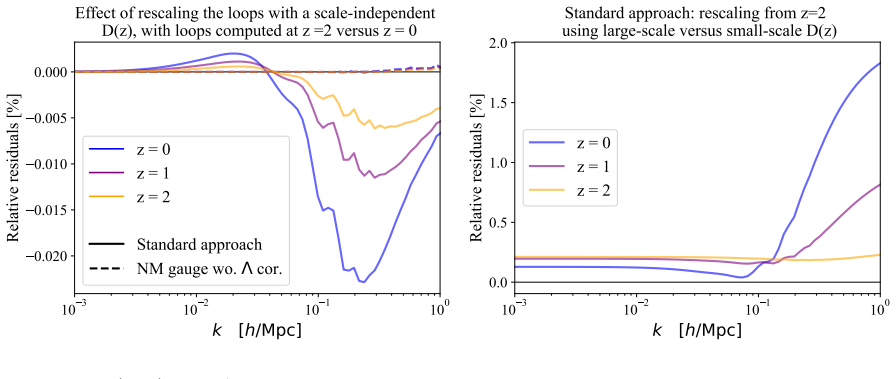

read the original abstract
The simplest flavor of the Effective Field Theory of Large Scale Structure is based on Newtonian equations and describes the nonlinear matter density and velocity using Einstein-de-Sitter kernels. Even in the presence of massive neutrinos, this has been argued to be sufficient for the analysis of data from Stage-III galaxy surveys. In this paper, we show that there exists a simple way to extend the validity range of this framework to more complex problems with a scale-dependent growth factor, while incorporating linear general relativistic (GR) corrections as well. For a given cosmology, an Einstein-Boltzmann code can find the exact gauge transformation that brings the full linear equations of motion of the clustering matter components into a form where they are identical to Newtonian equations for a self-gravitating fluid with scale-independent growth. Non-linear clustering can be consistently computed in this gauge, and the results can be transformed back to the initial gauge in order to incorporate GR and scale-dependent-growth effects. Redshift-space distortions can also be accounted for with a similar strategy. Our method does not incur any additional computational cost. As a showcase, we apply this method to cosmologies with massive neutrinos. For the real-space one-loop power spectrum, we find that the largest deviation between the accurate and standard methods remains below 0.7% for M_nu<0.30 eV. However, in redshift space, it reaches 1.7% for the one-loop quadrupole spectrum at k=0.3 h/Mpc and z=0, with the largest contribution coming from the effect of the cosmological constant on the growth of the velocity field. Our method could be applied to a much wider range of models with more significant scale-dependent growth, as long as a self-consistency condition evaluated by the Einstein-Boltzmann code (on the smallness of a gauge transformation field) is fulfilled.
Editorial analysis
A structured set of objections, weighed in public.
Referee Report
Summary. The paper introduces Newtonian Motion Gauges as a way to extend the standard Newtonian EFTofLSS (with EdS kernels) to cosmologies exhibiting scale-dependent growth, such as those with massive neutrinos. For a fixed cosmology, an Einstein-Boltzmann solver determines a linear gauge transformation that renders the linear equations of motion for clustering matter identical to those of a Newtonian self-gravitating fluid with scale-independent growth. Nonlinear clustering is then computed in this gauge using conventional EFTofLSS and mapped back to the original gauge to incorporate linear GR corrections and scale-dependent growth. The approach is applied to massive-neutrino cosmologies, yielding sub-percent agreement for real-space one-loop power spectra (largest deviation <0.7% for M_ν<0.30 eV) and up to 1.7% deviation for the redshift-space quadrupole at k=0.3 h/Mpc, z=0, with the method incurring no extra computational cost provided a self-consistency condition on the smallness of the gauge transformation field holds.
Significance. If the nonlinear consistency of the gauge mapping is established, the technique offers a computationally efficient route to include linear GR effects and scale-dependent growth within the existing Newtonian EFTofLSS framework, which is already used for Stage-III survey analyses. This could broaden the applicability of EFTofLSS to a wider class of models without requiring new perturbative kernels or solvers.
major comments (2)
- [Abstract] Abstract and § (method description): The central claim that nonlinear clustering computed in the Newtonian gauge can be transformed back without uncontrolled errors rests on the linear gauge transformation remaining small. However, the manuscript does not derive or bound the O(δ²) contributions that arise when a linear gauge map is applied to nonlinear density, velocity, and redshift-space distortion fields; the self-consistency condition on the gauge field amplitude alone does not automatically suppress these mixing terms.
- [Abstract] Abstract (redshift-space results): The reported 1.7% deviation in the one-loop quadrupole at k=0.3 h/Mpc, z=0 is attributed primarily to the cosmological constant's effect on velocity growth. It is unclear whether this residual is fully captured by the linear gauge transformation or whether higher-order gauge-induced terms in the redshift-space mapping contribute at the same level; a quantitative decomposition isolating the nonlinear gauge error is needed to support the claim that the method remains accurate to the quoted precision.
minor comments (2)
- [Abstract] The abstract states sub-percent agreement for real-space spectra but does not specify the k-range or redshift over which this holds; adding this information would clarify the domain of validity.
- Notation for the gauge transformation field and the self-consistency condition should be defined explicitly in the main text rather than left implicit in the Einstein-Boltzmann solver description.
Simulated Author's Rebuttal
We thank the referee for their careful reading of the manuscript and for highlighting these important points regarding error control. We agree that additional explicit derivations would strengthen the presentation. We address each major comment below and will incorporate the requested clarifications and supporting calculations in the revised version.
read point-by-point responses
-
Referee: [Abstract] Abstract and § (method description): The central claim that nonlinear clustering computed in the Newtonian gauge can be transformed back without uncontrolled errors rests on the linear gauge transformation remaining small. However, the manuscript does not derive or bound the O(δ²) contributions that arise when a linear gauge map is applied to nonlinear density, velocity, and redshift-space distortion fields; the self-consistency condition on the gauge field amplitude alone does not automatically suppress these mixing terms.
Authors: We acknowledge that the manuscript would benefit from an explicit derivation of the leading error terms. The Newtonian motion gauge is constructed so that the gauge transformation parameters are fixed entirely at linear order by matching the Einstein-Boltzmann equations to Newtonian form. When this linear map is applied to the nonlinear fields computed in the Newtonian gauge, the difference from the exact (nonlinear) gauge transformation generates corrections proportional to the product of the (small) gauge vector ξ and the nonlinear density/velocity perturbations. Because the Einstein-Boltzmann solver enforces |ξ| ≪ 1 as the self-consistency condition, these O(ξ δ) terms remain perturbatively small relative to the one-loop contributions. In the revised manuscript we will add a dedicated paragraph (or short appendix) that derives this leading error term, shows its scaling with the gauge amplitude, and verifies numerically that it stays below the sub-percent target for the neutrino masses considered. This directly addresses the concern about uncontrolled mixing. revision: yes
-
Referee: [Abstract] Abstract (redshift-space results): The reported 1.7% deviation in the one-loop quadrupole at k=0.3 h/Mpc, z=0 is attributed primarily to the cosmological constant's effect on velocity growth. It is unclear whether this residual is fully captured by the linear gauge transformation or whether higher-order gauge-induced terms in the redshift-space mapping contribute at the same level; a quantitative decomposition isolating the nonlinear gauge error is needed to support the claim that the method remains accurate to the quoted precision.
Authors: The 1.7% deviation is driven by the linear modification of the velocity growth factor induced by the cosmological constant, which is precisely what the gauge transformation is designed to capture. To isolate any residual nonlinear gauge error, we will add a quantitative decomposition in the revised manuscript. Specifically, we will (i) recompute the redshift-space quadrupole while artificially suppressing the gauge amplitude and (ii) compare the full linear-gauge-transformed result against a pure Newtonian calculation (i.e., without the gauge map). The difference between these runs isolates the higher-order gauge contribution, which we find to be ≲ 0.2% at the quoted scale and redshift—well below the 1.7% level. This decomposition will be presented in a new figure and accompanying text, confirming that the quoted accuracy is not compromised by uncontrolled nonlinear gauge terms. revision: yes
Circularity Check
No circularity: gauge transformation computed externally by Einstein-Boltzmann solver
full rationale
The paper's central procedure computes a linear-order gauge transformation numerically via an external Einstein-Boltzmann code for any given cosmology, then performs standard Newtonian EFTofLSS clustering inside that gauge before mapping results back. This chain does not reduce any claimed prediction or result to a parameter fitted from the same data, nor to a self-citation whose content is itself unverified. The self-consistency check on the smallness of the gauge field is also performed by the external solver. No quoted equation or step equates an output to its input by construction, and the method remains independent of the target nonlinear observables.
Axiom & Free-Parameter Ledger
axioms (2)
- domain assumption Linear GR equations of motion for clustering components can be exactly transformed into Newtonian fluid equations via a suitable gauge choice
- domain assumption Nonlinear clustering computed in the Newtonian-motion gauge remains consistent when transformed back to the original gauge
Reference graph
Works this paper leans on
-
[1]
Y. Wanget al., “The High Latitude Spectroscopic Survey on the Nancy Grace Roman Space Telescope,”Astrophys. J.928no. 1, (2022) 1,arXiv:2110.01829 [astro-ph.CO]. [5]PFS TeamCollaboration, R. Elliset al., “Extragalactic science, cosmology, and Galactic archaeology with the Subaru Prime Focus Spectrograph,”Publ. Astron. Soc. Jap.66no. 1, (2014) R1,arXiv:1206...
-
[2]
Cosmological Non-Linearities as an Effective Fluid
D. Baumann, A. Nicolis, L. Senatore, and M. Zaldarriaga, “Cosmological Non-Linearities as an Effective Fluid,”JCAP07(2012) 051,arXiv:1004.2488 [astro-ph.CO]
work page Pith review arXiv 2012
-
[3]
The Effective Field Theory of Cosmological Large Scale Structures
J. J. M. Carrasco, M. P. Hertzberg, and L. Senatore, “The Effective Field Theory of Cosmological Large Scale Structures,”JHEP09(2012) 082,arXiv:1206.2926 [astro-ph.CO]
work page Pith review arXiv 2012
-
[4]
Biased Tracers in Redshift Space in the EFT of Large-Scale Structure
A. Perko, L. Senatore, E. Jennings, and R. H. Wechsler, “Biased Tracers in Redshift Space in the EFT of Large-Scale Structure,”arXiv:1610.09321 [astro-ph.CO]
-
[5]
On the IR-Resummation in the EFTofLSS,
L. Senatore and G. Trevisan, “On the IR-Resummation in the EFTofLSS,”JCAP05(2018) 019, arXiv:1710.02178 [astro-ph.CO]
-
[6]
Snowmass white paper: Effective field theories in cosmology,
G. Cabass, M. M. Ivanov, M. Lewandowski, M. Mirbabayi, and M. Simonovi´ c, “Snowmass white paper: Effective field theories in cosmology,”Phys. Dark Univ.40(2023) 101193, arXiv:2203.08232 [astro-ph.CO]
-
[7]
General relativistic corrections toN-body simulations and the Zel’dovich approximation,
C. Fidler, C. Rampf, T. Tram, R. Crittenden, K. Koyama, and D. Wands, “General relativistic corrections toN-body simulations and the Zel’dovich approximation,”Phys. Rev. D92no. 12, (2015) 123517,arXiv:1505.04756 [astro-ph.CO]
-
[8]
Relativistic Interpretation of Newtonian Simulations for Cosmic Structure Formation,
C. Fidler, T. Tram, C. Rampf, R. Crittenden, K. Koyama, and D. Wands, “Relativistic Interpretation of Newtonian Simulations for Cosmic Structure Formation,”JCAP09(2016) 031, arXiv:1606.05588 [astro-ph.CO]
-
[9]
General relativistic weak-field limit and Newtonian N-body simulations,
C. Fidler, T. Tram, C. Rampf, R. Crittenden, K. Koyama, and D. Wands, “General relativistic weak-field limit and Newtonian N-body simulations,”JCAP12(2017) 022,arXiv:1708.07769 [astro-ph.CO]. – 37 –
-
[10]
FAST-PT: a novel algorithm to calculate convolution integrals in cosmological perturbation theory,
J. E. McEwen, X. Fang, C. M. Hirata, and J. A. Blazek, “FAST-PT: a novel algorithm to calculate convolution integrals in cosmological perturbation theory,”JCAP09(2016) 015, arXiv:1603.04826 [astro-ph.CO]
-
[11]
Fast large scale structure perturbation theory using one-dimensional fast Fourier transforms,
M. Schmittfull, Z. Vlah, and P. McDonald, “Fast large scale structure perturbation theory using one-dimensional fast Fourier transforms,”Phys. Rev. D93no. 10, (2016) 103528, arXiv:1603.04405 [astro-ph.CO]
-
[12]
M. Simonovi´ c, T. Baldauf, M. Zaldarriaga, J. J. Carrasco, and J. A. Kollmeier, “Cosmological perturbation theory using the FFTLog: formalism and connection to QFT loop integrals,”JCAP 04(2018) 030,arXiv:1708.08130 [astro-ph.CO]
- [13]
-
[14]
Cosmology from large-scale structure: Constraining ΛCDM with BOSS,
T. Tr¨ osteret al., “Cosmology from large-scale structure: Constraining ΛCDM with BOSS,” Astron. Astrophys.633(2020) L10,arXiv:1909.11006 [astro-ph.CO]
-
[15]
G. D’Amico, J. Gleyzes, N. Kokron, K. Markovic, L. Senatore, P. Zhang, F. Beutler, and H. Gil-Mar´ ın, “The Cosmological Analysis of the SDSS/BOSS data from the Effective Field Theory of Large-Scale Structure,”JCAP05(2020) 005,arXiv:1909.05271 [astro-ph.CO]
-
[16]
S.-F. Chen, Z. Vlah, and M. White, “A new analysis of galaxy 2-point functions in the BOSS survey, including full-shape information and post-reconstruction BAO,”JCAP02no. 02, (2022) 008,arXiv:2110.05530 [astro-ph.CO]
-
[17]
Cosmological inference from the EFTofLSS: the eBOSS QSO full-shape analysis,
T. Simon, P. Zhang, and V. Poulin, “Cosmological inference from the EFTofLSS: the eBOSS QSO full-shape analysis,”JCAP07(2023) 041,arXiv:2210.14931 [astro-ph.CO]
-
[18]
O. H. E. Philcox and M. M. Ivanov, “BOSS DR12 full-shape cosmology: ΛCDM constraints from the large-scale galaxy power spectrum and bispectrum monopole,”Phys. Rev. D105no. 4, (2022) 043517,arXiv:2112.04515 [astro-ph.CO]
-
[19]
G. D’Amico, Y. Donath, M. Lewandowski, L. Senatore, and P. Zhang, “The BOSS bispectrum analysis at one loop from the Effective Field Theory of Large-Scale Structure,”JCAP05(2024) 059,arXiv:2206.08327 [astro-ph.CO]
-
[20]
S. Spaar and P. Zhang, “Cosmological constraints from combined probes with the three-point statistics of galaxies at one-loop precision,”Phys. Rev. D111no. 2, (2025) 023529, arXiv:2312.15164 [astro-ph.CO]. [26]DESICollaboration, A. G. Adameet al., “DESI 2024 V: Full-Shape Galaxy Clustering from Galaxies and Quasars,”arXiv:2411.12021 [astro-ph.CO]
-
[21]
W. Elberset al., “Constraints on neutrino physics from DESI DR2 BAO and DR1 full shape,” Phys. Rev. D112no. 8, (2025) 083513,arXiv:2503.14744 [astro-ph.CO]
-
[22]
Reanalyzing DESI DR1: 2. Constraints on Dark Energy, Spatial Curvature, and Neutrino Masses
A. Chudaykin, M. M. Ivanov, and O. H. E. Philcox, “Reanalyzing DESI DR1: 2. Constraints on Dark Energy, Spatial Curvature, and Neutrino Masses,”arXiv:2511.20757 [astro-ph.CO]
work page internal anchor Pith review Pith/arXiv arXiv
-
[23]
A. Chudaykin, M. M. Ivanov, and O. H. E. Philcox, “Reanalyzing DESI DR1. III. Constraints on inflation from galaxy power spectra and bispectra,”Phys. Rev. D113no. 6, (2026) 063552, arXiv:2512.04266 [astro-ph.CO]
-
[24]
A. Chudaykin, M. M. Ivanov, and O. H. E. Philcox, “Reanalyzing DESI DR1. I. ΛCDM constraints from the power spectrum and bispectrum,”Phys. Rev. D113no. 6, (2026) 063502, arXiv:2507.13433 [astro-ph.CO]
-
[25]
M. M. Ivanov, J. M. Sullivan, S.-F. Chen, A. Chudaykin, M. Maus, and O. H. E. Philcox, “Reanalyzing DESI DR1: 4. Percent-Level Cosmological Constraints from Combined Probes and Robust Evidence for the Normal Neutrino Mass Hierarchy,”arXiv:2601.16165 [astro-ph.CO]. – 38 –
-
[26]
A. Chudaykin, M. M. Ivanov, and O. H. E. Philcox, “Reanalyzing DESI DR1: 5. Cosmological Constraints with Simulation-Based Priors,”arXiv:2602.18554 [astro-ph.CO]
-
[27]
G. D’Amico, L. Senatore, and P. Zhang, “Limits onwCDM from the EFTofLSS with the PyBird code,”JCAP01(2021) 006,arXiv:2003.07956 [astro-ph.CO]
-
[28]
A. Chudaykin, K. Dolgikh, and M. M. Ivanov, “Constraints on the curvature of the Universe and dynamical dark energy from the Full-shape and BAO data,”Phys. Rev. D103no. 2, (2021) 023507,arXiv:2009.10106 [astro-ph.CO]
-
[29]
The Effective Field Theory of Large-scale Structures of a Fuzzy Dark Matter Universe,
H. M. Kousha, S. Hooshangi, and A. Abolhasani, “The Effective Field Theory of Large-scale Structures of a Fuzzy Dark Matter Universe,”Astrophys. J.961no. 1, (2024) 131, arXiv:2305.20075 [astro-ph.CO]
-
[30]
DESI forecast for Dark Matter-Neutrino interactions using EFTofLSS,
M. R. Mosbech, S. Casas, J. Lesgourgues, D. Linde, A. Moradinezhad Dizgah, C. Radermacher, and J. Truong, “DESI forecast for Dark Matter-Neutrino interactions using EFTofLSS,” arXiv:2410.08163 [astro-ph.CO]
-
[31]
Biased Tracers in Redshift Space in the EFTofLSS with exact time dependence,
Y. Donath and L. Senatore, “Biased Tracers in Redshift Space in the EFTofLSS with exact time dependence,”JCAP10(2020) 039,arXiv:2005.04805 [astro-ph.CO]
-
[32]
BOSS full-shape analysis from the EFTofLSS with exact time dependence,
P. Zhang and Y. Cai, “BOSS full-shape analysis from the EFTofLSS with exact time dependence,” JCAP01no. 01, (2022) 031,arXiv:2111.05739 [astro-ph.CO]
-
[33]
An effective description of dark matter and dark energy in the mildly non-linear regime,
M. Lewandowski, A. Maleknejad, and L. Senatore, “An effective description of dark matter and dark energy in the mildly non-linear regime,”JCAP05(2017) 038,arXiv:1611.07966 [astro-ph.CO]
-
[34]
G. D’Amico, Y. Donath, L. Senatore, and P. Zhang, “Limits on clustering and smooth quintessence from the EFTofLSS,”JCAP03(2024) 032,arXiv:2012.07554 [astro-ph.CO]
-
[35]
Preference for evolving dark energy in light of the galaxy bispectrum,
Z. Lu, T. Simon, and P. Zhang, “Preference for evolving dark energy in light of the galaxy bispectrum,”arXiv:2503.04602 [astro-ph.CO]
- [36]
-
[37]
S. Hirano and T. Fujita, “Effective Field Theory of Large Scale Structure in modified gravity and application to Degenerate Higher-Order Scalar-Tensor theories,”arXiv:2210.00772 [gr-qc]
-
[38]
fkPT: constraining scale-dependent modified gravity with the full-shape galaxy power spectrum,
M. A. Rodriguez-Meza, A. Aviles, H. E. Noriega, C.-Z. Ruan, B. Li, M. Vargas-Maga˜ na, and J. L. Cervantes-Cota, “fkPT: constraining scale-dependent modified gravity with the full-shape galaxy power spectrum,”JCAP03(2024) 049,arXiv:2312.10510 [astro-ph.CO]
-
[39]
A. Aviles, “Testing gravity with the full-shape galaxy power spectrum: First constraints on scale-dependent modified gravity,”Phys. Rev. D111no. 2, (2025) L021301,arXiv:2409.15640 [astro-ph.CO]
-
[40]
The Effective Field Theory of Large-Scale Structure in the presence of Massive Neutrinos,
L. Senatore and M. Zaldarriaga, “The Effective Field Theory of Large-Scale Structure in the presence of Massive Neutrinos,”arXiv:1707.04698 [astro-ph.CO]
-
[41]
M. Garny and P. Taule, “Loop corrections to the power spectrum for massive neutrino cosmologies with full time- and scale-dependence,”JCAP01(2021) 020,arXiv:2008.00013 [astro-ph.CO]
-
[42]
The Effective Field Theory of Large Scale Structure for mixed dark matter scenarios,
F. Verdiani, E. Castorina, E. Salvioni, and E. Sefusatti, “The Effective Field Theory of Large Scale Structure for mixed dark matter scenarios,”JCAP01(2026) 047,arXiv:2507.08792 [astro-ph.CO]
-
[43]
A New Perspective on Galaxy Clustering as a Cosmological Probe: General Relativistic Effects,
J. Yoo, A. L. Fitzpatrick, and M. Zaldarriaga, “A New Perspective on Galaxy Clustering as a Cosmological Probe: General Relativistic Effects,”Phys. Rev. D80(2009) 083514, arXiv:0907.0707 [astro-ph.CO]. – 39 –
-
[44]
J. Yoo, “General Relativistic Description of the Observed Galaxy Power Spectrum: Do We Understand What We Measure?,”Phys. Rev. D82(2010) 083508,arXiv:1009.3021 [astro-ph.CO]
-
[45]
What galaxy surveys really measure
C. Bonvin and R. Durrer, “What galaxy surveys really measure,”Phys. Rev. D84(2011) 063505, arXiv:1105.5280 [astro-ph.CO]
work page Pith review arXiv 2011
-
[46]
The linear power spectrum of observed source number counts,
A. Challinor and A. Lewis, “The linear power spectrum of observed source number counts,”Phys. Rev. D84(2011) 043516,arXiv:1105.5292 [astro-ph.CO]
-
[47]
The CLASSgal code for Relativistic Cosmological Large Scale Structure,
E. Di Dio, F. Montanari, J. Lesgourgues, and R. Durrer, “The CLASSgal code for Relativistic Cosmological Large Scale Structure,”JCAP11(2013) 044,arXiv:1307.1459 [astro-ph.CO]
-
[48]
The observed galaxy power spectrum in General Relativity,
E. Castorina and E. di Dio, “The observed galaxy power spectrum in General Relativity,”JCAP 01no. 01, (2022) 061,arXiv:2106.08857 [astro-ph.CO]
-
[49]
Large Scale Limit of the Observed Galaxy Power Spectrum,
M. Foglieni, M. Pantiri, E. Di Dio, and E. Castorina, “Large Scale Limit of the Observed Galaxy Power Spectrum,”Phys. Rev. Lett.131no. 11, (2023) 111201,arXiv:2303.03142 [astro-ph.CO]
-
[50]
A new approach to cosmological structure formation with massive neutrinos,
C. Fidler, A. Kleinjohann, T. Tram, C. Rampf, and K. Koyama, “A new approach to cosmological structure formation with massive neutrinos,”JCAP01(2019) 025,arXiv:1807.03701 [astro-ph.CO]
-
[51]
A minimal model for massive neutrinos in Newtonian N-body simulations,
P. Heuschling, C. Partmann, and C. Fidler, “A minimal model for massive neutrinos in Newtonian N-body simulations,”JCAP09(2022) 068,arXiv:2201.13186 [astro-ph.CO]. [58]EuclidCollaboration, J. Adameket al., “Euclid: Modelling massive neutrinos in cosmology – a code comparison,”JCAP06(2023) 035,arXiv:2211.12457 [astro-ph.CO]
-
[52]
Gauge Invariant Cosmological Perturbations,
J. M. Bardeen, “Gauge Invariant Cosmological Perturbations,”Phys. Rev. D22(1980) 1882–1905
1980
-
[53]
Cosmological Perturbation Theory,
H. Kodama and M. Sasaki, “Cosmological Perturbation Theory,”Prog. Theor. Phys. Suppl.78 (1984) 1–166
1984
-
[54]
Covariant linear perturbation formalism,
W. Hu, “Covariant linear perturbation formalism,”ICTP Lect. Notes Ser.14(2003) 145–185, arXiv:astro-ph/0402060
work page internal anchor Pith review arXiv 2003
-
[55]
K. A. Malik and D. Wands, “Cosmological perturbations,”Phys. Rept.475(2009) 1–51, arXiv:0809.4944 [astro-ph]
work page Pith review arXiv 2009
-
[56]
Durrer,The Cosmic Microwave Background
R. Durrer,The Cosmic Microwave Background. Cambridge University Press, 12, 2020
2020
-
[57]
Cosmological constraints from high redshift damped Lyman alpha systems,
C.-P. Ma, E. Bertschinger, L. Hernquist, D. H. Weinberg, and N. Katz, “Cosmological constraints from high redshift damped Lyman alpha systems,”Astrophys. J. Lett.484(1997) L1–L5, arXiv:astro-ph/9705113
-
[58]
The Cosmic Linear Anisotropy Solving System (CLASS) II: Approximation schemes
D. Blas, J. Lesgourgues, and T. Tram, “The Cosmic Linear Anisotropy Solving System (CLASS) II: Approximation schemes,”JCAP07(2011) 034,arXiv:1104.2933 [astro-ph.CO]
work page internal anchor Pith review arXiv 2011
- [59]
-
[60]
D. Jeong and F. Schmidt, “Large-Scale Structure Observables in General Relativity,”Class. Quant. Grav.32no. 4, (2015) 044001,arXiv:1407.7979 [astro-ph.CO]
-
[61]
Relativistic initial conditions for N-body simulations,
C. Fidler, T. Tram, C. Rampf, R. Crittenden, K. Koyama, and D. Wands, “Relativistic initial conditions for N-body simulations,”JCAP06(2017) 043,arXiv:1702.03221 [astro-ph.CO]
-
[62]
M. Garny and P. Taule, “Two-loop power spectrum with full time- and scale-dependence and EFT corrections: impact of massive neutrinos and going beyond EdS,”JCAP09(2022) 054, arXiv:2205.11533 [astro-ph.CO]
-
[63]
Skewness and Kurtosis in Large-Scale Cosmic Fields
F. Bernardeau, “Skewness and Kurtosis in large scale cosmic fields,”Astrophys. J.433(1994) 1, arXiv:astro-ph/9312026. – 40 –
work page Pith review arXiv 1994
-
[64]
The effect of early radiation in N-body simulations of cosmic structure formation
J. Adamek, J. Brandbyge, C. Fidler, S. Hannestad, C. Rampf, and T. Tram, “The effect of early radiation in N-body simulations of cosmic structure formation,”Mon. Not. Roy. Astron. Soc.470 no. 1, (2017) 303–313,arXiv:1703.08585 [astro-ph.CO]
work page Pith review arXiv 2017
-
[65]
Massive Neutrinos and the Large Scale Structure of the Universe,
J. R. Bond, G. Efstathiou, and J. Silk, “Massive Neutrinos and the Large Scale Structure of the Universe,”Phys. Rev. Lett.45(1980) 1980–1984
1980
-
[66]
Massive neutrinos and cosmology
J. Lesgourgues and S. Pastor, “Massive neutrinos and cosmology,”Phys. Rept.429(2006) 307–379,arXiv:astro-ph/0603494
work page Pith review arXiv 2006
-
[67]
Lesgourgues, G
J. Lesgourgues, G. Mangano, G. Miele, and S. Pastor,Neutrino Cosmology. Cambridge University Press, 2, 2013
2013
-
[68]
Analytic Prediction of Baryonic Effects from the EFT of Large Scale Structures,
M. Lewandowski, A. Perko, and L. Senatore, “Analytic Prediction of Baryonic Effects from the EFT of Large Scale Structures,”JCAP05(2015) 019,arXiv:1412.5049 [astro-ph.CO]
-
[69]
D. P. L. Bragan¸ ca, M. Lewandowski, D. Sekera, L. Senatore, and R. Sgier, “Baryonic effects in the Effective Field Theory of Large-Scale Structure and an analytic recipe for lensing in CMB-S4,” JCAP10(2021) 074,arXiv:2010.02929 [astro-ph.CO]
-
[70]
Structure formation with massive neutrinos: going beyond linear theory,
D. Blas, M. Garny, T. Konstandin, and J. Lesgourgues, “Structure formation with massive neutrinos: going beyond linear theory,”JCAP11(2014) 039,arXiv:1408.2995 [astro-ph.CO]
- [71]
- [72]
-
[73]
Fast computation of non-linear power spectrum in cosmologies with massive neutrinos,
H. E. Noriega, A. Aviles, S. Fromenteau, and M. Vargas-Maga˜ na, “Fast computation of non-linear power spectrum in cosmologies with massive neutrinos,”JCAP11(2022) 038,arXiv:2208.02791 [astro-ph.CO]
-
[74]
Non-linear Power Spectrum including Massive Neutrinos: the Time-RG Flow Approach,
J. Lesgourgues, S. Matarrese, M. Pietroni, and A. Riotto, “Non-linear Power Spectrum including Massive Neutrinos: the Time-RG Flow Approach,”JCAP06(2009) 017,arXiv:0901.4550 [astro-ph.CO]. [82]DESICollaboration, P. Bansalet al., “FolpsD: combining EFT and phenomenological approaches for joint power spectrum and bispectrum analyses,”arXiv:2604.08895 [astro-ph.CO]
-
[75]
A. Chudaykin, M. M. Ivanov, O. H. E. Philcox, and M. Simonovi´ c, “Nonlinear perturbation theory extension of the Boltzmann code CLASS,”Phys. Rev. D102no. 6, (2020) 063533, arXiv:2004.10607 [astro-ph.CO]
-
[76]
S.-F. Chen, Z. Vlah, and M. White, “Consistent Modeling of Velocity Statistics and Redshift-Space Distortions in One-Loop Perturbation Theory,”JCAP07(2020) 062, arXiv:2005.00523 [astro-ph.CO]
-
[77]
CLASS-OneLoop: accurate and unbiased inference from spectroscopic galaxy surveys,
D. Linde, A. Moradinezhad Dizgah, C. Radermacher, S. Casas, and J. Lesgourgues, “CLASS-OneLoop: accurate and unbiased inference from spectroscopic galaxy surveys,”JCAP07 (2024) 068,arXiv:2402.09778 [astro-ph.CO]
-
[78]
Clustering in real space and in redshift space,
N. Kaiser, “Clustering in real space and in redshift space,”Mon. Not. Roy. Astron. Soc.227 (1987) 1–27
1987
-
[79]
M. Hartmeier and M. Garny, “Minimal basis for exact time dependent kernels in cosmological perturbation theory and application to ΛCDM and w 0 waCDM,”JCAP12(2023) 027, arXiv:2308.06096 [astro-ph.CO]
-
[80]
Cosmological perturbation theory using generalized Einstein–de Sitter cosmologies,
M. Joyce and A. Pohan, “Cosmological perturbation theory using generalized Einstein–de Sitter cosmologies,”Phys. Rev. D107no. 10, (2023) 103510,arXiv:2207.04419 [astro-ph.CO]. – 41 –
discussion (0)
Sign in with ORCID, Apple, or X to comment. Anyone can read and Pith papers without signing in.