Numerical study of the 2D Kaup-Broer-Kuperschmidt Boussinesq system
Pith reviewed 2026-05-08 16:16 UTC · model grok-4.3
The pith
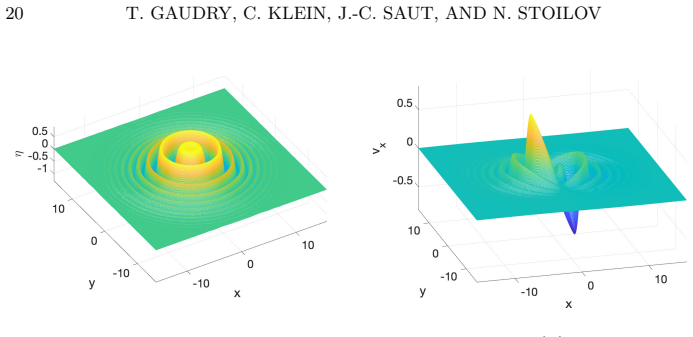
Numerical simulations indicate that soliton solutions to the 2D Kaup-Broer-Kuperschmidt Boussinesq system are unstable.
A machine-rendered reading of the paper's core claim, the machinery that carries it, and where it could break.
Core claim
The authors numerically construct soliton type solutions for the well-posed version of the Kaup-Broer-Kuperschmidt system in two dimensions and demonstrate that they are unstable both against dispersion and singularity formation. They further examine line solitons and their stability together with generally localised initial data. In every case examined the simulations produce no stable structures.
What carries the argument
Numerical construction of soliton-type profiles followed by direct time integration to monitor evolution toward dispersion or blow-up.
If this is right
- The two-dimensional system lacks the stable localized traveling waves known to exist in its one-dimensional counterpart.
- Line solitons, which might appear more robust, also destabilize under the same dynamics.
- Generic localized initial conditions evolve into either spreading waves or singular profiles rather than coherent structures.
- Physical models based on this equation in two dimensions cannot rely on soliton stability for long-term wave propagation.
Where Pith is reading between the lines
- The observed instabilities may stem from the absence of certain conserved quantities that stabilize one-dimensional solitons.
- Similar numerical searches in other two-dimensional Boussinesq-type systems could reveal whether the lack of stable structures is generic.
- Adding small dissipative terms or periodic forcing might allow stable structures to form and could be tested numerically.
Load-bearing premise
The chosen discretization and time-stepping scheme faithfully reproduce the continuous system's behavior without creating false instabilities.
What would settle it
A single simulation run at substantially higher resolution or with an independent numerical scheme that produces a persistent, non-dispersing, non-singular soliton would contradict the reported findings.
Figures


read the original abstract
In this work we consider the well posed version of the Kaup-Broer-Kuperschmidt system in two dimensions. We numerically construct soliton type solutions and show that they are unstable both against dispersion and singularity formation. Further, we study line solitons and their stability, as well as generally localised initial data. In either case we fail to find stable structures.
Editorial analysis
A structured set of objections, weighed in public.
Referee Report
Summary. The paper presents a numerical investigation of the two-dimensional well-posed Kaup-Broer-Kuperschmidt Boussinesq system. It constructs soliton-type solutions and reports that they are unstable to both dispersion and singularity formation. The study further examines the stability of line solitons and the evolution of general localized initial data, concluding in all cases that no stable structures are observed.
Significance. If the numerical observations hold, the work supplies evidence that the 2D KBK system supports no stable soliton-like or localized solutions. This negative result would be relevant to the long-time dynamics and well-posedness theory of this dispersive system, potentially informing future analytical studies of blow-up or dispersive decay.
major comments (3)
- [§3] §3 (Numerical methods): No conservation checks (discrete mass or energy drift), grid-convergence studies, or comparisons against analytically known stable regimes of the 1D reduction are reported. Without these, the observed dispersion and singularity formation cannot be unambiguously attributed to the continuous PDE rather than truncation or artificial viscosity, directly weakening the central claim that stable structures are absent.
- [§4] §4 (Soliton-type solutions): The construction and time evolution of soliton-type solutions lack quantitative diagnostics such as instability growth rates, resolution dependence of the observed blow-up, or error bounds on the initial profile. This makes it impossible to confirm that the reported instability is not an artifact of the chosen discretization.
- [§5] §5 (Line solitons and localized data): The experiments on line solitons and general localized initial data similarly omit details on the time intervals examined, the criteria used to detect singularity formation, and any mesh-refinement tests. These omissions are load-bearing for the conclusion that no stable structures exist.
minor comments (2)
- [Abstract] The abstract and introduction could briefly state the spatial and temporal discretization orders employed, for immediate context.
- [Introduction] Notation for the 2D system variables and the precise form of the well-posed version should be cross-referenced to the 1D KBK literature to aid readers.
Simulated Author's Rebuttal
We thank the referee for the careful reading of our manuscript and the constructive comments on the numerical aspects of our study of the 2D Kaup-Broer-Kuperschmidt Boussinesq system. We address each major comment below and will incorporate revisions to provide the requested validation and diagnostics.
read point-by-point responses
-
Referee: [§3] §3 (Numerical methods): No conservation checks (discrete mass or energy drift), grid-convergence studies, or comparisons against analytically known stable regimes of the 1D reduction are reported. Without these, the observed dispersion and singularity formation cannot be unambiguously attributed to the continuous PDE rather than truncation or artificial viscosity, directly weakening the central claim that stable structures are absent.
Authors: We agree that these elements strengthen the numerical evidence. In the revised version we will add a dedicated subsection on numerical validation. This will include time histories of the discrete mass and energy showing relative drifts below 0.5 % over the full simulation intervals, together with grid-convergence tests (doubling the resolution in each direction) for representative soliton-type and localized initial data. We will also include a direct comparison with the 1D reduction, where the known stable line solitons are recovered to machine precision, thereby confirming that the 2D instabilities are not produced by the discretization. These additions will make clear that the reported dispersion and singularity formation are properties of the continuous system. revision: yes
-
Referee: [§4] §4 (Soliton-type solutions): The construction and time evolution of soliton-type solutions lack quantitative diagnostics such as instability growth rates, resolution dependence of the observed blow-up, or error bounds on the initial profile. This makes it impossible to confirm that the reported instability is not an artifact of the chosen discretization.
Authors: We will augment §4 with the requested quantitative information. The initial profiles are obtained by solving the traveling-wave ODE to a tolerance of 10^{-10}; we will report the resulting L^2 and L^∞ residuals. For the time evolution we will plot the growth of the maximum amplitude and the L^2 norm of the perturbation for three successively refined grids, demonstrating that the exponential growth rate converges and that blow-up occurs at essentially the same time independent of resolution. These diagnostics will be added to the revised manuscript. revision: yes
-
Referee: [§5] §5 (Line solitons and localized data): The experiments on line solitons and general localized initial data similarly omit details on the time intervals examined, the criteria used to detect singularity formation, and any mesh-refinement tests. These omissions are load-bearing for the conclusion that no stable structures exist.
Authors: We accept that these details are essential. The revised §5 will state that all runs are performed up to t = 20 or until the L^∞ norm exceeds 100 times its initial value (our operational criterion for singularity formation), whichever occurs first. We will also present mesh-refinement studies for both the line-soliton and localized-data cases, showing that the absence of stable structures persists under refinement. These clarifications will be inserted into the text and figure captions. revision: yes
Circularity Check
No circularity: direct numerical experiments without derivations or fitted predictions
full rationale
The paper reports numerical constructions of soliton-type solutions, line solitons, and evolution of localized data for the 2D Kaup-Broer-Kuperschmidt system, concluding that no stable structures are found. No analytical derivations, parameter fittings presented as predictions, self-citations used as load-bearing uniqueness theorems, or ansatzes smuggled via prior work appear in the central claims. All results follow from direct simulation outputs under chosen discretizations, rendering the work self-contained with no reduction of outputs to inputs by construction.
Axiom & Free-Parameter Ledger
Reference graph
Works this paper leans on
-
[1]
T. Akhunov, D.A. Ambrose and J.D. Wright , Well-posedness of fully nonlinear KdV-type equations , Nonlinearity 32 (2019), 2914-2954
work page 2019
-
[2]
D.M. Ambrose, J.L. Bona and T. Milgram , Global solutions and ill-posedness for the Kaup system and related systems , Indiana Math. J. 68 (4) (2019), 1173-1198
work page 2019
-
[3]
Amick , Regularity and uniqueness of solutions for the Boussinesq system of equations , J
C.J. Amick , Regularity and uniqueness of solutions for the Boussinesq system of equations , J. Differential Eq. 54 (1) (1984), 231-247
work page 1984
-
[4]
Angulo Pava , On the Cauchy problem for a Boussinesq-type system , Adv
J. Angulo Pava , On the Cauchy problem for a Boussinesq-type system , Adv. Diff. Eq. 4 (1999), 457-492
work page 1999
-
[5]
C.N. Babalic and A.S. Carstea , Bilinear approach to Kupershmidt super-KdV type equations , J. Physics A: Mathematical and Theoretical 51 (2018), 225204
work page 2018
-
[6]
A. Barros , Local well-posedness for the super-Korteweg-de Vries equation , Nonlinear Analysis 68 (2008), 1581-1584
work page 2008
- [7]
-
[8]
H. Berestycki and P.-L. Lions , Nonlinear scalar field equation I , Arch. Rat. Mech.Anal. 32 (1983), 313-346
work page 1983
- [9]
-
[10]
J. L. Bona, T. Colin and D. Lannes , Long-wave approximation for water waves ,
-
[11]
J. L. Bona, M. Chen and J.-C. Saut , Boussinesq equations and
-
[12]
J. L. Bona, M. Chen and J.-C. Saut ,
-
[13]
J. Boussinesq , Th\' eorie des ondes et des remous qui se propagent le long d'un canal rectangulaire horizontal, en communicant au liquide contenu dans ce canal des vitesses sensiblement pareilles de la surface au fond , J. Math. Pures Appl. 7 (2) (1872), 55-108
-
[14]
Broer , Approximate equations for long water waves , Appl
L.J.F. Broer , Approximate equations for long water waves , Appl. Sci. Res. 31 (1975), 377-395
work page 1975
-
[15]
L.J.F. Broer, E.W.C. Van Groesen and J.M.W. Timmers , Stable model equations for long water waves , Appl. Sci. Res. 32 (1976), 619-636
work page 1976
-
[16]
Burtea , New long time existence results for a class of Boussinesq-type systems , J
C. Burtea , New long time existence results for a class of Boussinesq-type systems , J. Math. Pures Appl. 106 (2) (2016), 203-236
work page 2016
-
[17]
R. Camassa, G. Falqui, G. Ortenzi, P. Pedroni and T.T. Vu Ho , Simple two-layer dispersive models in the Hamiltonian reduction formalism , Nonlinearity 36 (2023), 4523-4552
work page 2023
-
[18]
Burtea , Long time existence results for bore-type initial data for BBM-Boussinesq systems , .J
C. Burtea , Long time existence results for bore-type initial data for BBM-Boussinesq systems , .J. Diff. Equations 261 (2016), 4825-4860
work page 2016
- [19]
- [20]
-
[21]
Min Chen , Solitary-wave and multi-pulsed traveling-wave solutions of Boussinesq systems , Appl. Anal. 75 (1-2) (2000), 213-240
work page 2000
-
[22]
P.A. Clarkson , Rational solutions of thye classical Boussinesq system , Nonlinear Analysis : Real World applications, 10 (2009), 3360-3371
work page 2009
-
[23]
T. Colin and M.I. Weinstein , On the ground states of vector nonlinear Schr\" o dinger equations , Annales de ll'I.H.P. section A, 65 (1) (1996), 57-79
work page 1996
-
[24]
T. Congy, S.K. Ivanov, A.M. Kamchatnov and N. Pavloff , Evolution of initial discontinuities in the Riemann problem for the Kaup-Boussinesq equation with positive dispersion , Chaos 27 (8) (2017), 083107
work page 2017
- [25]
- [26]
-
[27]
O. Darrigol , Worlds of flow. A history of hydrodynamics from the Bernoullis to Prandtl , Oxford University Press 2005
work page 2005
-
[28]
O. Darrigol , The Spirited Horse, the Engineer, and the Mathematician : Water Waves in Nineteenth -Century Hydrodynamics , Arch. Hist. Exact Sci. 58 (2003), 21-95
work page 2003
-
[29]
Darrigol , Joseph Boussinesq's legacy in fluid mechanics , C.R
O. Darrigol , Joseph Boussinesq's legacy in fluid mechanics , C.R. Mechanics 345 (2017), 427-445
work page 2017
-
[30]
Dingemans , Water wave propagation over uneven bottoms
M.W. Dingemans , Water wave propagation over uneven bottoms. Part 2- Non-linear Wave Propagation , Advances Series on Ocean Engineering-Volume 13. World Scientific, (2000)
work page 2000
-
[31]
i , Remarks on the Cauchy problem for Schr\
S.I. Do\" i , Remarks on the Cauchy problem for Schr\" o dinger-type equations , Comm. Partial Diff. Eq. 21 (1996), 163-178
work page 1996
- [32]
-
[33]
Nonliner Science 23 (2013), 527-555
Xianguo Geng, Lihua Wu and Guoliang He , Quasi-periodic solutions of the Kaup-Kuppershmidt hierarchy , J. Nonliner Science 23 (2013), 527-555
work page 2013
-
[34]
V.A. Dougalis, A. Duran and L. Saridaki , On solitary-wave solutions of Boussinesq/Boussinesq systems for internal waves , Physica D (2021)
work page 2021
-
[35]
G.A.El, R.H.J. Grimshaw and M.V. Pavlov , Integrable shallow-water equations and undular bores , Studies in Appl. Math. 106 (2001), 157-186
work page 2001
-
[36]
M. Grillakis, J. Shatah and W.A. Strauss , Stability theory of solitary waves in the presence of symmetry. I , J. Funct.Anal. 74 (1987), 160-197
work page 1987
-
[37]
M.D. Groves , Hamiltonian long-wave approximations for water waves in a uniform channel , in Nonlinear Dispersive Wave Systems, Lokenath Debnath Ed. World Scientific (1992), 99-125
work page 1992
-
[38]
Junqi Hu , Global well-posedness of the BCL system with viscosity , Chin. App. Math. Ser. B 30 (2) (2009), 153-172
work page 2009
-
[39]
R. Hirota , Solutions of the classical Boussinesq equations and the sperical Boussinesq equation: the wronskian technique , J. Phys. Soc. japna 55 (1985), 2137-2150
work page 1985
- [40]
-
[41]
M. Ito , Symmetries and conservation laws of the classical Boussinesq equation , Physics Letters 104 A (1984), 248-250
work page 1984
-
[42]
A.M. Kamchatnov, R.A. Kraenkel and B.A. Umarov , Asymptotic soliton train solutions of Kaup-Bousinesq equations , Wave Motion 38 (203), 355-365
-
[43]
D.J.Kaup , On the inverse scattering problem for cubic eigenvalue problems of the class _ xxx +6q _x+6r = . , Stud. Appl. Math. 62 (1980), 189-216
work page 1980
-
[44]
Kaup , A higher-order water-wave equation and the method for solving it , Progr
D.J. Kaup , A higher-order water-wave equation and the method for solving it , Progr. Theoret. Phys. 54 (1975), 396-408
work page 1975
-
[45]
N. Kita and J. Segata , Well-posedness for the Boussinesq-type system related to the water wave , Funkcial. Ekvac. 47 (2004), 329-350
work page 2004
-
[46]
Klein and J.-C.Saut , Numerical study of the Amick-Schonbek system , arXiv: 2311.17517v1 29 Nov 2023
C. Klein and J.-C.Saut , Numerical study of the Amick-Schonbek system , arXiv: 2311.17517v1 29 Nov 2023
- [47]
- [48]
-
[49]
Klein , Fourth order time-stepping for low dispersion Korteweg-de
C. Klein , Fourth order time-stepping for low dispersion Korteweg-de
-
[50]
C. Klein and K. Roidot , Numerical study of shock formation in the dispersionless
-
[51]
C. Klein and J.-C. Saut , A numerical approach to blow-up issues for dispersive perturbations of Burgers' equation, Phys. D. 295–296 (2015), 46-65
work page 2015
- [52]
-
[53]
B.A. Kupershmidt , Mathematics of dispersive water waves , Communications in Mathematical Physics 99 (1985), 51-73
work page 1985
-
[54]
Kupershmidt , A super Korteweg-de Vrie sequation: an integrable system , Phys
B.A. Kupershmidt , A super Korteweg-de Vrie sequation: an integrable system , Phys. Lett; A 102 (1984), 213-215
work page 1984
-
[55]
C. Kwak, C. Munoz, F. Poblete and J.C. Pozo , The scattering problem for Hamiltonian ABCD Boussinesq systems in the energy space , J. Math. Pures et Appl. 127 121-159, (2019)
work page 2019
-
[56]
C. Kwak and C. Munoz , Asymptotic dynamics for the small data weakly dispersive one-dimensional Hamiltonian abcd systems , Trans. Am; Math. Soc. 373 (12) 1043-1107, (2019)
work page 2019
-
[57]
D. Lannes , Water waves : mathematical theory and asymptotics , Mathematical Surveys and Monographs, vol 188 (2013), AMS, Providence
work page 2013
-
[58]
F. Linares, G. Ponce and D.L. Smith , On the regularity of solutions to a class of nonlinear dispersive equations . Math. Ann. 369 (1-2) (2017), 797-837
work page 2017
-
[59]
V.B. Matveev and M.I. Yavor , Solutions presque p\' eriodiques et \`a N-solitons de l'\' equation hydrodynamique non lin\' eaire de Kaup , Ann. Inst Henri Poincar\' e 31 (1) (1979), 25-41
work page 1979
-
[60]
B. Melinand , Dispersion estimates for non-homogeneous radial phases : an application to weakly dispersive equations and water waves models , J. Funct. Analysis 286 (1) (2024), 110204
work page 2024
-
[61]
M. Ming, J.-C. Saut and P. Zhang , Long time existence of solutions to Boussinesq systems , SIAM. J. Math. Anal. 44 (6) (2012), 4078--4100
work page 2012
-
[62]
R. Peres de Moura and A. Pastor , On the Cauchy problem for the super Korteweg- de Vries system , Nonlinear Analysis 76 (2013), 229-243
work page 2013
-
[63]
P. Nabelek , On solutions to the nonlocal - problem and (2+1) dimensional completely integrable systems , Letters in Mathematical Physics 16 (2021), article 16
work page 2021
-
[64]
P.V. Nabelek, A. Arlen and T. Fromcke , On periodic and finite genus solutions to the integrable Kaup-Broer system for capillary waves , Applied Numerical Mathematics (2023)
work page 2023
-
[65]
P.V. Nabelek and V.E. Zakharov , Solutions to the Kaup-Broer system and its (2+1) dimensional integrable generalization via a dressing method , Physica D 409 (2020), 132478
work page 2020
-
[66]
A. Nakamura and R. Hirota , A new example of explode-decay solitary wave , J. Phys. Soc. japan 54 (1985), 491-499
work page 1985
-
[67]
Peregrine , Long waves on a beach , J
D.H. Peregrine , Long waves on a beach , J. Fluid Mech. 27 (1967), 815-827
work page 1967
- [68]
-
[69]
C. Rogers and O. Pashaev , On a 2+1 dimensional Whitham-Broer-Kaup system: A resonant NLS connection , Stud. Appl. Math. 127 (2) (2011), 141-52
work page 2011
-
[70]
R.A. Sachs , On the integrable version of the Boussinesq system: Painlev\' e property, rational solutions, a related many-body system, and equivalence with the AKNS hierarchy , Physica D 30D (1988), 1-27
work page 1988
-
[71]
J. C. Saut, Chao Wang and Li Xu , The Cauchy problem on large time for surface waves Boussinesq systems II, SIAM Journal on Mathematical Analysis, 49 (4) (2017), 2321--2386
work page 2017
-
[72]
Saut and Li Xu , The Cauchy problem on large time for surface waves Boussinesq systems , J
J.-C. Saut and Li Xu , The Cauchy problem on large time for surface waves Boussinesq systems , J. Math.Pures Appl. 97 (2012), 635--662
work page 2012
- [73]
-
[74]
C.Valls , Stability of some waves in the Boussinesq system , Communications in Pure and Applied Analysis 5 (4), 929-939
-
[75]
Rudong Zheng, Boling Guo and Yamin Xiao , Asymptotic stability of solitary waves for the Kaup-Boussinesq system , J. Math. Phys. 67 (2026), 031509
work page 2026
-
[76]
Phys.A: Math.Theor 55 (2022), 225207
Hanyu Zhou, Kai Tian and Nianhua Li , Four super integrable equations : nonlocal symmetries and applications ,J. Phys.A: Math.Theor 55 (2022), 225207
work page 2022
-
[77]
Junyi Zhu and Xueru Wang , Broer-Kaup system revisited : inelastic interaction and blow-up , J. Math. Anal. Appl. 496 (2021), 124791. thebibliography 99
work page 2021
-
[78]
J. L. Bona, T. Colin and D. Lannes , Long-wave approximation for water waves , Arch. Ration. Mech. Anal. 178 , (2005), 373-410
work page 2005
-
[79]
J. L. Bona, M. Chen and J.-C. Saut , Boussinesq equations and other systems for small-amplitude long waves in nonlinear dispersive media I : Derivation and the linear theory , J. Nonlinear Sci. 12 (2002), 283-318
work page 2002
-
[80]
J. L. Bona, M. Chen and J.-C. Saut , Boussinesq equations and other systems for small-amplitude long waves in nonlinear dispersive media. II : The nonlinear theory , Nonlinearity 17 (2004) 925-952
work page 2004
discussion (0)
Sign in with ORCID, Apple, or X to comment. Anyone can read and Pith papers without signing in.