Recognition: unknown
The diverse outcomes of binary white dwarf mergers and connections to Galactic LISA sources
Pith reviewed 2026-05-08 15:33 UTC · model grok-4.3
The pith
Public mock catalogs of Milky Way white dwarf mergers connect LISA gravitational wave data to specific binary evolution outcomes.
A machine-rendered reading of the paper's core claim, the machinery that carries it, and where it could break.
Core claim
Using the COSMIC population synthesis code, the authors create suites of mock catalogs representing the white dwarf merger history of the Milky Way. These catalogs summarize expected merger outcomes based on white dwarf masses and compositions and show how rates vary with binary evolution model uncertainties. The catalogs are released publicly to enable connections between LISA gravitational wave science and white dwarf binary astrophysics.
What carries the argument
The COSMIC population synthesis code, which evolves binary systems from initial masses and separations through mass transfer and common-envelope phases to produce predicted merger outcomes and their rates.
If this is right
- Different white dwarf masses and compositions produce distinct merger products ranging from stable mass-transferring systems to explosive transients.
- Uncertainties in binary evolution parameters change the relative rates of these outcomes across the Galaxy.
- LISA observations of close white dwarf binaries can be cross-matched with the catalogs to forecast their future electromagnetic signatures.
- The public catalogs enable combined gravitational-wave and electromagnetic studies of white dwarf binary populations.
Where Pith is reading between the lines
- Updated catalogs incorporating tighter constraints on common-envelope efficiency could narrow the allowed range of merger rates for each outcome class.
- The same simulation framework could be extended to predict LISA source counts for other compact-object binaries such as neutron star pairs.
- Direct counting of observed merger products in the Milky Way would provide an independent check on the binary evolution physics assumed in the models.
Load-bearing premise
The COSMIC code accurately models the uncertain physics of binary white dwarf evolution including mass transfer stability and common-envelope ejection.
What would settle it
A mismatch between the fraction of LISA-detected white dwarf binaries that evolve into each predicted outcome class, such as Type Ia supernovae versus stable AM CVn systems, and the distributions in the released catalogs when the same binaries are followed forward.
Figures


read the original abstract
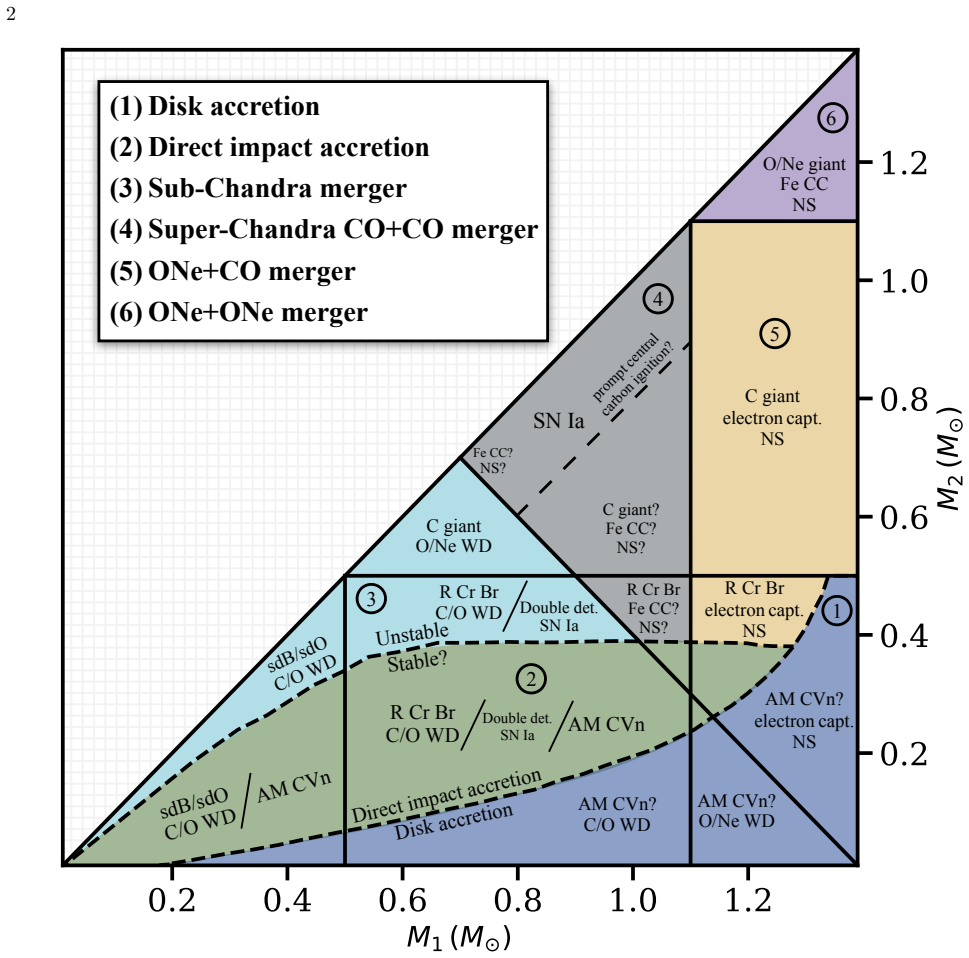
In the coming decade, the millihertz gravitational wave observatory LISA will provide the best constraints yet on the tens of thousands of close white dwarf binaries in the Milky Way, yielding unprecedented insights into the most abundant class of compact object binaries. Following inspiral via gravitational wave emission, interacting white dwarf binary pairs can lead to a multitude of outcomes, including AM Canum Venaticorum (AM CVn) binaries, R Coronae Borealis stars, young, rapidly-spinning single white dwarfs, (millisecond) magnetars, and a variety of explosive transients, most notably Type Ia supernovae. Current and future electromagnetic observations of these various outcomes coupled with the forthcoming flood of data from LISA place us on the precipice of a significant advance in our understanding of the long-term fate of white dwarf binaries. In this paper, we present a suite of mock catalogs of the Milky Way's white dwarf merger history, created using the population synthesis code $\texttt{COSMIC}$. We summarize the various merger outcomes expected (based upon varying white dwarf masses and chemical compositions) and explore ways the rates of these outcomes may vary with model uncertainties pertaining to binary evolution. We publicly release these merger catalogs as a tool for facilitating connections between gravitational wave science and white dwarf binary astrophysics.
Editorial analysis
A structured set of objections, weighed in public.
Referee Report
Summary. The paper uses the COSMIC population synthesis code to generate a suite of mock catalogs of Milky Way white dwarf binary merger histories. It summarizes expected merger outcomes (AM CVn binaries, RCB stars, magnetars, SNe Ia and other transients) as a function of white dwarf masses and compositions, explores variations in outcome rates arising from uncertainties in binary evolution parameters, and publicly releases the catalogs to support connections between LISA gravitational-wave observations and white dwarf astrophysics.
Significance. If the underlying COSMIC modeling is reliable, the public catalogs would provide a practical resource for linking future LISA detections of close white dwarf binaries to their electromagnetic outcomes and for testing binary evolution models. The forward-modeling approach and explicit release of the catalogs are clear strengths. However, the absence of any quantitative validation, error budgets, or comparisons to observed populations substantially limits the immediate scientific impact.
major comments (2)
- [Section 3] Section 3 (Merger Outcomes): the manuscript presents predicted fractions and rates for each outcome class but supplies no comparison to observed rates (e.g., Galactic SN Ia rate, AM CVn space density, or RCB star counts) or to results from independent population-synthesis codes; this omission is load-bearing for the claim that the catalogs are ready tools for LISA science.
- [Section 4] Section 4 (Model Uncertainties): while common-envelope efficiency and a few other parameters are varied, the paper does not document or test the specific COSMIC prescriptions for mass-transfer stability, common-envelope ejection, and the progenitor-to-WD composition mapping that determine the final merger products; without such tests the explored variations cannot be shown to bracket the true uncertainty.
minor comments (2)
- [Abstract] The abstract states that catalogs are released but does not specify the total number of realizations, the exact parameter grid, or the data format; adding these details would improve usability.
- [Figures] Figure captions and axis labels in the results figures should explicitly state which binary-evolution parameters are held fixed versus varied in each panel.
Simulated Author's Rebuttal
We thank the referee for their constructive and detailed report. We agree that strengthening the documentation of COSMIC prescriptions and providing context for the model predictions relative to observations will improve the manuscript's utility. We respond point-by-point to the major comments below and indicate the revisions we will make.
read point-by-point responses
-
Referee: [Section 3] Section 3 (Merger Outcomes): the manuscript presents predicted fractions and rates for each outcome class but supplies no comparison to observed rates (e.g., Galactic SN Ia rate, AM CVn space density, or RCB star counts) or to results from independent population-synthesis codes; this omission is load-bearing for the claim that the catalogs are ready tools for LISA science.
Authors: We acknowledge that explicit comparisons would help users assess the catalogs for LISA applications. The core purpose of the paper is to generate and publicly release the COSMIC mock catalogs so that the community can perform tailored comparisons incorporating selection effects and specific science cases. To address the concern, we will revise Section 3 to include a short discussion referencing literature values for key rates (e.g., the Milky Way SN Ia rate of approximately 0.003 yr^{-1} and AM CVn space densities from observational surveys) and note that our predicted outcome fractions lie within the broad ranges reported in the literature and other population synthesis studies. We will add a clear caveat that full quantitative validation requires modeling of observational biases and is facilitated by the released catalogs rather than performed here. This addition will support the utility claim without overstepping the paper's scope. revision: partial
-
Referee: [Section 4] Section 4 (Model Uncertainties): while common-envelope efficiency and a few other parameters are varied, the paper does not document or test the specific COSMIC prescriptions for mass-transfer stability, common-envelope ejection, and the progenitor-to-WD composition mapping that determine the final merger products; without such tests the explored variations cannot be shown to bracket the true uncertainty.
Authors: We agree that more explicit documentation of the underlying prescriptions is needed. The mass-transfer stability criterion (based on the adiabatic response of the donor star), common-envelope ejection (alpha-lambda formalism with lambda from stellar structure), and progenitor-to-WD composition mapping (using SSE/BSE evolutionary tracks for initial mass and metallicity) are fully specified in the COSMIC reference paper (Breivik et al. 2020). We will add a dedicated subsection to Section 4 that summarizes these prescriptions, including the default parameter choices and equations used in our simulations, with direct references to the COSMIC documentation. We will also clarify that the parameter variations (including common-envelope efficiency) are intended to illustrate sensitivity to major uncertainties rather than to exhaustively bracket every possible variation in binary evolution physics. This revision will make the explored range more transparent without requiring new simulations. revision: yes
Circularity Check
No circularity: forward population synthesis from external code inputs
full rationale
The paper performs forward modeling of Milky Way white dwarf merger catalogs using the established COSMIC population synthesis code, varying binary evolution parameters (common-envelope efficiency, mass-transfer stability) to explore outcome distributions (AM CVn, RCB, SNe Ia, etc.). No equations, fitted parameters, or self-referential definitions are present that reduce claimed outputs back to inputs by construction. The catalogs are direct simulation products; model uncertainties are propagated explicitly rather than fitted to match targets. Self-citation to COSMIC (if present) is tool usage, not load-bearing justification of a derived result. The derivation chain is self-contained against external benchmarks.
Axiom & Free-Parameter Ledger
free parameters (1)
- common-envelope efficiency and other binary-evolution parameters
axioms (1)
- domain assumption Standard stellar and binary evolution prescriptions implemented in the COSMIC population synthesis code are sufficiently accurate for the mass and composition ranges considered.
Reference graph
Works this paper leans on
-
[1]
2023, Living Reviews in Relativity, 26, 2, doi: 10.1007/s41114-022-00041-y
Amaro-Seoane, P., Andrews, J., Arca Sedda, M., et al. 2023, Living Reviews in Relativity, 26, 2, doi: 10.1007/s41114-022-00041-y
-
[2]
2014, MNRAS, 439, 1079, doi: 10.1093/mnras/stu039
Amaro-Seoane, P. 2014, MNRAS, 439, 1079, doi: 10.1093/mnras/stu039
-
[3]
Gladstone, J. C. 2013, ApJ, 766, 136, doi: 10.1088/0004-637X/766/2/136
-
[4]
Belczynski, K., Bulik, T., & Ruiter, A. J. 2005, ApJ, 629, 915, doi: 10.1086/431578
-
[5]
Belczynski, K., Kalogera, V., Rasio, F. A., et al. 2008, ApJS, 174, 223, doi: 10.1086/521026 16
-
[6]
I - 0.9 and 1.2 solar mass stars
Benz, W., Bowers, R. L., Cameron, A. G. W., & Press, W. H. . 1990, ApJ, 348, 647, doi: 10.1086/168273
-
[7]
Bildsten, L., Shen, K. J., Weinberg, N. N., & Nelemans, G. 2007, ApJL, 662, L95, doi: 10.1086/519489
-
[8]
Bregman, J. N., Gnedin, O. Y., Seitzer, P. O., & Qu, Z. 2024, ApJL, 968, L6, doi: 10.3847/2041-8213/ad498f
-
[9]
2018, ApJL, 854, L1, doi: 10.3847/2041-8213/aaaa23
Breivik, K., Kremer, K., Bueno, M., et al. 2018, ApJL, 854, L1, doi: 10.3847/2041-8213/aaaa23
-
[10]
Breivik, K., Mingarelli, C. M. F., & Larson, S. L. 2020a, ApJ, 901, 4, doi: 10.3847/1538-4357/abab99
-
[11]
Breivik, K., Coughlin, S., Zevin, M., et al. 2020b, ApJ, 898, 71, doi: 10.3847/1538-4357/ab9d85
-
[12]
2017, ApJ, 850, 127, doi: 10.3847/1538-4357/aa9568
Brooks, J., Schwab, J., Bildsten, L., et al. 2017, ApJ, 850, 127, doi: 10.3847/1538-4357/aa9568
-
[13]
P., Ferrario, L., Pakmor, R., et al
Burmester, U. P., Ferrario, L., Pakmor, R., et al. 2023, MNRAS, 523, 527, doi: 10.1093/mnras/stad1394
-
[14]
Caiazzo, I., Burdge, K. B., Fuller, J., et al. 2021, Nature, 595, 39, doi: 10.1038/s41586-021-03615-y
-
[15]
Caiazzo, I., Burdge, K. B., Tremblay, P.-E., et al. 2023, Nature, 620, 61, doi: 10.1038/s41586-023-06171-9
-
[16]
2014, A&A, 566, A86, doi: 10.1051/0004-6361/201323052
Camacho, J., Torres, S., Garc´ ıa-Berro, E., et al. 2014, A&A, 566, A86, doi: 10.1051/0004-6361/201323052
-
[17]
Carter, P. J., Marsh, T. R., Steeghs, D., et al. 2013, MNRAS, 429, 2143, doi: 10.1093/mnras/sts485
-
[18]
Cheng, S., Cummings, J. D., & M´ enard, B. 2019, ApJ, 886, 100, doi: 10.3847/1538-4357/ab4989
-
[19]
Cheng, S., Cummings, J. D., M´ enard, B., & Toonen, S. 2020, ApJ, 891, 160, doi: 10.3847/1538-4357/ab733c
-
[20]
Verbunt, F. W. M. 2014, A&A, 563, A83, doi: 10.1051/0004-6361/201322714
-
[21]
Clark, G. W. 1975, ApJL, 199, L143, doi: 10.1086/181869
-
[22]
Clayton, G. C. 1996, PASP, 108, 225, doi: 10.1086/133715
-
[23]
2007, ApJ, 662, 1220, doi: 10.1086/518307
Asplund, M. 2007, ApJ, 662, 1220, doi: 10.1086/518307
-
[24]
Cool, A. M., Piotto, G., & King, I. R. 1996, ApJ, 468, 655, doi: 10.1086/177723
-
[25]
2019, ApJ, 885, 74, doi: 10.3847/1538-4357/ab46b9 de Wit, J., Alonso, R., Rackham, B
Coutu, S., Dufour, P., Bergeron, P., et al. 2019, ApJ, 885, 74, doi: 10.3847/1538-4357/ab46b9
-
[26]
2014, MNRAS, 438, 14, doi: 10.1093/mnras/stt1766
Dan, M., Rosswog, S., Br¨ uggen, M., & Podsiadlowski, P. 2014, MNRAS, 438, 14, doi: 10.1093/mnras/stt1766
-
[27]
2011, ApJ, 737, 89, doi: 10.1088/0004-637X/737/2/89 De Marco, O
Dan, M., Rosswog, S., Guillochon, J., & Ramirez-Ruiz, E. 2011, ApJ, 737, 89, doi: 10.1088/0004-637X/737/2/89 De Marco, O. 2009, PASP, 121, 316, doi: 10.1086/597765
-
[28]
Dessart, L., Burrows, A., Ott, C. D., et al. 2006, ApJ, 644, 1063, doi: 10.1086/503626
-
[29]
R., Chornock, R., Soderberg, A
Drout, M. R., Chornock, R., Soderberg, A. M., et al. 2014, ApJ, 794, 23, doi: 10.1088/0004-637X/794/1/23
-
[30]
H., & Clemens, J
Dunlap, B. H., & Clemens, J. C. 2015, in Astronomical Society of the Pacific Conference Series, Vol. 493, 19th European Workshop on White Dwarfs, ed. P. Dufour, P. Bergeron, & G. Fontaine, 547
2015
-
[31]
Fang, X., Thompson, T. A., & Hirata, C. M. 2018, MNRAS, 476, 4234, doi: 10.1093/mnras/sty472
-
[32]
Ferrario, L., de Martino, D., & G¨ ansicke, B. T. 2015, SSRv, 191, 111, doi: 10.1007/s11214-015-0152-0
-
[33]
Fink, M., R¨ opke, F. K., Hillebrandt, W., et al. 2010, A&A, 514, A53, doi: 10.1051/0004-6361/200913892
-
[34]
Rasio, F. A. 2019, ApJ, 872, 165, doi: 10.3847/1538-4357/ab0214
-
[35]
Gokhale, V., Peng, X. M., & Frank, J. 2007, ApJ, 655, 1010, doi: 10.1086/510119
-
[36]
J., van Roestel, J., & Wong, T
Green, M. J., van Roestel, J., & Wong, T. L. S. 2025, A&A, 700, A107, doi: 10.1051/0004-6361/202554925
-
[37]
2004, A&A, 413, 257, doi: 10.1051/0004-6361:20031504
Guerrero, J., Garc´ ıa-Berro, E., & Isern, J. 2004, A&A, 413, 257, doi: 10.1051/0004-6361:20031504
-
[38]
2010, ApJL, 709, L64, doi: 10.1088/2041-8205/709/1/L64
Guillochon, J., Dan, M., Ramirez-Ruiz, E., & Rosswog, S. 2010, ApJL, 709, L64, doi: 10.1088/2041-8205/709/1/L64
-
[39]
V., Gr¨ afener, G., Langer, N., et al
Gvaramadze, V. V., Gr¨ afener, G., Langer, N., et al. 2019, Nature, 569, 684, doi: 10.1038/s41586-019-1216-1
-
[40]
Han, Z., Podsiadlowski, P., & Eggleton, P. P. 1995, MNRAS, 272, 800, doi: 10.1093/mnras/272.4.800
-
[41]
Han, Z., Podsiadlowski, P., Maxted, P. F. L., & Marsh, T. R. 2003, MNRAS, 341, 669, doi: 10.1046/j.1365-8711.2003.06451.x
-
[42]
Hansen, B. M. S., Kalirai, J. S., Anderson, J., et al. 2013, Nature, 500, 51, doi: 10.1038/nature12334
-
[43]
2025, ApJ, 986, 123, doi: 10.3847/1538-4357/add32b
He, W., Zhou, P., Gjergo, E., & Fu, X. 2025, ApJ, 986, 123, doi: 10.3847/1538-4357/add32b
-
[44]
2016, PASP, 128, 082001, doi: 10.1088/1538-3873/128/966/082001
Heber, U. 2016, PASP, 128, 082001, doi: 10.1088/1538-3873/128/966/082001
-
[45]
FIRE-2 Simulations: Physics versus Numerics in Galaxy Formation
Hopkins, P. F., Wetzel, A., Kereˇ s, D., et al. 2018, MNRAS, 480, 800, doi: 10.1093/mnras/sty1690
-
[46]
Hurley, J. R., Tout, C. A., & Pols, O. R. 2002, MNRAS, 329, 897, doi: 10.1046/j.1365-8711.2002.05038.x
-
[47]
1990, ApJ, 353, 215, doi: 10.1086/168609
Iben, Jr., I. 1990, ApJ, 353, 215, doi: 10.1086/168609
-
[48]
Iben, Jr., I., & Tutukov, A. V. 1984, ApJS, 54, 335, doi: 10.1086/190932 —. 1985, ApJS, 58, 661, doi: 10.1086/191054 —. 1987, ApJ, 313, 727, doi: 10.1086/165011
-
[49]
Iben, Jr., I., Tutukov, A. V., & Yungelson, L. R. 1997, ApJ, 475, 291, doi: 10.1086/303525
-
[50]
Justham, S., Podsiadlowski, P., & Han, Z. 2011, MNRAS, 410, 984, doi: 10.1111/j.1365-2966.2010.17497.x
-
[51]
Katz, J. I. 1975, Nature, 253, 698, doi: 10.1038/253698a0
-
[52]
Kilic, M., Hermes, J. J., Gianninas, A., et al. 2014, MNRAS, 438, L26, doi: 10.1093/mnrasl/slt151 17
-
[53]
King, A. R., Pringle, J. E., & Wickramasinghe, D. T. 2001, MNRAS, 320, L45, doi: 10.1046/j.1365-8711.2001.04184.x
-
[54]
2022, Nature, 602, 585, doi: 10.1038/s41586-021-04354-w
Kirsten, F., Marcote, B., Nimmo, K., et al. 2022, Nature, 602, 585, doi: 10.1038/s41586-021-04354-w
-
[55]
S., Janka, H.-T., & Hillebrandt, W
Kitaura, F. S., Janka, H.-T., & Hillebrandt, W. 2006, A&A, 450, 345, doi: 10.1051/0004-6361:20054703
-
[56]
Koester, D., & Kepler, S. O. 2019, A&A, 628, A102, doi: 10.1051/0004-6361/201935946
-
[57]
2022, MNRAS, 511, 5936, doi:10.1093/mnras/stac415 Kovács, O
Korol, V., Hallakoun, N., Toonen, S., & Karnesis, N. 2022, MNRAS, 511, 5936, doi: 10.1093/mnras/stac415
-
[58]
Korol, V., Rossi, E. M., Groot, P. J., et al. 2017, MNRAS, 470, 1894, doi: 10.1093/mnras/stx1285
-
[59]
, year = 1962, month = nov, volume =
Kozai, Y. 1962, AJ, 67, 591, doi: 10.1086/108790
-
[60]
2026, in Encyclopedia of Astrophysics, Volume 3, Vol
Kremer, K. 2026, in Encyclopedia of Astrophysics, Volume 3, Vol. 3, 458–472, doi: 10.1016/B978-0-443-21439-4.00103-6
-
[61]
Kremer, K., Breivik, K., Larson, S. L., & Kalogera, V. 2017, ApJ, 846, 95, doi: 10.3847/1538-4357/aa8557
-
[62]
Kremer, K., Fuller, J., Piro, A. L., & Ransom, S. M. 2023, MNRAS, 525, L22, doi: 10.1093/mnrasl/slad088
-
[63]
Kremer, K., Piro, A. L., & Li, D. 2021a, ApJL, 917, L11, doi: 10.3847/2041-8213/ac13a0
-
[64]
Kremer, K., Rui, N. Z., Weatherford, N. C., et al. 2021b, ApJ, 917, 28, doi: 10.3847/1538-4357/ac06d4
-
[65]
2015, ApJ, 806, 76, doi: 10.1088/0004-637X/806/1/76
Kremer, K., Sepinsky, J., & Kalogera, V. 2015, ApJ, 806, 76, doi: 10.1088/0004-637X/806/1/76
-
[66]
2001, MNRAS, 322, 231
Kroupa, P. 2001, MNRAS, 322, 231
2001
-
[67]
Lamberts, A., Blunt, S., Littenberg, T. B., et al. 2019, MNRAS, 490, 5888, doi: 10.1093/mnras/stz2834
-
[68]
2011, MNRAS, 418, 467, doi: 10.1111/j.1365-2966.2011.19497.x
Li, W., Chornock, R., Leaman, J., et al. 2011, MNRAS, 412, 1473, doi: 10.1111/j.1365-2966.2011.18162.x
-
[69]
Lidov, M. L. 1962, Planet. Space Sci., 9, 719, doi: 10.1016/0032-0633(62)90129-0
-
[70]
Lipunov, V. M., & Postnov, K. A. 1988, Ap&SS, 145, 1, doi: 10.1007/BF00645692
-
[71]
Research in Astronomy and Astrophysics , keywords =
Liu, Z.-W., R¨ opke, F. K., & Han, Z. 2023, Research in Astronomy and Astrophysics, 23, 082001, doi: 10.1088/1674-4527/acd89e
-
[72]
1990, ApJL, 354, L53, doi: 10.1086/185721 Lor´ en-Aguilar, P., Isern, J., & Garc´ ıa-Berro, E
Livne, E. 1990, ApJL, 354, L53, doi: 10.1086/185721 Lor´ en-Aguilar, P., Isern, J., & Garc´ ıa-Berro, E. 2009, A&A, 500, 1193, doi: 10.1051/0004-6361/200811060
-
[73]
Lorimer, D. R. 2008, Living Reviews in Relativity, 11, 8, doi: 10.12942/lrr-2008-8
-
[74]
2022, MNRAS, 510, 1867, doi: 10.1093/mnras/stab3500
Lu, W., Beniamini, P., & Kumar, P. 2022, MNRAS, 510, 1867, doi: 10.1093/mnras/stab3500
-
[75]
2012, PASA, 29, 447, doi: 10.1071/AS11052
Maoz, D., & Mannucci, F. 2012, PASA, 29, 447, doi: 10.1071/AS11052
-
[76]
2014, ARA&A, 52, 107, https://doi.org/10.1146/annurev-astro-082812-141031
Maoz, D., Mannucci, F., & Nelemans, G. 2014, ARA&A, 52, 107, doi: 10.1146/annurev-astro-082812-141031
-
[77]
R., Nelemans, G., & Steeghs, D
Marsh, T. R., Nelemans, G., & Steeghs, D. 2004, MNRAS, 350, 113, doi: 10.1111/j.1365-2966.2004.07564.x
-
[78]
2021, ApJ, 923, 100, doi: 10.3847/1538-4357/ac2a39
Strader, J. 2021, ApJ, 923, 100, doi: 10.3847/1538-4357/ac2a39
-
[79]
1980, PASJ, 32, 303, doi: 10.1093/pasj/32.2.303
Miyaji, S., Nomoto, K., Yokoi, K., & Sugimoto, D. 1980, PASJ, 32, 303, doi: 10.1093/pasj/32.2.303
-
[80]
Moe, M., & Di Stefano, R. 2017, ApJS, 230, 15, doi: 10.3847/1538-4365/aa6fb6
discussion (0)
Sign in with ORCID, Apple, or X to comment. Anyone can read and Pith papers without signing in.