Balanced bipartite distance of K₄-free graphs
Pith reviewed 2026-05-08 16:05 UTC · model grok-4.3
The pith
Every K4-free graph on n vertices can be made balanced bipartite by removing at most n²/9 edges.
A machine-rendered reading of the paper's core claim, the machinery that carries it, and where it could break.
Core claim
We show that every K4-free graph on n vertices can be made balanced bipartite by removing at most n²/9 edges. This proves a conjecture of Balogh, Clemen, and Lidický, and generalizes both Sudakov's result on the bipartite distance of K4-free graphs and Reiher's result on the sparse half of K4-free graphs.
What carries the argument
The balanced bipartite distance, i.e., the minimum number of edges that must be deleted to obtain a bipartite graph with equal part sizes; the K4-free hypothesis supplies the structural control needed to bound this distance by n²/9.
If this is right
- The minimum number of edges to delete to reach a balanced bipartite graph is at most n²/9 for every K4-free graph.
- The conjecture of Balogh, Clemen, and Lidický on this quantity is correct.
- Sudakov's earlier bound on the ordinary bipartite distance of K4-free graphs follows as a special case.
- Reiher's bound on the size of a sparse half in a K4-free graph follows as a special case.
Where Pith is reading between the lines
- The same n²/9 bound may serve as a benchmark when studying edit distances to other equitable hereditary properties in K4-free graphs.
- Extremal examples achieving equality are likely to be obtained from balanced complete 3-partite graphs by removing all edges inside one part.
Load-bearing premise
The graph contains no four vertices that are all pairwise adjacent.
What would settle it
A single K4-free graph on n vertices whose balanced bipartite distance exceeds n²/9.
Figures
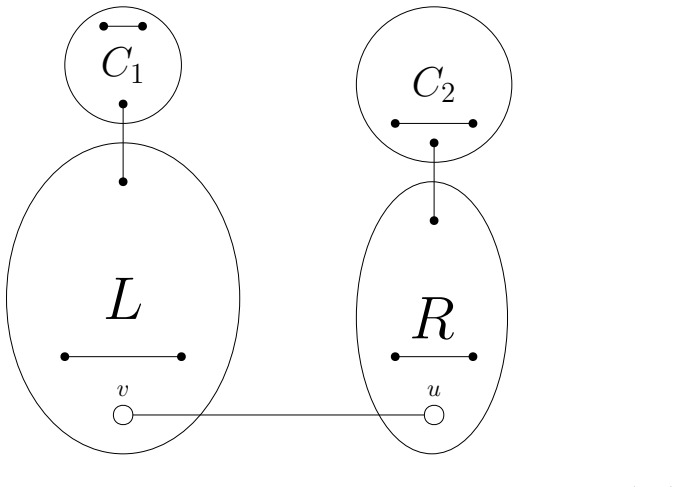
read the original abstract
We show that every $K_4$-free graph on $n$ vertices can be made balanced bipartite by removing at most $\frac{n^2}{9}$ edges. This proves a conjecture of Balogh, Clemen, and Lidick\'{y}, and generalizes both Sudakov's result on the bipartite distance of $K_4$-free graphs and Reiher's result on the sparse half of $K_4$-free graphs.
Editorial analysis
A structured set of objections, weighed in public.
Referee Report
Summary. The paper proves that every K_4-free graph on n vertices can be made balanced bipartite by deleting at most n²/9 edges. This confirms a conjecture of Balogh, Clemen, and Lidický and generalizes Sudakov's bound on the bipartite distance of K_4-free graphs together with Reiher's result on their sparse halves. The argument proceeds by exploiting the extremal structure of K_4-free graphs (in particular the properties of the Turán graph T(n,3)) to produce a nearly balanced bipartition whose crossing edges differ from the target balanced bipartite graph by at most the stated number of deletions; the bound is shown to be tight.
Significance. If the proof is correct, the result supplies a sharp, parameter-free upper bound on the balanced bipartite distance of K_4-free graphs and thereby resolves an open conjecture while unifying two earlier theorems in the same extremal setting. The explicit tightness example with T(n,3) and the direct combinatorial approach (no hidden parameters or fitted constants) constitute a clean contribution to the study of forbidden-subgraph problems and the quantitative distance to bipartiteness.
minor comments (2)
- The abstract and introduction cite Sudakov and Reiher; verify that the bibliography entries are complete and that the precise statements being generalized are quoted or referenced with page numbers.
- In the tightness argument for T(n,3), confirm that the final adjustment to a balanced bipartition stays within the n²/9 budget for all residue classes of n modulo 3.
Simulated Author's Rebuttal
We thank the referee for their positive assessment of the manuscript, for recognizing that the result resolves the conjecture of Balogh, Clemen, and Lidický while unifying earlier theorems of Sudakov and Reiher, and for recommending acceptance.
Circularity Check
Direct combinatorial proof; no circular reductions or load-bearing self-citations
full rationale
The manuscript establishes the balanced bipartite distance bound for K4-free graphs via a direct structural argument that decomposes the graph according to its K4-free properties and explicitly constructs a bipartition after edge deletions bounded by n²/9. This derivation relies on extremal graph theory facts about K4-free graphs (including the known tightness example T(n,3)) that are external to the present proof and do not reduce to fitted parameters, self-definitions, or ansatzes imported from the authors' prior work. The conjecture being proved is stated as an open claim rather than an assumption, and the generalizations of Sudakov and Reiher are cited as context rather than as load-bearing steps that would make the central result tautological. No equation or lemma equates a derived quantity to its own input by construction.
Axiom & Free-Parameter Ledger
axioms (1)
- standard math Standard axioms and definitions of graphs, subgraphs, bipartiteness, and K4-freeness.
Forward citations
Cited by 1 Pith paper
-
Bipartite cuts in Ramsey-Tur\'an style
K5-free graphs on n vertices with sublinear independence number lie at most (1/18 + o(1))n² edges from bipartiteness, and 1/18 is asymptotically best possible.
Reference graph
Works this paper leans on
-
[1]
Rahil Baber and John Talbot. “Hypergraphs Do Jump”. In: Combinatorics, Proba- bility and Computing 20.2 (2011), pp. 161–171
work page 2011
-
[2]
10 problems for par- titions of triangle-free graphs
J´ ozsef Balogh, Felix Christian Clemen, and Bernard Lid ick´ y. “10 problems for par- titions of triangle-free graphs”. In: European Journal of Combinatorics 121 (2024), p. 103841
work page 2024
-
[3]
Max cuts in triangle- free graphs
J´ ozsef Balogh, Felix Christian Clemen, and Bernard Lid ick´ y. “Max cuts in triangle- free graphs”. In: Extended Abstracts EuroComb 2021: European Conference on Com- binatorics, Graph Theory and Applications . Springer. 2021, pp. 509–514. 20
work page 2021
-
[4]
Upper bounds on the size of 4- and 6-cycle-free subgraphs of the hypercube
J´ ozsef Balogh, Ping Hu, Bernard Lidick´ y, and Hong Liu. “Upper bounds on the size of 4- and 6-cycle-free subgraphs of the hypercube”. In: European Journal of Combinatorics 35 (2014), pp. 75–85
work page 2014
-
[5]
Minimum number of monotone subsequences of length 4 in permutations
J´ ozsef Balogh, Ping Hu, Bernard Lidick´ y, Oleg Pikhurk o, Bal´ azs Udvari, and Jan Volec. “Minimum number of monotone subsequences of length 4 in permutations”. In: Combinatorics, Probability and Computing 24.4 (2015), pp. 658–679
work page 2015
-
[6]
Inducibility of 4-vertex tournaments
Dalton Burke, Bernard Lidick´ y, Florian Pfender, and Mi chael Phillips. “Inducibility of 4-vertex tournaments”. arXiv: 2103.07047
-
[7]
On graphs not containing pr escribed induced subgraphs
Fan Chung and Ronald Graham. “On graphs not containing pr escribed induced subgraphs”. In: A Tribute to Paul Erdos . Cambridge University Press, 1990, pp. 111– 120
work page 1990
-
[8]
Problems and results in graph theory and co mbinatorial analysis
Paul Erd˝ os. “Problems and results in graph theory and co mbinatorial analysis”. In: Proceedings of the Fifth British Combinatorial Conference (U niv. Aberdeen, Ab- erdeen). Vol. XV. 1975, pp. 169–192
work page 1975
-
[9]
Some unsolved problems in graph theory and combinatorial analysis
Paul Erd˝ os. “Some unsolved problems in graph theory and combinatorial analysis”. In: Combinatorial Mathematics and Its Applications (Proc. Conf., Oxford, 1969) (1971), pp. 97–109
work page 1969
-
[10]
Paul Erd˝ os, Ralph Faudree, J´ anos Pach, and Joel Spenc er. “How to make a graph bipartite”. In: Journal of Combinatorial Theory, Series B 45.1 (1988), pp. 86–98
work page 1988
-
[11]
A local density condition for triangles
Paul Erd˝ os, Ralph Faudree, Cecil Rousseau, and Richar d Schelp. “A local density condition for triangles”. In: Discrete Mathematics 127.1 (1994), pp. 153–161
work page 1994
-
[12]
How many edges should be deleted to make a triangle-free graph bipartite
Paul Erd˝ os, Ervin Gy˝ ori, and Mikl´ os Simonovits. “How many edges should be deleted to make a triangle-free graph bipartite”. In: Sets, graphs and numbers, Colloq. Math. Soc. J´ anos Bolyai. Vol. 60. 1992, pp. 239–263
work page 1992
-
[13]
On application s of Razborov’s flag algebra calculus to extremal 3-graph theory
Victor Falgas-Ravry and Emil Vaughan. “On application s of Razborov’s flag algebra calculus to extremal 3-graph theory”. In: Combinatorics, Probability and Computing 22(01) (2011), pp. 21–54
work page 2011
-
[14]
On the maximum number of C5’s in a triangle-free graph
Andrzej Grzesik. “On the maximum number of C5’s in a triangle-free graph”. In: Journal of Combinatorial Theory, Series B 102 (2011), pp. 1061–1066
work page 2011
-
[15]
Minimum numbe r of edges that occur in odd cycles
Andrzej Grzesik, Ping Hu, and Jan Volec. “Minimum numbe r of edges that occur in odd cycles”. In: Journal of Combinatorial Theory, Series B 137 (2019), pp. 65–103
work page 2019
-
[16]
On the number of pentagons in triangle-free graphs
Hamed Hatami, Jan Hladk` y, Daniel Kr´ al’, Sergey Norin , and Alexander Razborov. “On the number of pentagons in triangle-free graphs”. In: Journal of Combinatorial Theory, Series A 120.3 (2013), pp. 722–732
work page 2013
-
[17]
Counting flags in triangle-free di- graphs
Jan Hladk´ y, Daniel Kr´ al, and Sergey Norin. “Counting flags in triangle-free di- graphs”. In: Combinatorica 37.1 (2016), pp. 49–76
work page 2016
-
[18]
An Introduction to Razbo- rov’s Flag Algebra as a Proof System for Extremal Graph Theory
Gyeongwon Jeong, Seonghun Park, and Hongseok Yang. “An Introduction to Razbo- rov’s Flag Algebra as a Proof System for Extremal Graph Theory”. arXiv: 2601.12741
-
[19]
Sparse halves in tria ngle-free graphs
Peter Keevash and Benny Sudakov. “Sparse halves in tria ngle-free graphs”. In: Jour- nal of Combinatorial Theory, Series B 96.4 (2006), pp. 614–620
work page 2006
-
[20]
Semidefinite Pr ogramming and Ramsey Numbers
Bernard Lidick´ y and Florian Pfender. “Semidefinite Pr ogramming and Ramsey Numbers”. In: SIAM Journal on Discrete Mathematics 35.4 (2021), pp. 2328–2344
work page 2021
-
[21]
Sparse halves in K4-free graphs
Xizhi Liu and Jie Ma. “Sparse halves in K4-free graphs”. In: Journal of Graph Theory 99.1 (2022), pp. 5–25. 21
work page 2022
-
[22]
Sparse halves in den se triangle-free graphs
Sergey Norin and Liana Yepremyan. “Sparse halves in den se triangle-free graphs”. In: Journal of Combinatorial Theory, Series B 115 (2015), pp. 1–25
work page 2015
-
[23]
Minimum Number of k-Cliques in Graphs with Bounded Independence Number
Oleg Pikhurko and Emil Vaughan. “Minimum Number of k-Cliques in Graphs with Bounded Independence Number”. In: Combinatorics, Probability and Computing 22 (2012), pp. 910–934
work page 2012
-
[24]
Alexander Razborov. “Flag Algebras”. In: The Journal of Symbolic Logic 72.4 (2007), pp. 1239–1282
work page 2007
-
[25]
Flag algebras: an interim report
Alexander Razborov. “Flag algebras: an interim report ”. In: The Mathematics of Paul Erd˝ os II. Springer, 2013, pp. 207–232
work page 2013
-
[26]
More about sparse halves in trian gle-free graphs
Alexander Razborov. “More about sparse halves in trian gle-free graphs”. In: Sbornik: Mathematics 213.1 (2022), pp. 109–128
work page 2022
-
[27]
On the Caccetta-H¨ aggkvist Conj ecture with Forbidden Sub- graphs
Alexander Razborov. “On the Caccetta-H¨ aggkvist Conj ecture with Forbidden Sub- graphs”. In: Journal of Graph Theory 74 (2013), pp. 236–248
work page 2013
-
[28]
On the minimal density of triangl es in graphs
Alexander Razborov. “On the minimal density of triangl es in graphs”. In: Combi- natorics, Probability and Computing 17.4 (2008), pp. 603–618
work page 2008
-
[29]
K4-free graphs have sparse halves
Christian Reiher. “ K4-free graphs have sparse halves”. In: Bulletin of the London Mathematical Society 55 (2022), pp. 1178–1195
work page 2022
-
[30]
Marcel de Carli Silva, Fernando M´ ario de Oliveira Filh o, and Cristiane Maria Sato. “Flag algebras: A first glance”. arXiv: 1607.04741
-
[31]
Note making a K4-free graph bipartite
Benny Sudakov. “Note making a K4-free graph bipartite”. In: Combinatorica 27.4 (2007), pp. 509–518. 22
work page 2007
discussion (0)
Sign in with ORCID, Apple, or X to comment. Anyone can read and Pith papers without signing in.