Recognition: unknown
Spin Parity of Spiral Galaxies VI -- A Search for Dynamical Memory in the Spin Distribution of Galaxies in HSC WIDE Survey Regions
Pith reviewed 2026-05-08 08:07 UTC · model grok-4.3
The pith
Spiral galaxy spin vectors follow a random distribution with no detectable large-scale alignments.
A machine-rendered reading of the paper's core claim, the machinery that carries it, and where it could break.
Core claim
The observed cumulative distribution functions for the sets of cubes are in good agreement with the theoretical binomial distribution and with those obtained from Monte Carlo realizations assuming random S/Z spin assignments. The number of statistically anomalous cubes is also comparable to that expected from the random assignments. These results indicate that the spin-vector distribution of spiral galaxies is consistent with statistical randomness expected from the standard cosmological model of structure formation.
What carries the argument
S/Z morphological classification of spiral winding parity as a proxy for the sign of the line-of-sight spin vector, combined with binomial probability tests for imbalance inside cubic volumes of varying size.
If this is right
- No coherent spin alignments exist across the examined cubic volumes on scales of 20 to 200 Mpc.
- The spin distribution matches the outcome of assigning S or Z labels at random.
- The standard model of structure formation, which expects statistical randomness in galaxy spins, is supported by the data.
- The same statistical framework can be applied to future samples to tighten limits on any residual coherence.
Where Pith is reading between the lines
- Deeper or wider samples could test whether any weak correlations appear only on even larger scales.
- The parity method offers a simple way to check spin isotropy in other redshift slices.
- If the result holds, it constrains models in which galaxy angular momentum is acquired through processes that could introduce large-scale preferences.
Load-bearing premise
The S/Z classification accurately reflects the true sign of each galaxy's line-of-sight spin component without significant bias from misclassification or face-on contamination.
What would settle it
Finding substantially more cubic volumes with extreme S/Z imbalances than predicted by the binomial distribution or by Monte Carlo random trials would show that spins are not randomly oriented.
Figures


read the original abstract
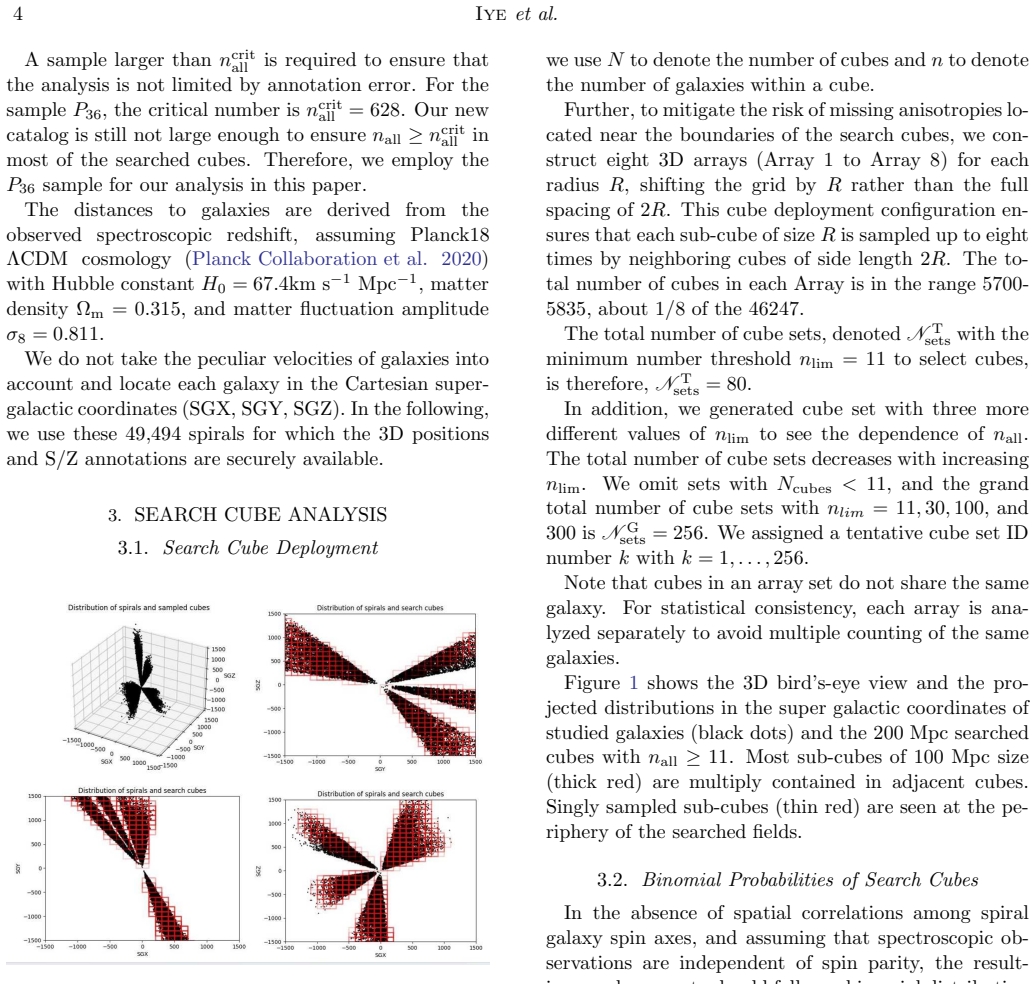
We analyzed the distribution of spin parity in spiral galaxies using the HSC DR2 data. The spiral winding parity of disk galaxies, observed as S-spiral or Z-spiral projected onto the sky plane, provides robust information on the sign of the line-of-sight component of their spin vectors, specifically whether the spin vector points toward or away from us. The distribution of 49,494 S/Z annotated spirals with spectroscopic redshift (0.05 $\le z$) was analyzed for 46,247 fiducial cubic search volumes of various sizes, 20--200 Mpc, deployed in the 3D supergalactic coordinates. We counted the number of S-spirals and Z-spirals in each cube, evaluated the binomial probability of the observed S/Z imbalance, and identified statistically anomalous cube candidates. The observed cumulative distribution functions for the 256 sets of cubes are in good agreement with the theoretical binomial distribution and with those obtained from 1000 Monte Carlo realizations assuming random S/Z spin assignments. The number of statistically anomalous cubes is also comparable to that expected from the random assignments. These results indicate that the spin-vector distribution of spiral galaxies is consistent with statistical randomness expected from the standard cosmological model of structure formation.
Editorial analysis
A structured set of objections, weighed in public.
Referee Report
Summary. The paper analyzes the spin parity (S/Z winding) of 49,494 spectroscopically confirmed spiral galaxies (0.05 ≤ z) from HSC DR2. It deploys 46,247 cubic volumes (side lengths 20–200 Mpc) in supergalactic coordinates, counts S and Z galaxies per cube, computes binomial probabilities of observed imbalances, and compares the cumulative distribution functions of these probabilities (across 256 cube sets) plus the number of statistically anomalous cubes against both the analytic binomial expectation (p = 0.5) and 1000 Monte Carlo realizations that randomize S/Z labels on fixed galaxy positions. The observed distributions match the random expectations, leading to the conclusion that galaxy spin vectors show no detectable departure from statistical randomness on these scales.
Significance. If the result holds, it supplies a direct, large-sample observational test supporting the standard ΛCDM expectation of random spin orientations with no preferred large-scale dynamical memory. The statistical design—fixing positions and randomizing only parity labels—automatically incorporates varying galaxy densities and provides a clean null-hypothesis comparison; the dual agreement with both analytic binomial CDFs and MC realizations is a clear methodological strength.
major comments (2)
- The central claim rests on the assumption that S/Z morphological classification is an unbiased proxy for the sign of the line-of-sight spin component with negligible contamination from face-on systems or misclassifications. No quantitative assessment of classification accuracy, completeness, or systematic bias is provided in the methods or results sections, which is load-bearing for interpreting the null result as evidence for randomness rather than classification artifact.
- The binomial probability calculations treat the cubic volumes as independent trials. For the smaller cube sizes (20–50 Mpc) where adjacent or overlapping cubes are likely, the independence assumption requires explicit justification or a covariance correction; without it, the reported agreement between data and binomial/MC CDFs may be overstated.
minor comments (3)
- The redshift range is stated as 0.05 ≤ z without an explicit upper bound; state the full redshift interval and any magnitude or quality cuts applied to the 49,494 galaxies.
- The abstract and figure captions should briefly note the classification method (visual or automated) and any validation against known samples to allow readers to assess the robustness of the S/Z indicator.
- Clarify whether the 256 sets of cubes correspond to different side lengths or different spatial realizations, and ensure the Monte Carlo procedure is described with sufficient detail for reproducibility (e.g., how many galaxies per realization).
Simulated Author's Rebuttal
We thank the referee for the constructive review and the recommendation for minor revision. We address each major comment below, indicating the revisions that will be incorporated.
read point-by-point responses
-
Referee: The central claim rests on the assumption that S/Z morphological classification is an unbiased proxy for the sign of the line-of-sight spin component with negligible contamination from face-on systems or misclassifications. No quantitative assessment of classification accuracy, completeness, or systematic bias is provided in the methods or results sections, which is load-bearing for interpreting the null result as evidence for randomness rather than classification artifact.
Authors: We agree that an explicit summary of classification reliability would strengthen the manuscript. The S/Z classification method and its validation (including >90% inter-classifier agreement and low face-on contamination for the selected inclined spirals) are documented in Papers I–II of this series. We will add a short paragraph to the Methods section citing these prior validations and the selection cuts used to suppress misclassification, thereby supporting the interpretation of the null result. revision: yes
-
Referee: The binomial probability calculations treat the cubic volumes as independent trials. For the smaller cube sizes (20–50 Mpc) where adjacent or overlapping cubes are likely, the independence assumption requires explicit justification or a covariance correction; without it, the reported agreement between data and binomial/MC CDFs may be overstated.
Authors: We concur that overlapping cubes violate strict independence for the analytic binomial. However, the Monte Carlo realizations (which fix positions and only permute S/Z labels) automatically incorporate all spatial correlations from overlaps. We will revise Section 3 to state explicitly that the MC distributions constitute the primary, robust null test while the binomial serves only as an idealized reference, and to note that covariance is already accounted for in the simulations. The conclusions remain unchanged. revision: yes
Circularity Check
No circularity: direct observational test against external null model
full rationale
The paper conducts a straightforward statistical test: it classifies galaxies as S or Z spirals from imaging, counts them in fixed cubic volumes in 3D space, computes binomial probabilities for the observed imbalances, and compares the resulting CDFs to the theoretical binomial distribution (p=0.5) plus 1000 Monte Carlo realizations that randomize parity labels on the fixed positions. No parameters are fitted from the data and then used to generate a 'prediction' of the same data; the null hypothesis of randomness is external and parameter-free. No equations, ansatzes, or self-citations are invoked to derive the central result from the inputs themselves. The procedure is self-contained as an empirical consistency check against the standard cosmological expectation of random spin orientations.
Axiom & Free-Parameter Ledger
free parameters (1)
- cube side lengths
axioms (2)
- domain assumption S/Z classification accurately reflects the sign of the line-of-sight spin component
- standard math Binomial probability model applies to S/Z counts in independent volumes
Reference graph
Works this paper leans on
-
[1]
Abdullah, A. H. and Kroupa, P. 2014, ASP Conf. 486, 137
2014
-
[2]
Abdurro'uf 2022, , 259, 35
2022
-
[3]
2019, , 71, 114
Aihara, H., AlSayyad,Y., Ando, M. 2019, , 71, 114
2019
-
[4]
Baldry I. K. 2018, , 474, 3875
2018
-
[5]
Bardeen, J. M. 1980, Physics Review D, 22, 1882
1980
- [6]
-
[7]
2011, , 741, 8
Coil, A.L. 2011, , 741, 8
2011
-
[8]
Colless, M., 2001, , 328, 1039
2001
-
[9]
2013, , 767, 118
Cool, R.J. 2013, , 767, 118
2013
-
[10]
DESI Collaboration 2025, arxiv:2503.14745
work page internal anchor Pith review arXiv 2025
-
[11]
Drinkwater, M. J. 2018, , 474, 4151
2018
-
[12]
Eisenstein, D. J. 2005, , 633, 560
2005
-
[13]
B., Davis, D., and Silva, P
Hayes, W. B., Davis, D., and Silva, P. 2017, , 466, 3928
2017
-
[14]
Hirata, C. M. & Seljak, U. 2004, , 70, 063526
2004
-
[15]
M., Mandelbaum, R., Ishak, M
Hirata, C. M., Mandelbaum, R., Ishak, M. 2007, , 381, 1197
2007
-
[16]
and Sugai, H
Iye, M. and Sugai, H. 1991, , 374, 112
1991
-
[17]
2019, , 886, 133
Iye, M., Tadaki, K., and Fukumoto, H. 2019, , 886, 133
2019
-
[18]
Iye, M., Yagi, M., and Fukumoto, H. 2021. , 907, 123
2021
-
[19]
2019, , 624, A30
Johnston, H., Geprgiou, C., Joachimi, B. 2019, , 624, A30
2019
-
[20]
Jones, D. H. 2009, , 399, 683
2009
-
[21]
Jones, D. H. 2004, , 355, 747
2004
-
[22]
2022, Nature Reviews Physics, 4, 452
Komatsu, E. 2022, Nature Reviews Physics, 4, 452
2022
-
[23]
2013, , 559, A14
Le Fevre, O. 2013, , 559, A14
2013
-
[24]
2013, , 770, L12
Li, C., Jing, Y.P., Faltenbacher, A., and Wang, J. 2013, , 770, L12
2013
-
[25]
I., Hoffman, Y., Steinmetz, M
Libeskind, N. I., Hoffman, Y., Steinmetz, M. & Gottl'' o ber, S. 2013 , 766, L15
2013
-
[26]
2011, , 410, 166
Lintott, C., Schawinski, K., Bamford, S. 2011, , 410, 166
2011
-
[27]
2021, , 502, 5528
Lopez, P., Cautun, M., Paz, D. . 2021, , 502, 5528
2021
-
[28]
2018, , 619, A24
Mesa, V., Duplancic, F., Alonso, S. 2018, , 619, A24
2018
-
[29]
2011, , 410, 844
Mandelbaum, R., Blake, C, Bridle, S. 2011, , 410, 844
2011
-
[30]
Motloch, P., Pen, U.-L., and Yu, H.-R., 2022, Phys. Rev.. D, 105, 083504
2022
-
[31]
Pajowska, P., Godfowski, W., Zhu, Z. 2019, J. Cosmology Astroparticle Physics, 2, 5
2019
-
[32]
& Desmond, H
Patel, D. & Desmond, H. 2024, , 534, 1553
2024
-
[33]
Peebles, P. J. E. 1969, , 155, 393
1969
-
[34]
2020, , 641, A6
Planck Collaboration, Aghanim, N., Akrami, Y., Ashdown, M. 2020, , 641, A6
2020
-
[35]
2018, , 609, A84
Scodeggio, M. 2018, , 609, A84
2018
-
[36]
E., Shimakawa, R
Tadaki, K., Iye, M., Fukumoto, H., Hayashi, M., Rusu, C. E., Shimakawa, R. and Tosaki T. 2020, , 496, 4276
2020
-
[37]
2006, , 640, L111
Trujillo, I., Carretero, C., and Patiri, S.G. 2006, , 640, L111
2006
-
[38]
and Ricciardelli, E
Varela, J., Betancort-Rijo, J.,Trujillo, I. and Ricciardelli, E. 2012, , 744, 82
2012
-
[39]
White, S., 1984, , 286, 38
1984
-
[40]
W., Lintott, C.J., Bamford, S.P
Willett K. W., Lintott, C.J., Bamford, S.P. 2013, , 435, 2835
2013
-
[41]
and Fukumoto, H., 2025, , 170, 90
Yagi, M., Iye, M. and Fukumoto, H., 2025, , 170, 90
2025
-
[42]
2000, , 120, 1579
York, D.G. 2000, , 120, 1579
2000
-
[43]
2013, , 779, 160
Zhang, Y., Yang, X., Wang, H. 2013, , 779, 160
2013
-
[44]
B., 1970, , 5, 84
Zeldovich, Y. B., 1970, , 5, 84
1970
discussion (0)
Sign in with ORCID, Apple, or X to comment. Anyone can read and Pith papers without signing in.