Complex organic molecules and cosmic ray ionisation rate towards the massive protostar Cepheus A HW2
Pith reviewed 2026-05-11 01:05 UTC · model grok-4.3
The pith
Observations show locally enhanced cosmic ray ionization rates in the complex organic molecule emitting gas towards Cepheus A HW2.
A machine-rendered reading of the paper's core claim, the machinery that carries it, and where it could break.
Core claim
The central claim is that the cosmic ray ionization rate of the kinematic component associated with most of the COMs' emission in the region is locally enhanced. This is shown by deriving CRIR values from observed ion abundances via analytic chemistry expressions, with the -11 km/s component at 6.8×10^{-17} s^{-1} while the -5 km/s component is at most 9.2×10^{-19} s^{-1}. The Nautilus chemical model matches the measured abundances of CH3OH, CH3CN, HCO+, and N2H+ at the observed density of 2.6×10^5 cm^{-3}, temperature, and the higher CRIR.
What carries the argument
Analytic chemistry expressions that convert observed abundances of ions such as HCO+ and N2H+ into cosmic ray ionization rates, validated by comparison to abundances predicted by the Nautilus gas-grain chemical code.
If this is right
- The Nautilus model reproduces the observed abundances of CH3OH, CH3CN, HCO+, and N2H+ at the derived density, temperature, and CRIR within model uncertainty.
- Deuterium fractions in the range 0.002-0.3 are measured in the -11 km/s component along with a molecular hydrogen density of 2.6×10^5 cm^{-3}.
- Abundances of additional COMs including t-HCOOH, H2CCO, CH3CHO, and CH3OCHO are reported for the main emitting component.
- The contrast in CRIR between components points to spatially varying ionization linked to the presence of COM emission.
Where Pith is reading between the lines
- The enhancement may result from the ionized jet accelerating cosmic rays locally, an effect that uniform-CRIR models of high-mass regions would miss.
- Higher-resolution mapping could test whether the CRIR increase correlates directly with jet position or with COM column density peaks.
- If the pattern holds in other high-mass protostars, chemical models should incorporate locally boosted ionization when predicting organic inventories near jets.
Load-bearing premise
The analytic chemistry expressions that convert observed ion abundances into a cosmic-ray ionization rate accurately reflect the dominant ionization processes and are not significantly affected by the nearby ionized jet or other unmodeled sources.
What would settle it
An independent measurement of the cosmic ray ionization rate, for instance via gamma-ray observations or additional ion ratios unaffected by the jet, that yields values inconsistent with 6.8×10^{-17} s^{-1} in the -11 km/s component and ≤9.2×10^{-19} s^{-1} in the -5 km/s component.
Figures


read the original abstract
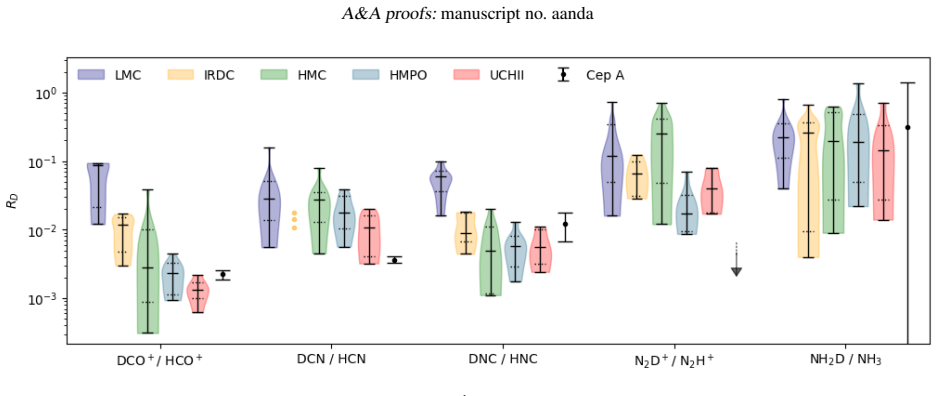
Cosmic rays (CRs) are important drivers for molecular chemistry in star-forming regions, and laboratory experiments have shown that CRs can stimulate the release of complex organic molecules (COMs) such as methanol. Observationally, this has primarily been tested in cold, low-mass cores, so studying how CRs affect COM formation in a high-mass star-forming environment is of great interest. We performed a high-sensitivity wide-band spectral line survey with the Onsala 20 m telescope towards the high-mass protostar Cepheus A HW2, which is known to host an ionised jet. Consistent with previous studies, two primary velocity components ($-11$ km s$^{-1}$ and $-5$ km s$^{-1}$) were identified. Column densities and relative abundances of the detected ions and COMs were estimated from rotational diagrams, single transitions and RADEX grid searches (CH$_3$OH: $1.6\times10^{-9}$, CH$_3$CN: $5.9\times10^{-11}$, t-HCOOH: $7.9\times10^{-11}$, H$_2$CCO: $1.7\times10^{-11}$, CH$_3$CHO: $1.9\times10^{-11}$, CH$_3$OCHO: $7.6\times10^{-10}$ at $-11$ km s$^{-1}$). Deuterium fractions were also estimated (in range $0.002-0.3$ at $-11$ km s$^{-1}$), and the volume density of molecular hydrogen ($2.6\times10^5$ cm$^{-3}$ at $-11$ km s$^{-1}$) was constrained from the RADEX grid searches. Electron fractions and CR ionisation rates (CRIR, $6.8\times10^{-17}$ s$^{-1}$ at $-11$ km s$^{-1}$, $\leq9.2\times10^{-19}$ s$^{-1}$ at $-5$ km s$^{-1}$) were estimated through analytic chemistry using different ions as probes. The gas-grain chemical code Nautilus reproduced the observed abundances of CH$_3$OH, CH$_3$CN, HCO$^+$, N$_2$H$^+$ at the observed density, temperature and CRIR within the uncertainty of the model. The results indicate that the CR ionisation rate of the kinematic component associated with most of the COMs' emission in the region is locally enhanced.
Editorial analysis
A structured set of objections, weighed in public.
Referee Report
Summary. The manuscript reports results from a wide-band spectral line survey of the high-mass protostar Cepheus A HW2 with the Onsala 20 m telescope. Two kinematic components are identified at approximately -11 km s^{-1} and -5 km s^{-1}. Column densities and abundances of detected COMs (e.g., CH3OH at 1.6e-9, CH3CN at 5.9e-11) and ions are derived using rotational diagrams, single-line estimates, and RADEX non-LTE grids; H2 volume density is constrained at 2.6e5 cm^{-3} for the -11 km s^{-1} component. Electron fractions and cosmic-ray ionization rates (CRIR) are obtained via analytic ion chemistry (CRIR = 6.8e-17 s^{-1} at -11 km s^{-1} versus an upper limit of 9.2e-19 s^{-1} at -5 km s^{-1}). The Nautilus gas-grain code is then run at the observed density, temperature, and derived CRIR to reproduce the abundances of CH3OH, CH3CN, HCO+, and N2H+. The central claim is that the CRIR is locally enhanced in the velocity component associated with the majority of the COM emission.
Significance. If the analytic CRIR derivation is shown to be robust, the work would extend studies of CR-driven COM chemistry from cold low-mass cores to a high-mass protostellar environment and provide a quantitative link between elevated CRIR and COM abundances. The multi-method approach (rotational diagrams + RADEX + analytic chemistry + Nautilus validation) and the successful reproduction of key abundances within model uncertainties are positive features that support the internal consistency of the analysis.
major comments (1)
- [CRIR estimation via analytic ion chemistry (methods and results sections)] The analytic chemistry expressions used to convert observed HCO+, N2H+, and electron abundances into CRIR values (reported as 6.8×10^{-17} s^{-1} at -11 km s^{-1}) assume cosmic-ray ionization is the dominant process balancing recombination and ion-molecule reactions. The source is known to host an ionized jet; any UV or X-ray leakage from the jet could produce the same ion enhancements without an increase in true CR flux. The Nautilus runs fix the CRIR at the analytically derived value and do not test whether an additional non-CR ionization term at a canonical CRIR can reproduce the observed abundances, which directly affects the load-bearing claim of local CRIR enhancement in the -11 km s^{-1} component.
minor comments (2)
- Explicit 1σ uncertainties or error bars should be reported on all derived quantities (column densities, abundances, CRIR values, and deuterium fractions) so that the statistical significance of the difference between the two velocity components can be evaluated.
- A supplementary table listing all detected transitions, integrated intensities, line widths, and the specific method used for each column-density estimate would improve reproducibility and allow independent verification of the rotational-diagram and RADEX results.
Simulated Author's Rebuttal
We appreciate the referee's detailed and constructive comments on our manuscript. The feedback highlights an important assumption in our analysis of the cosmic ray ionization rate. Below we provide a point-by-point response to the major comment and indicate the revisions we will make to the manuscript.
read point-by-point responses
-
Referee: The analytic chemistry expressions used to convert observed HCO+, N2H+, and electron abundances into CRIR values (reported as 6.8×10^{-17} s^{-1} at -11 km s^{-1}) assume cosmic-ray ionization is the dominant process balancing recombination and ion-molecule reactions. The source is known to host an ionized jet; any UV or X-ray leakage from the jet could produce the same ion enhancements without an increase in true CR flux. The Nautilus runs fix the CRIR at the analytically derived value and do not test whether an additional non-CR ionization term at a canonical CRIR can reproduce the observed abundances, which directly affects the load-bearing claim of local CRIR enhancement in the -11 km s^{-1} component.
Authors: We thank the referee for this insightful comment. The analytic expressions do indeed assume that cosmic-ray ionization is the primary driver. We have revised the manuscript to state this assumption more clearly and to discuss the ionized jet as a potential source of UV or X-ray ionization. We note that the localization of the high CRIR and COM emission to one kinematic component supports a local process rather than widespread jet leakage. Regarding the chemical models, the Nautilus runs were intended to check consistency with the derived CRIR. We have added text acknowledging that models with canonical CRIR plus extra ionization were not explored in the current work and suggest this as an avenue for future investigation. This does not change our main conclusion but highlights a limitation in distinguishing ionization sources. revision: partial
Circularity Check
No circularity: CRIR from standard analytic ion chemistry; Nautilus is post-hoc consistency check
full rationale
The paper derives CRIR values (6.8e-17 s^-1 and upper limit 9.2e-19 s^-1) directly from observed ion abundances via standard analytic chemistry expressions that balance cosmic-ray ionization against recombination and ion-molecule reactions. These expressions are applied separately to the two velocity components using HCO+, N2H+ and electron fractions. Nautilus is then run forward at the fixed observed density, temperature and this independently-derived CRIR to verify that CH3OH, CH3CN, HCO+ and N2H+ abundances fall within model uncertainty; it is not used to fit or back-solve for CRIR. No self-citation chain, ansatz smuggling, or renaming of known results is present in the derivation steps. The central claim therefore rests on external analytic formulae applied to new observations rather than reducing to its own inputs by construction.
Axiom & Free-Parameter Ledger
axioms (2)
- domain assumption Steady-state assumptions in analytic chemistry relating ion abundances to cosmic-ray ionization rate
- domain assumption Validity of RADEX non-LTE modeling for constraining H2 density and molecular abundances from observed lines
Reference graph
Works this paper leans on
-
[1]
Ag \'u ndez , M., Marcelino , N., Tercero , B., et al. 2021, , 649, L4
work page 2021
- [2]
-
[3]
Bacmann , A., Taquet , V., Faure , A., Kahane , C., & Ceccarelli , C. 2012, , 541, L12
work page 2012
-
[4]
Bettens , R. P. A., Hansen , T. A., & Collins , M. A. 1999, , 111, 6322
work page 1999
-
[5]
Bobylev, V. V. & Bajkova, A. T. 2010, Monthly Notices of the Royal Astronomical Society, 408, 1788–1795
work page 2010
-
[6]
Brogan , C. L., Chandler , C. J., Hunter , T. R., Shirley , Y. L., & Sarma , A. P. 2007, , 660, L133
work page 2007
- [7]
-
[8]
M., Tercero , B., Berm \'u dez , C., & Cernicharo , J
Cabezas , C., Neeman , E. M., Tercero , B., Berm \'u dez , C., & Cernicharo , J. 2021, , 645, A75
work page 2021
-
[9]
Cabezas , C., V \'a vra , K., Molpeceres , G., et al. 2025, , 698, L24
work page 2025
- [10]
-
[11]
Caselli, P., Walmsley, C. M., Terzieva, R., & Herbst, E. 1998, The Astrophysical Journal, 499, 234
work page 1998
-
[12]
Caselli, P., Walmsley, C. M., Zucconi, A., et al. 2002, The Astrophysical Journal, 565, 331–343
work page 2002
- [13]
-
[14]
Chac \'o n-Tanarro , A., Caselli , P., Bizzocchi , L., et al. 2019, , 622, A141
work page 2019
- [15]
-
[16]
Crapsi , A., Caselli , P., Walmsley , M. C., & Tafalla , M. 2007, , 470, 221
work page 2007
-
[17]
Dagdigian , P. J. 2024, , 527, 2209
work page 2024
- [18]
-
[19]
De Buizer , J. M., Liu , M., Tan , J. C., et al. 2017, , 843, 33
work page 2017
-
[20]
Draine , B. T. 1978, , 36, 595
work page 1978
-
[21]
P., Schlemmer , S., Schilke , P., Stutzki , J., & M \"u ller , H
Endres , C. P., Schlemmer , S., Schilke , P., Stutzki , J., & M \"u ller , H. S. P. 2016, Journal of Molecular Spectroscopy, 327, 95
work page 2016
-
[22]
Entekhabi , N., Tan , J. C., Cosentino , G., et al. 2022, , 662, A39
work page 2022
-
[23]
D., Cloutier , P., Sanche , L., & Huels , M
Esmaili , S., Bass , A. D., Cloutier , P., Sanche , L., & Huels , M. A. 2018, , 148, 164702
work page 2018
-
[24]
Fedriani , R., Tan , J. C., Telkamp , Z., et al. 2023, , 942, 7
work page 2023
- [25]
- [26]
- [27]
- [28]
-
[29]
Gaches, B. A. L. & Viti, S. 2026, ACS Earth and Space Chemistry
work page 2026
-
[30]
T., Wakelam , V., & Herbst , E
Garrod , R. T., Wakelam , V., & Herbst , E. 2007, , 467, 1103
work page 2007
- [31]
-
[32]
Gerner , T., Shirley , Y. L., Beuther , H., et al. 2015, , 579, A80
work page 2015
- [33]
-
[34]
Ginsburg , A. & Mirocha , J. 2011, PySpecKit: Python Spectroscopic Toolkit , Astrophysics Source Code Library, record ascl:1109.001
work page 2011
-
[35]
2022, The Astronomical Journal, 163, 291
Ginsburg, A., Sokolov, V., de Val-Borro, M., et al. 2022, The Astronomical Journal, 163, 291
work page 2022
-
[36]
Goetz , J. A., Pipher , J. L., Forrest , W. J., et al. 1998, , 504, 359
work page 1998
-
[37]
Goldsmith, P. F. & Langer, W. D. 1999, The Astrophysical Journal, 517, 209
work page 1999
-
[38]
Guti \'e rrez-Quintanilla , A., Layssac , Y., Butscher , T., et al. 2021, , 506, 3734
work page 2021
-
[39]
Hacar , A., Bosman , A. D., & van Dishoeck , E. F. 2020, , 635, A4
work page 2020
- [40]
- [41]
- [42]
- [43]
-
[44]
Hern \'a ndez-Vera , C., Guzm \'a n , V. V., Pety , J., et al. 2026, arXiv e-prints, arXiv:2601.20146
-
[45]
Hughes , V. A. & Wouterloot , J. G. A. 1984, , 276, 204
work page 1984
-
[46]
L., Henkel , C., & Mauersberger , R
Huttemeister , S., Wilson , T. L., Henkel , C., & Mauersberger , R. 1993, , 276, 445
work page 1993
- [47]
-
[48]
Indriolo , N., Ivlev , A. V., Pellegrin , T., et al. 2026, , 997, 123
work page 2026
-
[49]
Jim \'e nez-Serra , I., Vasyunin , A. I., Caselli , P., et al. 2016, , 830, L6
work page 2016
-
[50]
Jim \'e nez-Serra , I., Vasyunin , A. I., Spezzano , S., et al. 2021, , 917, 44
work page 2021
-
[51]
C., Wakelam , V., & Sipil \"a , O
Kong , S., Caselli , P., Tan , J. C., Wakelam , V., & Sipil \"a , O. 2015, , 804, 98
work page 2015
-
[52]
Lacy , J. H., Knacke , R., Geballe , T. R., & Tokunaga , A. T. 1994, , 428, L69
work page 1994
- [53]
- [54]
-
[55]
Linsky , J. L., Draine , B. T., Moos , H. W., et al. 2006, , 647, 1106
work page 2006
-
[56]
Luo, G., Bisbas, T. G., Padovani, M., & Gaches, B. A. L. 2024, , 690, A293
work page 2024
-
[57]
Meg \' as , A., Jim \'e nez-Serra , I., Mart \' n-Pintado , J., et al. 2023, , 519, 1601
work page 2023
- [58]
-
[59]
Moscadelli , L., Reid , M. J., Menten , K. M., et al. 2009, , 693, 406
work page 2009
-
[60]
M \"u ller , H. S. P., Thorwirth , S., Roth , D. A., & Winnewisser , G. 2001, , 370, L49
work page 2001
-
[61]
Müller, H. S. P., Menten, K. M., & Mäder, H. 2004, , 428, 1019–1026
work page 2004
- [62]
-
[63]
Nummelin , A., Dickens , J. E., Bergman , P., et al. 1998, , 337, 275
work page 1998
- [64]
-
[65]
Padovani , M., Marcowith , A., Hennebelle , P., & Ferri \`e re , K. 2016, , 590, A8
work page 2016
-
[66]
Pazukhin , A. G., Zinchenko , I. I., Trofimova , E. A., & Henkel , C. 2022, Astronomy Reports, 66, 1302
work page 2022
-
[67]
Pazukhin , A. G., Zinchenko , I. I., Trofimova , E. A., Henkel , C., & Semenov , D. A. 2023, , 526, 3673
work page 2023
-
[68]
Petrashkevich , I., Punanova , A., Caselli , P., et al. 2026, , 997, 296
work page 2026
-
[69]
Petrashkevich , I. V., Punanova , A. F., Caselli , P., et al. 2024, , 528, 1327
work page 2024
-
[70]
Pickett , H. M., Poynter , R. L., Cohen , E. A., et al. 1998, , 60, 883
work page 1998
-
[71]
Pillai , T., Wyrowski , F., Hatchell , J., Gibb , A. G., & Thompson , M. A. 2007, , 467, 207
work page 2007
-
[72]
Pineda, J. E., Sipilä, O., Segura-Cox, D. M., et al. 2024, , 686, A162
work page 2024
-
[73]
Punanova , A., Caselli , P., Pon , A., Belloche , A., & Andr \'e , P. 2016, , 587, A118
work page 2016
-
[74]
Reboussin , L., Wakelam , V., Guilloteau , S., & Hersant , F. 2014, , 440, 3557
work page 2014
-
[75]
Redaelli , E., Bizzocchi , L., Caselli , P., et al. 2019, , 629, A15
work page 2019
- [76]
-
[77]
Redaelli , E., Bovino , S., Sabatini , G., et al. 2025, , 702, A210
work page 2025
- [78]
-
[79]
Roueff , E., Lis , D. C., van der Tak , F. F. S., Gerin , M., & Goldsmith , P. F. 2005, , 438, 585
work page 2005
- [80]
discussion (0)
Sign in with ORCID, Apple, or X to comment. Anyone can read and Pith papers without signing in.