Persistent Imbalance in Open Networks with Coevolutionary dynamics
Pith reviewed 2026-05-11 00:46 UTC · model grok-4.3
The pith
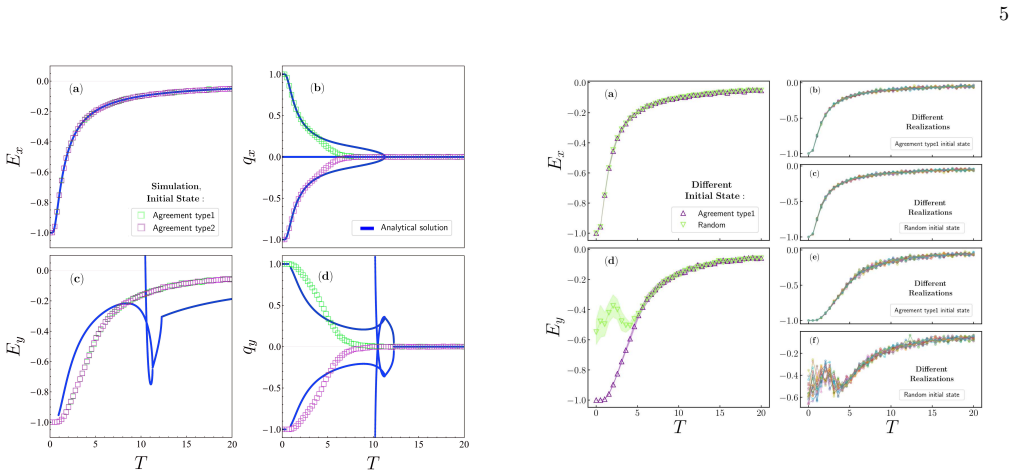
Asymmetric coupling between an independent and open network sustains imbalance in the dependent system below a transition temperature while raising that temperature.
A machine-rendered reading of the paper's core claim, the machinery that carries it, and where it could break.
Core claim
In a coevolutionary system consisting of an independent network and an open network linked by asymmetric directed coupling, below the transition temperature the independent network reaches structural balance while the open network enters a sustained imbalance phase; the coupling also produces a measurable upward shift in the transition temperature.
What carries the argument
Mean-field framework for coevolutionary balance dynamics under directed asymmetric coupling between an autonomous independent network and a dependent open network.
If this is right
- The open network enters a sustained imbalance phase below the transition temperature.
- Asymmetric coupling raises the transition temperature relative to an isolated network.
- Direct numerical simulations confirm both the persistent imbalance and the upward temperature shift.
Where Pith is reading between the lines
- External influences can maintain imbalance in open social systems even when internal rules favor balance.
- The same mechanism may operate in other open networks such as economic or information systems under asymmetric external drive.
Load-bearing premise
The mean-field approximation remains accurate for the coupled directed dynamics and the chosen asymmetric coupling form captures the essential external influence.
What would settle it
A simulation or observation in which the open network reaches balance below the predicted transition temperature or in which the transition temperature shows no upward shift with coupling would falsify the central claim.
Figures



read the original abstract
Societies are quintessential open systems, shaped by internal dynamics as well as external influences. The question is how these external influences alter the collective behavior and network dynamics. To answer this, we investigate coevolutionary balance dynamics in a system of independent and open networks. Here, the system consists of two interacting networks with directed (asymmetric) coupling: an independent network evolving autonomously and an open (dependent) network whose dynamics are influenced by the former. Using a mean-field framework, we demonstrate a transition temperature: below the transition temperature, the independent network reaches a state of structural balance, while the open network is destabilized by persistent imbalance states and enters a sustained imbalance phase. This coupling also induces a measurable upward shift in the transition temperature. Direct numerical simulations robustly confirm these analytical predictions.
Editorial analysis
A structured set of objections, weighed in public.
Referee Report
Summary. The paper examines coevolutionary structural balance dynamics in a system of two asymmetrically coupled networks: an independent network that evolves autonomously and an open network whose dynamics are driven by the independent one. Using a mean-field framework, the authors derive a transition temperature below which the independent network reaches structural balance while the open network enters a sustained imbalance phase characterized by persistent imbalance states. The directed coupling is shown to produce a measurable upward shift in the transition temperature, with these predictions confirmed by direct numerical simulations.
Significance. If the central results hold, the work meaningfully extends structural balance theory to open systems by demonstrating how external asymmetric influences can destabilize balance and shift critical points. The combination of an analytic mean-field derivation with numerical confirmation provides a concrete framework for coevolutionary dynamics in social and complex networks, with potential implications for modeling external perturbations in real-world open systems.
major comments (2)
- [Mean-field analysis] Mean-field analysis section: the closure for the joint probability distribution in the asymmetrically coupled directed dynamics assumes sufficient factorization. In the sustained-imbalance regime, long-lived correlations between the open network's persistent states and the driving network may survive the truncation and shift both the location of T_c and the magnitude of the upward shift; an explicit quantification of the factorization error (e.g., via moment comparisons or finite-size scaling of the shift) is needed to support the quantitative claim.
- [Numerical simulations] Simulation results section: while the abstract states that direct simulations confirm the analytic predictions, the manuscript does not report how the transition is identified in finite systems, the system sizes used, or error estimates on the measured shift in T_c. These details are load-bearing for validating the mean-field result against possible correlation effects.
minor comments (2)
- [Abstract] The abstract refers to a 'measurable upward shift' without giving its analytic form or numerical magnitude; including the explicit expression or a representative value would improve precision.
- [Model definition] Notation for the coupling strength and order parameters should be defined at first use and used consistently across equations and figures.
Simulated Author's Rebuttal
We thank the referee for the constructive and detailed comments, which help improve the clarity and rigor of our work on coevolutionary structural balance in asymmetrically coupled networks. We address each major comment below and indicate the corresponding revisions.
read point-by-point responses
-
Referee: [Mean-field analysis] Mean-field analysis section: the closure for the joint probability distribution in the asymmetrically coupled directed dynamics assumes sufficient factorization. In the sustained-imbalance regime, long-lived correlations between the open network's persistent states and the driving network may survive the truncation and shift both the location of T_c and the magnitude of the upward shift; an explicit quantification of the factorization error (e.g., via moment comparisons or finite-size scaling of the shift) is needed to support the quantitative claim.
Authors: We acknowledge that the mean-field closure relies on a factorization assumption for the joint probability distribution, and that persistent correlations in the sustained-imbalance regime could in principle affect the precise location and magnitude of the upward shift in T_c. Our defense is that the analytic predictions nevertheless match the exact finite-system simulations to high accuracy over the full range of coupling strengths and temperatures examined, indicating that residual correlations do not qualitatively alter the reported phenomenology. To make this explicit, the revised manuscript will add a dedicated paragraph quantifying the factorization error through direct comparison of two-point and three-point moments extracted from simulations against the mean-field closure, together with a finite-size scaling analysis of the measured T_c shift. revision: yes
-
Referee: [Numerical simulations] Simulation results section: while the abstract states that direct simulations confirm the analytic predictions, the manuscript does not report how the transition is identified in finite systems, the system sizes used, or error estimates on the measured shift in T_c. These details are load-bearing for validating the mean-field result against possible correlation effects.
Authors: We agree that these implementation details are essential for assessing the robustness of the comparison. The original text omitted them for conciseness. In the revised version we will explicitly state the network sizes employed (N = 500–2000 nodes per network), describe the operational definition of the transition (location of the peak in the susceptibility of the imbalance order parameter, cross-checked with Binder-cumulant crossings), and report statistical uncertainties on the extracted T_c shift obtained from 50–100 independent Monte Carlo realizations per parameter point. revision: yes
Circularity Check
Mean-field derivation of transition temperature remains self-contained without reduction to inputs
full rationale
The paper presents an analytical derivation of the transition temperature and the upward shift induced by asymmetric coupling, obtained from a mean-field treatment of the coevolutionary balance dynamics on the two networks. The independent network is shown to reach structural balance below Tc while the open network enters a sustained imbalance phase, with the coupling effect emerging directly from the closed equations. No step reduces a claimed prediction to a fitted parameter or to a self-citation chain; the mean-field closure is an explicit modeling assumption whose consequences are then compared to direct simulations. The derivation chain is therefore independent of the target phenomena and does not exhibit any of the enumerated circularity patterns.
Axiom & Free-Parameter Ledger
free parameters (1)
- coupling strength
axioms (2)
- domain assumption Mean-field approximation accurately describes the collective dynamics of the two networks
- domain assumption Structural balance rules apply independently to each network except for the directed influence
Lean theorems connected to this paper
-
IndisputableMonolith/Cost/FunctionalEquation.leanwashburn_uniqueness_aczel unclear?
unclearRelation between the paper passage and the cited Recognition theorem.
Using a mean-field framework, we demonstrate a transition temperature: below the transition temperature, the independent network reaches a state of structural balance, while the open network is destabilized by persistent imbalance states...
-
IndisputableMonolith/Foundation/AbsoluteFloorClosure.leanreality_from_one_distinction unclear?
unclearRelation between the paper passage and the cited Recognition theorem.
the Hamiltonian of the system defines the interaction structure between nodes and links... H(G) = −∑i<j Si σij Sj
What do these tags mean?
- matches
- The paper's claim is directly supported by a theorem in the formal canon.
- supports
- The theorem supports part of the paper's argument, but the paper may add assumptions or extra steps.
- extends
- The paper goes beyond the formal theorem; the theorem is a base layer rather than the whole result.
- uses
- The paper appears to rely on the theorem as machinery.
- contradicts
- The paper's claim conflicts with a theorem or certificate in the canon.
- unclear
- Pith found a possible connection, but the passage is too broad, indirect, or ambiguous to say the theorem truly supports the claim.
Reference graph
Works this paper leans on
-
[1]
Self-Consistent Equations We can decompose the Hamiltonian of the auxiliary networkZinto two parts: one that includes the element i(H z i ) and another part that contains all the remaining terms (H ′z). Hz(Gz) =−2 X i<j Sz i σz ij Sz j , Hz =H z i +H ′z.(A1) Similarly, the Hamiltonian can also be decomposed into two parts in another way: Hz =H z ij +H ′′z...
-
[2]
Derivation of the Energy Equation With the background of the equationsH z(Gz) = −2 X i<j Sz i σz ij Sz j (7) andH z =H z ij +H ′′z (A2), we can write: Hz i,j =−S z i X l̸=i,j σz il Sz l −S z j X l̸=i,j σz jl Sz l −S z i σz ij Sz j .(A12) The expected value of⟨S z i σz ijSz j ⟩is given by the sum over all possible configurations, where each term is the pro...
-
[3]
Self-Consistent Equation Using the equations of the independent networkXand the auxiliary networkZ, we derive the equations for the dependent networkY. First, the mean values of nodes in the networks are related as follows: pz = px +p y 2 , py = 2pz −p x.(B1) Next, we turn our attention to the node-link correla- tions: qz =⟨σ z ijSz j ⟩ = ⟨σx ijSx j ⟩+⟨σ ...
-
[4]
Energy of the Dependent Network We start by considering the Hamiltonian of the aux- iliary networkZ, where the contributions of individual node-link-node triplets can be expressed in terms of the corresponding elements of the independent and depen- dent networks: Hz(Gz) =−2 X i<j Sz i σz ij Sz j , as we know, the auxiliary networkZis defined from the inde...
-
[5]
Heider, Journal of Psychology21, 107 (1946)
F. Heider, Journal of Psychology21, 107 (1946)
work page 1946
- [6]
-
[7]
Heider,The Psychology of Interpersonal Relations, 1st ed
F. Heider,The Psychology of Interpersonal Relations, 1st ed. (Psychology Press, New York, 1958)
work page 1958
-
[8]
Hart, Journal of Peace Research11, 229 (1974)
J. Hart, Journal of Peace Research11, 229 (1974)
work page 1974
-
[9]
M. Szell, R. Lambiotte, and S. Thurner, Proceedings of the National Academy of Sciences107, 13636 (2010), https://www.pnas.org/doi/pdf/10.1073/pnas.1004008107
-
[10]
F. Rabbani, A. H. Shirazi, and G. R. Jafari, Phys. Rev. E99, 062302 (2019)
work page 2019
-
[11]
A. Kargaran, H. Jafari, and G. R. Jafari, Hierarchical balance theory: Emergence of instability in follower layer below critical temperatures (2025), arXiv:2504.17714 [physics.soc-ph]
-
[12]
M. G. Noudehi, A. Kargaran, N. Azimi-Tafreshi, and G. R. Jafari, Phys. Rev. E106, 044303 (2022)
work page 2022
- [13]
-
[14]
N. Allahyari, A. Kargaran, A. Hosseiny, and G. R. Jafari, PLOS ONE17, 1 (2022)
work page 2022
-
[15]
Z. Moradimanesh, R. Khosrowabadi, M. Eshaghi Gordji, and G. R. Jafari, Scientific Reports11, 1966 (2021)
work page 1966
- [16]
-
[17]
C. Castellano, S. Fortunato, and V. Loreto, Rev. Mod. Phys.81, 591 (2009)
work page 2009
-
[18]
Galam, Physica A: Statistical Mechanics and its Ap- plications230, 174–188 (1996)
S. Galam, Physica A: Statistical Mechanics and its Ap- plications230, 174–188 (1996)
work page 1996
- [19]
- [20]
-
[21]
M. McPherson, L. Smith-Lovin, and J. M. Cook, Annual Review of Sociology27, 415 (2001)
work page 2001
- [22]
-
[23]
E. Lee, F. Karimi, C. Wagner, H.-H. Jo, M. Strohmaier, and M. Galesic, Nature Human Behaviour3, 1078 (2019)
work page 2019
- [24]
-
[25]
C. Castellano, M. Marsili, and A. Vespignani, Physical Review Letters85, 3536 (2000)
work page 2000
-
[26]
C. Castellano, D. Vilone, and A. Vespignani, Europhysics Letters63, 153 (2003)
work page 2003
-
[27]
M. Saeedian, M. S. Miguel, and R. Toral, New Journal of Physics22, 113001 (2020)
work page 2020
-
[28]
M. Saeedian, C. Tu, F. Menegazzo, P. D’Odorico, S. Aza- ele, and S. Suweis, New Journal of Physics26, 083004 (2024)
work page 2024
- [29]
- [30]
-
[31]
P. J. G´ orski, K. Bochenina, J. A. Ho lyst, and R. M. D’Souza, Phys. Rev. Lett.125, 078302 (2020)
work page 2020
-
[32]
P. J. G´ orski, C. Atkisson, and J. A. Ho lyst, Network Science11, 536–559 (2023)
work page 2023
- [33]
-
[34]
T. M. Pham, J. Korbel, R. Hanel, and S. Thurner, Proceedings of the National Academy of Sciences119, e2121103119 (2022)
work page 2022
-
[35]
U. Kan, M. Feng, and M. A. Porter, Journal of Complex Networks11, cnac055 (2023)
work page 2023
- [36]
- [37]
- [38]
- [39]
-
[40]
T. A. B. Snijders, P. E. Pattison, G. L. Robins, and M. S. Handcock, Sociological Methodology36, 99 (2006), https://doi.org/10.1111/j.1467-9531.2006.00176.x
-
[41]
G. Robins, P. Pattison, Y. Kalish, and D. Lusher, Social Networks29, 173 (2007), special Section: Advances in Exponential Random Graph (p*) Models. [38]Exponential Random Graph Models for Social Networks: Theory, Methods, and Applications, Structural Analy- sis in the Social Sciences (Cambridge University Press, 2012)
work page 2007
-
[42]
R. W. Krause, M. Huisman, C. Steglich, and T. Snijders, Social Networks62, 99 (2020)
work page 2020
-
[43]
H. Goldstein, C. Poole, and J. Safko,Classical Mechan- ics, 3rd ed. (Addison-Wesley, 2002)
work page 2002
-
[44]
K. KU LAKOWSKI, P. GAWRO´NSKI, and P. GRONEK, International Journal of Modern Physics C16, 707 (2005), https://doi.org/10.1142/S012918310500742X
-
[45]
S. A. Marvel, J. Kleinberg, R. D. Kleinberg, and S. H. Strogatz, Proceedings of the Na- tional Academy of Sciences108, 1771 (2011), https://www.pnas.org/doi/pdf/10.1073/pnas.1013213108
discussion (0)
Sign in with ORCID, Apple, or X to comment. Anyone can read and Pith papers without signing in.