Recognition: no theorem link
RcLLM: Accelerating Generative Recommendation via Beyond-Prefix KV Caching
Pith reviewed 2026-05-11 02:03 UTC · model grok-4.3
The pith
RcLLM decomposes recommendation prompts into reusable blocks to cache KV states beyond contiguous prefixes and cut time-to-first-token by 1.31x to 9.51x.
A machine-rendered reading of the paper's core claim, the machinery that carries it, and where it could break.
Core claim
RcLLM is a distributed inference system that replaces standard prefix KV caching with beyond-prefix caching: prompts are decomposed into reusable blocks, user-history caches are fully replicated for zero-latency retrieval, item caches are sharded by similarity, and an affinity-based global scheduler plus selective attention mechanism together eliminate most redundant quadratic attention computation while preserving output quality.
What carries the argument
Beyond-prefix KV caching, which decomposes prompts into reusable blocks and supports non-contiguous reuse through stratified storage and selective attention correction.
If this is right
- Real-time generative recommendation becomes feasible at industrial scale because first-token latency drops enough for interactive use.
- Memory and compute costs for serving large item catalogs fall because only relevant blocks are loaded and attention is pruned selectively.
- The same decomposition approach can be applied to any workload whose prompts contain repeated non-contiguous segments.
- Distributed serving systems gain a new caching layer that sits between pure prefix reuse and full recomputation.
Where Pith is reading between the lines
- The method may extend naturally to multi-turn conversational recommendation where later turns share history blocks with earlier ones.
- Cache hit-rate measurements on catalogs of varying sizes would quantify how the sharding strategy scales beyond the reported datasets.
- If block boundaries are chosen by learned embeddings rather than fixed rules, the approach could adapt to new prompt styles without manual tuning.
Load-bearing premise
Prompts can be reliably broken into reusable blocks and the selective attention fix will correct any approximation errors without meaningfully harming recommendation quality.
What would settle it
Run the same recommendation task on a dataset where block decomposition produces frequent mismatches; if TTFT gains disappear or accuracy falls below the reported negligible threshold, the central claim is falsified.
Figures


read the original abstract
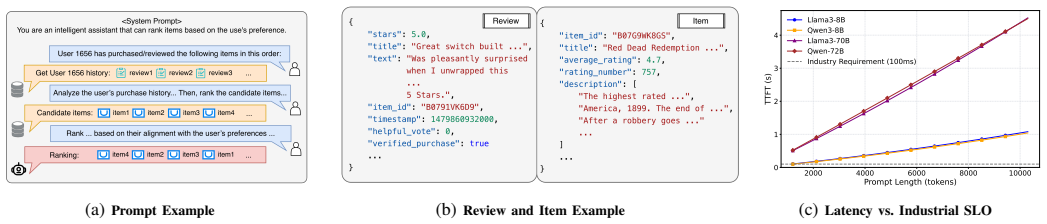
Large Language Models (LLMs) are transforming recommendation from ranking into a generative task, but industrial deployment remains limited by the high latency of processing long, personalized prompts. Standard prefix caching provides limited benefit because reuse in recommendation workloads is often non-contiguous across user histories and item contexts. We present RcLLM, a distributed inference system for generative recommendation with Beyond-Prefix KV Caching. RcLLM decomposes prompts into reusable blocks and supports large item catalogs with a stratified distributed storage design: compact user-history caches are replicated for zero-latency retrieval, while massive item caches are sharded using similarity-aware placement. To reduce redundant quadratic attention computation, RcLLM combines an affinity-based global scheduler that improves data locality with a selective attention mechanism that corrects approximation errors. Experiments on real-world datasets show that RcLLM reduces Time-To-First-Token (TTFT) by 1.31x-9.51x compared with state-of-the-art prefix caching systems, enabling real-time serving with negligible impact on recommendation accuracy.
Editorial analysis
A structured set of objections, weighed in public.
Referee Report
Summary. The manuscript introduces RcLLM, a distributed inference system for generative recommendation that uses beyond-prefix KV caching. Prompts are decomposed into reusable blocks with stratified storage (replicated user-history caches and sharded item caches), an affinity-based global scheduler for data locality, and a selective attention mechanism to correct approximation errors from non-contiguous reuse. Experiments on real-world datasets are reported to yield 1.31x-9.51x TTFT reductions versus state-of-the-art prefix caching systems while maintaining recommendation accuracy.
Significance. If the performance and accuracy claims are substantiated, the work would address a key barrier to industrial deployment of generative LLMs in recommendation by enabling real-time serving of long personalized prompts where standard prefix caching provides limited benefit due to non-contiguous reuse patterns.
major comments (3)
- Abstract: The central claim of 1.31x-9.51x TTFT reduction with 'negligible impact on recommendation accuracy' is presented without any reference to experimental setup details, baselines, datasets, error bars, or statistical tests, leaving the load-bearing performance result with insufficient verifiable support.
- Selective attention mechanism (described in abstract): The assertion that this mechanism reliably corrects approximation errors arising from prompt decomposition into reusable blocks lacks any ablation studies, error analysis, or bounds on when correction succeeds, particularly for long heterogeneous user histories; this directly underpins the 'negligible accuracy impact' claim.
- Stratified distributed storage design (abstract): No quantitative evaluation or comparison is referenced for the similarity-aware sharding of massive item caches versus alternatives, making it impossible to assess whether this design is load-bearing for the reported TTFT gains.
minor comments (1)
- Abstract: The range 1.31x-9.51x is stated without specifying the conditions or datasets under which the minimum and maximum are achieved.
Simulated Author's Rebuttal
We thank the referee for the constructive and detailed review. We address each major comment below and outline revisions to strengthen the manuscript.
read point-by-point responses
-
Referee: Abstract: The central claim of 1.31x-9.51x TTFT reduction with 'negligible impact on recommendation accuracy' is presented without any reference to experimental setup details, baselines, datasets, error bars, or statistical tests, leaving the load-bearing performance result with insufficient verifiable support.
Authors: We agree the abstract's brevity limits immediate verifiability. The full manuscript (Section 5) specifies real-world datasets, state-of-the-art prefix caching baselines, and averaged TTFT results across runs. We will revise the abstract to briefly reference the datasets, baselines, and note that improvements are consistent with low variance across multiple trials, while retaining conciseness. revision: partial
-
Referee: Selective attention mechanism (described in abstract): The assertion that this mechanism reliably corrects approximation errors arising from prompt decomposition into reusable blocks lacks any ablation studies, error analysis, or bounds on when correction succeeds, particularly for long heterogeneous user histories; this directly underpins the 'negligible accuracy impact' claim.
Authors: We acknowledge the current version lacks dedicated ablations and bounds. The manuscript describes the mechanism's design for correcting non-contiguous reuse errors, but we will add a new subsection with ablations isolating selective attention's accuracy impact over varying history lengths and heterogeneity. We will also include error analysis quantifying pre- and post-correction approximation errors and empirical bounds from experiments to substantiate the negligible accuracy claim. revision: yes
-
Referee: Stratified distributed storage design (abstract): No quantitative evaluation or comparison is referenced for the similarity-aware sharding of massive item caches versus alternatives, making it impossible to assess whether this design is load-bearing for the reported TTFT gains.
Authors: The stratified design (replicated user caches, similarity-aware sharded item caches) is evaluated end-to-end in the manuscript, but we agree specific comparisons are needed. We will add quantitative results comparing similarity-aware sharding against random and hash-based alternatives, showing effects on load balance, hit rates, and TTFT to demonstrate its contribution to the gains. revision: yes
Circularity Check
No circularity: empirical systems claims rest on experiments
full rationale
The paper describes a distributed KV-caching system for generative recommendation with no mathematical derivation chain, no fitted parameters renamed as predictions, and no load-bearing self-citations or uniqueness theorems. TTFT reductions and accuracy claims are presented as outcomes of reported experiments on real-world datasets rather than reductions to inputs by construction. Design elements such as block decomposition, affinity scheduling, and selective attention are introduced as engineering choices whose correctness is asserted via empirical measurement, not self-definition or prior-author ansatz smuggling.
Axiom & Free-Parameter Ledger
Reference graph
Works this paper leans on
-
[1]
Updlrm: Pim-based accelerator to address the memory bottleneck in dlrm inference,
S. Chen, H. Tan, A. C. Zhou, Y . Liet al., “Updlrm: Pim-based accelerator to address the memory bottleneck in dlrm inference,” in DAC’24, 2024, pp. 1–6
work page 2024
-
[2]
Near-zero-overhead fresh- ness for recommendation systems via inference-side model updates,
W. Yu, S. Chen, A. C. Zhou, and C. Chen, “Near-zero-overhead fresh- ness for recommendation systems via inference-side model updates,” in HPCA’26, 2026
work page 2026
-
[3]
Onerec technical report.arXiv preprint arXiv:2506.13695, 2025
G. Zhou, J. Deng, J. Zhang, K. Caiet al., “Onerec technical report,” arXiv:2506.13695, 2025
-
[4]
Gpt4rec: A generative frame- work for personalized recommendation and user interests interpretation,
J. Li, W. Zhang, T. Wang, G. Xionget al., “Gpt4rec: A generative frame- work for personalized recommendation and user interests interpretation,” arXiv:2304.03879, 2023
-
[5]
J. Beswick. (2021) Operating lambda: Performance optimization – part
work page 2021
- [6]
-
[7]
Deeprecsys: A system for optimizing end-to-end at-scale neural recommendation inference,
U. Gupta, S. Hsia, V . Saraph, X. Wanget al., “Deeprecsys: A system for optimizing end-to-end at-scale neural recommendation inference,” in ISCA’20, 2020
work page 2020
-
[8]
Minference 1.0: Accelerat- ing pre-filling for long-context llms via dynamic sparse attention,
H. Jiang, Y . Li, C. Zhang, Q. Wuet al., “Minference 1.0: Accelerat- ing pre-filling for long-context llms via dynamic sparse attention,” in NeurIPS’24, 2024
work page 2024
-
[9]
Transformers: State- of-the-art natural language processing,
T. Wolf, L. Debut, V . Sanh, J. Chaumondet al., “Transformers: State- of-the-art natural language processing,” inEMNLP’20, 2020
work page 2020
-
[10]
Efficient memory management for large language model serving with pagedattention,
W. Kwon, Z. Li, S. Zhuang, Y . Shenget al., “Efficient memory management for large language model serving with pagedattention,” in SOSP’23, 2023
work page 2023
-
[11]
Sglang: efficient execution of structured language model programs,
L. Zheng, L. Yin, Z. Xie, C. Sunet al., “Sglang: efficient execution of structured language model programs,” inNeurIPS’24, 2024
work page 2024
-
[12]
arXiv preprint arXiv:2409.12740 , year=
J. Chen, L. Chi, B. Peng, and Z. Yuan, “Hllm: Enhancing sequential recommendations via hierarchical large language models for item and user modeling,”arXiv:2409.12740, 2024
-
[13]
R. He and J. McAuley, “Ups and downs: Modeling the visual evolution of fashion trends with one-class collaborative filtering,” inWWW ’16, 2016
work page 2016
-
[14]
A. Grattafiori, A. Dubey, A. Jauhri, A. Pandeyet al., “The llama 3 herd of models,”arXiv:2407.21783, 2024
work page internal anchor Pith review Pith/arXiv arXiv 2024
-
[15]
A. Yang, A. Li, B. Yang, B. Zhanget al., “Qwen3 technical report,” arXiv:2505.09388, 2025
work page internal anchor Pith review Pith/arXiv arXiv 2025
-
[16]
Preble: Efficient distributed prompt scheduling for LLM serving,
V . Srivatsa, Z. He, R. Abhyankar, D. Liet al., “Preble: Efficient distributed prompt scheduling for LLM serving,” inICLR’25, 2025
work page 2025
-
[17]
A sur- vey on locality sensitive hashing algorithms and their applications,
O. Jafari, P. Maurya, P. Nagarkar, K. M. Islamet al., “A sur- vey on locality sensitive hashing algorithms and their applications,” arXiv:2102.08942, 2021
-
[18]
Bridging Language and Items for Retrieval and Recommendation: Benchmarking LLMs as Semantic Encoders
Y . Hou, J. Li, Z. He, A. Yanet al., “Bridging language and items for retrieval and recommendation,”arXiv:2403.03952, 2024
work page internal anchor Pith review Pith/arXiv arXiv 2024
-
[19]
Y . Inc. (2025) Yelp open dataset. Yelp Open Dataset. [Online]. Available: https://business.yelp.com/data/resources/open-dataset/
work page 2025
-
[20]
Item recommendation on monotonic behavior chains,
M. Wan and J. McAuley, “Item recommendation on monotonic behavior chains,” inRecSys’18, 2018
work page 2018
-
[21]
Multilevelk-way partitioning scheme for irregular graphs,
G. Karypis and V . Kumar, “Multilevelk-way partitioning scheme for irregular graphs,”Journal of Parallel and Distributed computing, 1998
work page 1998
-
[22]
Aibrix: Towards scalable, cost-effective large language model inference infrastructure,
T. A. Team, J. Shan, V . Gupta, L. Xuet al., “Aibrix: Towards scalable, cost-effective large language model inference infrastructure,” arXiv:2504.03648, 2025
-
[23]
Zero-copy i/o processing for low- latency gpu computing,
S. Kato, J. Aumiller, and S. Brandt, “Zero-copy i/o processing for low- latency gpu computing,” inICCPS’13, 2013
work page 2013
-
[24]
Semsharekv: Efficient kvcache sharing for semantically similar prompts via token-level lsh matching,
X. Zhao and S. Mastorakis, “Semsharekv: Efficient kvcache sharing for semantically similar prompts via token-level lsh matching,” inAACL- IJCNLP’25, 2025
work page 2025
-
[25]
Cacheblend: Fast large language model serving for rag with cached knowledge fusion,
J. Yao, H. Li, Y . Liu, S. Rayet al., “Cacheblend: Fast large language model serving for rag with cached knowledge fusion,” inEuroSys ’25, 2025
work page 2025
-
[26]
Roformer: Enhanced transformer with rotary position embedding,
J. Su, M. Ahmed, Y . Lu, S. Panet al., “Roformer: Enhanced transformer with rotary position embedding,”Neurocomputing, 2024
work page 2024
-
[27]
Vidur: A large-scale simulation framework for llm inference,
A. Agrawal, N. Kedia, J. Mohan, A. Panwaret al., “Vidur: A large-scale simulation framework for llm inference,” inMLSYS’24, 2024
work page 2024
-
[28]
A. Yang, B. Yang, B. Hui, B. Zhenget al., “Qwen2 technical report,” arXiv:2407.10671, 2024
work page internal anchor Pith review Pith/arXiv arXiv 2024
-
[29]
Agentsociety challenge: Designing llm agents for user modeling and recommendation on web platforms,
Y . Yan, Y . Shang, Q. Zeng, Y . Liet al., “Agentsociety challenge: Designing llm agents for user modeling and recommendation on web platforms,” inWWW’25, 2025
work page 2025
-
[30]
EPIC: Efficient position- independent caching for serving large language models,
J. Hu, W. Huang, W. Wang, H. Wanget al., “EPIC: Efficient position- independent caching for serving large language models,” inICML ’25, 2025
work page 2025
-
[31]
arXiv preprint arXiv:2304.03153 , year=
L. Wang and E.-P. Lim, “Zero-shot next-item recommendation using large pretrained language models,”arXiv:2304.03153, 2023
-
[32]
Large language models are zero-shot rankers for recommender systems,
Y . Hou, J. Zhang, Z. Lin, H. Luet al., “Large language models are zero-shot rankers for recommender systems,” inECIR’24, 2024
work page 2024
-
[33]
L. Xu, J. Zhang, B. Li, J. Wanget al., “Tapping the potential of large language models as recommender systems: A comprehensive framework and empirical analysis,”ACM TKDD, 2025
work page 2025
-
[34]
Star: A simple training- free approach for recommendations using large language models,
D.-H. Lee, A. Kraft, L. Jin, N. Mehtaet al., “Star: A simple training- free approach for recommendations using large language models,” arXiv:2410.16458, 2025
-
[35]
Llamarec: Two-stage recommendation using large language models for ranking, 2023
Z. Yue, S. Rabhi, G. de Souza Pereira Moreira, D. Wanget al., “Llamarec: Two-stage recommendation using large language models for ranking,”arXiv:2311.02089, 2023
-
[36]
Drdt: Dynamic reflection with divergent thinking for llm-based sequential recommendation,
Y . Wang, Z. Liu, J. Zhang, W. Yaoet al., “Drdt: Dynamic reflection with divergent thinking for llm-based sequential recommendation,” arXiv:2312.11336, 2023
-
[37]
arXiv preprint arXiv:2303.14524 , year=
Y . Gao, T. Sheng, Y . Xiang, Y . Xionget al., “Chat-rec: Towards interactive and explainable llms-augmented recommender system,” arXiv:2303.14524, 2023
-
[38]
Genrec: Large language model for generative recommendation,
J. Ji, Z. Li, S. Xu, W. Huaet al., “Genrec: Large language model for generative recommendation,” inECIR’24, 2024
work page 2024
-
[39]
Let me do it for you: Towards llm empowered recommendation via tool learning,
Y . Zhao, J. Wu, X. Wang, W. Tanget al., “Let me do it for you: Towards llm empowered recommendation via tool learning,” inSIGIR’24, 2024
work page 2024
-
[40]
RecMind: Large language model powered agent for recommendation,
Y . Wang, Z. Jiang, Z. Chen, F. Yanget al., “RecMind: Large language model powered agent for recommendation,” inNAACL’24, 2024
work page 2024
-
[41]
Agentcf: Collaborative learning with autonomous language agents for recommender systems,
J. Zhang, Y . Hou, R. Xie, W. Sunet al., “Agentcf: Collaborative learning with autonomous language agents for recommender systems,” inWWW’24, 2024
work page 2024
-
[42]
On generative agents in recommendation,
A. Zhang, Y . Chen, L. Sheng, X. Wanget al., “On generative agents in recommendation,” inSIGIR’24, 2024
work page 2024
-
[43]
Llamarec-lkg-rag: A single-pass, learnable knowledge graph-rag framework for llm-based ranking,
V . Azizi and F. Koochaki, “Llamarec-lkg-rag: A single-pass, learnable knowledge graph-rag framework for llm-based ranking,” arXiv:2506.07449, 2025
-
[44]
J. Zhai, L. Liao, X. Liu, Y . Wanget al., “Actions speak louder than words: trillion-parameter sequential transducers for generative recom- mendations,” inICML’24, 2024
work page 2024
-
[45]
Bat: Efficient generative recommender serving with bipartite attention,
J. Sun, S. Wang, Z. Zhang, Z. Liuet al., “Bat: Efficient generative recommender serving with bipartite attention,” inASPLOS’26, 2026
work page 2026
discussion (0)
Sign in with ORCID, Apple, or X to comment. Anyone can read and Pith papers without signing in.