Recognition: no theorem link
Shuttling of mathbb{Z}₄ parafermions in an electronic ladder model
Pith reviewed 2026-05-11 03:27 UTC · model grok-4.3
The pith
Z4 parafermion edge states can be transported along an electronic ladder while remaining adiabatic.
A machine-rendered reading of the paper's core claim, the machinery that carries it, and where it could break.
Core claim
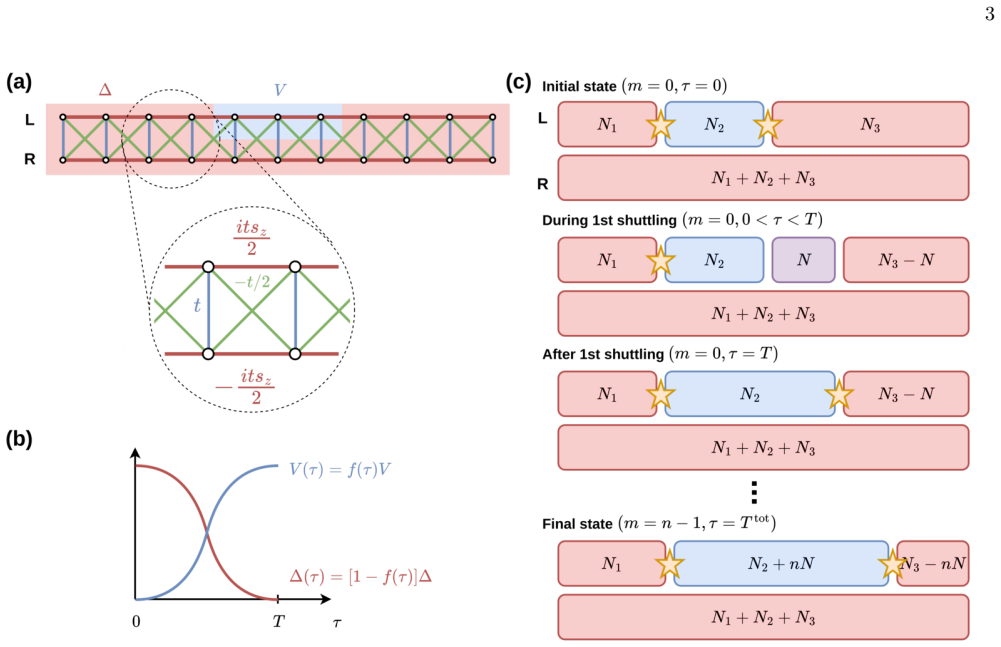
We investigate the real-time dynamics of the elementary shuttling process by applying a combination of the density matrix renormalization group and the time-dependent variational principle approaches. We analyze the transport of Z4 parafermion edge states and assess the corresponding adiabatic speed limit under experimentally relevant conditions.
What carries the argument
The electronic ladder model hosting Z4 parafermion edge states, whose shuttling is simulated by controlled changes in local potentials and tracked via DMRG and TDVP time evolution.
If this is right
- The shuttling remains feasible provided the movement respects the adiabatic speed limit found in the simulations.
- The non-Abelian character of the edge states survives the transport if the process stays within that limit.
- This shuttling step supplies a basic operation needed to implement geometric braiding of the parafermions.
- The combination of DMRG and TDVP methods yields quantitative estimates usable for designing laboratory realizations.
Where Pith is reading between the lines
- Successful shuttling would allow parafermions to be moved past one another without direct overlap, potentially simplifying gate designs.
- The same numerical approach could be applied to test shuttling in variants of the ladder model with different interaction strengths.
- Experimental groups could use the reported speed limits to choose drive frequencies that keep the process adiabatic in real devices.
- If the states remain protected, this transport could be chained into longer sequences that realize more complex topological operations.
Load-bearing premise
The ladder model must host stable Z4 parafermion edge states that keep their non-Abelian properties intact during the entire shuttling process.
What would settle it
A numerical run or experiment in which the transported edge states lose their topological protection or require shuttling times longer than the system's coherence time would show the claim is false.
Figures


read the original abstract
Parafermions with non-Abelian statistics have been proposed as a promising platform for quantum computation, potentially enabling a broader set of topologically protected gates than Majorana fermions. The experimental and theoretical exploration of these exotic quasiparticles remains challenging, as their stability is linked to strong electron-electron interactions. A key step toward practical applications is the controlled shuttling of parafermionic modes, which is required for implementing geometric braiding operations. In the present work, we investigate the real-time dynamics of the elementary shuttling process by applying a combination of the density matrix renormalization group and the time-dependent variational principle approaches. We analyze the transport of $\mathbb{Z}_4$ parafermion edge states and assess the corresponding adiabatic speed limit under experimentally relevant conditions.
Editorial analysis
A structured set of objections, weighed in public.
Referee Report
Summary. The manuscript introduces an electronic ladder model supporting Z4 parafermion edge states and employs a combination of DMRG and TDVP to simulate the real-time shuttling dynamics of these states. It extracts an adiabatic speed limit for transport while preserving the non-Abelian character under experimentally relevant conditions.
Significance. If the numerical results are robust, the work provides concrete guidance on the timescales required for parafermion shuttling, a necessary step toward geometric braiding operations in Z4 parafermion-based quantum computation. The use of TDVP for real-time many-body dynamics in a strongly interacting ladder is a technically appropriate choice for this problem.
major comments (1)
- [numerical methods and results sections] The central claim of an adiabatic speed limit and preserved parafermionic character during shuttling rests on TDVP/DMRG simulations, yet the manuscript provides no bond-dimension extrapolation, truncation-error estimates, or comparison against exact diagonalization on small systems. This omission directly affects the reliability of the reported fidelity and speed limit (see the numerical methods and results sections describing the TDVP protocol).
minor comments (1)
- [abstract] The abstract states that the model supports stable Z4 parafermion edge states, but a brief clarification on how the edge-state degeneracy is identified and monitored post-shuttling would improve readability.
Simulated Author's Rebuttal
We thank the referee for the careful review and constructive feedback on the numerical aspects of our work. We address the single major comment below and will revise the manuscript to strengthen the validation of the TDVP results.
read point-by-point responses
-
Referee: [numerical methods and results sections] The central claim of an adiabatic speed limit and preserved parafermionic character during shuttling rests on TDVP/DMRG simulations, yet the manuscript provides no bond-dimension extrapolation, truncation-error estimates, or comparison against exact diagonalization on small systems. This omission directly affects the reliability of the reported fidelity and speed limit (see the numerical methods and results sections describing the TDVP protocol).
Authors: We agree that explicit convergence checks and error estimates are important for establishing the reliability of the TDVP/DMRG results. Although our simulations employed bond dimensions that yielded stable observables in practice, the manuscript does not document these checks sufficiently. In the revised version we will add a subsection to the numerical methods section that includes: (i) bond-dimension extrapolation plots for the shuttling fidelity and the parafermion character measure at representative speeds, (ii) reported truncation-error estimates from the TDVP runs, and (iii) direct comparisons with exact diagonalization on small ladder lengths (where the Hilbert space permits) to benchmark the TDVP accuracy. These additions will directly support the robustness of the reported adiabatic speed limit and the preservation of non-Abelian character. revision: yes
Circularity Check
No significant circularity; results from direct numerical simulation
full rationale
The paper applies standard DMRG and TDVP methods to simulate real-time dynamics of a fixed model Hamiltonian for Z4 parafermion shuttling. No load-bearing steps reduce to self-definition, fitted inputs renamed as predictions, or self-citation chains. The adiabatic speed limit and transport analysis follow from explicit time evolution on the ladder model without tautological closure.
Axiom & Free-Parameter Ledger
axioms (2)
- domain assumption The electronic ladder Hamiltonian supports stable Z4 parafermion edge states with non-Abelian statistics.
- domain assumption DMRG and TDVP accurately approximate the real-time many-body dynamics without significant truncation artifacts affecting topological properties.
Reference graph
Works this paper leans on
-
[1]
Quantum Fields on a Lattice , DOI=
Montvay, Istvan and Münster, Gernot , year=. Quantum Fields on a Lattice , DOI=
- [2]
-
[3]
Time-dependent variational principle with ancillary Krylov subspace , author =. Phys. Rev. B , volume =. 2020 , month =. doi:10.1103/PhysRevB.102.094315 , url =
-
[4]
Quantum computing with realistically noisy devices,
Knill, E. , title=. Nature , year=. doi:10.1038/nature03350 , url=
-
[5]
Journal of Modern Optics , volume =
Richard Jozsa , title =. Journal of Modern Optics , volume =. 1994 , publisher =. doi:10.1080/09500349414552171 , URL =
-
[6]
Saad, Y. , title =. SIAM Journal on Numerical Analysis , volume =. 1992 , doi =. https://doi.org/10.1137/0729014 , abstract =
-
[7]
Hatano, Naomichi and Suzuki, Masuo. Finding Exponential Product Formulas of Higher Orders. Quantum Annealing and Other Optimization Methods. 2005. doi:10.1007/11526216_2
-
[8]
S.N. Shevchenko and S. Ashhab and Franco Nori , keywords =. Landau–Zener–Stückelberg interferometry , journal =. 2010 , issn =. doi:https://doi.org/10.1016/j.physrep.2010.03.002 , url =
-
[9]
Kiczynski, M. and Gorman, S. K. and Geng, H. and Donnelly, M. B. and Chung, Y. and He, Y. and Keizer, J. G. and Simmons, M. Y. , title=. Nature , year=. doi:10.1038/s41586-022-04706-0 , url=
-
[10]
Semiconductor spin qubits , author =. Rev. Mod. Phys. , volume =. 2023 , month =. doi:10.1103/RevModPhys.95.025003 , url =
-
[11]
Overlap of parafermionic zero modes at a finite distance , author =. Phys. Rev. Res. , volume =. 2022 , month =. doi:10.1103/PhysRevResearch.4.043094 , url =
-
[12]
Reports on Mathematical Physics , volume =
The. Reports on Mathematical Physics , volume =. 1976 , issn =. doi:https://doi.org/10.1016/0034-4877(76)90060-4 , url =
-
[13]
Accuracy of the density-matrix renormalization-group method , author =. Phys. Rev. B , volume =. 1996 , month =. doi:10.1103/PhysRevB.53.14349 , url =
-
[14]
Safwan, Ali Hamed and Bomantara, Raditya Weda , title =. 2025 , month =. doi:10.1088/1751-8121/aded51 , url =
-
[15]
Steane, A. M. , publisher =. Space, Time, Parallelism and Noise Requirements for Reliable Quantum Computing , booktitle =. doi:https://doi.org/10.1002/3527603093.ch8 , url =. https://onlinelibrary.wiley.com/doi/pdf/10.1002/3527603093.ch8 , year =
-
[16]
Donnelly, M. B. and Chung, Y. and Garreis, R. and Plugge, S. and Pye, D. and Kiczynski, M. and T. Large-scale analogue quantum simulation using atom dot arrays , journal=. 2026 , month=. doi:10.1038/s41586-025-10053-7 , url=
-
[17]
Unifying time evolution and optimization with matrix product states , author =. Phys. Rev. B , volume =. 2016 , month =. doi:10.1103/PhysRevB.94.165116 , url =
-
[18]
Time-Dependent Variational Principle for Quantum Lattices , author =. Phys. Rev. Lett. , volume =. 2011 , month =. doi:10.1103/PhysRevLett.107.070601 , url =
-
[19]
Post-matrix product state methods: To tangent space and beyond , author =. Phys. Rev. B , volume =. 2013 , month =. doi:10.1103/PhysRevB.88.075133 , url =
-
[20]
Bela Bauer and Torsten Karzig and Ryan V. Mishmash and Andrey E. Antipov and Jason Alicea , journal=. 2018 , publisher=. doi:10.21468/SciPostPhys.5.1.004 , url=
-
[21]
Emergent space-time supersymmetry at the boundary of a topological phase , author=. Science , volume=. 2014 , publisher=
work page 2014
-
[22]
Coupled wire construction of a topological phase with chiral tricritical Ising edge modes , author =. Phys. Rev. B , volume =. 2020 , month =. doi:10.1103/PhysRevB.102.165123 , url =
-
[23]
Matthew Fishman and Steven R. White and E. Miles Stoudenmire , year=. The. 2007.14822 , archivePrefix=
-
[24]
Annual Review of Condensed Matter Physics , volume =
Alicea, Jason and Fendley, Paul , title =. Annual Review of Condensed Matter Physics , volume =. 2016 , doi =
work page 2016
-
[25]
Journal of Statistical Mechanics: Theory and Experiment , abstract =
Paul Fendley , title =. Journal of Statistical Mechanics: Theory and Experiment , abstract =. doi:10.1088/1742-5468/2012/11/p11020 , url =
-
[26]
Reports on Progress in Physics , abstract =
Jason Alicea , title =. Reports on Progress in Physics , abstract =. doi:10.1088/0034-4885/75/7/076501 , url =
-
[27]
Beenakker, C.W.J. , title =. Annual Review of Condensed Matter Physics , volume =. 2013 , doi =. https://doi.org/10.1146/annurev-conmatphys-030212-184337 , abstract =
-
[29]
2013 , month = jan, publisher =
Maissam Barkeshli and Chao-Ming Jian and Xiao-Liang Qi , title =. 2013 , month = jan, publisher =. doi:10.1103/physrevb.87.045130 , url =
-
[30]
2014 , month = nov, publisher =
Maissam Barkeshli and Xiao-Liang Qi , title =. 2014 , month = nov, publisher =. doi:10.1103/physrevx.4.041035 , url =
-
[31]
Topological Quantization in Units of the Fine Structure Constant , author =. Phys. Rev. Lett. , volume =. 2010 , month =. doi:10.1103/PhysRevLett.105.166803 , url =
-
[32]
Spin polarization of the quantum spin Hall edge states , journal =
Christoph Br\". Spin polarization of the quantum spin Hall edge states , journal =. 2012 , month = may, publisher =. doi:10.1038/nphys2322 , url =
-
[33]
Frank Arute and Kunal Arya and Ryan Babbush and Dave Bacon and Joseph C. Bardin and Rami Barends and Rupak Biswas and Sergio Boixo and Fernando G. S. L. Brandao and David A. Buell and Brian Burkett and Yu Chen and Zijun Chen and Ben Chiaro and Roberto Collins and William Courtney and Andrew Dunsworth and Edward Farhi and Brooks Foxen and Austin Fowler and...
-
[34]
Preskill, John , journal =. Quantum. doi:10.22331/q-2018-08-06-79 , url =
work page internal anchor Pith review doi:10.22331/q-2018-08-06-79 2018
-
[35]
Paul Wiegmann , title =. 1992 , publisher =. doi:10.1143/ptps.107.243 , url =
-
[36]
A Yu Kitaev , title =. Physics-Uspekhi , abstract =. doi:10.1070/1063-7869/44/10s/s29 , url =
-
[37]
Fault-tolerant quantum computation by anyons
A.Yu. Kitaev , title =. 2003 , month = jan, publisher =. doi:10.1016/s0003-4916(02)00018-0 , url =
work page Pith review doi:10.1016/s0003-4916(02)00018-0 2003
-
[38]
Anyons in an exactly solved model and beyond
Alexei Kitaev , title =. 2006 , month = jan, publisher =. doi:10.1016/j.aop.2005.10.005 , url =
-
[39]
Quantum error correction for quantum memories , author =. Rev. Mod. Phys. , volume =. 2015 , month =. doi:10.1103/RevModPhys.87.307 , url =
-
[40]
V. Mourik and K. Zuo and S. M. Frolov and S. R. Plissard and E. P. A. M. Bakkers and L. P. Kouwenhoven , title =. 2012 , month = may, publisher =. doi:10.1126/science.1222360 , url =
-
[41]
Oliv. Andreev Molecule in Parallel. 2021 , month = sep, publisher =. doi:10.1021/acs.nanolett.1c01956 , url =
-
[42]
Majorana qubits for topological quantum computing , journal =
Ram. Majorana qubits for topological quantum computing , journal =. 2020 , month = jun, publisher =. doi:10.1063/pt.3.4499 , url =
-
[43]
Superconducting Proximity Effect and Majorana Fermions at the Surface of a Topological Insulator , author =. Phys. Rev. Lett. , volume =. 2008 , month =. doi:10.1103/PhysRevLett.100.096407 , url =
-
[44]
Splitting of a Cooper Pair by a Pair of Majorana Bound States , author =. Phys. Rev. Lett. , volume =. 2008 , month =. doi:10.1103/PhysRevLett.101.120403 , url =
-
[45]
Josephson current and noise at a superconductor/quantum-spin-Hall-insulator/superconductor junction , author =. Phys. Rev. B , volume =. 2009 , month =. doi:10.1103/PhysRevB.79.161408 , url =
-
[46]
Non-Abelian Topological Order in s -Wave Superfluids of Ultracold Fermionic Atoms , author =. Phys. Rev. Lett. , volume =. 2009 , month =. doi:10.1103/PhysRevLett.103.020401 , url =
-
[47]
Generic New Platform for Topological Quantum Computation Using Semiconductor Heterostructures , author =. Phys. Rev. Lett. , volume =. 2010 , month =. doi:10.1103/PhysRevLett.104.040502 , url =
-
[48]
Majorana fermions in a tunable semiconductor device , author =. Phys. Rev. B , volume =. 2010 , month =. doi:10.1103/PhysRevB.81.125318 , url =
-
[49]
Majorana Fermions and a Topological Phase Transition in Semiconductor-Superconductor Heterostructures , author =. Phys. Rev. Lett. , volume =. 2010 , month =. doi:10.1103/PhysRevLett.105.077001 , url =
-
[50]
Helical Liquids and Majorana Bound States in Quantum Wires , author =. Phys. Rev. Lett. , volume =. 2010 , month =. doi:10.1103/PhysRevLett.105.177002 , url =
-
[51]
Zhang, Fan and Kane, C. L. , journal =. Time-Reversal-Invariant. 2014 , month =. doi:10.1103/PhysRevLett.113.036401 , url =
-
[52]
Journal of Physics C: Solid State Physics6(7), 1181–1203 (1973)
Ordering, metastability and phase transitions in two-dimensional systems , volume =. Journal of Physics C: Solid State Physics , author =. 1973 , pages =. doi:10.1088/0022-3719/6/7/010 , abstract =
-
[53]
Error estimates for extrapolations with matrix-product states , author =. Phys. Rev. B , volume =. 2018 , month =. doi:10.1103/PhysRevB.97.045125 , url =
-
[54]
Quantized. Physical Review B , author =. 1981 , pages =. doi:10.1103/PhysRevB.23.5632 , abstract =
-
[55]
Reviews of Modern Physics , author =
Colloquium:. Reviews of Modern Physics , author =. 2010 , pages =. doi:10.1103/RevModPhys.82.3045 , abstract =
-
[56]
Topological nodal semimetals , volume =. Physical Review B , author =. 2011 , pages =. doi:10.1103/PhysRevB.84.235126 , language =
-
[57]
Reports on Progress in Physics , author =
Topological superconductors: a review , volume =. Reports on Progress in Physics , author =. 2017 , pages =. doi:10.1088/1361-6633/aa6ac7 , abstract =
-
[58]
Reviews of Modern Physics , volume =
Weyl and Dirac semimetals in three-dimensional solids , author =. Reviews of Modern Physics , volume =. 2018 , month =
work page 2018
-
[59]
and Oroszlány, László and Pályi, András , year =
Asboth, Janos K. and Oroszlány, László and Pályi, András , year =. A short course on topological insulators: band-structure and edge states in one and two dimensions , isbn =
-
[60]
Proceedings 35th annual symposium on foundations of computer science , pages=
Algorithms for quantum computation: discrete logarithms and factoring , author=. Proceedings 35th annual symposium on foundations of computer science , pages=. 1994 , organization=
work page 1994
-
[61]
Physical Review Letters , volume=
Density matrix formulation for quantum renormalization groups , author=. Physical Review Letters , volume=. 1992 , publisher=
work page 1992
-
[62]
Anyons in an exactly solved model and beyond , author=. Annals of Physics , volume=. 2006 , publisher=
work page 2006
-
[63]
Unpaired Majorana fermions in quantum wires , author=. Physics-uspekhi , volume=. 2001 , publisher=
work page 2001
-
[64]
Physical Review Letters , volume=
Majorana fermions and a topological phase transition in semiconductor-superconductor heterostructures , author=. Physical Review Letters , volume=. 2010 , publisher=
work page 2010
-
[65]
Physical Review Letters , volume=
Helical liquids and Majorana bound states in quantum wires , author=. Physical Review Letters , volume=. 2010 , publisher=
work page 2010
-
[66]
Signatures of Majorana fermions in hybrid superconductor-semiconductor nanowire devices , author=. Science , volume=. 2012 , publisher=
work page 2012
-
[67]
Quantum computing with parafermions , author=. Physical Review B , volume=. 2016 , publisher=
work page 2016
-
[68]
Physical Review Letters , volume=
Time-reversal-invariant Z 4 fractional Josephson effect , author=. Physical Review Letters , volume=. 2014 , publisher=
work page 2014
-
[69]
Non-Abelian parafermions in time-reversal-invariant interacting helical systems , author=. Physical Review B , volume=. 2015 , publisher=
work page 2015
-
[70]
Communications in Mathematical Physics , volume=
A modular functor which is universal P for quantum computation , author=. Communications in Mathematical Physics , volume=. 2002 , publisher=
work page 2002
-
[71]
The two-eigenvalue problem and density of Jones representation of braid groups , author=. arXiv preprint math/0103200 , year=
-
[72]
Communications of the ACM , volume=
A method for obtaining digital signatures and public-key cryptosystems , author=. Communications of the ACM , volume=. 1978 , publisher=
work page 1978
-
[73]
Z 4 parafermions in one-dimensional fermionic lattices , author=. Physical Review B , volume=. 2018 , publisher=
work page 2018
-
[74]
Universal topological quantum computation from a superconductor-abelian quantum hall heterostructure , author=. Physical Review X , volume=. 2014 , publisher=
work page 2014
-
[75]
Twist defects and projective non-Abelian braiding statistics , author=. Physical Review B , volume=. 2013 , publisher=
work page 2013
-
[76]
Synthetic topological qubits in conventional bilayer quantum Hall systems , author=. Physical Review X , volume=. 2014 , publisher=
work page 2014
-
[77]
Matrix Product State Representations
Matrix product state representations , author=. arXiv preprint quant-ph/0608197 , year=
-
[78]
The density-matrix renormalization group in the age of matrix product states , author=. Annals of Physics , volume=. 2011 , publisher=
work page 2011
-
[79]
A practical introduction to tensor networks: Matrix product states and projected entangled pair states , author=. Annals of Physics , volume=. 2014 , publisher=
work page 2014
-
[80]
Valence-bond states for quantum computation , author=. Physical Review A , volume=. 2004 , publisher=
work page 2004
-
[81]
Class of Quantum Many-Body States That Can Be Efficiently Simulated , author =. Phys. Rev. Lett. , volume =
discussion (0)
Sign in with ORCID, Apple, or X to comment. Anyone can read and Pith papers without signing in.