Pith. sign in

REVIEW 2 major objections 1 minor 1 cited by

Empirical estimates of how massive galaxies can be in {\Lambda}CDM

T0 review · 2 major / 1 minor · reviewed 2026-05-14 · grok-4.3

Pith's one-line read Massive galaxies stay within ΛCDM limits once Eddington bias and scatter are accounted for.

desk verdict The paper delivers new redshift-dependent upper bounds on maximum galaxy stellar masses after Eddington and scatter corrections, but the LambdaCDM consistency claim rests on an unverified perfect rank-order assumption between extreme galaxies and halos. read the letter →

arxiv 2605.08353 v2 submitted 2026-05-08 astro-ph.GA astro-ph.CO

classification astro-ph.GAastro-ph.CO
keywords galaxystellarmassfunctionextremevaluestatisticsLambdaCDMhighredshiftgalaxiesstellar-halorelationEddingtonbiasUVluminosity
open problems Dark Matter
verification ladder T0 review T1 audit T2 compute T3 formal

The pith

A machine-rendered reading of the paper's core claim, the machinery that carries it, and where it could break.

The reading

This paper applies extreme value statistics to observed stellar mass and UV luminosity functions to find the masses of the most extreme galaxies in surveys of different sizes and redshifts. It folds in uncertainties from stellar mass measurements and the scatter between stellar mass and halo mass to set empirical upper bounds. The highest galaxy masses approach the theoretical ceiling of roughly 16 percent of the host halo's virial mass, especially at high redshift, but never exceed it once corrections are applied. The results indicate that existing data are consistent with standard cosmology at every redshift examined.

What carries the argument

Extreme Value Statistics applied to galaxy stellar mass and UV luminosity functions, with corrections for Eddington bias and scatter in the stellar-halo mass relation.

What would settle it

A secure detection of any galaxy whose stellar mass exceeds 0.16 times the virial mass of its host halo at any redshift after the same bias and scatter corrections are applied.

Watch

Extended reading notes

Core claim

Using Extreme Value Statistics applied to the observed galaxy stellar mass and the UV luminosity functions, we empirically estimate masses and luminosities of the most extreme galaxies in cosmological surveys, including the full sky. We incorporate uncertainties in stellar mass measurements (Eddington bias) and the scatter in the stellar-halo mass relation to derive empirical limits for galaxies residing in the most massive halos. Accounting for measurement uncertainties significantly reduces the inferred maximum M* by up to ~1 dex at z≳10, yielding stellar masses consistent with M* < 0.16 at all redshifts. Assuming a perfect rank-order correspondence between the most massive halos and the m

Load-bearing premise

The assumption that the most massive observed galaxies correspond in perfect rank order to the most massive dark matter halos.

Editorial extensions

If this is right

  • At 2 ≲ z ≲ 6 the most massive galaxies contain stellar mass comparable to the total cold gas reservoir from inflows, implying near-maximal star formation efficiency.
  • At higher redshifts halos are expected to host galaxies in starburst phases.
  • When dust attenuation and empirically inferred efficiencies are included, the model matches the brightest observed UV galaxies at high redshift.
  • At lower redshifts the observed UV galaxies remain brighter than the model predicts.

Reading between the lines

Editorial extensions of the paper, not claims the author makes directly.

  • Deeper high-redshift surveys could reveal whether the maximum stellar mass continues to approach the 0.16 M_vir ceiling more closely.
  • If rank-order correspondence holds, the stellar-mass limit is enforced independently of survey volume.
  • Reducing Eddington bias through better mass measurements would tighten limits on early star-formation efficiency.
Share X Bluesky LinkedIn Reddit HN

Signed reviews

No signed human review yet.

Editorial analysis

A structured set of objections, weighed in public.

Desk editor's note, referee report, simulated authors' rebuttal, and a circularity audit.

Referee Report

2 major / 1 minor

Summary. The paper applies extreme value statistics to observed galaxy stellar mass and UV luminosity functions to estimate the masses and luminosities of the most extreme galaxies in cosmological surveys. It incorporates Eddington bias corrections and scatter in the stellar-halo mass relation (SHMR), finding that maximum stellar masses are reduced by up to ~1 dex at high redshift and remain below the 0.16 M_vir baryonic limit at all redshifts under the assumption of perfect rank-order correspondence between the most massive galaxies and halos. The work also compares these galaxies to cold gas reservoirs from cooling flows, infers star formation efficiencies, and reports good agreement with the brightest UV galaxies at z ≳ 6 after dust attenuation corrections, concluding that current observations are broadly consistent with ΛCDM once statistical and observational effects are accounted for.

Significance. If the central results hold, the manuscript provides a useful empirical framework for testing ΛCDM consistency at the extreme end of the galaxy population using survey data. The incorporation of Eddington bias and SHMR scatter to reconcile apparent tensions is a constructive approach, and the comparison to cold gas reservoirs offers insight into star formation efficiencies. The application of extreme value statistics to both stellar mass and UV luminosity functions is a methodological strength that could be extended to other surveys.

major comments (2)
  1. [Abstract] Abstract: The consistency claim that M* remains below 0.16 M_vir at all redshifts is load-bearing on the assumption of perfect rank-order correspondence between the most massive halos and galaxies. However, the incorporated SHMR scatter permits high-M* galaxies to reside in halos well below the cosmic maximum M_vir; the manuscript does not provide a joint extreme-value calculation quantifying the probability of such assignments or the resulting violation rate in the tail.
  2. [Abstract] Abstract: The reported reduction of inferred maximum M* by up to ~1 dex from Eddington bias and SHMR scatter corrections is central to the no-tension conclusion, but the abstract provides no explicit error propagation, covariance treatment, or tabulated input luminosity functions, limiting the ability to audit the quantitative support for the claim.
minor comments (1)
  1. [Abstract] The abstract states that at 2 ≲ z ≲ 6 the most massive galaxies have stellar masses comparable to the total cold gas reservoir; a brief clarification of how the cold gas mass is estimated from the halo mass function would improve readability.

Simulated Author's Rebuttal

2 responses · 0 unresolved

We thank the referee for their constructive and positive assessment of the manuscript. We address each major comment below and have revised the manuscript to improve clarity and auditability while preserving the core analysis.

read point-by-point responses
  1. Referee: [Abstract] Abstract: The consistency claim that M* remains below 0.16 M_vir at all redshifts is load-bearing on the assumption of perfect rank-order correspondence between the most massive halos and galaxies. However, the incorporated SHMR scatter permits high-M* galaxies to reside in halos well below the cosmic maximum M_vir; the manuscript does not provide a joint extreme-value calculation quantifying the probability of such assignments or the resulting violation rate in the tail.

    Authors: We agree that the no-tension conclusion relies on the rank-order assumption stated in the abstract and that a full joint extreme-value treatment of halo-galaxy assignments would provide a more complete probabilistic picture. Our current approach uses the observed scatter in the SHMR to downward-correct the maximum stellar masses inferred from the luminosity functions, which already incorporates the possibility that the most massive galaxies occupy halos below the cosmic maximum. In the revised manuscript we have added a new paragraph in Section 4 that performs an order-of-magnitude estimate of the tail violation probability assuming log-normal scatter; this estimate remains below 10 percent at all redshifts and does not change the main conclusion that the corrected M* values lie below the baryonic limit. revision: partial

  2. Referee: [Abstract] Abstract: The reported reduction of inferred maximum M* by up to ~1 dex from Eddington bias and SHMR scatter corrections is central to the no-tension conclusion, but the abstract provides no explicit error propagation, covariance treatment, or tabulated input luminosity functions, limiting the ability to audit the quantitative support for the claim.

    Authors: The referee is correct that the abstract is too concise to contain the full error budget. The ~1 dex reduction is obtained in Section 3 by propagating the reported uncertainties on the input luminosity-function parameters together with the adopted 0.2 dex SHMR scatter; the input luminosity functions and their references are listed in Table 1. To improve auditability we have (i) expanded the abstract by one sentence that explicitly mentions the Eddington-bias and scatter corrections and (ii) added a supplementary table that tabulates the luminosity-function parameters, their uncertainties, and the resulting maximum-M* values with 1-sigma error bars. revision: yes

Circularity Check

0 steps flagged · score 0.0 of 10

No significant circularity; empirical estimates remain independent of fitted inputs

full rationale

The derivation applies Extreme Value Statistics directly to observed stellar mass and UV luminosity functions as inputs. Eddington bias and SHMR scatter are treated as external corrections drawn from standard relations rather than parameters fitted to the same dataset and then re-predicted. The 0.16 baryon-fraction ceiling is a fixed cosmological constant, not derived inside the paper. The rank-order correspondence is presented explicitly as a conditional assumption that would guarantee the inequality, not as a result obtained by construction from the paper's own equations. No quoted step reduces the output to the input via self-definition, renaming, or self-citation load-bearing. The consistency claim therefore rests on independent observational data and standard external benchmarks.

Assumptions & free parameters 2 free parameters · 2 assumptions · 0 invented entities

The central claim rests on standard LambdaCDM halo abundances, observed galaxy luminosity functions, and two conventional corrections whose numerical values are not re-derived inside the paper.

free parameters (2)
  • scatter in stellar-halo mass relation
    Used to map the most massive galaxies onto the most massive halos; specific dispersion value not stated in abstract.
  • Eddington bias correction amplitude
    Incorporated to reduce inferred maximum stellar masses; magnitude not quantified in abstract.
assumptions (2)
  • domain assumption Extreme value statistics governs the tail of the galaxy stellar-mass function
    Invoked to estimate the single most massive object in a survey volume.
  • standard math Maximum baryonic mass fraction inside halos is 0.16
    Taken as the theoretical ceiling M* ~ 0.16 M_vir.

how reviews work

0 comments
Cite this review

Pith. "Pith review of Empirical estimates of how massive galaxies can be in {\Lambda}CDM." pith.science (2026). https://pith.science/paper/2605.08353

@misc{pith2026260508353,
  author       = {Pith},
  title        = {Pith review of: Empirical estimates of how massive galaxies can be in \LambdaCDM},
  year         = {2026},
  howpublished = {\url{https://pith.science/paper/2605.08353}},
  note         = {Machine review of arXiv:2605.08353}
}
abstract

Using Extreme Value Statistics applied to the observed galaxy stellar mass and the UV luminosity functions, we empirically estimate masses and luminosities of the most extreme galaxies in cosmological surveys, including the full sky. We incorporate uncertainties in stellar mass measurements (Eddington bias) and the scatter in the stellar-halo mass relation to derive empirical limits for galaxies residing in the most massive halos. The maximum observed $M_\ast$ strongly depends on survey area and redshift, ranging from $M_\ast \sim 7 \times 10^{12} M_\odot$ for full-sky surveys at $z\sim0$ to $M_\ast \sim 10^{10}M_\odot$ at $z\sim16$. Massive galaxies, particularly at high redshift, approach the theoretical maximum baryonic mass available in halos $M_\ast \sim 0.16 \times M_{\mathrm{vir}}$, consistent with previous claims. Accounting for measurement uncertainties significantly reduces the inferred maximum $M_\ast$ by up to $\sim1$ dex at $z\gtrsim10$, yielding stellar masses consistent with $M_\ast < 0.16$ at all redshifts. Assuming a perfect rank-order correspondence between the most massive halos and galaxies would guarantee this inequality at all redshifts. At 2 $\lesssim$ z $\lesssim$ 6, the most massive galaxies have stellar masses comparable to the total cold gas reservoir from cold and cooling flows, suggesting near-maximal star formation efficiencies, SFEs. At higher redshifts, halos are predicted to host galaxies undergoing starburst phases. When accounting for dust attenuation and adopting empirically inferred SFEs, we find good agreement between the model and the brightest observed UV galaxies at high redshifts. At lower redshifts, however, observed UV galaxies are too bright. Overall, our results indicate that current observations remain broadly consistent with $\Lambda$CDM once statistical and observational effects are properly accounted for.

Figures

Figures reproduced from arXiv: 2605.08353 by the authors.

Figure 1
Figure 1. Redshift evolution of the 1σ random stellar mass uncertainties, σ∗,ran. Lines show different literature prescriptions, and the shaded region denotes the range adopted in this work. shown in the label, is intended to represent this alternative trend, consistent with the findings of Leja et al. (2020) and Weibel et al. (2024). This model will be further discussed in Rodriguez-Puebla et al. (in prep). Rather than adopt… view at source ↗
Figure 3
Figure 3. EVS predictions for the most massive galaxies as a function of redshift for different survey sky apertures (color dotted lines) and their best fits (color solid lines, see Eq. 18 and Appendix C). The left, middle, and right panels present results from the EVS framework applied to the observed, true, and intrinsic GSMFs, respectively. The true GSMF accounts for the effects of Eddington bias arising from random errors… view at source ↗
Figure 4
Figure 4. EVS predictions for the most luminous galaxy as a function of redshift for different survey areas, derived from the observed UV LF (see Appendix B for details). In contrast to the most massive galaxies ( [PITH_FULL_IMAGE:figures/full_fig_p008_4.png] view at source ↗
Figures from the paper (14 more)
Figure 5
Figure 5. Figure 5: EVS distributions for M∗,max as a function of redshift for four different survey areas, derived from the observed, true, and intrinsic GSMFs. In the case of the intrinsic GSMF, the ±1σ, ±2σ, and ±3σ confidence regions are shown as shaded areas. The dashed black line co…
Figure 6
Figure 6. Figure 6: EVS predictions for the maximum UV magnitude, MUV,max, as a function of redshift, derived from the observed UV LF. The solid curve shows the median for a survey area of A = 0.2, deg2 (COSMOS-Web), while the shaded regions indicate the ±1σ–±3σ intervals and the dotted l…
Figure 8
Figure 8. Figure 8: EVS distribution of the most massive dark matter halos over the redshift range 0 ≲ z ≲ 1.5 for four survey areas (from left to right): 750, 2.5 × 10³ , 14 × 103 , and 35 × 103 , deg2 . The solid dark line shows the median EVS prediction, while the shaded regions indica…
Figure 10
Figure 10. Figure 10: Redshift evolution of the number density nvir of the most massive 5σ halos predicted by EVS for different survey areas, using the same color scheme as in [PITH_FULL_IMAGE:figures/full_fig_p011_10.png]
Figure 11
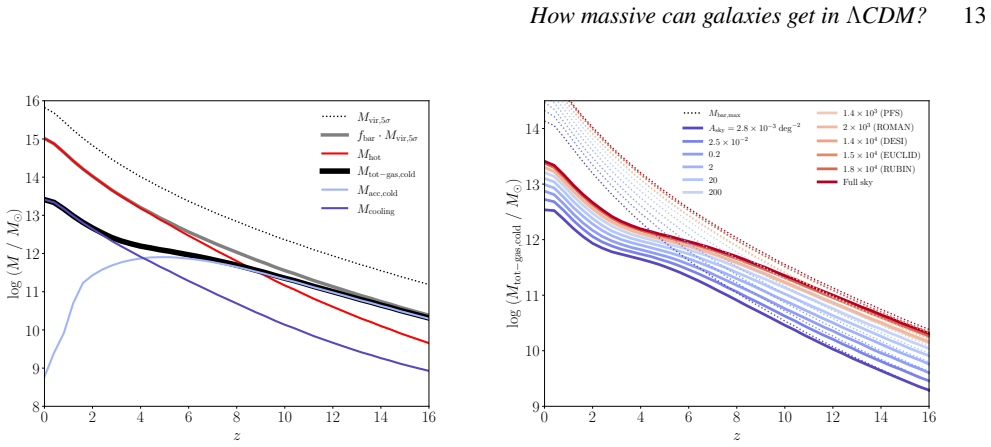
Figure 11. Figure 11: Left panel: Baryonic content of the 5σ most massive halo in a full-sky survey. The dotted line represents the mass of the most massive halo, while the gray solid line shows the maximum baryonic mass, fbarMvir. The red line indicates the gas mass in the hot phase, Mhot…
Figure 12
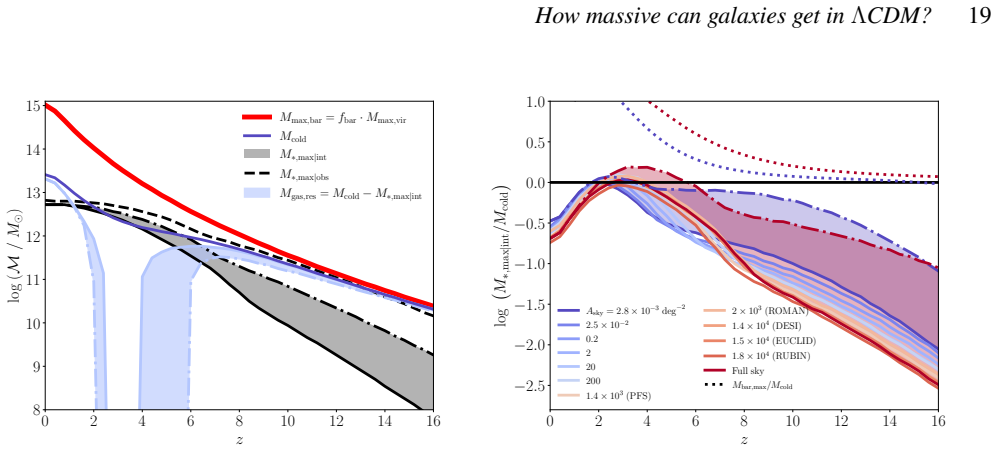
Figure 12. Figure 12: EVS distributions for M∗,max and Mbar,max = fbarMvir,max. Upper Panels: The black solid line shows the median, while the blue shaded regions indicate the 1–3σ intervals and the blue dashed lines mark the 5σ limit for the EVS distribution derived from the observed GSMF…
Figure 13
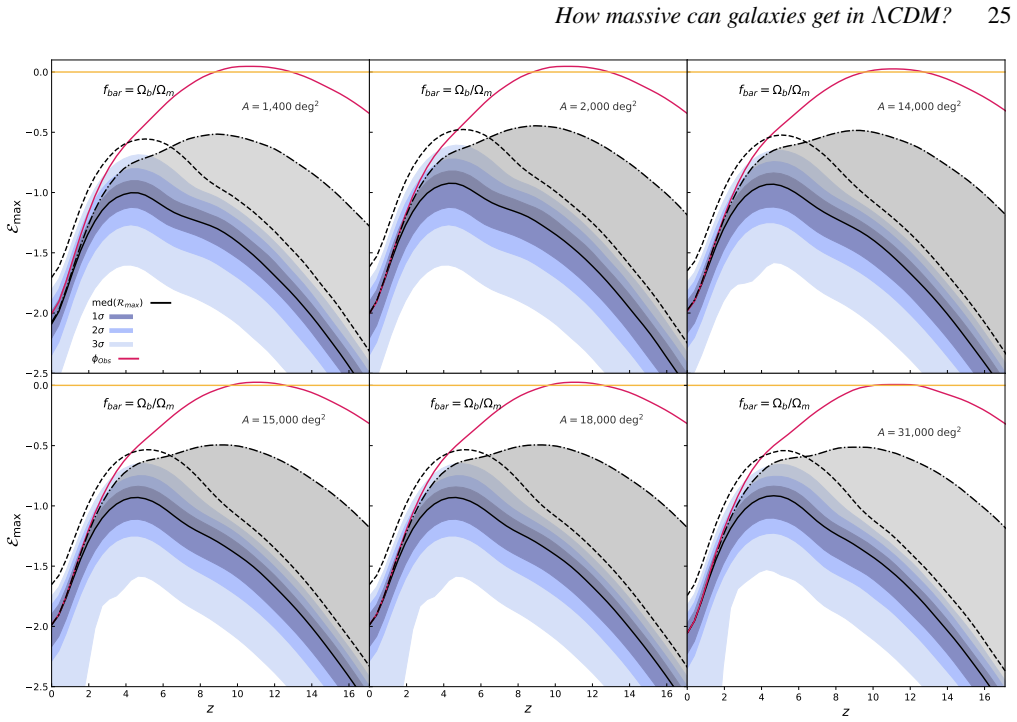
Figure 13. Figure 13: EVS distribution of the maximum cumulative star formation efficiency in ΛCDM halos in the stochastic case, computed as the convolution of the EVS distributions obtained from the GSMF and the HMF. The figure shows the redshift evolution of logϵmax =log[M∗,max/(fbarMvir…
Figure 14
Figure 14. Figure 14: Same as [PITH_FULL_IMAGE:figures/full_fig_p017_14.png]
Figure 15
Figure 15. Figure 15: Left Panel: Baryonic content of the 5σ most massive halo in a full-sky survey. The red solid line shows the maximum baryonic mass, fbarMvir, while the violet solid line represents the total cold gas mass, composed of cooling gas and cold streams (see Section 4.3). The…
Figure 16
Figure 16. Figure 16: Physical conditions of the baryons in the most massive halo. Left Panel: Cold gas surface density, Σgas,cold, in the most massive ΛCDM halo as a function of redshift for different survey areas. Right Panel: Predicted UV luminosity of the galaxy hosted by the halo. See…
Figure 17
Figure 17. Figure 17: Similar to [PITH_FULL_IMAGE:figures/full_fig_p022_17.png]
Figure 18
Figure 18. Figure 18: Impact of cosmological parameter variations on the EVS predictions of the most massive halos. The shaded regions represent the differences with respect to the median prediction within the fiducial ΛCDM cosmology, showing the spread corresponding to the 1σ, 2σ, and 3σ …
Figure 19
Figure 19. Figure 19: Comparison of the convolved distributions of halo and galaxy mass functions across the areas of different forthcoming surveys, including PFS, Roman Space Telescope, DESI, Euclid, and the Rubin Observatory, see [PITH_FULL_IMAGE:figures/full_fig_p025_19.png]
Figure 1
Figure 1. Figure 1: Parametric model of the GSMF adopted in this work, based on the compilation of Rodríguez-Puebla et al. (in prep.). The intrinsic GSMF is decomposed into star-forming and quiescent components, modeled with double and triple generalized Schechter functions (left and righ…

Discussion (0). Continue with ORCID to comment.

Lean theorems connected to this paper

Citations machine-checked in the Pith Canon. Every link opens the source theorem in the public Lean library.

  • IndisputableMonolith/Foundation/RealityFromDistinction.lean reality_from_one_distinction unclear
    ?
    unclear

    Relation between the paper passage and the cited Recognition theorem.

    Using Extreme Value Statistics applied to the observed galaxy stellar mass and the UV luminosity functions... incorporate uncertainties in stellar mass measurements (Eddington bias) and the scatter in the stellar-halo mass relation

What do these tags mean?
matches
The paper's claim is directly supported by a theorem in the formal canon.
supports
The theorem supports part of the paper's argument, but the paper may add assumptions or extra steps.
extends
The paper goes beyond the formal theorem; the theorem is a base layer rather than the whole result.
uses
The paper appears to rely on the theorem as machinery.
contradicts
The paper's claim conflicts with a theorem or certificate in the canon.
unclear
Pith found a possible connection, but the passage is too broad, indirect, or ambiguous to say the theorem truly supports the claim.

Forward citations

Cited by 1 Pith paper

Reviewed papers in the Pith corpus that reference this work. Sorted by Pith novelty score. Full citation record

  1. How galaxies acquire their stellar mass at high redshift: High star formation efficiencies and the relative roles of dust and initial mass function

    astro-ph.GA 2026-05 unverdicted novelty 6.0 of 10

    Massive galaxies at z≳9 built stellar mass in bursty episodes with star-formation efficiencies of 0.8–0.9; dust pushes efficiencies above unity unless a top-heavy IMF is allowed.

Reference graph

Works this paper leans on

299 extracted references · 299 canonical work pages · cited by 1 Pith paper

  1. [1]

    Galaxies at z > 10: {\Lambda}CDM predicts increased Star Formation Efficiency

    Galaxies at z > 10: CDM predicts increased Star Formation Efficiency. arXiv e-prints , keywords =. doi:10.48550/arXiv.2604.18683 , archivePrefix =. 2604.18683 , primaryClass =

  2. [2]

    , year = 2026, month = apr, doi =

    The evolution of the galaxy stellar mass function and star formation rates in the COLIBRE simulations from redshift 17 to 0. , year = 2026, month = apr, doi =

  3. [3]

    2008, , 676, 767, 10.1086/528674

    Trenti, M. and Stiavelli, M. , title =. 2008 , month =. doi:10.1086/528674 , url =

  4. [4]

    Bagla, J. S. and Ray, Suryadeep , title =. Monthly Notices of the Royal Astronomical Society , volume =. 2005 , month =. doi:10.1111/j.1365-2966.2005.08858.x , url =

  5. [5]

    The evolution of the galaxy stellar-mass function over the last 12 billion years from a combination of ground-based and <i>HST</i> surveys

    McLeod, D J and McLure, R J and Dunlop, J S and Cullen, F and Carnall, A C and Duncan, K , title =. Monthly Notices of the Royal Astronomical Society , volume =. 2021 , month =. doi:10.1093/mnras/stab731 , url =

  6. [6]

    doi:10.1093/mnras/staf1699 , eprint =

    CDM is still not broken: empirical constraints on the star formation efficiency at z 12─30. , keywords =. doi:10.1093/mnras/staf1699 , archivePrefix =. 2504.18618 , primaryClass =

  7. [7]

    The Cosmic Evolution Early Release Science Survey (CEERS)

    The Cosmic Evolution Early Release Science Survey (CEERS). , keywords =. doi:10.3847/2041-8213/adbbd3 , archivePrefix =. 2501.04085 , primaryClass =

  8. [8]

    CEERS Key Paper. I. An Early Look into the First 500 Myr of Galaxy Formation with JWST. , keywords =. doi:10.3847/2041-8213/acade4 , archivePrefix =. 2211.05792 , primaryClass =

Show all 299 references
  1. [9]

    , keywords =

    IDCS J1426.5+3508: The Most Massive Galaxy Cluster at z > 1.5. , keywords =. doi:10.3847/0004-637X/817/2/122 , archivePrefix =. 1504.01397 , primaryClass =

  2. [10]

    , keywords =

    Discovery of a massive X-ray luminous galaxy cluster at z = 1.579. , keywords =. doi:10.1051/0004-6361/201117190 , archivePrefix =. 1105.5877 , primaryClass =

  3. [11]

    , keywords =

    The Atacama Cosmology Telescope: ACT-CL J0102-4915 ``El Gordo,'' a Massive Merging Cluster at Redshift 0.87. , keywords =. doi:10.1088/0004-637X/748/1/7 , archivePrefix =. 1109.0953 , primaryClass =

  4. [12]

    , keywords =

    Galaxy Clusters Discovered via the Sunyaev-Zel'dovich Effect in the 2500-Square-Degree SPT-SZ Survey. , keywords =. doi:10.1088/0067-0049/216/2/27 , archivePrefix =. 1409.0850 , primaryClass =

  5. [13]

    The ROSAT-ESO Flux Limited X-ray (REFLEX) Galaxy cluster survey. V. The cluster catalogue. , keywords =. doi:10.1051/0004-6361:20034484 , archivePrefix =. astro-ph/0405546 , primaryClass =

  6. [14]

    , keywords =

    Deep Chandra observations of PLCKG287.0+32.9: A clear detection of a shock front in a heated former cool core. , keywords =. doi:10.1051/0004-6361/202453450 , archivePrefix =. 2503.13735 , primaryClass =

  7. [15]

    Planck 2015 results. XXVII. The second Planck catalogue of Sunyaev-Zeldovich sources. , keywords =. doi:10.1051/0004-6361/201525823 , archivePrefix =. 1502.01598 , primaryClass =

  8. [16]

    , keywords =

    Galaxy formation in WMAP1 and WMAP7 cosmologies. , keywords =. doi:10.1093/mnras/sts115 , archivePrefix =. 1206.0052 , primaryClass =

  9. [17]

    , keywords =

    The EAGLE simulations of galaxy formation: calibration of subgrid physics and model variations. , keywords =. doi:10.1093/mnras/stv725 , archivePrefix =. 1501.01311 , primaryClass =

  10. [18]

    , keywords =

    Quantifying the impact of mergers on the angular momentum of simulated galaxies. , keywords =. doi:10.1093/mnras/stx2667 , archivePrefix =. 1701.04407 , primaryClass =

  11. [19]

    Research in Astronomy and Astrophysics , keywords =

    Merging History of Massive Galaxies at 3 < z < 6. Research in Astronomy and Astrophysics , keywords =. doi:10.1088/1674-4527/ac9e90 , archivePrefix =. 2312.04040 , primaryClass =

  12. [20]

    , keywords =

    Gas-rich Mergers in LCDM: Disk Survivability and the Baryonic Assembly of Galaxies. , keywords =. doi:10.1088/0004-637X/702/1/307 , archivePrefix =. 0901.4336 , primaryClass =

  13. [21]

    The assembly and star formation cessation of galaxies at 0.2< z 7.5

    COSMOS2020: The galaxy stellar mass function. The assembly and star formation cessation of galaxies at 0.2< z 7.5. , keywords =. doi:10.1051/0004-6361/202245581 , archivePrefix =. 2212.02512 , primaryClass =

  14. [22]

    , keywords =

    Constraints on the Faint End of the Galaxy Stellar Mass Function at z ≃ 4 8 from Deep JWST Data. , keywords =. doi:10.3847/1538-4357/ad0df6 , archivePrefix =. 2305.16141 , primaryClass =

  15. [23]

    , keywords =

    The z 9 Galaxy UV Luminosity Function from the JWST Advanced Deep Extragalactic Survey: Insights into Early Galaxy Evolution and Reionization. , keywords =. doi:10.3847/1538-4357/adfddc , archivePrefix =. 2501.00984 , primaryClass =

  16. [24]

    , keywords =

    The Complete CEERS Early Universe Galaxy Sample: A Surprisingly Slow Evolution of the Space Density of Bright Galaxies at z 8.5 14.5. , keywords =. doi:10.3847/2041-8213/ad4495 , archivePrefix =. 2311.04279 , primaryClass =

  17. [25]

    , keywords =

    JWST PRIMER: a new multifield determination of the evolving galaxy UV luminosity function at redshifts z ≃ 9 - 15. , keywords =. doi:10.1093/mnras/stae2037 , archivePrefix =. 2403.03171 , primaryClass =

  18. [26]

    EPOCHS. II. The Ultraviolet Luminosity Function from 7.5 < z < 13.5 Using 180 arcmin ^ 2 of Deep, Blank Fields from the PEARLS Survey and Public JWST Data. , keywords =. doi:10.3847/1538-4357/ad2a7b , archivePrefix =. 2304.13721 , primaryClass =

  19. [27]

    , keywords =

    Life beyond 30: Probing the -20 < M _ UV < -17 Luminosity Function at 8 < z < 13 with the NIRCam Parallel Field of the MIRI Deep Survey. , keywords =. doi:10.3847/2041-8213/acd9d0 , archivePrefix =. 2302.02429 , primaryClass =

  20. [28]

    , keywords =

    NGDEEP Epoch 1: The Faint End of the Luminosity Function at z 9-12 from Ultradeep JWST Imaging. , keywords =. doi:10.3847/2041-8213/acf365 , archivePrefix =. 2306.06244 , primaryClass =

  21. [29]

    , keywords =

    Pushing JWST to the extremes: Search and scrutiny of bright galaxy candidates at z ≃ 15─30. , keywords =. doi:10.1051/0004-6361/202555082 , archivePrefix =. 2504.05893 , primaryClass =

  22. [30]

    , keywords =

    A Census of the Bright z = 8.5-11 Universe with the Hubble and Spitzer Space Telescopes in the CANDELS Fields. , keywords =. doi:10.3847/1538-4357/ac3aed , archivePrefix =. 2106.13813 , primaryClass =

  23. [31]

    z 2-9 Galaxies Magnified by the Hubble Frontier Field Clusters. II. Luminosity Functions and Constraints on a Faint-end Turnover. , keywords =. doi:10.3847/1538-4357/ac86d1 , archivePrefix =. 2205.11526 , primaryClass =

  24. [32]

    , keywords =

    Sub-Eddington star-forming regions are super-Eddington: momentum-driven outflows from supersonic turbulence. , keywords =. doi:10.1093/mnras/stv2331 , archivePrefix =. 1411.1769 , primaryClass =

  25. [33]

    , keywords =

    Multiphase gas in the circumgalactic medium: relative role of t _ cool /t _ ff and density fluctuations. , keywords =. doi:10.1093/mnras/stz1857 , archivePrefix =. 1901.02903 , primaryClass =

  26. [34]

    arXiv e-prints , keywords =

    Magnetohydrodynamic Precipitation. arXiv e-prints , keywords =

  27. [35]

    , keywords =

    The Uchuu simulations: Data Release 1 and dark matter halo concentrations. , keywords =. doi:10.1093/mnras/stab1755 , archivePrefix =. 2007.14720 , primaryClass =

  28. [36]

    arXiv e-prints , keywords =

    DeepDive: Tracing the early quenching pathways of massive quiescent galaxies at z>3 from their star-formation histories and chemical abundances. arXiv e-prints , keywords =

  29. [37]

    ALMA Observations toward the Starburst Dwarf Galaxy NGC 5253. I. Molecular Cloud Properties and Scaling Relations. , keywords =. doi:10.3847/1538-4357/aad69f , archivePrefix =. 1808.10089 , primaryClass =

  30. [38]

    , keywords =

    ALMA Reveals the Molecular Medium Fueling the Nearest Nuclear Starburst. , keywords =. doi:10.1088/0004-637X/801/1/25 , archivePrefix =. 1411.2836 , primaryClass =

  31. [39]

    Protostars and Planets VII , year = 2023, editor =

    The Life and Times of Giant Molecular Clouds. Protostars and Planets VII , year = 2023, editor =. doi:10.48550/arXiv.2203.09570 , archivePrefix =. 2203.09570 , primaryClass =

  32. [40]

    , keywords =

    Non-monotonic relations of galaxy star formation, radius, and structure at fixed stellar mass. , keywords =. doi:10.1093/mnras/stae1735 , archivePrefix =. 2404.10114 , primaryClass =

  33. [41]

    , keywords =

    Entrainment of hot gas into cold streams: the origin of excessive star formation rates at cosmic noon. , keywords =. doi:10.1093/mnras/stae1673 , archivePrefix =. 2403.00912 , primaryClass =

  34. [42]

    , keywords =

    A mock redshift catalogue of the dusty star-forming galaxy population with intrinsic clustering and lensing for deep millimetre surveys. , keywords =. doi:10.1093/mnras/stae1417 , archivePrefix =. 2403.15650 , primaryClass =

  35. [43]

    arXiv e-prints , keywords =

    Bottom-heavy initial mass functions reveal hidden mass in early galaxies. arXiv e-prints , keywords =

  36. [44]

    , keywords =

    The Constant Average Relationship between Dust-obscured Star Formation and Stellar Mass from z = 0 to z = 2.5. , keywords =. doi:10.3847/1538-4357/aa94ce , archivePrefix =. 1710.06872 , primaryClass =

  37. [45]

    , keywords =

    Clustering and halo abundances in early dark energy cosmological models. , keywords =. doi:10.1093/mnras/stab769 , archivePrefix =. 2006.14910 , primaryClass =

  38. [46]

    arXiv e-prints , keywords =

    The Co-Evolution Between Galaxies and Dark Matter Halos. arXiv e-prints , keywords =. doi:10.48550/arXiv.2404.10801 , archivePrefix =. 2404.10801 , primaryClass =

  39. [47]

    , keywords =

    The JWST EXCELS survey: too much, too young, too fast? Ultra-massive quiescent galaxies at 3 < z < 5. , keywords =. doi:10.1093/mnras/stae2092 , archivePrefix =. 2405.02242 , primaryClass =

  40. [48]

    , keywords =

    On the Significance of Rare Objects at High Redshift: The Impact of Cosmic Variance. , keywords =. doi:10.3847/1538-4357/adb422 , archivePrefix =. 2403.00050 , primaryClass =

  41. [49]

    arXiv e-prints , keywords =

    DeepDive: A deep dive into the physics of the first massive quiescent galaxies in the Universe. arXiv e-prints , keywords =. doi:10.48550/arXiv.2506.22642 , archivePrefix =. 2506.22642 , primaryClass =

  42. [50]

    arXiv e-prints , keywords =

    The Nature of High-Redshift Massive Quiescent Galaxies -- Searching for RUBIES-UDS-QG-z7 in FLARES. arXiv e-prints , keywords =. doi:10.48550/arXiv.2509.16111 , archivePrefix =. 2509.16111 , primaryClass =

  43. [51]

    , keywords =

    Explaining Ultramassive Quiescent Galaxies at 3 < z < 5 in the Context of Their Environments. , keywords =. doi:10.3847/2041-8213/adeb7c , archivePrefix =. 2507.05340 , primaryClass =

  44. [52]

    arXiv e-prints , keywords =

    Effects of helium sedimentation on late star formation in galaxy clusters. arXiv e-prints , keywords =. doi:10.48550/arXiv.2512.06223 , archivePrefix =. 2512.06223 , primaryClass =

  45. [53]

    arXiv e-prints , keywords =

    Statistical Properties of Cold Streams In Massive Star-Forming Halos in IllustrisTNG-50. arXiv e-prints , keywords =. doi:10.48550/arXiv.2511.21814 , archivePrefix =. 2511.21814 , primaryClass =

  46. [54]

    , keywords =

    Visual morphological classification of the full MaNGA DR17 sample: a general characterization. , keywords =. doi:10.1093/mnras/staf1784 , archivePrefix =. 2510.12792 , primaryClass =

  47. [55]

    Morphologies of 190,000 Galaxies at z = 0-10 Revealed with HST Legacy Data. I. Size Evolution. , keywords =. doi:10.1088/0067-0049/219/2/15 , archivePrefix =. 1503.07481 , primaryClass =

  48. [56]

    arXiv e-prints , keywords =

    Euclid Quick Data Release (Q1): Identification of massive galaxy candidates at the end of the Epoch of Reionisation. arXiv e-prints , keywords =. doi:10.48550/arXiv.2511.11943 , archivePrefix =. 2511.11943 , primaryClass =

  49. [57]

    , keywords =

    The Most Massive Objects in the Universe. , keywords =. doi:10.1088/2041-8205/755/2/L36 , archivePrefix =. 1004.5349 , primaryClass =

  50. [58]

    , keywords =

    An application of extreme value statistics to the most massive galaxy clusters at low and high redshifts. , keywords =. doi:10.1111/j.1365-2966.2011.20171.x , archivePrefix =. 1109.4820 , primaryClass =

  51. [59]

    , keywords =

    GRUMPY: a simple framework for realistic forward modelling of dwarf galaxies. , keywords =. doi:10.1093/mnras/stac1439 , archivePrefix =. 2106.09724 , primaryClass =

  52. [60]

    , keywords =

    The bending of the star-forming main sequence traces the cold- to hot-accretion transition mass over 0 < z < 4. , keywords =. doi:10.1051/0004-6361/202243574 , archivePrefix =. 2203.10880 , primaryClass =

  53. [61]

    , keywords =

    Ly blobs from cold streams undergoing Kelvin-Helmholtz instabilities. , keywords =. doi:10.1093/mnras/staa2421 , archivePrefix =. 2003.01724 , primaryClass =

  54. [62]

    , keywords =

    A deep ALMA image of the Hubble Ultra Deep Field. , keywords =. doi:10.1093/mnras/stw3088 , archivePrefix =. 1606.00227 , primaryClass =

  55. [63]

    , keywords =

    The SCUBA-2 Cosmology Legacy Survey: the nature of bright submm galaxies from 2 deg ^ 2 of 850- m imaging. , keywords =. doi:10.1093/mnras/stx861 , archivePrefix =. 1610.02409 , primaryClass =

  56. [64]

    , keywords =

    Cold streams in early massive hot haloes as the main mode of galaxy formation. , keywords =. doi:10.1038/nature07648 , archivePrefix =. 0808.0553 , primaryClass =

  57. [65]

    Survival of radiatively cooling streams

    Instability of supersonic cold streams feeding galaxies - IV. Survival of radiatively cooling streams. , keywords =. doi:10.1093/mnras/staa812 , archivePrefix =. 1910.05344 , primaryClass =

  58. [66]

    Astronomy and Computing , keywords =

    HMFcalc: An online tool for calculating dark matter halo mass functions. Astronomy and Computing , keywords =. doi:10.1016/j.ascom.2013.11.001 , archivePrefix =. 1306.6721 , primaryClass =

  59. [67]

    , keywords =

    Recovering galaxy stellar population properties from broad-band spectral energy distribution fitting. , keywords =. doi:10.1111/j.1365-2966.2012.20848.x , archivePrefix =. 1203.3548 , primaryClass =

  60. [68]

    and Castellano, Marco and Santini, Paola and Merlin, Emiliano and Fontana, A

    Menci, N. and Castellano, Marco and Santini, Paola and Merlin, Emiliano and Fontana, A. and Shankar, F. , year =. High-redshift Galaxies from Early JWST Observations: Constraints on Dark Energy Models , volume =. The Astrophysical Journal Letters , doi =

  61. [69]

    , keywords =

    Earliest Galaxies in the JADES Origins Field: Luminosity Function and Cosmic Star Formation Rate Density 300 Myr after the Big Bang. , keywords =. doi:10.3847/1538-4357/ad463d , archivePrefix =. 2312.10033 , primaryClass =

  62. [70]

    , keywords =

    COSMOS-Web: Intrinsically Luminous z 10 Galaxy Candidates Test Early Stellar Mass Assembly. , keywords =. doi:10.3847/1538-4357/ad2075 , archivePrefix =. 2308.10932 , primaryClass =

  63. [71]

    , keywords =

    Two Remarkably Luminous Galaxy Candidates at z 10-12 Revealed by JWST. , keywords =. doi:10.3847/2041-8213/ac9b22 , archivePrefix =. 2207.09434 , primaryClass =

  64. [72]

    , keywords =

    JADES NIRSpec Spectroscopy of GN-z11: Lyman- emission and possible enhanced nitrogen abundance in a z = 10.60 luminous galaxy. , keywords =. doi:10.1051/0004-6361/202346159 , archivePrefix =. 2302.07256 , primaryClass =

  65. [73]

    , keywords =

    The Cosmos in Its Infancy: JADES Galaxy Candidates at z > 8 in GOODS-S and GOODS-N. , keywords =. doi:10.3847/1538-4357/ad1ee4 , archivePrefix =. 2306.02468 , primaryClass =

  66. [74]

    , keywords =

    Unveiling the Distant Universe: Characterizing z 9 Galaxies in the First Epoch of COSMOS-Web. , keywords =. doi:10.3847/1538-4357/ad5e6a , archivePrefix =. 2308.00751 , primaryClass =

  67. [75]

    A New Census of the 0.2 < z < 3.0 Universe. I. The Stellar Mass Function. , keywords =. doi:10.3847/1538-4357/ab7e27 , archivePrefix =. 1910.04168 , primaryClass =

  68. [76]

    , keywords =

    EMERGE - an empirical model for the formation of galaxies since z 10. , keywords =. doi:10.1093/mnras/sty655 , archivePrefix =. 1705.05373 , primaryClass =

  69. [77]

    , keywords =

    Relating galaxies across different redshift to study galaxy evolution. , keywords =. doi:10.1093/mnras/stad262 , archivePrefix =. 2211.00485 , primaryClass =

  70. [78]

    , keywords =

    A large difference in the progenitor masses of active and passive galaxies in the EAGLE simulation. , keywords =. doi:10.1093/mnrasl/slw137 , archivePrefix =. 1605.00009 , primaryClass =

  71. [79]

    , keywords =

    Density-modulated star formation efficiency: implications for the observed abundance of ultraviolet luminous galaxies at z > 10. , keywords =. doi:10.1093/mnras/staf1824 , archivePrefix =. 2505.05442 , primaryClass =

  72. [80]

    , keywords =

    The Most Massive Galaxies with Large Depleted Cores: Structural Parameter Relations and Black Hole Masses. , keywords =. doi:10.3847/1538-4357/ab4d4f , archivePrefix =. 1910.10240 , primaryClass =

  73. [81]

    , keywords =

    The formation of hot gaseous haloes around galaxies. , keywords =. doi:10.1093/mnras/stx2332 , archivePrefix =. 1709.01938 , primaryClass =

  74. [82]

    , keywords =

    The universal acceleration scale from stellar feedback. , keywords =. doi:10.1093/mnrasl/slaa103 , archivePrefix =. 1910.06345 , primaryClass =

  75. [83]

    The growth of galaxies and supermassive black holes

    A two-phase model of galaxy formation: I. The growth of galaxies and supermassive black holes. , keywords =. doi:10.1093/mnras/stae1727 , archivePrefix =. 2311.05030 , primaryClass =

  76. [84]

    Scale-dependent bias induced by local non-Gaussianity: A comparison to N-body simulations

    Desjacques, Vincent and Seljak, Uros and Iliev, Ilian. Scale-dependent bias induced by local non-Gaussianity: A comparison to N-body simulations. Mon. Not. Roy. Astron. Soc. 2009. doi:10.1111/j.1365-2966.2009.14721.x. arXiv:0811.2748

  77. [85]

    and Baldi, Marco and Fiorilli, Andrea and Moscardini, Lauro

    Fiorino, Luca and Contarini, Sofia and Marulli, Federico and Sanchez, Ariel G. and Baldi, Marco and Fiorilli, Andrea and Moscardini, Lauro. A revisited Correction to the Halo Mass Function for local-type Primordial non-Gaussianity. 2024. arXiv:2410.21457

  78. [86]

    Effects of Scale-Dependent Non-Gaussianity on Cosmological Structures

    LoVerde, Marilena and Miller, Amber and Shandera, Sarah and Verde, Licia. Effects of Scale-Dependent Non-Gaussianity on Cosmological Structures. JCAP. 2008. doi:10.1088/1475-7516/2008/04/014. arXiv:0711.4126

  79. [87]

    The Abundance of high-redshift objects as a probe of non-Gaussian initial conditions

    Matarrese, Sabino and Verde, Licia and Jimenez, Raul. The Abundance of high-redshift objects as a probe of non-Gaussian initial conditions. Astrophys. J. 2000. doi:10.1086/309412. arXiv:astro-ph/0001366

  80. [88]

    When cosmic dawn breaks: evidence for evolved stellar populations in 7 < z < 12 galaxies from PEARLS GTO and public NIRCam imaging

    EPOCHS IX. When cosmic dawn breaks: evidence for evolved stellar populations in 7 < z < 12 galaxies from PEARLS GTO and public NIRCam imaging. , keywords =. doi:10.1093/mnras/stad3877 , archivePrefix =. 2308.09665 , primaryClass =

  81. [89]

    , keywords =

    CDM not dead yet: massive high-z Balmer break galaxies are less common than previously reported. , keywords =. doi:10.1093/mnras/stae1084 , archivePrefix =. 2310.03063 , primaryClass =

  82. [90]

    , keywords =

    On the expected purity of photometric galaxy surveys targeting the Cosmic Dawn. , keywords =. doi:10.1093/mnras/stad1799 , archivePrefix =. 2208.12828 , primaryClass =

  83. [91]

    , keywords =

    Dusty Starbursts Masquerading as Ultra-high Redshift Galaxies in JWST CEERS Observations. , keywords =. doi:10.3847/2041-8213/acacfe , archivePrefix =. 2208.01816 , primaryClass =

  84. [92]

    CEERS Key Paper. II. A First Look at the Resolved Host Properties of AGN at 3 < z < 5 with JWST. , keywords =. doi:10.3847/2041-8213/acad00 , archivePrefix =. 2208.14480 , primaryClass =

  85. [93]

    arXiv e-prints , keywords =

    The Rise of Faint, Red AGN at z>4 : A Sample of Little Red Dots in the JWST Extragalactic Legacy Fields. arXiv e-prints , keywords =. doi:10.48550/arXiv.2404.03576 , archivePrefix =. 2404.03576 , primaryClass =

  86. [94]

    , keywords =

    UNCOVER: Candidate Red Active Galactic Nuclei at 3 < z < 7 with JWST and ALMA. , keywords =. doi:10.3847/1538-4357/ad3551 , archivePrefix =. 2306.07320 , primaryClass =

  87. [95]

    , keywords =

    Efficient formation of massive galaxies at cosmic dawn by feedback-free starbursts. , keywords =. doi:10.1093/mnras/stad1557 , archivePrefix =. 2303.04827 , primaryClass =

  88. [96]

    arXiv e-prints , keywords =

    DESI DR2 Results II: Measurements of Baryon Acoustic Oscillations and Cosmological Constraints. arXiv e-prints , keywords =. doi:10.48550/arXiv.2503.14738 , archivePrefix =. 2503.14738 , primaryClass =

  89. [97]

    Philosophical Transactions of the Royal Society of London Series A , keywords =

    Status of the CDM theory: supporting evidence and anomalies. Philosophical Transactions of the Royal Society of London Series A , keywords =. doi:10.1098/rsta.2024.0021 , archivePrefix =. 2405.18307 , primaryClass =

  90. [98]

    , keywords =

    Feedback-free starbursts at cosmic dawn: Observable predictions for JWST. , keywords =. doi:10.1051/0004-6361/202348727 , archivePrefix =. 2311.14662 , primaryClass =

  91. [99]

    and Bagley, Micaela and Dickinson, Mark and Ferguson, Henry C

    Tacchella, Sandro and Finkelstein, Steven L. and Bagley, Micaela and Dickinson, Mark and Ferguson, Henry C. and Giavalisco, Mauro and Graziani, Luca and Grogin, Norman A. and Hathi, Nimish and Hutchison, Taylor A. and Jung, Intae and Koekemoer, Anton M. and Larson, Rebecca L. ...

  92. [100]

    , keywords =

    The brightest galaxies at cosmic dawn. , keywords =. doi:10.1093/mnras/stad035 , archivePrefix =. 2207.14808 , primaryClass =

  93. [101]

    , keywords =

    Revealing galaxy candidates out to z 16 with JWST observations of the lensing cluster SMACS0723. , keywords =. doi:10.1093/mnras/stac3144 , archivePrefix =. 2207.12338 , primaryClass =

  94. [102]

    , keywords =

    On matching galaxy number densities to reconstruct galaxy evolutionary tracks. , keywords =. doi:10.1093/mnras/staf544 , archivePrefix =. 2503.13348 , primaryClass =

  95. [103]

    , keywords =

    Massive dark matter haloes at high redshift: implications for observations in the JWST era. , keywords =. doi:10.1093/mnras/stad2866 , archivePrefix =. 2304.13890 , primaryClass =

  96. [104]

    Monthly Notices of the Royal Astronomical Society , volume =

    Ferrara, Andrea and Pallottini, Andrea and Dayal, Pratika , title =. Monthly Notices of the Royal Astronomical Society , volume =. 2023 , month =. doi:10.1093/mnras/stad1095 , url =

  97. [105]

    , keywords =

    Exploring the nature of UV-bright z 10 galaxies detected by JWST: star formation, black hole accretion, or a non-universal IMF?. , keywords =. doi:10.1093/mnras/stae651 , archivePrefix =. 2305.04944 , primaryClass =

  98. [106]

    , keywords =

    Characterizing ultra-high-redshift dark matter halo demographics and assembly histories with the GUREFT simulations. , keywords =. doi:10.1093/mnras/stae1188 , archivePrefix =. 2309.14408 , primaryClass =

  99. [107]

    , keywords =

    The Astropy Project: Building an Open-science Project and Status of the v2.0 Core Package. , keywords =. doi:10.3847/1538-3881/aabc4f , archivePrefix =. 1801.02634 , primaryClass =

  100. [108]

    , keywords =

    Astropy: A community Python package for astronomy. , keywords =. 2013. doi:10.1051/0004-6361/201322068 , archivePrefix =. 1307.6212 , primaryClass =

  101. [110]

    , keywords =

    Quantifying the Observational Effort Required for the Radial Velocity Characterization of TESS Planets. , keywords =. 2018. doi:10.3847/1538-3881/aacea9 , archivePrefix =. 1807.01263 , primaryClass =

  102. [111]

    , keywords =

    X-Ray Scattering Echoes and Ghost Halos from the Intergalactic Medium: Relation to the Nature of AGN Variability. , keywords =. 2015. doi:10.1088/0004-637X/805/1/23 , archivePrefix =. 1503.01475 , primaryClass =

  103. [112]

    , keywords =

    The 2013 Release of Cloudy. , keywords =. 2013

  104. [113]

    1989", month =

    T _ E X and LAT _ E X Macro Definition Files for Astronomical Publications. , year = "1989", month = "Mar", pages =

  105. [114]

    LaTeX: A Document Preparation System. 1994

  106. [115]

    , keywords =

    Quasi-periodic Fast Propagating Magnetoacoustic Waves during the Magnetic Reconnection Between Solar Coronal Loops. , keywords =. 2018. doi:10.3847/2041-8213/aaf167 , archivePrefix =. 1811.08553 , primaryClass =

  107. [116]

    , keywords =

    Nominal Values for Selected Solar and Planetary Quantities: IAU 2015 Resolution B3. , keywords =. 2016. doi:10.3847/0004-6256/152/2/41 , archivePrefix =. 1605.09788 , primaryClass =

  108. [117]

    Swift X-Ray Observations of Classical Novae. II. The Super Soft Source Sample. , keywords =. 2011. doi:10.1088/0067-0049/197/2/31 , archivePrefix =. 1110.6224 , primaryClass =

  109. [118]

    , keywords =

    Galaxy Emission Line Classification Using Three-dimensional Line Ratio Diagrams. , keywords =. 2014. doi:10.1088/0004-637X/793/2/127 , archivePrefix =. 1406.5186 , primaryClass =

  110. [119]

    arXiv e-prints , keywords =

    Why do semi-analytic models predict higher scatter in the stellar mass-halo mass relation than cosmological hydrodynamic simulations?. arXiv e-prints , keywords =. doi:10.48550/arXiv.2310.11507 , archivePrefix =. 2310.11507 , primaryClass =

  111. [120]

    arXiv e-prints , keywords =

    On The Very Bright Dropouts Selected Using the James Webb Space Telescope NIRCam Instrument. arXiv e-prints , keywords =. doi:10.48550/arXiv.2502.05751 , archivePrefix =. 2502.05751 , primaryClass =

  112. [121]

    , keywords =

    The halo mass function from the dark ages through the present day. , keywords =. doi:10.1111/j.1365-2966.2006.11204.x , archivePrefix =. astro-ph/0607150 , primaryClass =

  113. [122]

    , keywords =

    Ellipsoidal collapse and an improved model for the number and spatial distribution of dark matter haloes. , keywords =. doi:10.1046/j.1365-8711.2001.04006.x , archivePrefix =. astro-ph/9907024 , primaryClass =

  114. [123]

    arXiv e-prints , keywords =

    Future directions in cosmology. arXiv e-prints , keywords =

  115. [124]

    , keywords =

    A Comprehensive Study of Galaxies at z 9-16 Found in the Early JWST Data: Ultraviolet Luminosity Functions and Cosmic Star Formation History at the Pre-reionization Epoch. , keywords =. doi:10.3847/1538-4365/acaaa9 , archivePrefix =. 2208.01612 , primaryClass =

  116. [125]

    arXiv e-prints , keywords =

    Accelerated Formation of Ultra-Massive Galaxies in the First Billion Years. arXiv e-prints , keywords =. doi:10.48550/arXiv.2309.02492 , archivePrefix =. 2309.02492 , primaryClass =

  117. [126]

    , keywords =

    COLOSSUS: A Python Toolkit for Cosmology, Large-scale Structure, and Dark Matter Halos. , keywords =. doi:10.3847/1538-4365/aaee8c , archivePrefix =. 1712.04512 , primaryClass =

  118. [127]

    , keywords =

    JWST unveils heavily obscured (active and passive) sources up to z 13. , keywords =. doi:10.1093/mnrasl/slac115 , archivePrefix =. 2208.02825 , primaryClass =

  119. [128]

    , keywords =

    The most massive galaxies and black holes allowed by CDM. , keywords =. doi:10.1093/mnras/sty945 , archivePrefix =. 1609.04402 , primaryClass =

  120. [129]

    , keywords =

    The Impact of Theoretical Uncertainties in the Halo Mass Function and Halo Bias on Precision Cosmology. , keywords =. doi:10.1088/0004-637X/713/2/856 , archivePrefix =. 0910.3668 , primaryClass =

  121. [130]

    , keywords =

    Are the ultra-high-redshift galaxies at z > 10 surprising in the context of standard galaxy formation models?. , keywords =. doi:10.1093/mnras/stad3484 , archivePrefix =. 2304.04348 , primaryClass =

  122. [131]

    , keywords =

    Accurate mass and velocity functions of dark matter haloes. , keywords =. doi:10.1093/mnras/stx1183 , archivePrefix =. 1702.01628 , primaryClass =

  123. [132]

    , keywords =

    Accurate halo mass functions from the simplest excursion set theory. , keywords =. doi:10.1093/mnras/stae141 , archivePrefix =. 2311.17986 , primaryClass =

  124. [133]

    , keywords =

    The universality of the virial halo mass function and models for non-universality of other halo definitions. , keywords =. doi:10.1093/mnras/stv2842 , archivePrefix =. 1507.05627 , primaryClass =

  125. [134]

    arXiv e-prints , keywords =

    Early Galaxies and Early Dark Energy: A Unified Solution to the Hubble Tension and Puzzles of Massive Bright Galaxies revealed by JWST. arXiv e-prints , keywords =. doi:10.48550/arXiv.2406.15548 , archivePrefix =. 2406.15548 , primaryClass =

  126. [135]

    , keywords =

    Galaxy build-up in the first 1.5 Gyr of cosmic history: insights from the stellar mass function at z 4-9 from JWST NIRCam observations. , keywords =. doi:10.1093/mnras/stae1891 , archivePrefix =. 2403.08872 , primaryClass =

  127. [136]

    EPOCHS. IV. SED Modeling Assumptions and Their Impact on the Stellar Mass Function at 6.5 z 13.5 Using PEARLS and Public JWST Observations. , keywords =. doi:10.3847/1538-4357/ad8c29 , archivePrefix =. 2403.03908 , primaryClass =

  128. [137]

    , keywords =

    Testing cosmology with extreme galaxy clusters. , keywords =. doi:10.1111/j.1745-3933.2011.01198.x , archivePrefix =. 1111.1184 , primaryClass =

  129. [138]

    , keywords =

    Exact extreme value statistics and the halo mass function. , keywords =. doi:10.1111/j.1745-3933.2011.01134.x , archivePrefix =. 1108.1358 , primaryClass =

  130. [139]

    , keywords =

    Extreme value statistics of the halo and stellar mass distributions at high redshift: are JWST results in tension with CDM?. , keywords =. doi:10.1093/mnras/stac3224 , archivePrefix =. 2208.10479 , primaryClass =

  131. [140]

    Exploring the Expansion History of the Universe , author =. Phys. Rev. Lett. , volume =. 2003 , month =. doi:10.1103/PhysRevLett.90.091301 , url =

  132. [141]

    , keywords =

    Predicting fully self-consistent satellite richness, galaxy growth, and star formation rates from the STatistical sEmi-Empirical modeL STEEL. , keywords =. doi:10.1093/mnras/stz2956 , archivePrefix =. 1910.08417 , primaryClass =

  133. [142]

    , keywords =

    Unveiling the (in)consistencies among the galaxy stellar mass function, star formation histories, satellite abundances, and intracluster light from a semi-empirical perspective. , keywords =. doi:10.1093/mnras/stae1492 , archivePrefix =. 2406.07605 , primaryClass =

  134. [143]

    , year = 1913, month = mar, volume =

    On a formula for correcting statistics for the effects of a known error of observation. , year = 1913, month = mar, volume =. doi:10.1093/mnras/73.5.359 , adsurl =

  135. [144]

    , keywords =

    A Critical Assessment of Stellar Mass Measurement Methods. , keywords =. doi:10.1088/0004-637X/808/1/101 , archivePrefix =. 1505.01501 , primaryClass =

  136. [145]

    , keywords =

    Galaxy growth from redshift 5 to 0 at fixed comoving number density. , keywords =. doi:10.1093/mnras/stw1690 , archivePrefix =. 1607.01483 , primaryClass =

  137. [146]

    Nature Astronomy , keywords =

    Stress testing CDM with high-redshift galaxy candidates. Nature Astronomy , keywords =. doi:10.1038/s41550-023-01937-7 , archivePrefix =. 2208.01611 , primaryClass =

  138. [147]

    , keywords =

    A population of red candidate massive galaxies 600 Myr after the Big Bang. , keywords =. doi:10.1038/s41586-023-05786-2 , archivePrefix =. 2207.12446 , primaryClass =

  139. [148]

    , keywords =

    The Impossibly Early Galaxy Problem. , keywords =. doi:10.3847/0004-637X/824/1/21 , archivePrefix =. 1506.01377 , primaryClass =

  140. [149]

    , keywords =

    Inferring the star formation histories of massive quiescent galaxies with BAGPIPES: evidence for multiple quenching mechanisms. , keywords =. doi:10.1093/mnras/sty2169 , archivePrefix =. 1712.04452 , primaryClass =

  141. [150]

    , keywords =

    How well can we really estimate the stellar masses of galaxies from broad-band photometry?. , keywords =. doi:10.1093/mnras/stt1280 , archivePrefix =. 1303.7228 , primaryClass =

  142. [151]

    , keywords =

    Accurate photometric redshifts for the CFHT legacy survey calibrated using the VIMOS VLT deep survey. , keywords =. doi:10.1051/0004-6361:20065138 , archivePrefix =. astro-ph/0603217 , primaryClass =

  143. [152]

    , keywords =

    Measuring and modelling the redshift evolution of clustering: the Hubble Deep Field North. , keywords =. doi:10.1046/j.1365-8711.1999.02978.x , archivePrefix =. astro-ph/9902290 , primaryClass =

  144. [153]

    , keywords =

    The Art of Measuring Physical Parameters in Galaxies: A Critical Assessment of Spectral Energy Distribution Fitting Techniques. , keywords =. doi:10.3847/1538-4357/acacff , archivePrefix =. 2212.01915 , primaryClass =

  145. [154]

    Thirteen billion years of stellar mass assembly in ten snapshots

    The COSMOS2015 galaxy stellar mass function . Thirteen billion years of stellar mass assembly in ten snapshots. , keywords =. doi:10.1051/0004-6361/201730419 , archivePrefix =. 1701.02734 , primaryClass =

  146. [155]

    , keywords =

    Linking bar- and interaction-driven molecular gas concentration with centrally enhanced star formation in EDGE-CALIFA galaxies. , keywords =. doi:10.1093/mnras/stz349 , archivePrefix =. 1810.08624 , primaryClass =

  147. [156]

    , keywords =

    Bar-induced Central Star Formation as Revealed by Integral Field Spectroscopy from CALIFA. , keywords =. doi:10.3847/1538-4357/aa657a , archivePrefix =. 1609.05287 , primaryClass =

  148. [157]

    , keywords =

    A Turnover in the Galaxy Main Sequence of Star Formation at M _ * -0.5ex 10 ^ 10 M _ for Redshifts z < 1.3. , keywords =. doi:10.1088/0004-637X/801/2/80 , archivePrefix =. 1501.01080 , primaryClass =

  149. [158]

    , keywords =

    Hot-mode accretion and the physics of thin-disc galaxy formation. , keywords =. doi:10.1093/mnras/stac1603 , archivePrefix =. 2201.07235 , primaryClass =

  150. [159]

    arXiv e-prints , keywords =

    Star-forming and Quiescent Central Galaxies Cluster Similarly: Implications for the Galaxy-Halo Connection. arXiv e-prints , keywords =

  151. [160]

    , keywords =

    Calibrating Extinction-free Star Formation Rate Diagnostics with 33 GHz Free-free Emission in NGC 6946. , keywords =. doi:10.1088/0004-637X/737/2/67 , archivePrefix =. 1105.4877 , primaryClass =

  152. [161]

    , keywords =

    Converting from 3.6 and 4.5 m Fluxes to Stellar Mass. , keywords =. doi:10.1088/0004-6256/143/6/139 , archivePrefix =. 1204.0524 , primaryClass =

  153. [162]

    , keywords =

    The Connection Between Galaxies and Their Dark Matter Halos. , keywords =. doi:10.1146/annurev-astro-081817-051756 , archivePrefix =. 1804.03097 , primaryClass =

  154. [163]

    , keywords =

    Hyper Suprime-Cam Subaru Strategic Program: A Mass-dependent Slope of the Galaxy Size-Mass Relation at z < 1. , keywords =. doi:10.3847/1538-4357/ac1f21 , archivePrefix =. 2109.09766 , primaryClass =

  155. [164]

    , keywords =

    Structural and Star-forming Relations since z 3: Connecting Compact Star-forming and Quiescent Galaxies. , keywords =. doi:10.3847/1538-4357/aa6b05 , archivePrefix =. 1509.00469 , primaryClass =

  156. [165]

    , keywords =

    New lessons from the H I size-mass relation of galaxies. , keywords =. doi:10.1093/mnras/stw1099 , archivePrefix =. 1605.01489 , primaryClass =

  157. [166]

    HI properties

    Short 21-cm WSRT observations of spiral and irregular galaxies. HI properties. , keywords =

  158. [167]

    Meddelanden fran Lunds Astronomiska Observatorium Serie II , year = 1950, month = jun, volume =

    A photometric study of nearby galaxies. Meddelanden fran Lunds Astronomiska Observatorium Serie II , year = 1950, month = jun, volume =

  159. [168]

    , keywords =

    _ SFR -M _ * Diagram: A Valuable Galaxy Evolution Diagnostic to Complement (s)SFR-M _ * Diagrams. , keywords =. doi:10.3847/1538-4357/ad04db , archivePrefix =. 2310.11493 , primaryClass =

  160. [169]

    arXiv e-prints , keywords =

    Starbursts driven by central gas compaction. arXiv e-prints , keywords =. doi:10.48550/arXiv.2309.09046 , archivePrefix =. 2309.09046 , primaryClass =

  161. [170]

    , keywords =

    Deriving a multivariate _ CO conversion function using the [C II]/CO (1-0) ratio and its application to molecular gas scaling relations. , keywords =. doi:10.1093/mnras/stx1556 , archivePrefix =. 1702.03888 , primaryClass =

  162. [171]

    , keywords =

    The Global and Radial Stellar Mass Assembly of Milky Way-sized Galaxies. , keywords =. doi:10.3847/1538-4357/aaab69 , archivePrefix =. 1801.01919 , primaryClass =

  163. [172]

    , keywords =

    The evolution of radial gradients of MaNGA quiescent elliptical galaxies: inside-out quenching or outer mass growth?. , keywords =. doi:10.1093/mnras/stad1638 , archivePrefix =. 2304.09967 , primaryClass =

  164. [173]

    , keywords =

    Overview of the SDSS-IV MaNGA Survey: Mapping nearby Galaxies at Apache Point Observatory. , keywords =. doi:10.1088/0004-637X/798/1/7 , archivePrefix =. 1412.1482 , primaryClass =

  165. [174]

    , keywords =

    The Role of Pressure in GMC Formation II: The H _ 2 -Pressure Relation. , keywords =. doi:10.1086/505417 , archivePrefix =. astro-ph/0605035 , primaryClass =

  166. [175]

    Secular Evolution of Galaxies , year = 2013, editor =

    Star Formation Rate Indicators. Secular Evolution of Galaxies , year = 2013, editor =. doi:10.48550/arXiv.1208.2997 , adsurl =

  167. [176]

    , keywords =

    From Outside-in to Inside-out: Galaxy Assembly Mode Depends on Stellar Mass. , keywords =. doi:10.1088/2041-8205/804/2/L42 , archivePrefix =. 1504.06821 , primaryClass =

  168. [177]

    , keywords =

    The half-mass radius of MaNGA galaxies: effect of IMF gradients. , keywords =. doi:10.1093/mnras/stac3361 , archivePrefix =. 2201.07810 , primaryClass =

  169. [178]

    Revisiting the Integrated Star Formation Law. II. Starbursts and the Combined Global Schmidt Law. , keywords =. doi:10.3847/1538-4357/abd3a2 , archivePrefix =. 2012.05363 , primaryClass =

  170. [179]

    Revisiting the Integrated Star Formation Law. I. Non-starbursting Galaxies. , keywords =. doi:10.3847/1538-4357/aafa82 , archivePrefix =. 1901.01283 , primaryClass =

  171. [180]

    arXiv preprint arXiv:1909.09223 , year=

    InterpretML: A Unified Framework for Machine Learning Interpretability , author=. arXiv preprint arXiv:1909.09223 , year=

  172. [181]

    2015 , isbn =

    Caruana, Rich and Lou, Yin and Gehrke, Johannes and Koch, Paul and Sturm, Marc and Elhadad, Noemie , title =. 2015 , isbn =. doi:10.1145/2783258.2788613 , booktitle =

  173. [182]

    2013 , isbn =

    Lou, Yin and Caruana, Rich and Gehrke, Johannes and Hooker, Giles , title =. 2013 , isbn =. doi:10.1145/2487575.2487579 ,booktitle =

  174. [183]

    Hastie, Trevor and Tibshirani, Robert , biburl =

  175. [184]

    , keywords =

    Morphological Quenching of Star Formation: Making Early-Type Galaxies Red. , keywords =. doi:10.1088/0004-637X/707/1/250 , archivePrefix =. 0905.4669 , primaryClass =

  176. [185]

    From Haloes to Galaxies. II. The Fundamental Relations in Star Formation and Quenching. , keywords =. doi:10.3847/1538-4357/abd17c , archivePrefix =. 2010.03579 , primaryClass =

  177. [186]

    , keywords =

    Galaxy And Mass Assembly (GAMA): mass-size relations of z < 0.1 galaxies subdivided by S \'e rsic index, colour and morphology. , keywords =. doi:10.1093/mnras/stu2467 , archivePrefix =. 1411.6355 , primaryClass =

  178. [187]

    , keywords =

    Unification of the fundamental plane and Super Massive Black Hole Masses. , keywords =. doi:10.3847/0004-637X/831/2/134 , archivePrefix =. 1606.01246 , primaryClass =

  179. [188]

    , keywords =

    Two channels of supermassive black hole growth as seen on the galaxies mass-size plane. , keywords =. doi:10.1093/mnras/stx2704 , archivePrefix =. 1707.04274 , primaryClass =

  180. [189]

    , keywords =

    Is the dark-matter halo spin a predictor of galaxy spin and size?. , keywords =. doi:10.1093/mnras/stz1952 , archivePrefix =. 1804.07306 , primaryClass =

  181. [190]

    , keywords =

    Observational measures of halo properties beyond mass. , keywords =. doi:10.1093/mnras/stab3193 , archivePrefix =. 2101.05280 , primaryClass =

  182. [191]

    , keywords =

    The structural evolution of isolated galaxies at low redshift in the IllustrisTNG simulation. , keywords =. doi:10.1093/mnras/stab840 , archivePrefix =. 2103.12098 , primaryClass =

  183. [192]

    , keywords =

    Quenching time-scales in the IllustrisTNG simulation. , keywords =. doi:10.1093/mnras/stac283 , archivePrefix =. 2202.00015 , primaryClass =

  184. [193]

    , keywords =

    Wet compaction to a blue nugget: a critical phase in galaxy evolution. , keywords =. doi:10.1093/mnras/stad1263 , archivePrefix =. 2302.12234 , primaryClass =

  185. [194]

    , keywords =

    IllustrisTNG in the HSC-SSP: image data release and the major role of mini mergers as drivers of asymmetry and star formation. , keywords =. doi:10.1093/mnras/stad2971 , archivePrefix =. 2308.14793 , primaryClass =

  186. [195]

    , keywords =

    The time-scales probed by star formation rate indicators for realistic, bursty star formation histories from the FIRE simulations. , keywords =. doi:10.1093/mnras/staa3893 , archivePrefix =. 2008.08582 , primaryClass =

  187. [196]

    Continuous Mid-Infrared Star Formation Rate Indicators

  188. [197]

    Hazy, A Brief Introduction to Cloudy 90

  189. [198]

    , keywords =

    Nebular emission from star-forming galaxies. , keywords =. doi:10.1046/j.1365-8711.2001.04260.x , archivePrefix =. astro-ph/0101097 , primaryClass =

  190. [199]

    , keywords =

    Dust Attenuation Curves in the Local Universe: Demographics and New Laws for Star-forming Galaxies and High-redshift Analogs. , keywords =. doi:10.3847/1538-4357/aabf3c , archivePrefix =. 1804.05850 , primaryClass =

  191. [200]

    , keywords =

    GALEX-SDSS-WISE Legacy Catalog (GSWLC): Star Formation Rates, Stellar Masses, and Dust Attenuations of 700,000 Low-redshift Galaxies. , keywords =. doi:10.3847/0067-0049/227/1/2 , archivePrefix =. 1610.00712 , primaryClass =

  192. [201]

    , keywords =

    The H I and stellar mass bivariate distribution of centrals and satellites for all, late-, and early-type local galaxies. , keywords =. doi:10.1093/mnras/stab1282 , archivePrefix =. 2104.01983 , primaryClass =

  193. [202]

    , keywords =

    Structural and stellar-population properties versus bulge types in Sloan Digital Sky Survey central galaxies. , keywords =. doi:10.1093/mnras/staa328 , archivePrefix =. 1908.08055 , primaryClass =

  194. [203]

    , keywords =

    Two growing modes and the morphology-quiescence relation in isolated galaxies. , keywords =. doi:10.1093/mnras/stz1377 , archivePrefix =. 1810.12298 , primaryClass =

  195. [204]

    , keywords =

    Galaxy Bulges and their Black Holes: a Requirement for the Quenching of Star Formation. , keywords =. doi:10.1086/589551 , archivePrefix =. 0804.4001 , primaryClass =

  196. [205]

    Comparison with semi-analytic models of galaxy formation

    COLD GASS, an IRAM legacy survey of molecular gas in massive galaxies - III. Comparison with semi-analytic models of galaxy formation. , keywords =. doi:10.1111/j.1365-2966.2012.20672.x , archivePrefix =. 1202.2972 , primaryClass =

  197. [206]

    , keywords =

    Bulge mass is king: the dominant role of the bulge in determining the fraction of passive galaxies in the Sloan Digital Sky Survey. , keywords =. doi:10.1093/mnras/stu594 , archivePrefix =. 1403.5269 , primaryClass =

  198. [207]

    , keywords =

    Galaxy Structure and Mode of Star Formation in the SFR-Mass Plane from z -0.5ex 2.5 to z -0.5ex 0.1. , keywords =. doi:10.1088/0004-637X/742/2/96 , archivePrefix =. 1107.0317 , primaryClass =

  199. [208]

    Demographics of Star-forming Galaxies since z 2.5. I. The UVJ Diagram in CANDELS. , keywords =. doi:10.3847/1538-4357/aabcba , archivePrefix =. 1710.05489 , primaryClass =

  200. [209]

    , keywords =

    The relationship between star formation activity and galaxy structural properties in CANDELS and a semi-analytic model. , keywords =. doi:10.1093/mnras/stw2690 , archivePrefix =. 1607.06075 , primaryClass =

  201. [210]

    , keywords =

    Predicting Quiescence: The Dependence of Specific Star Formation Rate on Galaxy Size and Central Density at 0.5 < z < 2.5. , keywords =. doi:10.3847/1538-4357/aa6258 , archivePrefix =. 1607.03107 , primaryClass =

  202. [211]

    , keywords =

    UNIVERSEMACHINE: The correlation between galaxy growth and dark matter halo assembly from z = 0-10. , keywords =. doi:10.1093/mnras/stz1182 , archivePrefix =. 1806.07893 , primaryClass =

  203. [212]

    , keywords =

    Structure and Kinematics of Early-Type Galaxies from Integral Field Spectroscopy. , keywords =. doi:10.1146/annurev-astro-082214-122432 , archivePrefix =. 1602.04267 , primaryClass =

  204. [213]

    , keywords =

    On the Size and Comoving Mass Density Evolution of Early-Type Galaxies. , keywords =. doi:10.1088/0004-637X/698/2/1232 , archivePrefix =. 0903.4857 , primaryClass =

  205. [214]

    A New Census of the 0.2 < z < 3.0 Universe. II. The Star-forming Sequence. , keywords =. doi:10.3847/1538-4357/ac887d , archivePrefix =. 2110.04314 , primaryClass =

  206. [215]

    , keywords =

    GOODS-Herschel: an infrared main sequence for star-forming galaxies. , keywords =. doi:10.1051/0004-6361/201117239 , archivePrefix =. 1105.2537 , primaryClass =

  207. [216]

    , keywords =

    Quenching as a Contest between Galaxy Halos and Their Central Black Holes. , keywords =. doi:10.3847/1538-4357/ab9633 , archivePrefix =. 1909.10817 , primaryClass =

  208. [217]

    , keywords =

    The Star Formation Mass Sequence Out to z = 2.5. , keywords =. doi:10.1088/2041-8205/754/2/L29 , archivePrefix =. 1205.0547 , primaryClass =

  209. [218]

    , keywords =

    What is Important? Morphological Asymmetries are Useful Predictors of Star Formation Rates of Star-forming Galaxies in SDSS Stripe 82. , keywords =. doi:10.3847/1538-4357/ac27a7 , archivePrefix =. 2109.08882 , primaryClass =

  210. [219]

    , keywords =

    The connection between galaxy structure and quenching efficiency. , keywords =. doi:10.1093/mnras/stu331 , archivePrefix =. 1402.3394 , primaryClass =

  211. [220]

    Communications Physics , keywords =

    The link between star formation and gas in nearby galaxies. Communications Physics , keywords =. doi:10.1038/s42005-020-00493-0 , archivePrefix =. 2012.05914 , primaryClass =

  212. [221]

    , keywords =

    The Star Formation Rate-Radius Connection: Data and Implications for Wind Strength and Halo Concentration. , keywords =. doi:10.3847/1538-4357/aba755 , archivePrefix =. 1910.10947 , primaryClass =

  213. [222]

    The Propagation of Uncertainties in Stellar Population Synthesis Modeling. I. The Relevance of Uncertain Aspects of Stellar Evolution and the Initial Mass Function to the Derived Physical Properties of Galaxies. , keywords =. doi:10.1088/0004-637X/699/1/486 , archivePrefix =. ...

  214. [223]

    Boletin de los Observatorios Tonantzintla y Tacubaya , keywords =

    Densities, potencials, escape velocities and related functions for a spherical reduced galaxy (<i>Spanish Title: Densidades, potenciales y funciones asociadas en una galaxia esf \'e rica reducida</i>). Boletin de los Observatorios Tonantzintla y Tacubaya , keywords =

  215. [224]

    , keywords =

    The Star-forming Main Sequence and the Contribution of Dust-obscured Star Formation since z 4 from the Far-UV+IR Luminosity Functions. , keywords =. doi:10.3847/1538-4357/abc7c2 , archivePrefix =. 2008.06514 , primaryClass =

  216. [225]

    , keywords =

    The bivariate gas-stellar mass distributions and the mass functions of early- and late-type galaxies at z 0. , keywords =. doi:10.1017/pasa.2020.15 , archivePrefix =. 2004.13740 , primaryClass =

  217. [226]

    World of Galaxies (Le Monde des Galaxies) , year = 1989, editor =

    Photometry of early-type galaxies and the r ^ 1/4 law. World of Galaxies (Le Monde des Galaxies) , year = 1989, editor =

  218. [227]

    Boletin de la Asociacion Argentina de Astronomia La Plata Argentina , year = 1963, volume = 6, pages =

    Influence of the atmospheric and instrumental dispersion on the brightness distribution in a galaxy. Boletin de la Asociacion Argentina de Astronomia La Plata Argentina , year = 1963, volume = 6, pages =

  219. [228]

    , keywords =

    From massive spirals to dwarf irregulars: a new set of tight scaling relations for cold gas and stars driven by disc gravitational instability. , keywords =. doi:10.1093/mnras/stz3367 , archivePrefix =. 1905.05752 , primaryClass =

  220. [229]

    , keywords =

    The Alfalfa Almost Darks Campaign: Pilot VLA HI Observations of Five High Mass-To-Light Ratio Systems. , keywords =. doi:10.1088/0004-6256/149/2/72 , archivePrefix =. 1412.3018 , primaryClass =

  221. [230]

    Earth, Planets, and Space , keywords =

    Far-ultraviolet and far-infrared bivariate luminosity function of galaxies: Complex relation between stellar and dust emission. Earth, Planets, and Space , keywords =. doi:10.5047/eps.2012.06.008 , archivePrefix =. 1206.5950 , primaryClass =

  222. [231]

    , keywords =

    Constructing a bivariate distribution function with given marginals and correlation: application to the galaxy luminosity function. , keywords =. doi:10.1111/j.1365-2966.2010.16778.x , archivePrefix =. 1004.0439 , primaryClass =

  223. [232]

    Analysis of a complete galaxy redshift survey. II. The field-galaxy luminosity function. , keywords =. doi:10.1093/mnras/232.2.431 , adsurl =

  224. [233]

    , keywords =

    MultiDark simulations: the story of dark matter halo concentrations and density profiles. , keywords =. doi:10.1093/mnras/stw248 , archivePrefix =. 1411.4001 , primaryClass =

  225. [234]

    Linear Regression with Censored Data , volume =

    Jonathan Buckley and Ian James , journal =. Linear Regression with Censored Data , volume =

  226. [235]

    Final data release

    The GALEX Arecibo SDSS Survey - VIII. Final data release. The effect of group environment on the gas content of massive galaxies. , archivePrefix = "arXiv", eprint =. doi:10.1093/mnras/stt1417 , adsurl =

  227. [236]

    I - Univariate distributions

    Statistical methods for astronomical data with upper limits. I - Univariate distributions. , keywords =. doi:10.1086/163225 , adsurl =

  228. [237]

    Relations between H _ 2 , H I, stellar content and structural properties

    COLD GASS, an IRAM legacy survey of molecular gas in massive galaxies - I. Relations between H _ 2 , H I, stellar content and structural properties. , archivePrefix = "arXiv", eprint =. doi:10.1111/j.1365-2966.2011.18677.x , adsurl =

  229. [238]

    , keywords =

    Variation of galactic cold gas reservoirs with stellar mass. , keywords =. 2015. doi:10.1093/mnras/stu2532 , archivePrefix =. 1412.0852 , primaryClass =

  230. [239]

    , keywords =

    On the Baryonic, Stellar, and Luminous Scaling Relations of Disk Galaxies. , keywords =. 2008. doi:10.1088/0004-6256/136/3/1340 , archivePrefix =. 0807.0636 , primaryClass =

  231. [240]

    , keywords =

    Galaxy formation in the Planck Millennium: the atomic hydrogen content of dark matter halos. , keywords =. 2019. doi:10.1093/mnras/sty3427 , archivePrefix =. 1808.08276 , primaryClass =

  232. [241]

    , keywords =

    SIMBA: Cosmological simulations with black hole growth and feedback. , keywords =. 2019. doi:10.1093/mnras/stz937 , archivePrefix =. 1901.10203 , primaryClass =

  233. [242]

    arXiv e-prints , keywords =

    The Population of Galaxies that Contribute to The HI Mass Function. arXiv e-prints , keywords =. 2019

  234. [243]

    , keywords =

    A Revised Model for the Formation of Disk Galaxies: Low Spin and Dark Halo Expansion. , keywords =. 2007. doi:10.1086/509314 , archivePrefix =. astro-ph/0604553 , primaryClass =

  235. [244]

    Annalen der Physik , keywords =

    Dark matter and cosmic structure. Annalen der Physik , keywords =. 2012. doi:10.1002/andp.201200212 , archivePrefix =. 1210.0544 , primaryClass =

  236. [245]

    , keywords =

    An accurate low-redshift measurement of the cosmic neutral hydrogen density. , keywords =. 2019. doi:10.1093/mnras/stz2038 , archivePrefix =. 1907.10375 , primaryClass =

  237. [246]

    Galaxy Formation and Evolution. 2010

  238. [247]

    , keywords =

    The IAC Stripe 82 Legacy Project: a wide-area survey for faint surface brightness astronomy. , keywords =. 2016. doi:10.1093/mnras/stv2686 , archivePrefix =. 1603.04474 , primaryClass =

  239. [248]

    , keywords =

    The Sloan Digital Sky Survey-II Supernova Survey: Technical Summary. , keywords =. 2008. doi:10.1088/0004-6256/135/1/338 , archivePrefix =. 0708.2749 , primaryClass =

  240. [249]

    , keywords =

    The galaxy stellar mass function and low surface brightness galaxies from core-collapse supernovae. , keywords =. 2019. doi:10.1093/mnras/stz186 , archivePrefix =. 1901.05020 , primaryClass =

  241. [250]

    , archivePrefix = "arXiv", eprint =

    Cosmological simulations of black hole growth: AGN luminosities and downsizing. , archivePrefix = "arXiv", eprint =. doi:10.1093/mnras/stu1023 , adsurl =

  242. [251]

    , archivePrefix = "arXiv", eprint =

    Semi-Analytic Galaxy Evolution (SAGE): Model Calibration and Basic Results. , archivePrefix = "arXiv", eprint =. doi:10.3847/0067-0049/222/2/22 , adsurl =

  243. [252]

    , archivePrefix = "arXiv", eprint =

    The origin of the mass scales for maximal star formation efficiency and quenching: the critical role of supernovae. , archivePrefix = "arXiv", eprint =. doi:10.1093/mnras/stz577 , adsurl =

  244. [253]

    arXiv e-prints , archivePrefix = "arXiv", eprint =

    The ALMA Spectroscopic Survey in the HUDF: the molecular gas content of galaxies and tensions with IllustrisTNG and the Santa Cruz SAM. arXiv e-prints , archivePrefix = "arXiv", eprint =

  245. [254]

    UV luminosity functions at z = 4-10

    Semi-analytic forecasts for JWST - I. UV luminosity functions at z = 4-10. , archivePrefix = "arXiv", eprint =. doi:10.1093/mnras/sty3241 , adsurl =

  246. [255]

    The GALEX Arecibo SDSS Survey. VII. The Bivariate Neutral Hydrogen-Stellar Mass Function for Massive Galaxies. , archivePrefix = "arXiv", eprint =. doi:10.1088/0004-637X/776/2/74 , adsurl =

  247. [256]

    , archivePrefix = "arXiv", eprint =

    The Evolution of Galaxy Number Density at z 8 and Its Implications. , archivePrefix = "arXiv", eprint =. doi:10.3847/0004-637X/830/2/83 , adsurl =

  248. [257]

    Trudy Astrofizicheskogo Instituta Alma-Ata , year = 1965, volume = 5, pages =

    On the Construction of a Composite Model for the Galaxy and on the Determination of the System of Galactic Parameters. Trudy Astrofizicheskogo Instituta Alma-Ata , year = 1965, volume = 5, pages =

  249. [258]

    Universality and asymptotic slopes

    The inner structure of CDM haloes - III. Universality and asymptotic slopes. , eprint =. doi:10.1111/j.1365-2966.2004.07586.x , adsurl =

  250. [259]

    , archivePrefix = "arXiv", eprint =

    Dark-matter halo profiles of a general cusp/core with analytic velocity and potential. , archivePrefix = "arXiv", eprint =. doi:10.1093/mnras/stx486 , adsurl =

  251. [260]

    Homogeneous Velocity-Distance Data for Peculiar Velocity Analysis. III. The Mark III Catalog of Galaxy Peculiar Velocities. , eprint =. doi:10.1086/312983 , adsurl =

  252. [261]

    , eprint =

    The H I Mass Function of Galaxies from a Deep Survey in the 21 Centimeter Line. , eprint =. doi:10.1086/304872 , adsurl =

  253. [262]

    The GALEX Arecibo SDSS Survey. VI. Second data release and updated gas fraction scaling relations. , archivePrefix = "arXiv", eprint =. doi:10.1051/0004-6361/201219261 , adsurl =

  254. [263]

    , archivePrefix = "arXiv", eprint =

    The Herschel Reference Survey. , archivePrefix = "arXiv", eprint =. doi:10.1086/651535 , adsurl =

  255. [264]

    , archivePrefix = "arXiv", eprint =

    Eddington's demon: inferring galaxy mass functions and other distributions from uncertain data. , archivePrefix = "arXiv", eprint =. doi:10.1093/mnras/stx3155 , adsurl =

  256. [265]

    Data presentation

    The HIPASS catalogue - I. Data presentation. , eprint =. doi:10.1111/j.1365-2966.2004.07710.x , adsurl =

  257. [266]

    , archivePrefix = "arXiv", eprint =

    The Arecibo Legacy Fast ALFA Survey: The ALFALFA Extragalactic H I Source Catalog. , archivePrefix = "arXiv", eprint =. doi:10.3847/1538-4357/aac956 , adsurl =

  258. [267]

    , archivePrefix = "arXiv", eprint =

    The Arecibo Legacy Fast ALFA Survey: The .40 H I Source Catalog, Its Characteristics and Their Impact on the Derivation of the H I Mass Function. , archivePrefix = "arXiv", eprint =. doi:10.1088/0004-6256/142/5/170 , adsurl =

  259. [268]

    , archivePrefix = "arXiv", eprint =

    Physical Models of Galaxy Formation in a Cosmological Framework. , archivePrefix = "arXiv", eprint =. doi:10.1146/annurev-astro-082812-140951 , adsurl =

  260. [269]

    Planck 2015 results. XIII. Cosmological parameters. , archivePrefix = "arXiv", eprint =. doi:10.1051/0004-6361/201525830 , adsurl =

  261. [270]

    Planck 2018 results. VI. Cosmological parameters. arXiv e-prints , keywords =. 2018

  262. [271]

    Journal of the American Statistical Association , jstor_issuetitle =

    Nonparametric Estimation from Incomplete Observations , author =. Journal of the American Statistical Association , jstor_issuetitle =. 1958 , publisher =

  263. [272]

    , archivePrefix = "arXiv", eprint =

    Analytical approximations of K-corrections in optical and near-infrared bands. , archivePrefix = "arXiv", eprint =. doi:10.1111/j.1365-2966.2010.16506.x , adsurl =

  264. [273]

    , eprint =

    K-Corrections and Filter Transformations in the Ultraviolet, Optical, and Near-Infrared. , eprint =. doi:10.1086/510127 , adsurl =

  265. [274]

    Method and implications for global mass estimates

    Resolved stellar mass maps of galaxies - I. Method and implications for global mass estimates. , archivePrefix = "arXiv", eprint =. doi:10.1111/j.1365-2966.2009.15528.x , adsurl =

  266. [275]

    , archivePrefix = "arXiv", eprint =

    Does the galaxy-halo connection vary with environment?. , archivePrefix = "arXiv", eprint =. doi:10.1093/mnras/sty283 , adsurl =

  267. [276]

    , year = 1968, month = feb, volume = 151, pages =

    Space Distribution and Luminosity Functions of Quasi-Stellar Radio Sources. , year = 1968, month = feb, volume = 151, pages =. doi:10.1086/149446 , adsurl =

  268. [277]

    , eprint =

    Detailed Structural Decomposition of Galaxy Images. , eprint =. doi:10.1086/340952 , adsurl =

  269. [278]

    , keywords =

    SExtractor: Software for source extraction. , keywords =. doi:10.1051/aas:1996164 , adsurl =

  270. [279]

    , archivePrefix = "arXiv", eprint =

    Evolution of Cosmic Molecular Gas Mass Density from z 0 to z = 1-1.5. , archivePrefix = "arXiv", eprint =. doi:10.3847/1538-4357/835/2/120 , adsurl =

  271. [280]

    The FCRAO Extragalactic CO Survey. I. The Data. , keywords =. doi:10.1086/192159 , adsurl =

  272. [281]

    , archivePrefix = "arXiv", eprint =

    xCOLD GASS: The Complete IRAM 30 m Legacy Survey of Molecular Gas for Galaxy Evolution Studies. , archivePrefix = "arXiv", eprint =. doi:10.3847/1538-4365/aa97e0 , adsurl =

  273. [282]

    , archivePrefix = "arXiv", eprint =

    A blind H I mass function from the Arecibo Ultra-Deep Survey (AUDS). , archivePrefix = "arXiv", eprint =. doi:10.1093/mnras/stv1084 , adsurl =

  274. [283]

    , archivePrefix = "arXiv", eprint =

    Detection of H I in distant galaxies using spectral stacking. , archivePrefix = "arXiv", eprint =. doi:10.1093/mnras/stt810 , adsurl =

  275. [284]

    , archivePrefix = "arXiv", eprint =

    Cosmological Evolution of Atomic Gas and Implications for 21 cm H I Absorption. , archivePrefix = "arXiv", eprint =. doi:10.1088/0004-637X/749/1/87 , adsurl =

  276. [285]

    , archivePrefix = "arXiv", eprint =

    SDSS-IV MaNGA - an archaeological view of the cosmic star formation history. , archivePrefix = "arXiv", eprint =. doi:10.1093/mnras/sty2730 , adsurl =

  277. [286]

    , archivePrefix = "arXiv", eprint =

    Cosmic Star-Formation History. , archivePrefix = "arXiv", eprint =. doi:10.1146/annurev-astro-081811-125615 , adsurl =

  278. [287]

    Philosophical Transactions of the Royal Society of London Series A , eprint =

    The baryonic mass function of galaxies. Philosophical Transactions of the Royal Society of London Series A , eprint =. doi:10.1098/rsta.2005.1648 , adsurl =

  279. [288]

    , eprint =

    The Cosmic Baryon Budget. , eprint =. doi:10.1086/306025 , adsurl =

  280. [289]

    , eprint =

    The Cosmic Energy Inventory. , eprint =. doi:10.1086/425155 , adsurl =

  281. [290]

    , archivePrefix = "arXiv", eprint =

    M _ * /L gradients driven by IMF variation: large impact on dynamical stellar mass estimates. , archivePrefix = "arXiv", eprint =. doi:10.1093/mnras/sty781 , adsurl =

  282. [291]

    , archivePrefix = "arXiv", eprint =

    A Universal Stellar Initial Mass Function? A Critical Look at Variations. , archivePrefix = "arXiv", eprint =. doi:10.1146/annurev-astro-082708-101642 , adsurl =

  283. [292]

    , archivePrefix = "arXiv", eprint =

    Dynamical versus Stellar Masses in Compact Early-type Galaxies: Further Evidence for Systematic Variation in the Stellar Initial Mass Function. , archivePrefix = "arXiv", eprint =. doi:10.1088/2041-8205/776/2/L26 , adsurl =

  284. [293]

    , archivePrefix = "arXiv", eprint =

    Bivariate luminosity-HI mass distribution function of galaxies based on the NIBLES survey. , archivePrefix = "arXiv", eprint =. doi:10.1051/0004-6361/201832659 , adsurl =

  285. [294]

    , archivePrefix = "arXiv", eprint =

    Constraining the galaxy-halo connection over the last 13.3 Gyr: star formation histories, galaxy mergers and structural properties. , archivePrefix = "arXiv", eprint =. doi:10.1093/mnras/stx1172 , adsurl =

  286. [295]

    , archivePrefix = "arXiv", eprint =

    Understanding the H _ 2 /HI ratio in galaxies. , archivePrefix = "arXiv", eprint =. doi:10.1111/j.1365-2966.2009.14497.x , adsurl =

  287. [296]

    , eprint =

    CO Luminosity Functions for Far-Infrared- and B-Band-selected Galaxies and the First Estimate for _ HI +H _ 2. , eprint =. doi:10.1086/344820 , adsurl =

  288. [297]

    , eprint =

    The HIPASS catalogue: _ HI and environmental effects on the HI mass function of galaxies. , eprint =. doi:10.1111/j.1745-3933.2005.00029.x , adsurl =

  289. [298]

    The Arecibo Legacy Fast ALFA Survey. X. The H I Mass Function and \_H I from the 40\. , archivePrefix = "arXiv", eprint =. doi:10.1088/0004-637X/723/2/1359 , adsurl =

  290. [299]

    , archivePrefix = "arXiv", eprint =

    The ALFALFA H I mass function: a dichotomy in the low-mass slope and a locally suppressed `knee' mass. , archivePrefix = "arXiv", eprint =. doi:10.1093/mnras/sty521 , adsurl =

  291. [300]

    , archivePrefix = "arXiv", eprint =

    Galaxy And Mass Assembly (GAMA): stellar mass functions by Hubble type. , archivePrefix = "arXiv", eprint =. doi:10.1093/mnras/stu1507 , adsurl =

Pith tools

Reviewed May 14, 2026 · model on record in the stance chip above.