Recognition: 2 theorem links
· Lean TheoremQUANTAS 2 An Abstract, Concrete and Byzantine Simulator
Pith reviewed 2026-05-12 01:02 UTC · model grok-4.3
The pith
QUANTAS 2 runs the same distributed algorithm code in both fast abstract round-based mode and concrete socket-based mode while allowing composable Byzantine fault injection.
A machine-rendered reading of the paper's core claim, the machinery that carries it, and where it could break.
Core claim
QUANTAS 2 supports fast abstract exploration, concrete validation, and adversarial fault injection while preserving a compact implementation model. The platform achieves this by allowing unmodified algorithm code and JSON experiment files to execute in either round-based abstract mode or socket-based concrete mode, and by providing a Byzantine-fault interface where adversarial actions are expressed as composable fault strategies that substitute correct behavior.
What carries the argument
The dual-mode execution engine together with the reusable Byzantine-fault interface that substitutes correct sends, receives, and local computation with adversarial strategies.
If this is right
- Researchers can explore algorithm behavior rapidly in abstract mode then validate the same code on real networks without rewriting implementations.
- Compos able fault strategies let users inject crash, equivocation, or selfish-mining behaviors into any simulated algorithm by swapping the fault module.
- The same experiment files can be reused for both quick parameter sweeps and full-scale concrete runs on blockchains, consensus protocols, and distributed hash tables.
- Comparative studies between abstract and concrete executions become straightforward for algorithms like PBFT, Raft, Chord, and Kademlia.
Where Pith is reading between the lines
- The approach could shorten the path from theoretical algorithm design to deployment testing by eliminating separate code bases for simulation and real execution.
- It opens the possibility of automatically porting abstract-scale results into concrete settings to check whether timing or network artifacts alter expected behavior.
- Extending the fault interface to additional models such as asynchrony or partial synchrony would allow even broader adversarial testing with the same code.
Load-bearing premise
The same algorithm source code and JSON experiment files can execute without modification in both abstract round-based mode and concrete socket-based mode while still producing comparable results.
What would settle it
Take a simple algorithm such as Raft and run identical JSON experiments in abstract mode and concrete mode; if the observed message counts, termination rounds, or success rates diverge beyond what network timing differences alone would predict, the claim of seamless dual-mode execution is challenged.
Figures




read the original abstract
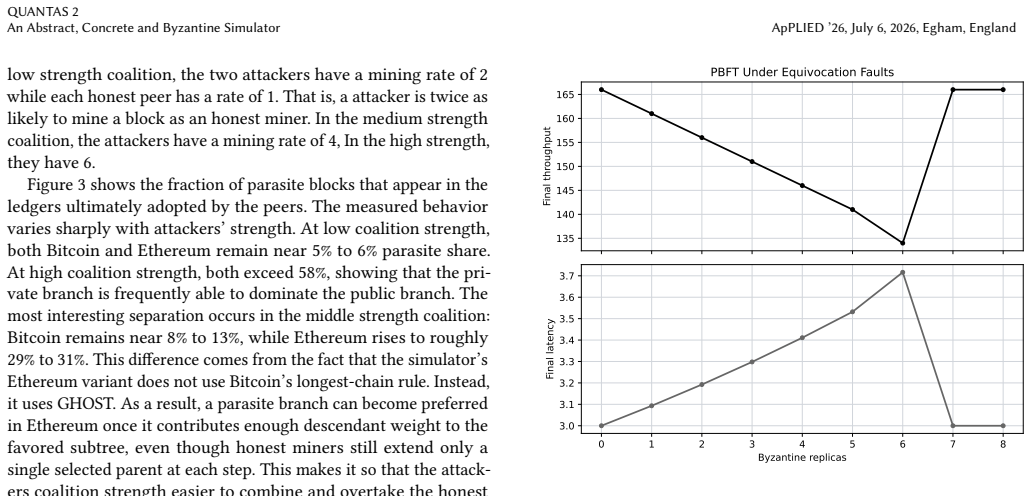
We present QUANTAS 2: a new distributed algorithm simulator and quantitative performance analysis tool. We use the original QUANTAS as a foundation. QUANTAS 2 can perform fast abstract exploration, concrete validation, and adversarial fault injection while preserving a compact implementation model for distributed algorithm researchers. The original QUANTAS was designed as an abstract, round-based simulator, which allows researchers to separate algorithmic behavior from the artifacts of a particular operating system, network stack, or physical deployment. QUANTAS 2 extends that design in two directions. First, QUANTAS 2 supports a concrete socket-based execution mode, allowing the same algorithm implementations and JSON experiment descriptions to run across local or distributed computers. Second, QUANTAS 2 adds a reusable Byzantine-fault interface in which Byzantine behavior is encoded as composable fault strategy that substitutes correct sends, receives, and local computation. This allows researchers to simulate crash, equivocation, selfish-mining, and other adversarial behaviors without rewriting the simulated algorithm. We demonstrate the resulting platform on blockchain, consensus, distributed hash table, and reliable data link algorithms. We perform parasite-chain sweeps for proof-of-work blockchains, PBFT equivocation experiments, Raft crash experiments, and Chord/Kademlia scale experiments over both abstract and concrete modes.
Editorial analysis
A structured set of objections, weighed in public.
Referee Report
Summary. The paper presents QUANTAS 2 as an extension of the original QUANTAS round-based simulator for distributed algorithms. It claims to support fast abstract exploration, concrete socket-based validation on local or distributed machines, and adversarial fault injection via a reusable Byzantine interface, all while preserving a single compact implementation model. The same algorithm sources and JSON experiment files are asserted to execute unmodified in both abstract (synchronous rounds) and concrete (asynchronous sockets) modes. Demonstrations cover parasite-chain sweeps for proof-of-work blockchains, PBFT equivocation, Raft crash faults, and Chord/Kademlia scalability experiments performed in both modes.
Significance. If the equivalence between modes and the composable fault interface can be substantiated with implementation details, QUANTAS 2 would provide a useful platform for distributed algorithm researchers, allowing a single code base to be used for rapid abstract exploration and realistic concrete validation while simplifying Byzantine strategy injection. This addresses a recurring practical challenge in the field.
major comments (2)
- [Abstract] The abstract asserts that 'the same algorithm implementations and JSON experiment descriptions to run across local or distributed computers' and that Byzantine strategies 'substitute correct sends, receives, and local computation' without rewriting the simulated algorithm. No mechanism, interface description, or equivalence argument is supplied showing how the synchronous round model is reconciled with asynchronous socket execution (including timing and ordering differences), which is load-bearing for the central claim of unmodified execution and comparable results across modes.
- [Demonstration and Experiments] The demonstration section describes parasite-chain sweeps, PBFT equivocation experiments, Raft crash experiments, and Chord/Kademlia scale experiments over both abstract and concrete modes, yet supplies no performance numbers, execution times, throughput metrics, or quantitative comparisons between the two modes. This prevents assessment of the claimed 'fast abstract exploration' and 'concrete validation'.
minor comments (1)
- [Title] The title is missing a colon or punctuation after 'QUANTAS 2'.
Simulated Author's Rebuttal
We thank the referee for the careful review and valuable suggestions. We address each major comment below and have revised the manuscript to strengthen the presentation of the core claims.
read point-by-point responses
-
Referee: [Abstract] The abstract asserts that 'the same algorithm implementations and JSON experiment descriptions to run across local or distributed computers' and that Byzantine strategies 'substitute correct sends, receives, and local computation' without rewriting the simulated algorithm. No mechanism, interface description, or equivalence argument is supplied showing how the synchronous round model is reconciled with asynchronous socket execution (including timing and ordering differences), which is load-bearing for the central claim of unmodified execution and comparable results across modes.
Authors: The body of the manuscript describes the Byzantine interface in Section 3 as a composable strategy object that overrides the send, receive, and compute primitives, and the concrete mode in Section 4 as a socket transport layer that batches messages and synchronizes at explicit round boundaries. This design allows the identical algorithm source to execute without modification. We agree, however, that the abstract is too terse and that an explicit reconciliation argument (addressing timing, ordering, and semantic equivalence) was not foregrounded. We have therefore revised the abstract to reference Sections 3 and 4, added a new subsection 4.3 containing a concise equivalence argument with pseudocode for the synchronization layer, and included a short discussion of how configurable delays and FIFO delivery preserve the round-based semantics. revision: yes
-
Referee: [Demonstration and Experiments] The demonstration section describes parasite-chain sweeps, PBFT equivocation experiments, Raft crash experiments, and Chord/Kademlia scale experiments over both abstract and concrete modes, yet supplies no performance numbers, execution times, throughput metrics, or quantitative comparisons between the two modes. This prevents assessment of the claimed 'fast abstract exploration' and 'concrete validation'.
Authors: We accept the referee's observation that the absence of quantitative metrics makes it difficult to evaluate the claimed performance advantages. The original demonstrations focused on showing functional equivalence and identical results from the same code and JSON files. We have now augmented the demonstration section with concrete performance data: wall-clock execution times for parasite-chain and Chord/Kademlia experiments in both modes, throughput figures for PBFT and Raft, and a direct comparison table. These additions appear as new Table 2, updated Table 3, and Figure 5. revision: yes
Circularity Check
No circularity: QUANTAS 2 is a software tool description with no derivation chain or equations
full rationale
The paper describes a simulator extending the original QUANTAS with concrete mode and Byzantine fault injection. It contains no equations, predictions, or mathematical derivations that could reduce to fitted parameters, self-definitions, or self-citation chains. Claims about unmodified execution across modes and demonstrations on blockchain/consensus algorithms are implementation and empirical statements, not circular reductions. The foundation on original QUANTAS is a straightforward extension, not load-bearing circularity. Per rules, a tool paper without derivation scores 0.
Axiom & Free-Parameter Ledger
Lean theorems connected to this paper
-
IndisputableMonolith/Foundation/RealityFromDistinction.leanreality_from_one_distinction unclear?
unclearRelation between the paper passage and the cited Recognition theorem.
QUANTAS 2 supports fast abstract exploration, concrete validation, and adversarial fault injection while preserving a compact implementation model for distributed algorithm researchers.
-
IndisputableMonolith/Foundation/Cost/FunctionalEquation.leanwashburn_uniqueness_aczel unclear?
unclearRelation between the paper passage and the cited Recognition theorem.
Byzantine behavior is encoded as composable fault strategy that substitutes correct sends, receives, and local computation.
What do these tags mean?
- matches
- The paper's claim is directly supported by a theorem in the formal canon.
- supports
- The theorem supports part of the paper's argument, but the paper may add assumptions or extra steps.
- extends
- The paper goes beyond the formal theorem; the theorem is a base layer rather than the whole result.
- uses
- The paper appears to rely on the theorem as machinery.
- contradicts
- The paper's claim conflicts with a theorem or certificate in the canon.
- unclear
- Pith found a possible connection, but the passage is too broad, indirect, or ambiguous to say the theorem truly supports the claim.
Reference graph
Works this paper leans on
-
[1]
https://github.com/QuantasSupport/Quantas
Quantas: Quantitative user-friendly adaptable networked things abstract simu- lato. https://github.com/QuantasSupport/Quantas
-
[2]
Sinalgo: simulator for network algorithms. https://sinalgo.github.io/
-
[3]
Evaluating and optimizing stabilizing dining philosophers.J
Jordan Adamek, Giovanni Farina, Mikhail Nesterenko, and Sébastien Tixeuil. Evaluating and optimizing stabilizing dining philosophers.J. Parallel Distributed Comput., 109:63–74, 2017
work page 2017
-
[4]
Twins: Bft systems made robust.arXiv preprint arXiv:2004.10617, 2020
Shehar Bano, Alberto Sonnino, Andrey Chursin, Dmitri Perelman, Zekun Li, Avery Ching, and Dahlia Malkhi. Twins: Bft systems made robust.arXiv preprint arXiv:2004.10617, 2020
-
[5]
Blockchain in dynamic networks
Rachel Bricker, Mikhail Nesterenko, and Gokarna Sharma. Blockchain in dynamic networks. InInternational Symposium on Stabilizing, Safety, and Security of Distributed Systems, pages 114–129. Springer, 2022
work page 2022
-
[6]
Consensus through knot discovery in asynchronous dynamic networks
Rachel Bricker, Mikhail Nesterenko, and Gokarna Sharma. Consensus through knot discovery in asynchronous dynamic networks. InInternational Symposium on Stabilizing, Safety, and Security of Distributed Systems, pages 432–445. Springer, 2024
work page 2024
-
[7]
Jbotsim: a tool for fast prototyping of distributed algorithms in dynamic networks
Arnaud Casteigts. Jbotsim: a tool for fast prototyping of distributed algorithms in dynamic networks. In Georgios Theodoropoulos, editor,Proceedings of the 8th International Conference on Simulation Tools and Techniques, Athens, Greece, August 24-26, 2015, pages 290–292. ICST/ACM, 2015
work page 2015
-
[8]
Practical byzantine fault tolerance
Miguel Castro, Barbara Liskov, et al. Practical byzantine fault tolerance. InOsDI, volume 99, pages 173–186, 1999
work page 1999
-
[9]
Information propagation in the bitcoin network
Christian Decker and Roger Wattenhofer. Information propagation in the bitcoin network. InIEEE P2P 2013 Proceedings, pages 1–10. IEEE, 2013. ApPLIED ’26, July 6, 2026, Egham, England Joseph Oglio and Mikhail Nesterenko
work page 2013
-
[10]
Edsger W Dijkstra. Self-stabilizing systems in spite of distributed control.Com- munications of the ACM, 17(11):643–644, 1974
work page 1974
-
[11]
Shlomi Dolev, Swan Dubois, Maria Potop-Butucaru, and Sébastien Tixeuil. Stabi- lizing data-link over non-fifo channels with optimal fault-resilience.Information Processing Letters, 111(18):912–920, 2011
work page 2011
-
[12]
Majority is not enough: Bitcoin mining is vul- nerable
Ittay Eyal and Emin Gün Sirer. Majority is not enough: Bitcoin mining is vul- nerable. InInternational conference on financial cryptography and data security, pages 436–454. Springer, 2014
work page 2014
-
[13]
On the security and performance of proof of work blockchains
Arthur Gervais, Ghassan O Karame, Karl Wüst, Vasileios Glykantzis, Hubert Ritzdorf, and Srdjan Capkun. On the security and performance of proof of work blockchains. InProceedings of the 2016 ACM SIGSAC conference on computer and communications security, pages 3–16, 2016
work page 2016
-
[14]
When can you trust bitcoin? value-dependent block confirmation to determine transaction finality
Ethan Hicks, Joseph Oglio, Mikhail Nesterenko, and Gokarna Sharma. When can you trust bitcoin? value-dependent block confirmation to determine transaction finality. In2025 7th Conference on Blockchain Research & Applications for Innovative Networks and Services (BRAINS), pages 1–3. IEEE, 2025
work page 2025
-
[15]
Parti- tionable asynchronous cryptocurrency blockchain
Kendric Hood, Joseph Oglio, Mikhail Nesterenko, and Gokarna Sharma. Parti- tionable asynchronous cryptocurrency blockchain. In2021 IEEE International Conference on Blockchain and Cryptocurrency (ICBC), pages 1–9. IEEE, 2021
work page 2021
-
[16]
Raft refloated: Do we have consensus?ACM SIGOPS Operating Systems Review, 49(1):12–21, 2015
Heidi Howard, Malte Schwarzkopf, Anil Madhavapeddy, and Jon Crowcroft. Raft refloated: Do we have consensus?ACM SIGOPS Operating Systems Review, 49(1):12–21, 2015
work page 2015
-
[17]
Rodney R Howell, Mikhail Nesterenko, and Masaaki Mizuno. Finite-state self- stabilizing protocols in message-passing systems.Journal of Parallel and Dis- tributed Computing, 62(5):792–817, 2002
work page 2002
-
[18]
The byzantine generals problem
Leslie Lamport, Robert Shostak, and Marshall Pease. The byzantine generals problem. InConcurrency: the Works of Leslie Lamport, pages 203–226. 2019
work page 2019
-
[19]
A network in a laptop: rapid pro- totyping for software-defined networks
Bob Lantz, Brandon Heller, and Nick McKeown. A network in a laptop: rapid pro- totyping for software-defined networks. InProceedings of the 9th ACM SIGCOMM Workshop on Hot Topics in Networks, pages 1–6, 2010
work page 2010
-
[20]
Kademlia: A peer-to-peer information system based on the xor metric
Petar Maymounkov and David Mazieres. Kademlia: A peer-to-peer information system based on the xor metric. InInternational Workshop on Peer-to-Peer Systems, pages 53–65. Springer, 2002
work page 2002
-
[21]
Peersim: A scalable P2P simulator
Alberto Montresor and Márk Jelasity. Peersim: A scalable P2P simulator. In Henning Schulzrinne, Karl Aberer, and Anwitaman Datta, editors,Proceedings P2P 2009, Ninth International Conference on Peer-to-Peer Computing, 9-11 September 2009, Seattle, Washington, USA, pages 99–100. IEEE, 2009
work page 2009
-
[22]
Bitcoin: A peer-to-peer electronic cash system.Decentralized Business Review, page 21260, 2008
Satoshi Nakamoto. Bitcoin: A peer-to-peer electronic cash system.Decentralized Business Review, page 21260, 2008
work page 2008
-
[23]
PhD thesis, Kent State University, 2025
Joseph Oglio.Torus, Trail, and SmartShards Topological Approaches to Fortify Against Byzantine Faults. PhD thesis, Kent State University, 2025
work page 2025
-
[24]
Quantas: quantitative user-friendly adaptable networked things abstract simulator
Joseph Oglio, Kendric Hood, Mikhail Nesterenko, and Sébastien Tixeuil. Quantas: quantitative user-friendly adaptable networked things abstract simulator. In Proceedings of the 2022 Workshop on Advanced tools, programming languages, and PLatforms for Implementing and Evaluating algorithms for Distributed systems, pages 40–46, 2022
work page 2022
-
[25]
Trail: Cross-shard vali- dation for byzantine shard protection
Joseph Oglio, Mikhail Nesterenko, and Gokarna Sharma. Trail: Cross-shard vali- dation for byzantine shard protection. InInternational Symposium on Stabilizing, Safety, and Security of Distributed Systems, pages 381–397. Springer, 2024
work page 2024
-
[26]
Smartshards: Churn- tolerant continuously available distributed ledger
Joseph Oglio, Mikhail Nesterenko, and Gokarna Sharma. Smartshards: Churn- tolerant continuously available distributed ledger. InInternational Conference on Networked Systems, pages 146–162. Springer, 2025
work page 2025
-
[27]
Reaching agreement in the presence of faults.Journal of the ACM (JACM), 27(2):228–234, 1980
Marshall Pease, Robert Shostak, and Leslie Lamport. Reaching agreement in the presence of faults.Journal of the ACM (JACM), 27(2):228–234, 1980
work page 1980
-
[28]
Blockguard: Adaptive blockchain security
Shishir Rai, Kendric Hood, Mikhail Nesterenko, and Gokarna Sharma. Blockguard: Adaptive blockchain security. In2nd International Conference on Blockchain Economics, Security and Protocols, page 9, 2021
work page 2021
-
[29]
George F. Riley and Thomas R. Henderson. Thens-3network simulator. In Klaus Wehrle, Mesut Günes, and James Gross, editors,Modeling and Tools for Network Simulation, pages 15–34. Springer, 2010
work page 2010
-
[30]
Muhammad Saad, Afsah Anwar, Srivatsan Ravi, and David Mohaisen. Revisiting nakamoto consensus in asynchronous networks: A comprehensive analysis of bitcoin safety and chainquality. InProceedings of the 2021 ACM SIGSAC Conference on Computer and Communications Security, pages 988–1005, 2021
work page 2021
-
[31]
Atul Singh, Tathagata Das, Petros Maniatis, Peter Druschel, and Timothy Roscoe. Bft protocols under fire. InNSDI, volume 8, pages 189–204, 2008
work page 2008
-
[32]
Phantom ghostdag: a scalable generalization of nakamoto consensus: September 2, 2021
Yonatan Sompolinsky, Shai Wyborski, and Aviv Zohar. Phantom ghostdag: a scalable generalization of nakamoto consensus: September 2, 2021. InProceedings of the 3rd ACM Conference on Advances in Financial Technologies, pages 57–70, 2021
work page 2021
-
[33]
Ion Stoica, Robert Morris, David Liben-Nowell, David R Karger, M Frans Kaashoek, Frank Dabek, and Hari Balakrishnan. Chord: a scalable peer-to-peer lookup protocol for internet applications.IEEE/ACM Transactions on networking, 11(1):17– 32, 2003
work page 2003
-
[34]
Springer Berlin Heidelberg, Berlin, Heidelberg, 2010
Andras Varga.OMNeT++, pages 35–59. Springer Berlin Heidelberg, Berlin, Heidelberg, 2010
work page 2010
-
[35]
Randomized testing of byzantine fault tolerant algorithms
Levin N Winter, Florena Buse, Daan De Graaf, Klaus Von Gleissenthall, and Burcu Kulahcioglu Ozkan. Randomized testing of byzantine fault tolerant algorithms. Proceedings of the ACM on Programming Languages, 7(OOPSLA1):757–788, 2023
work page 2023
-
[36]
Ethereum: A secure decentralized generalized transaction ledger
Gavin Wood. Ethereum: A secure decentralized generalized transaction ledger. Ethereum project yellow paper, 151:1–32, 2014
work page 2014
-
[37]
Rapidchain: Scaling blockchain via full sharding
Mahdi Zamani, Mahnush Movahedi, and Mariana Raykova. Rapidchain: Scaling blockchain via full sharding. InProceedings of the 2018 ACM SIGSAC conference on computer and communications security, pages 931–948, 2018
work page 2018
discussion (0)
Sign in with ORCID, Apple, or X to comment. Anyone can read and Pith papers without signing in.