Recognition: no theorem link
Holographic Surface Enabled Integrated Sensing and Communications
Pith reviewed 2026-05-12 01:01 UTC · model grok-4.3
The pith
Reconfigurable holographic surfaces enable cost-efficient ultra-massive MIMO for joint sensing and communications.
A machine-rendered reading of the paper's core claim, the machinery that carries it, and where it could break.
Core claim
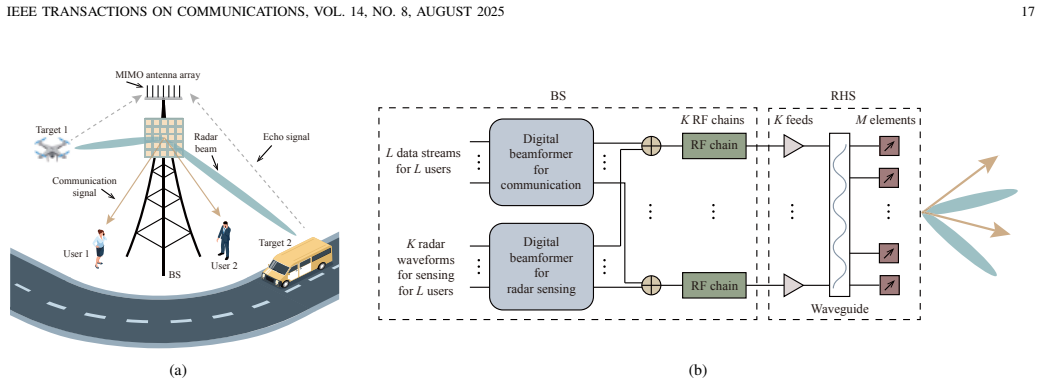
HISAC employs reconfigurable holographic surfaces (RHSs), a type of leaky-wave antenna, as a cost- and energy-efficient implementation of ultra-massive MIMO-based ISAC, and offers enhanced flexibility for ISAC beam synthesis through holographic beamforming.
What carries the argument
Reconfigurable holographic surfaces (RHSs) with holographic beamforming under a leakage power constraint, which replaces complex phase-shifter networks and enables joint optimization of communication and sensing beams.
If this is right
- HISAC jointly supports communication and sensing with lower cost and energy use than phased-array ultra-massive MIMO.
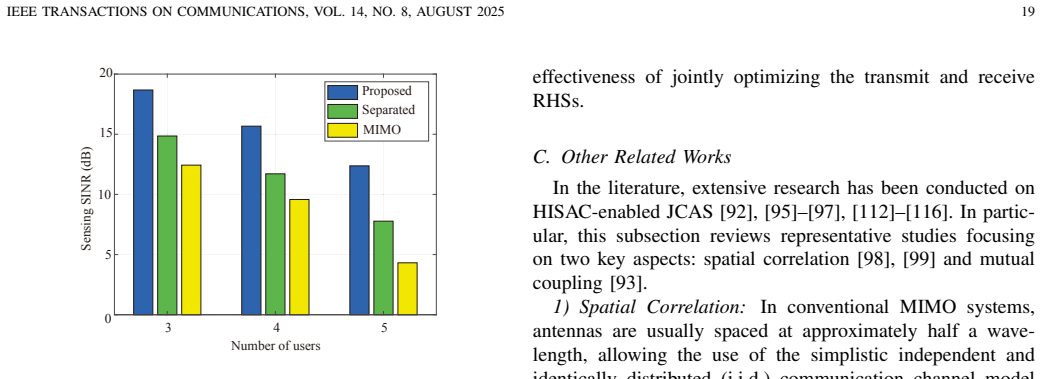
- The same surfaces enable sensing-assisted communication and communication-assisted sensing modes through a unified optimization framework.
- Practical implementations demonstrate feasible beam synthesis and performance under hardware constraints.
- The approach opens pathways to efficient, flexible, and high-performance ISAC networks for 6G.
Where Pith is reading between the lines
- The leakage-power model may allow simpler hardware calibration routines than full phase-shifter arrays.
- Integration with existing 6G waveforms could reduce the need for separate radar and communication hardware at base stations.
- Further work on surface reconfiguration speed would determine suitability for mobile sensing scenarios.
Load-bearing premise
The leakage power constraint of holographic beamforming can be incorporated into a general optimization framework that still yields meaningful joint communication and sensing performance gains under practical hardware limits.
What would settle it
Measurements on a prototype RHS system that show no reduction in power or hardware cost relative to a comparable phased array, or that fail to achieve target joint sensing and communication rates when the leakage constraint is enforced.
Figures





read the original abstract
Integrated sensing and communications (ISAC) is an essential 6G capability for joint data transmission and environmental sensing. To support 6G scenarios with stringent ISAC performance requirements, existing massive-MIMO-based systems are expected to scale toward ultra-massive MIMO. However, this scaling incurs prohibitive cost and power consumption when realized using widely adopted phased arrays with complex phase shifters and feeding networks. Recently, holographic integrated sensing and communications (HISAC) has emerged as a promising paradigm to address this issue. It employs reconfigurable holographic surfaces (RHSs), a type of leaky-wave antenna, as a cost- and energy-efficient implementation of ultra-massive MIMO-based ISAC, and offers enhanced flexibility for ISAC beam synthesis through holographic beamforming. In this paper, we provide a comprehensive tutorial on HISAC, focusing on how RHS-enabled holographic beamforming can be exploited to jointly support communication and sensing under practical hardware constraints. We first introduce the fundamentals of RHSs and discuss the unique leakage power constraint of holographic beamforming. We then present a general optimization framework for HISAC and show how HISAC enhances joint communication and sensing, sensing-assisted communication, and communication-assisted sensing. We further present HISAC system implementations and experimental results. Finally, we outline promising research directions for HISAC, highlighting the potential of HISAC in advancing efficient, flexible, and high-performance ISAC networks.
Editorial analysis
A structured set of objections, weighed in public.
Referee Report
Summary. The paper is a tutorial on holographic integrated sensing and communications (HISAC) that employs reconfigurable holographic surfaces (RHSs) as a cost- and energy-efficient means to realize ultra-massive MIMO-based ISAC for 6G. It introduces the fundamentals of RHSs and the leakage power constraint in holographic beamforming, presents a general optimization framework for joint communication and sensing, demonstrates enhancements in joint ISAC, sensing-assisted communication, and communication-assisted sensing, describes system implementations and experimental results, and outlines future research directions.
Significance. If the described optimization framework successfully integrates the leakage power constraint while delivering verifiable performance improvements in communication and sensing tasks, and if the experimental results confirm these gains under realistic hardware conditions, the tutorial could play a significant role in guiding the development of efficient ISAC systems. It highlights a promising alternative to traditional phased arrays, potentially reducing cost and power consumption in ultra-massive MIMO setups, which is critical for practical 6G deployment. The comprehensive coverage may also serve as an educational resource for researchers entering this area.
major comments (2)
- [Optimization framework] Optimization framework section: The abstract states that the leakage power constraint of holographic beamforming is folded into a general optimization framework that still yields meaningful joint communication and sensing performance gains under practical hardware limits. Without the explicit formulation, objective functions, or feasibility analysis in this section, it is impossible to determine whether the constraint is handled in a non-trivial manner or simply reduces the feasible set without delivering the claimed enhancements; this is load-bearing for the central claim of practical applicability.
- [Experimental results] Experimental results section: The manuscript claims to present HISAC system implementations and experimental results demonstrating the benefits. To support the claims of cost-efficiency and performance gains relative to phased-array baselines, this section must include specific details on hardware setups, performance metrics (e.g., rate, sensing accuracy), comparison baselines, and statistical analysis; the abstract provides none of these, preventing assessment of empirical support for the tutorial's conclusions.
minor comments (1)
- The abstract is clearly organized but would benefit from a single sentence summarizing one key quantitative outcome from the experimental results (e.g., a reported gain in spectral efficiency or sensing resolution) to better convey the practical impact.
Simulated Author's Rebuttal
We thank the referee for the detailed review and constructive feedback on our tutorial manuscript. We address the major comments point by point below, clarifying the content of the relevant sections and indicating revisions where appropriate to enhance clarity and support for the claims.
read point-by-point responses
-
Referee: [Optimization framework] Optimization framework section: The abstract states that the leakage power constraint of holographic beamforming is folded into a general optimization framework that still yields meaningful joint communication and sensing performance gains under practical hardware limits. Without the explicit formulation, objective functions, or feasibility analysis in this section, it is impossible to determine whether the constraint is handled in a non-trivial manner or simply reduces the feasible set without delivering the claimed enhancements; this is load-bearing for the central claim of practical applicability.
Authors: The optimization framework section of the full manuscript formulates the HISAC problem as a non-convex optimization that explicitly incorporates the leakage power constraint as a key restriction on the holographic beamforming weights, alongside the communication rate maximization and sensing beampattern matching objectives. The objective is a weighted combination of these metrics, and we include a feasibility discussion showing that the constraint is active yet permits meaningful performance improvements via techniques such as alternating optimization. Subsequent sections on joint ISAC enhancements provide numerical validation of the gains under hardware limits. To address the concern about explicitness, we will expand the section with additional mathematical details and a dedicated feasibility subsection in the revision. revision: partial
-
Referee: [Experimental results] Experimental results section: The manuscript claims to present HISAC system implementations and experimental results demonstrating the benefits. To support the claims of cost-efficiency and performance gains relative to phased-array baselines, this section must include specific details on hardware setups, performance metrics (e.g., rate, sensing accuracy), comparison baselines, and statistical analysis; the abstract provides none of these, preventing assessment of empirical support for the tutorial's conclusions.
Authors: The experimental results section details the HISAC implementations with reconfigurable holographic surface prototypes, specifying hardware parameters such as meta-atom count, operating frequency, and power consumption. It reports metrics including communication rates and sensing accuracy (e.g., angle estimation RMSE), with direct comparisons to phased-array baselines demonstrating cost and energy reductions. Statistical analysis from repeated trials is included to support the observed gains. While the abstract summarizes without these specifics, the section provides the empirical evidence. We will add a summary table of key metrics, baselines, and results for improved readability in the revision. revision: partial
Circularity Check
No circularity detected; tutorial abstract presents no derivation chain
full rationale
The abstract introduces HISAC as an emerging paradigm employing RHSs for ultra-massive MIMO ISAC and outlines a tutorial structure covering fundamentals, optimization, implementations, and directions. No equations, fitted parameters, predictions, or self-referential derivations are present. Claims rest on external literature references rather than internal reductions to inputs by construction, satisfying the criteria for a non-circular tutorial overview with no load-bearing steps to inspect.
Axiom & Free-Parameter Ledger
axioms (1)
- domain assumption Reconfigurable holographic surfaces can be treated as leaky-wave antennas whose leakage power must be explicitly constrained in beamforming design.
Reference graph
Works this paper leans on
-
[1]
A survey on fundamental limits of integrated sensing and communication,
A. Liu, Z. Huang, M. Li, Y . Wan, W. Li, T. X. Han, C. Liu, R. Du, D. K. P. Tan, J. Lu, Y . Shen, F. Colone, and K. Chetty, “A survey on fundamental limits of integrated sensing and communication,”IEEE Commun. Surv. Tutor., vol. 24, no. 2, pp. 994–1034, Feb. 2022. IEEE TRANSACTIONS ON COMMUNICATIONS, VOL. 14, NO. 8, AUGUST 2025 35
work page 2022
-
[2]
H. Yuhong, “Challenges and opportunities of sub-6 GHz integrated sensing and communications for 5G-advanced and beyond,”Chin. J. Electron., vol. 33, no. 2, pp. 323–325, Mar. 2024
work page 2024
-
[3]
A survey of autonomous driving from a deep learning perspective,
J. Zhao, Y . Wu, R. Deng, S. Xu, J. Gao, and A. Burke, “A survey of autonomous driving from a deep learning perspective,”ACM Comput. Surv., vol. 57, no. 10, pp. 1–60, May 2025
work page 2025
-
[4]
Integrated sensing and communication for low altitude economy: Opportunities and challenges,
Y . Jiang, X. Li, G. Zhu, H. Li, J. Deng, K. Han, C. Shen, Q. Shi, and R. Zhang, “Integrated sensing and communication for low altitude economy: Opportunities and challenges,”IEEE Commun. Mag., vol. 63, no. 12, pp. 72–78, Dec. 2025
work page 2025
-
[5]
Integrated sensing and communication signals toward 5G-A and 6G: A survey,
Z. Wei, H. Qu, Y . Wang, X. Yuan, H. Wu, Y . Du, K. Han, N. Zhang, and Z. Feng, “Integrated sensing and communication signals toward 5G-A and 6G: A survey,”IEEE Int. Things J., vol. 10, no. 13, pp. 11 068–11 092, Jul. 2023
work page 2023
-
[6]
X. Luo, Q. Lin, R. Zhang, H.-H. Chen, X. Wang, and M. Huang, “ISAC – a survey on its layered architecture, technologies, standardizations, prototypes and testbeds,”IEEE Commun. Surv. Tutor., vol. 28, pp. 485– 526, Apr. 2025
work page 2025
-
[7]
F. Liu, C. Masouros, and Y . C. Eldar,Integrated Sensing and Commu- nications. Singapore: Springer, 2023
work page 2023
-
[8]
Recent advances of 6G ultra-massive MIMO technologies in spatial and beam domains,
R. Feng, C.-X. Wang, J. Huang, and X. Gao, “Recent advances of 6G ultra-massive MIMO technologies in spatial and beam domains,”arXiv preprint arXiv:2501.10429, 2025
-
[9]
RIS-based IMT-2030 testbed for mmwave multi-stream ultra-massive MIMO communications,
S. Zeng, B. Di, H. Zhang, J. Gao, S. Yue, X. Hu, R. Fu, J. Zhou, X. Liu, H. Zhang, Y . Wang, S. Sun, H. Qin, X. Su, M. Wang, and L. Song, “RIS-based IMT-2030 testbed for mmwave multi-stream ultra-massive MIMO communications,”IEEE Wirel. Commun., vol. 31, no. 3, pp. 375–382, Jun. 2024
work page 2030
-
[10]
Z. Gao, X. Zhou, B. Ning, Y . Su, T. Qin, and D. Niyato, “Integrated location sensing and communication for ultra-massive MIMO with hybrid-field beam-squint effect,”IEEE J. Sel. Areas Commun., vol. 43, no. 4, pp. 1387–1404, Apr. 2025
work page 2025
-
[11]
Directivity-aware degrees of freedom analysis for extremely large-scale MIMO,
S. Yue, L. Liu, and B. Di, “Directivity-aware degrees of freedom analysis for extremely large-scale MIMO,”IEEE Trans. Veh. Technol., vol. 74, no. 6, pp. 9950–9954, Jun. 2025
work page 2025
-
[12]
Holographic integrated sensing and communication,
H. Zhang, H. Zhang, B. Di, M. D. Renzo, Z. Han, H. V . Poor, and L. Song, “Holographic integrated sensing and communication,”IEEE J. Sel. Areas Commun., vol. 40, no. 7, pp. 2114–2130, Jul. 2022
work page 2022
-
[13]
Holographic integrated sens- ing and communications: Principles, technology, and implementation,
H. Zhang, H. Zhang, B. Di, and L. Song, “Holographic integrated sens- ing and communications: Principles, technology, and implementation,” IEEE Commun. Mag., vol. 61, no. 5, pp. 83–89, May 2023
work page 2023
-
[14]
Holographic beamforming with leakage power constraints,
B. Di, S. Zhang, Z. Han, and R. Zhang, “Holographic beamforming with leakage power constraints,”IEEE Wirel. Commun., vol. 32, no. 4, pp. 14–21, Aug. 2025
work page 2025
-
[15]
R. Deng, B. Di, H. Zhang, Y . Tan, and L. Song, “Reconfig- urable holographic surface-enabled multi-user wireless communica- tions: Amplitude-controlled holographic beamforming,”IEEE Trans. Wirel. Commun., vol. 21, no. 8, pp. 6003–6017, Aug. 2022
work page 2022
-
[16]
P. Checcacci, V . Russo, and A. Scheggi, “Holographic antennas,”IEEE Trans. Antennas Propag., vol. 18, no. 6, pp. 811–813, Nov. 1970
work page 1970
-
[17]
——, “Holographic antennas,”Proc. IEEE, vol. 56, no. 12, pp. 2165– 2167, Dec. 1968
work page 1968
-
[18]
Waveguide-fed tunable metamaterial element for dynamic apertures,
T. Sleasman, M. F. Imani, W. Xu, J. Hunt, T. Driscoll, M. S. Reynolds, and D. R. Smith, “Waveguide-fed tunable metamaterial element for dynamic apertures,”IEEE Antennas Wirel. Propag. Lett., vol. 15, pp. 606–609, May 2016
work page 2016
-
[19]
S. Zhang, Y . Zhang, H. Hashida, Y . C. Eldar, M. D. Renzo, and B. Di, “Fluid antenna systems enabled by reconfigurable holographic surfaces: Beamforming design and experimental validation,”IEEE J. Sel. Areas Commun., vol. 44, pp. 1417–1431, Oct. 2025
work page 2025
-
[20]
Movable holographic surface antenna enabled ultra-massive MIMO,
S. Zhang, B. Di, and L. Song, “Movable holographic surface antenna enabled ultra-massive MIMO,”IEEE Wirel. Comm. Mag., accepted 2025
work page 2025
-
[21]
Reconfigurable holographic surface: A new paradigm for ultra-massive MIMO,
B. Di, H. Zhang, Z. Han, R. Zhang, and L. Song, “Reconfigurable holographic surface: A new paradigm for ultra-massive MIMO,”IEEE Trans. Cognitive Commun. Netw., vol. 11, no. 6, pp. 3761–3783, Mar. 2025
work page 2025
-
[22]
Integration of sensing, communication, and computing for metaverse: A survey,
X. Wang, Q. Guo, Z. Ning, L. Guo, G. Wang, X. Gao, and Y . Zhang, “Integration of sensing, communication, and computing for metaverse: A survey,”ACM Comput. Surv., vol. 56, no. 10, pp. 1–38, May 2024
work page 2024
-
[23]
Y . Ding, X. Li, Y . Cai, and Z. Wu, “Advancements in ISAC: A review of multi-antenna technology integration for next-generation communication and sensing systems,” inProc. 12th Int. Conf. Inf. Sys. Comput. Technol. (ISCTech), Xi’an, China, Nov. 2024
work page 2024
-
[24]
A tutorial on near-field XL-MIMO communications toward 6G,
H. Lu, Y . Zeng, C. You, Y . Han, J. Zhang, Z. Wang, Z. Dong, S. Jin, C.-X. Wang, T. Jiang, X. You, and R. Zhang, “A tutorial on near-field XL-MIMO communications toward 6G,”IEEE Commun. Surv. Tutor., vol. 26, no. 4, pp. 2213–2257, Oct. 2024
work page 2024
-
[25]
A tutorial on MIMO-OFDM ISAC: From far-field to near-field,
Q. Dai, Y . Zeng, H. Wang, C. You, C. Zhou, H. Cheng, X. Xu, S. Jin, A. Lee Swindlehurst, Y . C. Eldar, R. Schober, R. Zhang, and X. You, “A tutorial on MIMO-OFDM ISAC: From far-field to near-field,”IEEE Commun. Surv. Tutor., vol. 28, pp. 4319–4358, Jan. 2026
work page 2026
-
[26]
A roadmap for NF- ISAC in 6G: A comprehensive overview and tutorial,
A. Hakimi, D. Galappaththige, and C. Tellambura, “A roadmap for NF- ISAC in 6G: A comprehensive overview and tutorial,”Entropy, vol. 26, no. 9, p. 773, Sep. 2024
work page 2024
-
[27]
Near-field fading channel modeling for ELAAs: From communication to ISAC,
J. Liu, Y . Ma, A. Elzanaty, and R. Tafazolli, “Near-field fading channel modeling for ELAAs: From communication to ISAC,”arXiv preprint arXiv:2401.17014, 2024
-
[28]
Cell-Free Integrated Sensing and Communication: Principles, Advances, and Future Directions
D. Galappaththige, M. Mohammadi, G. A. Baduge, and C. Tellambura, “Cell-free integrated sensing and communication: Principles, advances, and future directions,”arXiv preprint arXiv:2502.20345, 2025
work page internal anchor Pith review arXiv 2025
-
[29]
RIS-aided cell-free massive MIMO systems for 6G: Fundamentals, system design, and applications,
E. Shi, J. Zhang, H. Du, B. Ai, C. Yuen, D. Niyato, K. B. Letaief, and X. Shen, “RIS-aided cell-free massive MIMO systems for 6G: Fundamentals, system design, and applications,”Proceedings of the IEEE, vol. 112, no. 4, pp. 331–364, Apr. 2024
work page 2024
-
[30]
Network-level ISAC design: State-of-the-art, challenges, and opportunities,
K. Han, K. Meng, X.-Y . Wang, and C. Masouros, “Network-level ISAC design: State-of-the-art, challenges, and opportunities,”IEEE J. Sel. Top. Electromagn. Antennas Propag., vol. 1, no. 1, pp. 65–83, Sep. 2025
work page 2025
-
[31]
The rise of networked ISAC: Emerging aspects and challenges,
D. P. M. Osorio, B. Barua, K.-L. Besser, H. Blue, P. Dass, and P. Porambage, “The rise of networked ISAC: Emerging aspects and challenges,”IEEE Open J. Commun. Society, vol. 6, pp. 5072–5091, Jun. 2025
work page 2025
-
[32]
A. Magbool, V . Kumar, Q. Wu, M. D. Renzo, and M. F. Flanagan, “A survey on integrated sensing and communication with intelligent metasurfaces: Trends, challenges, and opportunities,”IEEE Open J. Commun. Society, vol. 6, pp. 7270–7318, Aug. 2025
work page 2025
-
[33]
RIS-based physical layer security for integrated sensing and communication: A comprehensive survey,
Y . Li, F. Khan, M. Ahmed, A. A. Soofi, W. U. Khan, C. K. Sheemar, M. Asif, and Z. Han, “RIS-based physical layer security for integrated sensing and communication: A comprehensive survey,”IEEE Int. Things J., vol. 12, no. 16, pp. 32 444–32 468, Aug. 2025
work page 2025
-
[34]
Enabling intelligent connectivity: A survey of secure ISAC in 6G networks,
X. Zhu, J. Liu, L. Lu, T. Zhang, T. Qiu, C. Wang, and Y . Liu, “Enabling intelligent connectivity: A survey of secure ISAC in 6G networks,” IEEE Commun. Surv. Tutor., vol. 27, no. 2, pp. 748–781, Apr. 2025
work page 2025
-
[35]
A state-of-the-art survey on IRS-NOMA for integrated sensing and communication,
S. N. Sur, A. K. Singh, H. Q. Tran, P. Vishwakarma, A. L. Imoize, and C.-T. Li, “A state-of-the-art survey on IRS-NOMA for integrated sensing and communication,”IEEE Access, vol. 12, pp. 186 087– 186 123, Dec. 2024
work page 2024
-
[36]
RIS-assisted integrated sensing and com- munication: Applications, challenges and usecase scenario,
G. Chopra and S. Ahmed, “RIS-assisted integrated sensing and com- munication: Applications, challenges and usecase scenario,”Discover Appl. Sci., vol. 7, no. 7, p. 650, Jun. 2025
work page 2025
-
[37]
A. Tishchenko, M. Khalily, A. Shojaeifard, F. Burton, E. Bj ¨ornson, M. D. Renzo, and R. Tafazolli, “The emergence of multi-functional and hybrid reconfigurable intelligent surfaces for integrated sensing and communications - a survey,”IEEE Commun. Surv. Tutor., vol. 27, no. 5, pp. 2895–2936, Jan. 2025
work page 2025
-
[38]
F. L. Pedrotti, L. M. Pedrotti, and L. S. Pedrotti,Introduction to Optics. Cambridge, UK: Cambridge University Press, 2017
work page 2017
-
[39]
Some remarks on radio-frequency holography,
G. Deschamps, “Some remarks on radio-frequency holography,”Pro- ceedings of the IEEE, vol. 55, no. 4, pp. 570–571, Apr. 1967
work page 1967
-
[40]
Holo- graphic antenna concept, analysis, and parameters,
M. ElSherbiny, A. Fathy, A. Rosen, G. Ayers, and S. Perlow, “Holo- graphic antenna concept, analysis, and parameters,”IEEE Trans. An- tennas Propag., vol. 52, no. 3, pp. 830–839, Mar. 2004
work page 2004
-
[41]
Leaky-wave based interpre- tation of the radiation from holographic surfaces,
M. Nannetti, F. Caminita, and S. Maci, “Leaky-wave based interpre- tation of the radiation from holographic surfaces,” inIEEE AP-S Int. Symp., Honolulu, HI, Jun. 2007
work page 2007
-
[42]
N. Lang, A. K. Kludze, N. Shlezinger, Y . Ghasempour, T. Routtenberg, G. C. Alexandropoulos, and Y . C. Eldar, “Leaky wave antennas for next generation wireless applications in sub-THz frequencies: Current status and research challenges,”arXiv preprint arXiv:2510.11666, 2025
-
[43]
Dynamic metasurface antennas for 6G extreme massive MIMO communications,
N. Shlezinger, G. C. Alexandropoulos, M. F. Imani, Y . C. Eldar, and D. R. Smith, “Dynamic metasurface antennas for 6G extreme massive MIMO communications,”IEEE Wirel. Commun., vol. 28, no. 2, pp. 106–113, Apr. 2021
work page 2021
-
[44]
Target detection and positioning aided by reconfigurable surfaces: Reflective or holographic?
X. Zhang, H. Zhang, L. Liu, Z. Han, H. V . Poor, and B. Di, “Target detection and positioning aided by reconfigurable surfaces: Reflective or holographic?”IEEE Trans. Wirel. Commun., vol. 23, no. 12, pp. 19 215–19 230, Dec. 2024
work page 2024
-
[45]
Reconfigurable holographic metasurface aided wideband OFDM communications against beam squint,
B. Di, “Reconfigurable holographic metasurface aided wideband OFDM communications against beam squint,”IEEE Trans. Veh. Tech- nol., vol. 70, no. 5, pp. 5099–5103, May 2021. IEEE TRANSACTIONS ON COMMUNICATIONS, VOL. 14, NO. 8, AUGUST 2025 36
work page 2021
-
[46]
Analysis of a waveguide-fed metasurface antenna,
D. R. Smith, O. Yurduseven, L. P. Mancera, P. Bowen, and N. B. Kundtz, “Analysis of a waveguide-fed metasurface antenna,”Phys. Rev. Appl., vol. 8, no. 5, p. 054048, Nov. 2017
work page 2017
-
[47]
Reconfigurable holographic surface enabled ultra-massive MIMO: How large surface is enough?
X. Hu, B. Di, J. Wang, and L. Song, “Reconfigurable holographic surface enabled ultra-massive MIMO: How large surface is enough?” IEEE Trans. Commun., vol. 74, pp. 2348–2362, Dec. 2025
work page 2025
-
[48]
Z. Yang, X. Liu, H. Zhang, B. Di, and L. Song, “Reconfigurable holographic surface-assisted radio simultaneous localization and map- ping (SLAM) with leakage power constraints,”IEEE Trans. Commun., vol. 74, pp. 4415–4430, Jan. 2026
work page 2026
-
[49]
S. Zhang, Y . Zhang, and B. Di, “Large-scale intelligent surfaces enabled unified near-field and far-field communications: Codebook design and beam training,”IEEE Network, vol. 39, no. 1, pp. 90–96, Jan. 2025
work page 2025
-
[50]
Intelligent omni- surfaces aided wireless communications: Does the reciprocity hold?
S. Yue, S. Zeng, H. Zhang, F. Lin, L. Liu, and B. Di, “Intelligent omni- surfaces aided wireless communications: Does the reciprocity hold?” IEEE Trans. Veh. Technol., vol. 72, no. 6, pp. 8181–8185, Jun. 2023
work page 2023
-
[51]
Reconfigurable intelligent surfaces in 6G: Reflective, transmissive, or both?
S. Zeng, H. Zhang, B. Di, Y . Tan, Z. Han, H. V . Poor, and L. Song, “Reconfigurable intelligent surfaces in 6G: Reflective, transmissive, or both?”IEEE Commun. Lett., vol. 25, no. 6, pp. 2063–2067, Jun. 2021
work page 2063
-
[52]
UA V relaying: Power alloca- tion and trajectory optimization using decode-and-forward protocol,
S. Zeng, H. Zhang, K. Bian, and L. Song, “UA V relaying: Power alloca- tion and trajectory optimization using decode-and-forward protocol,” in Proc. IEEE Int. Conf. Commun. Workshops (ICC Workshops), Kansas City, MO, 2018
work page 2018
-
[53]
S. Zeng, H. Zhang, B. Di, Y . Liu, M. D. Renzo, Z. Han, H. V . Poor, and L. Song, “Intelligent omni-surfaces: Reflection-refraction circuit model, full-dimensional beamforming, and system implementation,” IEEE Trans. Commun., vol. 70, no. 11, pp. 7711–7727, Nov. 2022
work page 2022
-
[54]
Reconfigurable refractive surfaces: An energy-efficient way to holographic MIMO,
S. Zeng, H. Zhang, B. Di, H. Qin, X. Su, and L. Song, “Reconfigurable refractive surfaces: An energy-efficient way to holographic MIMO,” IEEE Commun. Lett., vol. 26, no. 10, pp. 2490–2494, Oct. 2022
work page 2022
-
[55]
Reconfigurable intelligent surfaces: Principles and opportunities,
Y . Liu, X. Liu, X. Mu, T. Hou, J. Xu, M. Di Renzo, and N. Al-Dhahir, “Reconfigurable intelligent surfaces: Principles and opportunities,” IEEE Commun. Surv. Tutor., vol. 23, no. 3, pp. 1546–1577, May 2021
work page 2021
-
[56]
S. Zeng, H. Zhang, B. Di, Z. Han, and L. Song, “Reconfigurable intelligent surface (RIS) assisted wireless coverage extension: RIS orientation and location optimization,”IEEE Commun. Lett., vol. 25, no. 1, pp. 269–273, Jan. 2021
work page 2021
-
[57]
W. Tang, M. Z. Chen, X. Chen, J. Y . Dai, Y . Han, M. Di Renzo, Y . Zeng, S. Jin, Q. Cheng, and T. J. Cui, “Wireless communications with reconfigurable intelligent surface: Path loss modeling and exper- imental measurement,”IEEE Trans. Wirel. Commun., vol. 20, no. 1, pp. 421–439, Jan. 2021
work page 2021
-
[58]
R. Liu, M. Li, H. Luo, Q. Liu, and A. L. Swindlehurst, “Integrated sensing and communication with reconfigurable intelligent surfaces: Opportunities, applications, and future directions,”IEEE Wirel. Com- mun., vol. 30, no. 1, pp. 50–57, Feb. 2023
work page 2023
-
[59]
SNR/CRB- constrained joint beamforming and reflection designs for RIS-ISAC systems,
R. Liu, M. Li, Q. Liu, and A. Lee Swindlehurst, “SNR/CRB- constrained joint beamforming and reflection designs for RIS-ISAC systems,”IEEE Trans. Wirel. Commun., vol. 23, no. 7, pp. 7456–7470, Jul. 2024
work page 2024
-
[60]
Q. Luo, J. Gao, and B. Di, “Horus: Enhancing safe corners via integrated sensing and communication enabled by reconfigurable in- telligent surface,” inProc. Annual Int. Conf. Mob. Comput. Netw., Washington D.C., 2024
work page 2024
-
[61]
A survey on integrated sensing, communication, and computation,
D. Wen, Y . Zhou, X. Li, Y . Shi, K. Huang, and K. B. Letaief, “A survey on integrated sensing, communication, and computation,”IEEE Commun. Surv. Tutor., vol. 27, no. 5, pp. 3058–3098, Oct. 2025
work page 2025
-
[62]
Stochastic geometry for modeling and analysis of sensing and communications: A survey,
H. K. Armeniakos, P. S. Bithas, S. A. Tegos, A. G. Kanatas, and G. K. Karagiannidis, “Stochastic geometry for modeling and analysis of sensing and communications: A survey,”IEEE Commun. Surv. Tutor., vol. 28, pp. 2691–2724, Jul. 2025
work page 2025
-
[63]
An overview of signal processing techniques for joint communication and radar sensing,
J. A. Zhang, F. Liu, C. Masouros, R. W. Heath, Z. Feng, L. Zheng, and A. Petropulu, “An overview of signal processing techniques for joint communication and radar sensing,”IEEE J. Sel. Topics Signal Process., vol. 15, no. 6, pp. 1295–1315, Nov. 2021
work page 2021
-
[64]
Location-aware communication for RIS-aided distributed MIMO systems,
Z. Yang, H. Zhang, B. Di, X. Li, X. Hou, and L. Song, “Location-aware communication for RIS-aided distributed MIMO systems,”IEEE Trans. Veh. Technol., vol. 74, no. 3, pp. 4445–4460, Mar. 2025
work page 2025
-
[65]
Z. Yang, S. Yang, H. Zhang, B. Di, X. Li, X. Hou, and L. Song, “Localization-assisted communication for RIS-aided distributed MIMO systems using distributionally robust optimization,” inProc. IEEE/CIC Int. Conf. Commun. China (ICCC), Hangzhou, China, Aug. 2024
work page 2024
-
[66]
Trends, challenges, and key technologies of beam-space multiplexing based on metasurfaces,
S. Chen, S. Sun, X. Su, X. Zhang, Q. Gao, H. Niu, W. Sun, S. Zeng, R. Deng, Y . Zhang, H. Zhang, X. Hu, B. Di, and L. Song, “Trends, challenges, and key technologies of beam-space multiplexing based on metasurfaces,”IEEE Wirel. Commun., vol. 32, no. 3, pp. 130–138, Jun. 2025
work page 2025
-
[67]
Cooperative sensing for 6G mobile cellular networks: Feasibility, performance, and field trial,
G. Liu, R. Xi, Z. Han, L. Han, X. Zhang, L. Ma, Y . Wang, M. Lou, J. Jin, Q. Wang, and J. Wang, “Cooperative sensing for 6G mobile cellular networks: Feasibility, performance, and field trial,”IEEE J. Sel. Areas Commun., vol. 42, no. 10, pp. 2863–2876, Oct. 2024
work page 2024
-
[68]
Framework and overall objectives of the future development of IMT for 2030 and beyond,
ITU-R, “Framework and overall objectives of the future development of IMT for 2030 and beyond,” International Telecommunication Union (ITU), Tech. Rep. Recommendation ITU-R M.2160-0, 2023
work page 2030
-
[69]
Dual-polarized reconfigurable intelligent surface-based antenna for holographic MIMO communications,
S. Zeng, H. Zhang, B. Di, Z. Han, and H. Vincent Poor, “Dual-polarized reconfigurable intelligent surface-based antenna for holographic MIMO communications,”IEEE Trans. Wirel. Commun., vol. 23, no. 11, pp. 17 339–17 353, Nov. 2024
work page 2024
-
[70]
Reconfigurable refractive surface-enabled multi-user holographic MIMO communications,
S. Zeng, H. Zhang, B. Di, and L. Song, “Reconfigurable refractive surface-enabled multi-user holographic MIMO communications,”IEEE Trans. Wirel. Commun., vol. 23, no. 5, pp. 4845–4860, May 2024
work page 2024
-
[71]
Near- far field channel modeling for holographic mimo using expectation- maximization methods,
H. Chen, S. Zeng, H. Guo, T. Svensson, and H. Zhang, “Near- far field channel modeling for holographic mimo using expectation- maximization methods,” inProc. IEEE Wirel. Commun. Netw. Conf. (WCNC), Dubai, UAE, Apr. 2024
work page 2024
-
[72]
Metalocalization: Reconfigurable intelligent surface aided multi-user wireless indoor localization,
H. Zhang, H. Zhang, D. Boya, K. Bian, Z. Han, and L. Song, “Metalocalization: Reconfigurable intelligent surface aided multi-user wireless indoor localization,”IEEE Trans. Wirel. Commun., vol. 20, no. 12, pp. 7743–7757, Dec. 2021
work page 2021
-
[73]
Holographic radar: Target detection enabled by reconfigurable holographic surfaces,
X. Zhang, H. Zhang, H. Zhang, and B. Di, “Holographic radar: Target detection enabled by reconfigurable holographic surfaces,”IEEE Commun. Lett., vol. 27, no. 1, pp. 332–336, Jan. 2023
work page 2023
-
[74]
MetaSLAM: Wireless simultaneous localization and mapping using reconfigurable intelligent surfaces,
Z. Yang, H. Zhang, H. Zhang, B. Di, M. Dong, L. Yang, and L. Song, “MetaSLAM: Wireless simultaneous localization and mapping using reconfigurable intelligent surfaces,”IEEE Trans. Wireless Commun., vol. 22, no. 4, pp. 2606–2620, Apr. 2023
work page 2023
-
[75]
Wireless indoor simultaneous localization and mapping using reconfigurable intelligent surface,
Z. Yang, H. Zhang, B. Di, H. Zhang, K. Bian, and L. Song, “Wireless indoor simultaneous localization and mapping using reconfigurable intelligent surface,” inProc. IEEE Global Commun. Conf. (GLOBE- COM), Madrid, Spain, Dec. 2021
work page 2021
-
[76]
Rethinking estimation rate for wireless sensing: A rate-distortion perspective,
F. Dong, F. Liu, S. Lu, and Y . Xiong, “Rethinking estimation rate for wireless sensing: A rate-distortion perspective,”IEEE Trans. Veh. Technol., vol. 72, no. 12, pp. 16 876–16 881, Dec. 2023
work page 2023
-
[77]
On probing signal design for MIMO radar,
P. Stoica, J. Li, and Y . Xie, “On probing signal design for MIMO radar,”IEEE Trans. Signal Process., vol. 55, no. 8, pp. 4151–4161, Jul. 2007
work page 2007
-
[78]
K. Zhang, J. Wu, F. Dong, S. Lu, X. Li, and W. Yuan, “Joint design of receiving filters and complementary set of sequences for ISAC with sidelobe level suppression,”IEEE J. Sel. Areas Sensors, vol. 1, pp. 211–223, Sep. 2024
work page 2024
-
[79]
Optimal transmit beamforming for integrated sensing and communication,
H. Hua, J. Xu, and T. X. Han, “Optimal transmit beamforming for integrated sensing and communication,”IEEE Trans. Veh. Technol., vol. 72, no. 8, pp. 10 588–10 603, Aug. 2023
work page 2023
-
[80]
A survey of collocated MIMO radar,
H. Zishu, C. Ziyang, L. Jun, Z. Wei, S. Jingxi, S. Yang, and D. Ming- long, “A survey of collocated MIMO radar,”J. Radars, vol. 11, no. 5, pp. 805–829, Aug. 2022
work page 2022
discussion (0)
Sign in with ORCID, Apple, or X to comment. Anyone can read and Pith papers without signing in.