Recognition: 2 theorem links
· Lean TheoremThe Extended Plane of the Local Supercluster
Pith reviewed 2026-05-13 01:53 UTC · model grok-4.3
The pith
The positions of radio galaxies, galaxy clusters, and galaxies bright at two microns correlate with the plane of the Local Supercluster at distances of 100 to 200 megaparsecs.
A machine-rendered reading of the paper's core claim, the machinery that carries it, and where it could break.
Core claim
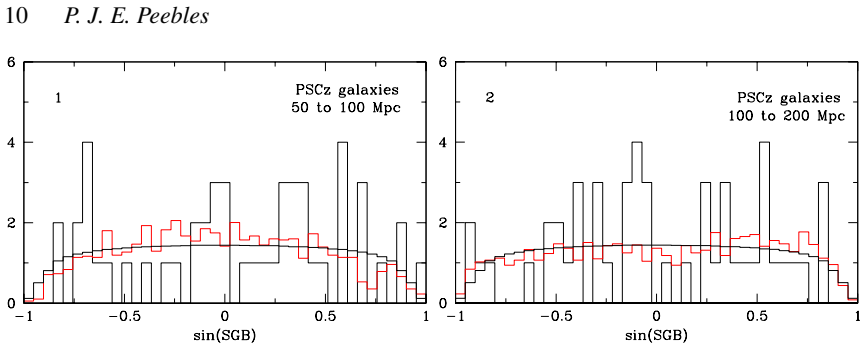
An update of the evidence that radio galaxies and clusters of galaxies are more common than average near the plane of the de Vaucouleurs Local Supercluster shows that in the distance range 100 to 200 Mpc objects whose positions are correlated with the plane of the Local Supercluster include galaxies that are exceptionally luminous at two microns, radio galaxies, and clusters of galaxies. There can be little doubt about this property of cosmic structure. There is also an argument for detection of this correlation for the galaxies at 400 Mpc distance that are exceptionally luminous at two microns.
What carries the argument
The plane of the de Vaucouleurs Local Supercluster, serving as a fixed reference to test whether positions of more distant objects show excess alignment.
If this is right
- Multiple independent object types exhibit the positional correlation in the 100-200 Mpc range.
- The Local Supercluster plane marks a detectable property of cosmic structure on these scales.
- The correlation may reach 400 Mpc for the two-micron luminous galaxies.
- Standard models of structure formation can be checked against whether they produce or forbid such alignments.
Where Pith is reading between the lines
- Confirmation would suggest that preferred directions in galaxy distribution persist on scales where the universe is often assumed to look more uniform.
- Similar alignments could be searched for in other wavebands or with newer distance indicators to test consistency.
- The result raises the question of how such a plane connects to the formation history of the Local Supercluster itself.
Load-bearing premise
The chosen samples of radio galaxies, clusters, and two-micron luminous galaxies, together with their distance estimates, are free from selection biases or incompleteness that could create an artificial appearance of alignment.
What would settle it
A complete volume-limited catalog of galaxies and clusters in the 100-200 Mpc range, analyzed without the original selection criteria, showing no excess concentration near the supercluster plane.
Figures



read the original abstract
An update of the evidence that radio galaxies and clusters of galaxies are more common than average near the plane of the de Vaucouleurs Local Supercluster shows that in the distance range 100 to 200Mpc objects whose positions are correlated with the plane of the Local Supercluster include galaxies that are exceptionally luminous at two microns, radio galaxies, and clusters of galaxies. There can be little doubt about this property of cosmic structure. I also argue for detection of this correlation for the galaxies at 400Mpc distance that are exceptionally luminous at two microns. It will be interesting to learn whether these results are expected in the standard cosmology.
Editorial analysis
A structured set of objections, weighed in public.
Referee Report
Summary. The manuscript updates evidence that radio galaxies, clusters of galaxies, and galaxies exceptionally luminous at 2 microns show positional correlations with the de Vaucouleurs plane of the Local Supercluster. It asserts that in the 100-200 Mpc distance range there can be 'little doubt' about this property of cosmic structure, and argues for a possible detection of the same correlation among 2-micron luminous galaxies at 400 Mpc. The paper concludes by asking whether such alignments are expected within standard cosmology.
Significance. A robust demonstration of extended alignments at these distances would indicate a large-scale anisotropy or filamentary structure on scales of ~100-200 Mpc that exceeds typical expectations from the cosmological principle. The work draws on multiple catalogs (2MASS, radio, cluster) and therefore has the potential to be a useful observational constraint if selection functions and completeness are properly quantified.
major comments (2)
- [Abstract] Abstract: the assertion of 'little doubt' and 'strong evidence' is presented without any statistical measures (significance levels, error bars, sample sizes, or completeness corrections) for the claimed excess in the 100-200 Mpc and 400 Mpc shells. This absence makes it impossible to evaluate whether the reported correlations exceed what is expected from random distributions.
- [Abstract] Abstract: the central claim that the observed positional correlations are intrinsic requires that direction-dependent selection effects (galactic extinction, survey footprint boundaries, Malmquist bias in distance estimates) have been controlled. No quantitative statement of the selection function or extinction correction applied to each catalog is supplied, leaving open the possibility that the apparent alignment is induced by the proximity of the supercluster plane to the galactic equator in some projections.
minor comments (2)
- The distance shells (100-200 Mpc, 400 Mpc) and the precise luminosity or flux thresholds used to define 'exceptionally luminous at two microns' should be stated explicitly with references to the parent catalogs.
- A brief description of the coordinate system or projection used to define 'near the plane' would improve reproducibility.
Simulated Author's Rebuttal
We thank the referee for the careful review and useful comments on our manuscript. We respond to each major comment below, indicating where revisions have been made.
read point-by-point responses
-
Referee: [Abstract] Abstract: the assertion of 'little doubt' and 'strong evidence' is presented without any statistical measures (significance levels, error bars, sample sizes, or completeness corrections) for the claimed excess in the 100-200 Mpc and 400 Mpc shells. This absence makes it impossible to evaluate whether the reported correlations exceed what is expected from random distributions.
Authors: We agree that the abstract would benefit from quantitative context. The body of the paper presents the positional correlations drawn from 2MASS, radio-galaxy, and cluster catalogs, with sample sizes of order 100–300 objects per distance shell and alignments assessed via direct comparison to randomized realizations of the same catalogs. We will revise the abstract to include brief statements of sample size and the approximate significance of the reported excesses while preserving its concise form. revision: yes
-
Referee: [Abstract] Abstract: the central claim that the observed positional correlations are intrinsic requires that direction-dependent selection effects (galactic extinction, survey footprint boundaries, Malmquist bias in distance estimates) have been controlled. No quantitative statement of the selection function or extinction correction applied to each catalog is supplied, leaving open the possibility that the apparent alignment is induced by the proximity of the supercluster plane to the galactic equator in some projections.
Authors: The concern is well taken. The supergalactic plane is inclined by approximately 30 degrees relative to the Galactic plane, which reduces the chance that a single extinction or footprint effect could produce a coherent alignment across independent surveys. The manuscript already employs three catalogs with dissimilar selection functions and wavelength regimes; consistency of the signal across them argues against a common observational bias. In the revised version we have added a short discussion paragraph that explicitly addresses galactic extinction, survey boundaries, and Malmquist bias, referencing the catalog documentation for the applied corrections. A full end-to-end quantitative selection-function model for every catalog lies outside the scope of this short update, but the multi-catalog agreement provides the primary support for an intrinsic origin. revision: partial
Circularity Check
No circularity: direct catalog-based positional correlations
full rationale
The paper updates observational evidence for alignment of radio galaxies, clusters, and 2-micron luminous galaxies with the de Vaucouleurs plane using positional data in distance shells (100-200 Mpc and ~400 Mpc). No mathematical derivation, fitted parameters renamed as predictions, self-definitional equations, or load-bearing self-citation chains appear in the abstract or described structure. Claims rest on direct comparisons to catalogs rather than any closed logical loop that reduces the result to its inputs by construction. Selection-bias concerns are matters of data quality, not circularity.
Axiom & Free-Parameter Ledger
axioms (1)
- domain assumption The de Vaucouleurs Local Supercluster plane is a well-defined reference structure for positional correlations.
Lean theorems connected to this paper
-
IndisputableMonolith/Foundation/AlexanderDuality.leanalexander_duality_circle_linking echoes?
echoesECHOES: this paper passage has the same mathematical shape or conceptual pattern as the Recognition theorem, but is not a direct formal dependency.
the direction of the supergalactic pole l=47.37°, b=6.32°... distribution of sin(SGB)... peak count near SGB=0
What do these tags mean?
- matches
- The paper's claim is directly supported by a theorem in the formal canon.
- supports
- The theorem supports part of the paper's argument, but the paper may add assumptions or extra steps.
- extends
- The paper goes beyond the formal theorem; the theorem is a base layer rather than the whole result.
- uses
- The paper appears to rely on the theorem as machinery.
- contradicts
- The paper's claim conflicts with a theorem or certificate in the canon.
- unclear
- Pith found a possible connection, but the passage is too broad, indirect, or ambiguous to say the theorem truly supports the claim.
Reference graph
Works this paper leans on
- [1]
-
[2]
doi:10.1086/191333 Aragon-Calvo M. A., Silk J., Neyrinck M., 2023, MNRAS, 520, L28. doi:10.1093/mnrasl/slac161 Beichman, C. A., Neugebauer, G., Habing, H. J., Clegg, P. E., Chester, T. J., eds. (1988), Infrared Astronomical Satellite (IRAS): Catalogs and Atlases (PDF). Volume 1: Explanatory Supplement (2nd ed.). NASA Scientific and Technical Information D...
-
[3]
de Vaucouleurs G., 1978, IAUS, 79, 205 de Vaucouleurs G., de Vaucouleurs A., and Corwin J
doi:10.1038/1821478a0. de Vaucouleurs G., 1978, IAUS, 79, 205 de Vaucouleurs G., de Vaucouleurs A., and Corwin J. R., 1976, Second reference catalogue of bright galaxies, Austin: University of Texas Press. HuchraJ.P.,MacriL.M.,MastersK.L.,JarrettT.H.,BerlindP.,CalkinsM.,CrookA.C.,etal.,2012,ApJS,199,26.doi:10.1088/0067- 0049/199/2/26 Karachentsev I. D., M...
-
[4]
doi:10.1088/0004-6256/145/4/101 Karachentseva V. E., 1969, Vest. Kiev Univ., Astron. Ser. (VeKie) 11, 114 Klein M., Hernández-Lang D., Mohr J. J., Bocquet S., Singh A., 2023, MNRAS, 526,
-
[5]
J., Bocquet S., Singh A., 2024, yCat,
doi:10.1093/mnras/stad2729 Klein M., Hernández-Lang D., Mohr J. J., Bocquet S., Singh A., 2024, yCat,
- [6]
-
[7]
doi:10.1093/mnras/stu199 Neuzil M. K., Mansfield P., Kravtsov A. V., 2020, MNRAS, 494,
-
[8]
doi:10.1093/mnras/staa898 Oort J. H., 1983, ARA&A, 21,
-
[9]
doi:10.1146/annurev.aa.21.090183.002105 Peebles P. J. E., 2022a, AnPhy, 447, 169159. doi:10.1016/j.aop.2022.169159 Peebles P. J. E., 2022b, AnPhy, 447, 169159. doi:10.1016/j.aop.2022.169159 Peebles P. J. E., 2023, MNRAS, 526,
-
[10]
doi:10.1093/mnras/stad3051 Sanders D. B., Mirabel I. F., 1996, ARA&A, 34,
-
[11]
doi:10.1146/annurev.astro.34.1.749 SaundersW.,SutherlandW.J.,MaddoxS.J.,KeebleO.,OliverS.J.,Rowan-RobinsonM.,McMahonR.G.,etal.,2000,MNRAS,317,
-
[12]
Comprehensiveanalyticformulaeforstellarevolutionasafunctionofmassandmetallicity,
doi:10.1046/j.1365-8711.2000.03528.x Schaller M., 2024, MNRAS, 529, L23. doi:10.1093/mnrasl/slad199 Shaver P. A., 1991, AuJPh, 44,
-
[13]
doi:10.1071/PH910759 Skrutskie M. F., Cutri R. M., Stiening R., Weinberg M. D., Schneider S., Carpenter J. M., Beichman C., et al., 2006, AJ, 131,
- [14]
-
[15]
doi:10.1086/159999 Tully R. B., 1986, ApJ, 303,
-
[16]
doi:10.1051/0004-6361/201219389 Wempe E., White S
doi:10.1086/164049 van Velzen S., Falcke H., Schellart P., Nierstenhöfer N., Kampert K.-H., 2012, A&A, 544, A18. doi:10.1051/0004-6361/201219389 Wempe E., White S. D. M., Helmi A., Lavaux G., Jasche J., 2026, NatAs.tmp. doi:10.1038/s41550-025-02770- Zel’dovich I. B., Einasto J., Shandarin S. F., 1982, Natur, 300,
-
[17]
doi:10.1038/300407a0 MNRAS000, 000–000 (0000)
discussion (0)
Sign in with ORCID, Apple, or X to comment. Anyone can read and Pith papers without signing in.