Recognition: 1 theorem link
· Lean TheoremRevisiting GW170817 at milliarcsecond scale: high-precision constraints on jet geometry and H₀
Pith reviewed 2026-05-13 01:57 UTC · model grok-4.3
The pith
New VLBI fitting of GW170817's afterglow gives a viewing angle of 17-20 degrees and H0 of 65.5 km/s/Mpc.
A machine-rendered reading of the paper's core claim, the machinery that carries it, and where it could break.
Core claim
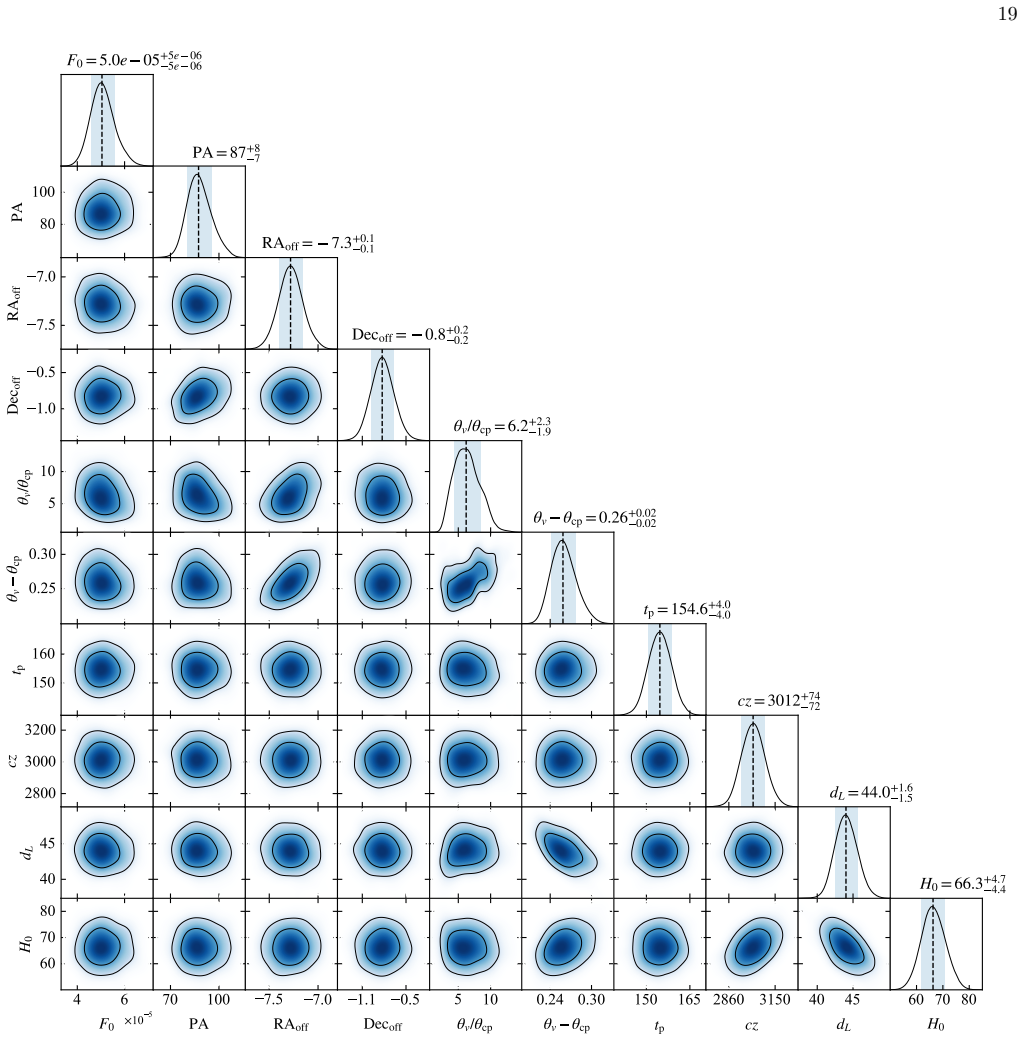
Using a Bayesian visibility-plane model-fitting framework together with hydrodynamical afterglow models that span a continuum of jet geometries, the analysis measures the viewing angle of GW170817 as 18.3-20.3 degrees when cosmology is fixed, and 16.8-19.2 degrees when luminosity distance and H0 are fitted simultaneously while marginalizing over an ensemble of peculiar-velocity corrections. The joint fit yields DL = 44.0 ± 1.6 Mpc and H0 = 65.5 ± 4.4 km s^{-1} Mpc^{-1}, with the H0 posterior peaking within 0.5 sigma of the Planck value but 1.7 sigma from the SH0ES value.
What carries the argument
Bayesian visibility-plane model-fitting framework applied to VLBI data and hydrodynamical afterglow models that allow a continuous range of jet opening angles.
If this is right
- The covariance between viewing angle and luminosity distance is reduced, tightening the standard-siren distance measurement.
- The derived H0 posterior favors the early-universe Planck value over the late-universe SH0ES value at 1.7 sigma.
- The same visibility-plane fitting approach can be applied to any future neutron-star merger with both gravitational-wave and radio afterglow data.
- Marginalization over multiple peculiar-velocity realizations prevents over-precision from an incomplete treatment of host-galaxy motion.
Where Pith is reading between the lines
- If the hydrodynamical models systematically under- or over-predict the radio flux at late times, the inferred viewing angle would shift and pull H0 with it.
- A sample of ten similar events analyzed this way could produce an H0 uncertainty below 2 km s^{-1} Mpc^{-1} without relying on the cosmic distance ladder.
- The method supplies a cross-check on whether the current Hubble tension arises from unmodeled systematics in either the early- or late-universe probes.
Load-bearing premise
The hydrodynamical afterglow models accurately describe the jet's emission physics and structure, and the ensemble of peculiar-velocity corrections captures all relevant uncertainties in the host galaxy's motion.
What would settle it
An independent measurement of the jet viewing angle from future VLBI imaging or from the gravitational-wave waveform alone that falls outside the 16.8-20.3 degree range, or a new standard-siren H0 from another well-observed merger that lies more than 2 sigma from 65.5 km s^{-1} Mpc^{-1}.
Figures




read the original abstract
The historic detection of gravitational waves from the electromagnetically bright binary neutron star merger GW170817 enabled the first standard siren measurement of Hubble's constant ($H_0$). The accuracy and precision of this measurement depends crucially on how well the merger inclination angle is constrained, given its strong covariance with luminosity distance ($D_L$). Modeling the light-curve of the jet's afterglow provides constraints on inclination, but is highly dependent on the similarly uncertain jet opening angle. Past studies have improved on this by invoking high-resolution radio observations, obtained through very long baseline interferometry (VLBI). We present a Bayesian visibility-plane model-fitting framework that provides a more informed and robust measurement of the viewing geometry of GW170817 and of $H_0$, by including all relevant VLBI data, robustly handling systematic uncertainties and rigorously sampling model parameter space. By fitting new hydrodynamical afterglow models with a continuum of jet geometries, we obtain a viewing angle of $18.^{\circ}3-20.^{\circ}3$ (for a fixed cosmology with $D_L=40.7$ Mpc, as used in most previous analyses). We extend our framework to fit for $D_L$ and $H_0$ directly, and marginalize over an ensemble of plausible peculiar velocity corrections to obtain viewing angle $16.^{\circ}8-19.^{\circ}2$, $D_L=44.0\pm1.6$ Mpc and $H_0=65.5\pm4.4$ km s$^{-1}$ Mpc$^{-1}$. Notably, the peak of our $H_0$ posterior is within $0.5\sigma$ of the early-Universe Planck $H_0$ value, but $1.7\sigma$ from the late-Universe SH0ES measurement. We discuss potential caveats and the implications of this result in the context of the current discrepancy between early and late-Universe measurements of the Hubble constant.
Editorial analysis
A structured set of objections, weighed in public.
Referee Report
Summary. The manuscript introduces a Bayesian visibility-plane model-fitting framework for VLBI data of the GW170817 afterglow. It employs new hydrodynamical afterglow models spanning a continuum of jet geometries to constrain the viewing angle, first at fixed cosmology (18.3–20.3°) and then jointly with luminosity distance and H0 while marginalizing over an ensemble of peculiar-velocity corrections, yielding viewing angle 16.8–19.2°, DL = 44.0 ± 1.6 Mpc, and H0 = 65.5 ± 4.4 km s^{-1} Mpc^{-1}.
Significance. If the hydrodynamical models correctly predict the observed VLBI visibilities across the sampled jet geometries, the analysis supplies an independent standard-siren H0 constraint that lies within 0.5σ of the Planck value. The explicit use of the full visibility data, marginalization over systematics, and continuum jet models represent methodological improvements over prior light-curve-only studies.
major comments (2)
- [Modeling framework / hydrodynamical afterglow models] The headline constraints on viewing angle, DL, and H0 rest on the assumption that the new hydrodynamical afterglow models accurately reproduce the time-evolving VLBI visibility amplitudes and phases. The manuscript should provide quantitative validation—e.g., residuals between model and observed visibilities for the best-fit parameters, or explicit tests of sensitivity to lateral spreading and surface-brightness profile assumptions—because any systematic mismatch would shift the inclination posterior and, through its covariance with DL, bias H0 (see the modeling section describing the hydrodynamical grid).
- [H0 fitting procedure] The marginalization over the ensemble of peculiar-velocity corrections is load-bearing for the quoted H0 uncertainty. The paper must specify the exact construction of this ensemble (range, priors, and number of realizations) and demonstrate that the H0 posterior width is stable when the ensemble is broadened or narrowed, as an incomplete ensemble would understate the total uncertainty on H0.
minor comments (2)
- [Abstract and results figures] The abstract quotes viewing-angle ranges without stating whether they are 68% or 95% credible intervals; this should be clarified in the text and figure captions.
- [Notation throughout] Notation for the jet opening angle and viewing angle should be made consistent between the hydrodynamical model description and the posterior plots to avoid reader confusion.
Simulated Author's Rebuttal
We thank the referee for their constructive and detailed comments on our manuscript. We address each major comment below and will incorporate the requested additions and clarifications into a revised version.
read point-by-point responses
-
Referee: [Modeling framework / hydrodynamical afterglow models] The headline constraints on viewing angle, DL, and H0 rest on the assumption that the new hydrodynamical afterglow models accurately reproduce the time-evolving VLBI visibility amplitudes and phases. The manuscript should provide quantitative validation—e.g., residuals between model and observed visibilities for the best-fit parameters, or explicit tests of sensitivity to lateral spreading and surface-brightness profile assumptions—because any systematic mismatch would shift the inclination posterior and, through its covariance with DL, bias H0 (see the modeling section describing the hydrodynamical grid).
Authors: We agree that quantitative validation is necessary to support the robustness of the derived constraints. In the revised manuscript we will add a dedicated subsection that presents the residuals between the best-fit hydrodynamical model visibilities and the observed VLBI data at each epoch. We will also include explicit sensitivity tests that vary the lateral spreading prescription and the assumed surface-brightness profile, demonstrating that the viewing-angle posterior remains stable within the quoted 68% credible interval. These additions will directly address the concern that unaccounted model systematics could bias the inclination–DL covariance and therefore H0. revision: yes
-
Referee: [H0 fitting procedure] The marginalization over the ensemble of peculiar-velocity corrections is load-bearing for the quoted H0 uncertainty. The paper must specify the exact construction of this ensemble (range, priors, and number of realizations) and demonstrate that the H0 posterior width is stable when the ensemble is broadened or narrowed, as an incomplete ensemble would understate the total uncertainty on H0.
Authors: We will revise the relevant methods section to provide a complete description of the peculiar-velocity ensemble, including the adopted range of corrections, the priors placed on each realization, and the total number of realizations drawn. In addition, we will add a supplementary figure that repeats the full H0 analysis for both a broadened and a narrowed version of the ensemble, confirming that the reported H0 uncertainty is insensitive to reasonable variations in the ensemble construction. This will demonstrate that the marginalization is not understating the total error budget. revision: yes
Circularity Check
No significant circularity in derivation chain
full rationale
The paper's central results are produced by direct Bayesian visibility-plane fitting of new hydrodynamical afterglow models (with continuum of jet geometries) to the full VLBI dataset, followed by direct fitting for DL and H0 while marginalizing over an external ensemble of peculiar-velocity corrections. No quoted step reduces a claimed prediction to a quantity defined by the authors' own prior fits, self-citations, or ansatzes; the hydrodynamical models and velocity ensemble are treated as independent inputs. This is the most common honest outcome for a paper whose load-bearing operations remain externally falsifiable.
Axiom & Free-Parameter Ledger
free parameters (2)
- jet geometry parameters
- peculiar velocity corrections
axioms (2)
- domain assumption Hydrodynamical simulations accurately capture the relativistic jet afterglow emission for the range of geometries considered
- domain assumption Bayesian inference with the chosen likelihood and priors properly accounts for all statistical and systematic uncertainties in the VLBI data
Lean theorems connected to this paper
-
IndisputableMonolith/Foundation/RealityFromDistinction.leanreality_from_one_distinction unclear?
unclearRelation between the paper passage and the cited Recognition theorem.
Bayesian visibility-plane model-fitting framework... hydrodynamical afterglow models with a continuum of jet geometries... H0 = 65.5±4.4 km s^{-1} Mpc^{-1}
What do these tags mean?
- matches
- The paper's claim is directly supported by a theorem in the formal canon.
- supports
- The theorem supports part of the paper's argument, but the paper may add assumptions or extra steps.
- extends
- The paper goes beyond the formal theorem; the theorem is a base layer rather than the whole result.
- uses
- The paper appears to rely on the theorem as machinery.
- contradicts
- The paper's claim conflicts with a theorem or certificate in the canon.
- unclear
- Pith found a possible connection, but the passage is too broad, indirect, or ambiguous to say the theorem truly supports the claim.
Reference graph
Works this paper leans on
-
[1]
Abbott, B. P., Abbott, R., Abbott, T. D., et al. 2017a, Nature, 551, 85, doi: 10.1038/nature24471 —. 2017b, ApJL, 848, L13, doi: 10.3847/2041-8213/aa920c
-
[2]
Abbott, B. P., Abbott, R., Abbott, T. D., et al. 2019, Phys. Rev. X, 9, 011001, doi: 10.1103/PhysRevX.9.011001
-
[3]
Ashton, G., H¨ ubner, M., Lasky, P. D., et al. 2019, ApJS, 241, 27, doi: 10.3847/1538-4365/ab06fc
-
[4]
Blake, C., & Turner, R. J. 2024, The Open Journal of Astrophysics, 7, 87, doi: 10.33232/001c.124509
-
[5]
2020, Living Reviews in Relativity, 23, 4, doi: 10.1007/s41114-020-00028-7
Burns, E. 2020, Living Reviews in Relativity, 23, 4, doi: 10.1007/s41114-020-00028-7
-
[6]
Cantiello, M., Jensen, J. B., Blakeslee, J. P., et al. 2018, The Astrophysical Journal Letters, 854, L31, doi: 10.3847/2041-8213/aaad64
-
[7]
Carr, A., Davis, T. M., Scolnic, D., et al. 2022, PASA, 39, e046, doi: 10.1017/pasa.2022.41
-
[8]
Carrick, J., Turnbull, S. J., Lavaux, G., & Hudson, M. J. 2015, Monthly Notices of the Royal Astronomical Society, 450, 317, doi: 10.1093/mnras/stv547
-
[9]
Crook, A. C., Huchra, J. P., Martimbeau, N., et al. 2007, ApJ, 655, 790, doi: 10.1086/510201 —. 2008, ApJ, 685, 1320, doi: 10.1086/590385
-
[10]
Dastidar, R. G., & Duffell, P. C. 2024, ApJ, 976, 252, doi: 10.3847/1538-4357/ad86bf
-
[11]
Dietrich, T., Coughlin, M. W., Pang, P. T. H., et al. 2020, Science, 370, 1450, doi: 10.1126/science.abb4317
-
[12]
2024, ApJL, 971, L24, doi: 10.3847/2041-8213/ad66d2
DuPont, M., & MacFadyen, A. 2024, ApJL, 971, L24, doi: 10.3847/2041-8213/ad66d2
-
[13]
Ghirlanda, G., Salafia, O. S., Paragi, Z., et al. 2019, Science, 363, 968, doi: 10.1126/science.aau8815
-
[14]
2024, MNRAS, 528, 2600, doi: 10.1093/mnras/stae198
Gianfagna, G., Piro, L., Pannarale, F., et al. 2024, MNRAS, 528, 2600, doi: 10.1093/mnras/stae198
-
[15]
2017, ApJL, 848, L14, doi: 10.3847/2041-8213/aa8f41
Goldstein, A., Veres, P., Burns, E., et al. 2017, ApJL, 848, L14, doi: 10.3847/2041-8213/aa8f41
-
[16]
Gourdji, K. 2026, Key reproduction data for the paper ‘Revisiting GW170817 at milliarcsecond scale: high-precision constraints on jet geometry and H0’ by Gourdji et al. 2026, Zenodo, doi: 10.5281/zenodo.20078339
-
[17]
2023, MNRAS, 524, 403, doi: 10.1093/mnras/stad1628
Govreen-Segal, T., & Nakar, E. 2023, MNRAS, 524, 403, doi: 10.1093/mnras/stad1628
-
[18]
Greisen, E. W. 2003, in Astrophysics and Space Science
work page 2003
-
[19]
285, Information Handling in Astronomy - Historical Vistas, ed
Library, Vol. 285, Information Handling in Astronomy - Historical Vistas, ed. A. Heck, 109, doi: 10.1007/0-306-48080-8 7
-
[20]
2017, ApJL, 851, L36, doi: 10.3847/2041-8213/aaa009
Guidorzi, C., Margutti, R., Brout, D., et al. 2017, ApJL, 851, L36, doi: 10.3847/2041-8213/aaa009
-
[21]
Hajela, A., Margutti, R., Bright, J. S., et al. 2022, ApJL, 927, L17, doi: 10.3847/2041-8213/ac504a
-
[22]
Hjorth, J., Levan, A. J., Tanvir, N. R., et al. 2017, ApJL, 848, L31, doi: 10.3847/2041-8213/aa9110
-
[23]
Holz, D. E., & Hughes, S. A. 2005, The Astrophysical Journal, 629, 15, doi: 10.1086/431341
-
[24]
2019, Nature Astronomy, 3, 940, doi: 10.1038/s41550-019-0820-1
Hotokezaka, K., Nakar, E., Gottlieb, O., et al. 2019, Nature Astronomy, 3, 940, doi: 10.1038/s41550-019-0820-1
-
[25]
Howlett, C., & Davis, T. M. 2020, MNRAS, 492, 3803, doi: 10.1093/mnras/staa049
-
[26]
1961, Theory of Probability, 3rd Edition (Clarendon Press, Oxford)
Jeffreys, H. 1961, Theory of Probability, 3rd Edition (Clarendon Press, Oxford)
work page 1961
-
[27]
Katira, A., Mooley, K. P., & Hotokezaka, K. 2025, MNRAS, 539, 2654, doi: 10.1093/mnras/staf579
-
[28]
2006, in Astronomical Society of the Pacific Conference Series, Vol
Cotton, B. 2006, in Astronomical Society of the Pacific Conference Series, Vol. 351, Astronomical Data Analysis Software and Systems XV, ed. C. Gabriel, C. Arviset, D. Ponz, & S. Enrique, 497
work page 2006
-
[29]
Kourkchi, E., & Tully, R. B. 2017, ApJ, 843, 16, doi: 10.3847/1538-4357/aa76db
-
[30]
doi:10.1088/1475-7516/2025/08/025 , urldate =
Lewis, A. 2025, JCAP, 08, 025, doi: 10.1088/1475-7516/2025/08/025
-
[31]
2021, MNRAS, 507, 1557, doi: 10.1093/mnras/stab2009
Lilow, R., & Nusser, A. 2021, MNRAS, 507, 1557, doi: 10.1093/mnras/stab2009
-
[32]
Makhathini, S., Mooley, K. P., Brightman, M., et al. 2021, ApJ, 922, 154, doi: 10.3847/1538-4357/ac1ffc
-
[33]
and Anderson, Jay and Lu, Wenbin , year=
Mooley, K. P., Anderson, J., & Lu, W. 2022, Nature, 610, 273, doi: 10.1038/s41586-022-05145-7
-
[34]
Mooley, K. P., Deller, A. T., Gottlieb, O., et al. 2018, Nature, 561, 355, doi: 10.1038/s41586-018-0486-3
-
[35]
and Jasche, Jens and Wandelt, Benjamin D
Mukherjee, S., Lavaux, G., Bouchet, F. R., et al. 2021, A&A, 646, A65, doi: 10.1051/0004-6361/201936724 M¨ uller, M., Mukherjee, S., & Ryan, G. 2024, ApJL, 977, L45, doi: 10.3847/2041-8213/ad8dd1
-
[36]
2021, ApJ, 909, 114, doi: 10.3847/1538-4357/abd6cd
Nakar, E., & Piran, T. 2021, ApJ, 909, 114, doi: 10.3847/1538-4357/abd6cd
-
[37]
2020, MNRAS, 495, 90, doi: 10.1093/mnras/staa1120
Nicolaou, C., Lahav, O., Lemos, P., Hartley, W., & Braden, J. 2020, MNRAS, 495, 90, doi: 10.1093/mnras/staa1120
-
[38]
Sievers, J. L. 2010, ApJ, 725, 496, doi: 10.1088/0004-637X/725/1/496 25
-
[39]
Palmese, A., Kaur, R., Hajela, A., et al. 2024, Phys. Rev. D, 109, 063508, doi: 10.1103/PhysRevD.109.063508
-
[40]
Perkins, S. J., Marais, P. C., Zwart, J. T. L., et al. 2015, Astronomy and Computing, 12, 73, doi: 10.1016/j.ascom.2015.06.003
-
[41]
Peterson, E. R., Kenworthy, W. D., Scolnic, D., et al. 2022, ApJ, 938, 112, doi: 10.3847/1538-4357/ac4698 Planck Collaboration, Aghanim, N., Akrami, Y., et al. 2020, A&A, 641, A6, doi: 10.1051/0004-6361/201833910
-
[42]
Pradel, N., Charlot, P., & Lestrade, J. F. 2006, A&A, 452, 1099, doi: 10.1051/0004-6361:20053021
-
[43]
Riess, A. G., Yuan, W., Macri, L. M., et al. 2022, ApJL, 934, L7, doi: 10.3847/2041-8213/ac5c5b
-
[44]
2020, ApJ, 896, 166, doi: 10.3847/1538-4357/ab93cf
Ryan, G., van Eerten, H., Piro, L., & Troja, E. 2020, ApJ, 896, 166, doi: 10.3847/1538-4357/ab93cf
-
[45]
Hudson, M. J. 2020, MNRAS, 497, 1275, doi: 10.1093/mnras/staa2032
-
[46]
Schutz, B. F. 1986, Nature, 323, 310, doi: 10.1038/323310a0
-
[47]
Shepherd, M. C., Pearson, T. J., & Taylor, G. B. 1994, in Bulletin of the American Astronomical Society, Vol. 26, 987–989
work page 1994
-
[48]
Speagle, J. S. 2020, MNRAS, 493, 3132, doi: 10.1093/mnras/staa278
-
[49]
M., Magoulas, C., Colless, M., et al
Springob, C. M., Magoulas, C., Colless, M., et al. 2014, MNRAS, 445, 2677, doi: 10.1093/mnras/stu1743
-
[50]
2018, PhRvD, 98, 022008, doi: 10.1103/PhysRevD.98.022008
Takeda, H., Nishizawa, A., Michimura, Y., et al. 2018, PhRvD, 98, 022008, doi: 10.1103/PhysRevD.98.022008
-
[51]
2018, MNRAS, 476, 4527, doi: 10.1093/mnras/sty409
Tazzari, M., Beaujean, F., & Testi, L. 2018, MNRAS, 476, 4527, doi: 10.1093/mnras/sty409
-
[52]
2022, MNRAS, 510, 1902, doi: 10.1093/mnras/stab3533
Troja, E., O’Connor, B., Ryan, G., et al. 2022, MNRAS, 510, 1902, doi: 10.1093/mnras/stab3533
-
[53]
Verde, L., Treu, T., & Riess, A. G. 2019, Nature Astronomy, 3, 891, doi: 10.1038/s41550-019-0902-0
work page internal anchor Pith review doi:10.1038/s41550-019-0902-0 2019
-
[54]
Wang, H., & Giannios, D. 2021, ApJ, 908, 200, doi: 10.3847/1538-4357/abd39c
discussion (0)
Sign in with ORCID, Apple, or X to comment. Anyone can read and Pith papers without signing in.