Recognition: no theorem link
Effect of Solar Flares on Decayless Kink Oscillations in Nearby Coronal Loops
Pith reviewed 2026-05-13 04:50 UTC · model grok-4.3
The pith
Decayless kink oscillations in coronal loops show little amplitude change in response to nearby solar flares of any class.
A machine-rendered reading of the paper's core claim, the machinery that carries it, and where it could break.
Core claim
The amplitude of decayless kink oscillations does not undergo a major change in response to nearby flares, especially for less powerful classes, suggesting that flare-related processes such as blast waves and reconnection inflows have little effect on the energy supply to oscillating loops.
What carries the argument
Fractional Anisotropy-based Video Motion Magnification technique applied to SDO/AIA 171 angstrom images, used to detect and quantify low-amplitude decayless kink oscillations before, during, and after each flare.
Load-bearing premise
The motion magnification technique accurately measures the small oscillation amplitudes without systematic bias, and the chosen loops are representative and free from confounding influences.
What would settle it
Observation of statistically significant amplitude increases or decreases in a larger sample of X-class flares where blast-wave impact on the loops can be confirmed independently.
Figures




read the original abstract
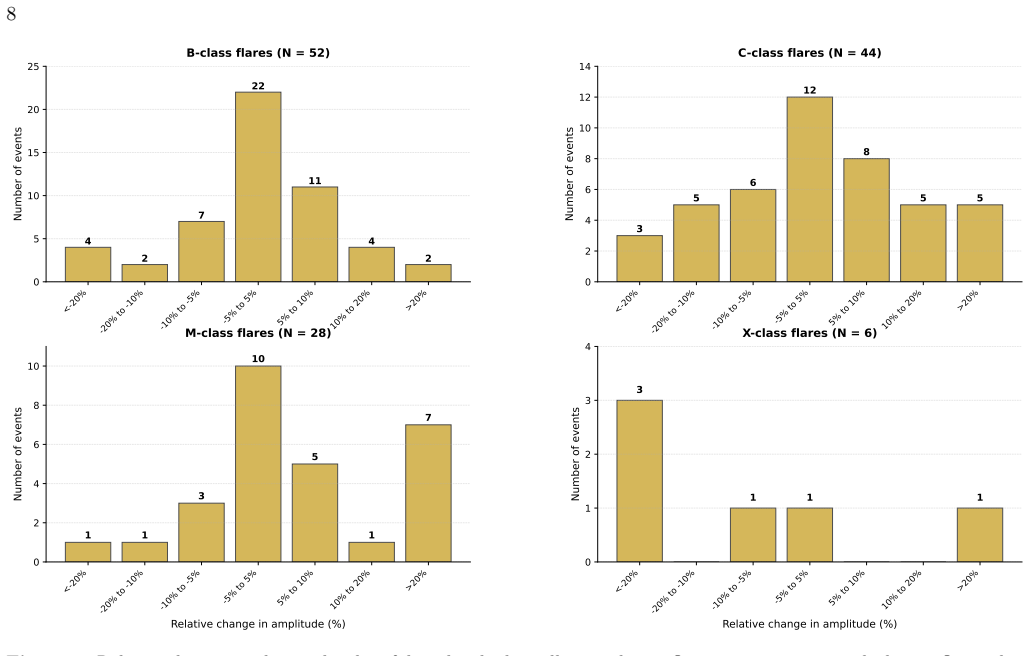
We present a statistical study of 130 solar flares (B to X class) that lack soft X-ray quasi-periodic pulsations and show no kink oscillations of nearby coronal loops visible in SDO/AIA 171~\AA~images. The aim is to investigate whether decayless kink oscillations of coronal loops respond to nearby flaring activity. Using the Fractional Anisotropy-based Video Motion Magnification technique, we detected low-amplitude decayless oscillations in all 130 loops before, during, and after each flare, confirming their ubiquitous nature. Oscillation periods are found to range from 122~s to 268~s, and the projected displacement amplitudes are 0.023--0.111~Mm. No amplitude--period correlation is found. For each event, we estimated the amplitude before, during, and after the flare. Across all flare classes, the average amplitude remains unchanged. However, in some specific cases, the oscillation amplitude may exhibit minor changes. For B-, C-, and M-class flares, the fraction of events with an amplitude change exceeding 10% is approximately 23%, 41%, and 36%, respectively. In M-class flares, such minor amplitude increases occur four times more often than decreases; in X-class flares (only six events), decreases dominate by a factor of three. The fraction of events that exhibit an increase in the amplitude of more than 20% appears to be highest when the loop centre is located at a distance of 100--120~Mm from the flare site, reaching 33% (6 out of 18 events). Overall, the amplitude of decayless kink oscillations does not undergo a major change in response to nearby flares, especially for less powerful classes, suggesting that flare-related processes such as blast waves and reconnection inflows have little effect on the energy supply to oscillating loops.
Editorial analysis
A structured set of objections, weighed in public.
Referee Report
Summary. The manuscript presents a statistical study of 130 solar flares (B to X class) lacking soft X-ray QPPs and visible kink oscillations in SDO/AIA 171 Å images. Using the Fractional Anisotropy-based Video Motion Magnification technique, the authors detect low-amplitude decayless kink oscillations in all 130 nearby loops before, during, and after each flare. They report periods of 122–268 s and projected amplitudes of 0.023–0.111 Mm with no amplitude–period correlation, finding that average amplitudes remain unchanged across flare classes while only modest fractions of events show >10% or >20% changes, with some distance dependence; this leads to the conclusion that flare-related processes have little effect on the energy supply to the oscillating loops.
Significance. If the amplitude measurements are shown to be reliable, the large sample of 130 events provides statistically meaningful evidence that decayless kink oscillations are largely unaffected by nearby flares of B–M class, reinforcing their ubiquitous nature and independence from flare-driven energy inputs such as blast waves. This would be a useful observational constraint on coronal loop dynamics and wave excitation mechanisms. The small X-class subsample limits broader claims, but the overall dataset strengthens the case for minimal flare influence on these oscillations.
major comments (3)
- [Methods] The central claim that amplitudes 'do not undergo a major change' and that only modest fractions exceed 10% or 20% thresholds rests on amplitude measurements extracted via the Fractional Anisotropy-based Video Motion Magnification technique, yet the manuscript provides no error budget, synthetic-injection recovery tests, or calibration of the method's precision for sub-resolution displacements (0.023–0.111 Mm). Without this, the reported change fractions (e.g., 23% for B-class, 41% for C-class) and the 33% increase in the 100–120 Mm distance bin cannot be distinguished from measurement scatter or intrinsic variability.
- [Results] Only six X-class events are analyzed, yet the abstract states that 'decreases dominate by a factor of three' in this class; this sample size is too small for robust comparison with the larger B/C/M subsamples and undermines any class-dependent conclusions about amplitude response.
- [Results] No statistical tests, p-values, or uncertainty estimates are reported for the 'no amplitude–period correlation' statement or for the significance of the before/during/after amplitude comparisons, making it impossible to evaluate whether the observed minor changes are distinguishable from noise.
minor comments (2)
- [Abstract] The abstract mentions the period range and amplitude range but does not specify how periods and amplitudes were fitted or what functional form was assumed for the oscillations.
- Loop selection criteria and any checks that the chosen loops are unaffected by other variables (e.g., nearby non-flaring activity) are not described in sufficient detail to assess sample representativeness.
Simulated Author's Rebuttal
We thank the referee for their constructive and detailed comments, which have identified important areas where the manuscript can be strengthened. We address each major comment below and will revise the paper to incorporate additional analysis and qualifications as appropriate.
read point-by-point responses
-
Referee: [Methods] The central claim that amplitudes 'do not undergo a major change' and that only modest fractions exceed 10% or 20% thresholds rests on amplitude measurements extracted via the Fractional Anisotropy-based Video Motion Magnification technique, yet the manuscript provides no error budget, synthetic-injection recovery tests, or calibration of the method's precision for sub-resolution displacements (0.023–0.111 Mm). Without this, the reported change fractions (e.g., 23% for B-class, 41% for C-class) and the 33% increase in the 100–120 Mm distance bin cannot be distinguished from measurement scatter or intrinsic variability.
Authors: We acknowledge that the manuscript does not present a formal error budget or synthetic recovery tests for the sub-resolution amplitude measurements. Although the Fractional Anisotropy-based Video Motion Magnification technique has been validated in earlier studies of decayless oscillations, we agree that demonstrating its precision specifically for the reported displacement range is necessary to support the change-fraction statistics. In the revised manuscript we will add an error analysis section that includes (i) per-event amplitude uncertainties derived from the AIA signal-to-noise ratio and (ii) synthetic displacement-injection tests performed on representative loop data to quantify recovery accuracy and scatter. These additions will allow direct comparison of observed amplitude variations against measurement uncertainties. revision: yes
-
Referee: [Results] Only six X-class events are analyzed, yet the abstract states that 'decreases dominate by a factor of three' in this class; this sample size is too small for robust comparison with the larger B/C/M subsamples and undermines any class-dependent conclusions about amplitude response.
Authors: We concur that the X-class subsample is limited to six events and that the descriptive statement in the abstract therefore cannot support robust class-dependent conclusions. The observation that decreases outnumber increases by a factor of three is simply a count within this small sample and was not presented as statistically significant. In the revision we will (i) qualify the abstract wording to read “in the limited sample of six X-class flares, amplitude decreases were observed more frequently than increases” and (ii) add an explicit discussion of the small-sample limitation in both the results and conclusions sections, thereby avoiding over-interpretation. revision: yes
-
Referee: [Results] No statistical tests, p-values, or uncertainty estimates are reported for the 'no amplitude–period correlation' statement or for the significance of the before/during/after amplitude comparisons, making it impossible to evaluate whether the observed minor changes are distinguishable from noise.
Authors: The original manuscript reported the absence of an amplitude–period correlation and the before/during/after amplitude comparisons without accompanying statistical tests or uncertainties. To rectify this, the revised version will include (i) Spearman rank correlation coefficients together with p-values for the amplitude–period relation across the full sample and per flare class, and (ii) mean (or median) amplitudes with standard errors (or interquartile ranges) for the before, during, and after intervals, accompanied by paired statistical tests (e.g., Wilcoxon signed-rank or paired t-tests) to assess the significance of any differences. These quantitative measures will be added to the results section and will enable readers to judge whether the reported minor changes exceed expected variability. revision: yes
Circularity Check
No circularity: purely observational statistical analysis with direct amplitude measurements
full rationale
The paper conducts a statistical study of 130 flare events, applying an established motion-magnification technique to measure projected displacement amplitudes (0.023–0.111 Mm) in coronal loops before, during, and after each flare. Periods and amplitude changes are computed directly from the processed image sequences; average amplitudes are compared across flare classes, and fractions exceeding 10% or 20% change are tallied from the same measurements. No equations, model derivations, fitted parameters presented as predictions, or self-referential steps appear in the reported chain. The central claim—that amplitudes show no major change—is an empirical summary of the observed values, not a reduction to inputs by construction. Any cited prior work on the magnification method or decayless oscillations supplies independent methodological context rather than a load-bearing premise that collapses the result.
Axiom & Free-Parameter Ledger
axioms (1)
- domain assumption Detected oscillations are decayless kink oscillations identifiable by their periods and amplitudes in 171 Å images
Reference graph
Works this paper leans on
-
[1]
Excitation of decay-less transverse oscillations of coronal loops by random motions. , keywords =. doi:10.1051/0004-6361/201937187 , archivePrefix =. 1912.07980 , primaryClass =
-
[2]
Motion Magnification in Coronal Seismology. , keywords =. doi:10.1007/s11207-016-1013-z , archivePrefix =. 1611.01790 , primaryClass =
-
[3]
Decayless low-amplitude kink oscillations: a common phenomenon in the solar corona?. , keywords =. doi:10.1051/0004-6361/201526195 , archivePrefix =. 1509.05519 , primaryClass =
-
[4]
Decay-less kink oscillations in coronal loops. , keywords =. doi:10.1051/0004-6361/201322094 , adsurl =
-
[5]
Fine Strand-like Structure in the Solar Corona from Magnetohydrodynamic Transverse Oscillations. , keywords =. doi:10.1088/2041-8205/787/2/L22 , archivePrefix =. 1405.0076 , primaryClass =
-
[6]
Coronal Loop Oscillations Observed with the Transition Region and Coronal Explorer. , keywords =. doi:10.1086/307502 , adsurl =
-
[7]
Detection of the Second Harmonic of Decay-less Kink Oscillations in the Solar Corona. , keywords =. doi:10.3847/2041-8213/aaaaeb , adsurl =
-
[8]
Acta Astronomica Sinica , keywords =
Research Progress of Decayless Oscillations in the Solar Corona. Acta Astronomica Sinica , keywords =
-
[9]
Dependence of kink oscillation damping on the amplitude. , keywords =. doi:10.1051/0004-6361/201628718 , adsurl =
-
[10]
A statistical study of decaying kink oscillations detected using SDO/AIA. , keywords =. doi:10.1051/0004-6361/201527341 , archivePrefix =. 1511.03558 , primaryClass =
-
[11]
Feature Identification and Statistical Characteristics of Quasi-periodic Pulsation in Solar Flares using the Markov-Chain-Monte-Carlo Approach. , keywords =. doi:10.3847/1538-4357/acb34f , adsurl =
-
[12]
Coronal Loop Oscillations and Flare Shock Waves. , keywords =. doi:10.1086/425314 , adsurl =
-
[13]
Simultaneous detection of flare-associated kink oscillations and extreme-ultraviolet waves. Science in China E: Technological Sciences , keywords =. doi:10.1007/s11431-023-2534-8 , archivePrefix =. 2311.08767 , primaryClass =
-
[14]
Traveling kink oscillations of coronal loops launched by a solar flare. , keywords =. doi:10.1051/0004-6361/202245812 , archivePrefix =. 2306.04973 , primaryClass =
-
[15]
Generating Transverse Loop Oscillations through a Steady-flow Driver. , keywords =. doi:10.3847/2041-8213/ab9f38 , archivePrefix =. 2007.13402 , primaryClass =
-
[16]
Decayless oscillations in 3D coronal loops excited by a power-law driver. , keywords =. doi:10.1051/0004-6361/202348144 , archivePrefix =. 2401.01095 , primaryClass =
-
[17]
Kelvin-Helmholtz instability and heating in oscillating loops perturbed by power-law transverse wave drivers. , keywords =. doi:10.1051/0004-6361/202348972 , archivePrefix =. 2406.11700 , primaryClass =
-
[18]
Frontiers in Astronomy and Space Sciences , keywords =
Amplitudes and energy fluxes of simulated decayless kink oscillations. Frontiers in Astronomy and Space Sciences , keywords =. doi:10.3389/fspas.2019.00038 , archivePrefix =. 1906.02001 , primaryClass =
-
[19]
Observational signature of continuously operating drivers of decayless kink oscillation. , keywords =. doi:10.1051/0004-6361/202348075 , archivePrefix =. 2311.16434 , primaryClass =
-
[20]
Observations of a Quasi-periodic Pulsation in the Coronal Loop and Microwave Flux during a Solar Preflare Phase. , keywords =. doi:10.3847/2041-8213/ab830c , archivePrefix =. 2003.09567 , primaryClass =
-
[21]
A Statistical Study of Short-period Decayless Oscillations of Coronal Loops in an Active Region. , keywords =. doi:10.3847/1538-4357/acacf4 , archivePrefix =. 2212.08804 , primaryClass =
-
[22]
Philosophical Transactions of the Royal Society A , year =
Revealing Ubiquitous Weak Kink Oscillations with Fractional Anisotropy Video Motion Magnification , author =. Philosophical Transactions of the Royal Society A , year =. doi:https://doi.org/10.1098/rsta.2025.0053 , note =
-
[23]
The Role of High-frequency Transverse Oscillations in Coronal Heating. , keywords =. doi:10.3847/2041-8213/ace423 , archivePrefix =. 2308.03657 , primaryClass =
-
[24]
Undersampling effects on observed periods of coronal oscillations. , keywords =. doi:10.1051/0004-6361/202451684 , archivePrefix =. 2409.12095 , primaryClass =
-
[25]
Transverse Oscillations of Coronal Loops Induced by a Jet-Related Confined Flare on 11 July 2022. , keywords =. doi:10.1007/s11207-025-02478-0 , archivePrefix =. 2504.18115 , primaryClass =
-
[26]
Damping of nonlinear standing kink oscillations: a numerical study. , keywords =. doi:10.1051/0004-6361/201629010 , archivePrefix =. 1609.06883 , primaryClass =
-
[27]
Flare-induced decay-less transverse oscillations in solar coronal loops. , keywords =. doi:10.1051/0004-6361/202141542 , archivePrefix =. 2107.02247 , primaryClass =
-
[28]
Kink Oscillations of Coronal Loops. , keywords =. doi:10.1007/s11214-021-00847-2 , archivePrefix =. 2109.11220 , primaryClass =
-
[29]
Undamped transverse oscillations of coronal loops as a self-oscillatory process. , keywords =. doi:10.1051/0004-6361/201628850 , adsurl =
-
[30]
Quasi-periodic modulation of solar and stellar flaring emission by magnetohydrodynamic oscillations in a nearby loop. , keywords =. doi:10.1051/0004-6361:20054608 , adsurl =
-
[31]
Diagnostics of the solar coronal plasmas by magnetohydrodynamic waves: magnetohydrodynamic seismology. Reviews of Modern Plasma Physics , keywords =. doi:10.1007/s41614-024-00160-9 , archivePrefix =. 2404.00105 , primaryClass =
-
[32]
Transition from decaying to decayless kink oscillations of solar coronal loops. , keywords =. doi:10.1093/mnras/stae1483 , archivePrefix =. 2406.07490 , primaryClass =
-
[33]
Catalog of Decaying Kink Oscillations of Coronal Loops in the 24th Solar Cycle. , keywords =. doi:10.3847/1538-4365/ab0e86 , adsurl =
-
[34]
Decaying and decayless transverse oscillations of a coronal loop. , keywords =. doi:10.1051/0004-6361/201220676 , adsurl =
-
[35]
Progress, Challenges, and Perspectives of the 3D MHD Numerical Modeling of Oscillations in the Solar Corona. , keywords =. doi:10.1007/s11214-009-9501-1 , adsurl =
-
[36]
Damping Time Scaling of Coronal Loop Oscillations Deduced from Transition Region and Coronal Explorer Observations. , keywords =. doi:10.1086/343886 , adsurl =
-
[37]
Seismology of contracting and expanding coronal loops using damping of kink oscillations by mode coupling. , keywords =. doi:10.1051/0004-6361/201730915 , adsurl =
-
[38]
Coronal kink oscillations and photospheric driving: Combining SolO/EUI and SST/CRISP high-resolution observations. , keywords =. doi:10.1051/0004-6361/202453025 , archivePrefix =. 2412.14805 , primaryClass =
-
[39]
High-order Harmonics of a Kink Wave and a Narrow Quasiperiodic Fast-propagating Wave Train Excited Simultaneously in a Plasma Resonator. , keywords =. doi:10.3847/1538-4357/acef10 , adsurl =
-
[40]
Excitation of decayless kink oscillations by random motion. , keywords =. doi:10.1093/mnras/staa3816 , adsurl =
-
[41]
The Damping of Coronal Loop Oscillations. , keywords =. doi:10.1086/342130 , adsurl =
-
[42]
Research in Astronomy and Astrophysics , keywords =
Investigation of the Oscillations in a Flare-productive Active Region. Research in Astronomy and Astrophysics , keywords =. doi:10.1088/1674-4527/ac8f8a , adsurl =
-
[43]
Implosion of Coronal Loops during the Impulsive Phase of a Solar Flare. , keywords =. doi:10.1088/0004-637X/777/2/152 , archivePrefix =. 1309.7090 , primaryClass =
-
[44]
Excitation and evolution of vertically polarised transverse loop oscillations by coronal rain. , keywords =. doi:10.1051/0004-6361/201730675 , adsurl =
-
[45]
2019 IEEE/CVF Conference on Computer Vision and Pattern Recognition (CVPR) , year=
Video Magnification in the Wild Using Fractional Anisotropy in Temporal Distribution , author=. 2019 IEEE/CVF Conference on Computer Vision and Pattern Recognition (CVPR) , year=
work page 2019
-
[46]
Nonlinear Instability of Kink Oscillations due to Shear Motions. , keywords =. doi:10.1086/593203 , archivePrefix =. 0809.3664 , primaryClass =
-
[47]
Persistent Doppler Shift Oscillations Observed with Hinode/EIS in the Solar Corona: Spectroscopic Signatures of Alfv \'e nic Waves and Recurring Upflows. , keywords =. doi:10.1088/0004-637X/759/2/144 , archivePrefix =. 1209.5286 , primaryClass =
-
[48]
Damping of Coronal Loop Oscillations: Calculation of Resonantly Damped Kink Oscillations of One-dimensional Nonuniform Loops. , keywords =. doi:10.1086/383191 , adsurl =
-
[49]
Coronal Heating by MHD Waves. , keywords =. doi:10.1007/s11214-020-00770-y , archivePrefix =. 2012.01371 , primaryClass =
-
[50]
Statistical seismology of transverse waves in the solar corona. , keywords =. doi:10.1051/0004-6361/201220456 , adsurl =
-
[51]
Wadhwa and Michael Rubinstein and Frédo Durand and William T
Neel S. Wadhwa and Michael Rubinstein and Frédo Durand and William T. Freeman , title =. ACM Transactions on Graphics , year =. doi:10.1145/2461912.2461966 , publisher =
-
[52]
Growing Transverse Oscillations of a Multistranded Loop Observed by SDO/AIA. , keywords =. doi:10.1088/2041-8205/751/2/L27 , archivePrefix =. 1204.1376 , primaryClass =
-
[53]
Interactive editing of deformable simulations , year =
Wu, H.Y. and Rubinstein, M. and Shih, E. and Guttag, J. and Durand, F. and Freeman, W. , title =. ACM Trans. Graph. , year =. doi:10.1145/2185520.2185561 , publisher =
-
[54]
Transverse Coronal-Loop Oscillations Induced by the Non-radial Eruption of a Magnetic Flux Rope. , keywords =. doi:10.1007/s11207-022-01952-3 , archivePrefix =. 2201.07389 , primaryClass =
-
[55]
Motion Magnification in Solar Imaging Data Sequences in the Sub-pixel Regime. , keywords =. doi:10.1007/s11207-021-01870-w , adsurl =
-
[56]
A 50 minute Coronal Kink Oscillation and Its Possible Photospheric Counterpart. , keywords =. doi:10.3847/2041-8213/ae122e , archivePrefix =. 2510.12527 , primaryClass =
-
[57]
Long-term evolution of decayless kink oscillations of solar coronal loops. , keywords =. doi:10.1093/mnras/stac1014 , adsurl =
-
[58]
Nature Communications , keywords =
Polarisation of decayless kink oscillations of solar coronal loops. Nature Communications , keywords =. doi:10.1038/s41467-023-41029-8 , archivePrefix =. 2308.10573 , primaryClass =
-
[59]
Two-spacecraft detection of short-period decayless kink oscillations of solar coronal loops. , keywords =. doi:10.1093/mnras/stac2545 , archivePrefix =. 2209.01917 , primaryClass =
-
[60]
Excitation of kink oscillations of coronal loops: statistical study. , keywords =. doi:10.1051/0004-6361/201424960 , adsurl =
discussion (0)
Sign in with ORCID, Apple, or X to comment. Anyone can read and Pith papers without signing in.