Recognition: 1 theorem link
· Lean TheoremHow plasma coupling and convective-zone depth shape the rotation of solar-mass stars
Pith reviewed 2026-05-13 03:35 UTC · model grok-4.3
The pith
A joint index of convective zone depth and plasma coupling shows moderate correlation with rotation rates of young solar-mass stars.
A machine-rendered reading of the paper's core claim, the machinery that carries it, and where it could break.
Core claim
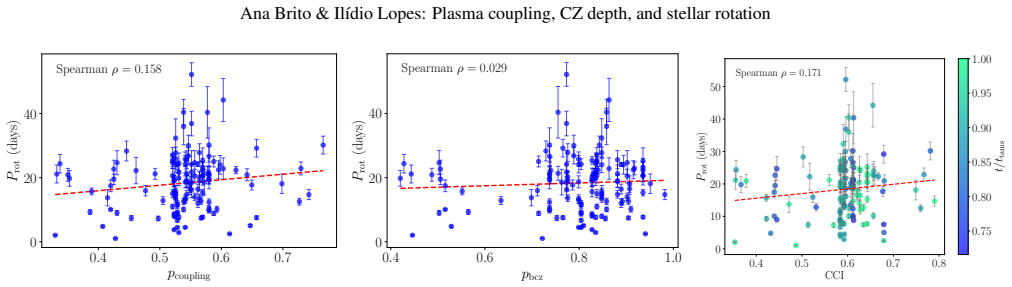
For this sample, rotation rates show only weak correlations with either the convective-zone depth or the plasma coupling parameter when considered independently. However, during the first two-thirds of the main-sequence lifetime, the correlation strengthens when both factors are considered jointly through a combined convective coupling index, indicating a moderate and statistically significant relationship. For older stars, these correlations weaken and lose significance, although the thermodynamic component becomes relatively more influential. These trends suggest that microphysical plasma properties may contribute to the regulation of angular momentum loss and may be connected to the onset
What carries the argument
The convective coupling index, formed by combining convective-zone depth with the plasma coupling parameter that quantifies interaction strength among charged particles in the stellar plasma.
If this is right
- Microphysical plasma properties contribute to regulating angular momentum loss in solar-mass stars.
- The combined convective coupling index predicts rotation rates better than either factor alone during early main-sequence phases.
- Correlations between these interior properties and rotation weaken after the first two-thirds of main-sequence lifetime.
- The thermodynamic component of plasma coupling gains relative influence on angular momentum loss in older solar-mass stars.
- The onset of weakened magnetic braking may link to shifts in convective zone structure and plasma conditions.
Where Pith is reading between the lines
- Stellar evolution codes could improve rotation predictions by incorporating explicit plasma-coupling terms alongside structural variables.
- The index might tighten gyrochronology age estimates for solar-mass stars if calibrated against larger samples.
- Similar joint effects could appear in stars of nearby masses, providing a test once rotation data expand beyond 1 solar mass.
Load-bearing premise
The MESA models with the chosen metallicities and the derived plasma coupling parameter accurately capture the physical conditions that control magnetic braking and angular-momentum loss in real solar-mass stars.
What would settle it
A new sample of solar-mass stars with independent ages and rotation periods showing no statistically significant correlation between the convective coupling index and rotation rates among stars younger than roughly two-thirds of their main-sequence lifetime would falsify the reported joint relationship.
Figures


read the original abstract
Stellar rotation on the main sequence is a complex function of mass and age, displaying multiple regimes whose physical origin remains only partially understood. In particular, the connection between the diversity of observed rotation rates and the internal structure and thermodynamic properties of stellar interiors is still unclear. We investigated how the depth of the convective zones and the degree of plasma coupling, quantified through the plasma coupling parameter, relate to the observed rotation rates of solar-mass stars. We used a grid of $1 \, M_\odot$ MESA stellar models with a wide range of metallicities to identify the best-matching models for 243 main-sequence stars with measured rotation periods. We then examined correlations between their rotation rates and both the structural properties of the convective zones and the corresponding convective plasma coupling parameter. For this sample, rotation rates show only weak correlations with either the convective-zone depth or the plasma coupling parameter when considered independently. However, during the first two-thirds of the main-sequence lifetime, the correlation strengthens when both factors are considered jointly through a combined convective coupling index, indicating a moderate and statistically significant relationship. For older stars, these correlations weaken and lose significance, although the thermodynamic component becomes relatively more influential. These trends suggest that microphysical plasma properties may contribute to the regulation of angular momentum loss and may be connected to the onset of weakened magnetic braking.
Editorial analysis
A structured set of objections, weighed in public.
Referee Report
Summary. The paper uses a grid of 1 M⊙ MESA models spanning a wide metallicity range to assign best-matching models to 243 main-sequence stars with measured rotation periods. It reports weak correlations between rotation rates and either convective-zone depth or the plasma coupling parameter taken separately, but finds a moderate and statistically significant correlation with a combined convective coupling index during the first two-thirds of the main-sequence lifetime; the correlation weakens for older stars while the thermodynamic component gains relative influence. The authors interpret this as evidence that microphysical plasma properties contribute to angular-momentum loss and the onset of weakened magnetic braking.
Significance. If the joint-index correlation survives scrutiny of model-assignment degeneracies and statistical procedures, the work would offer a concrete link between interior thermodynamic structure and the regulation of stellar spin-down, potentially clarifying the physical basis for the transition to weakened braking. The use of a broad-metallicity MESA grid to derive both structural and plasma quantities is a constructive step, though the moderate correlation strength and reliance on post-hoc age binning limit the immediate predictive power.
major comments (3)
- [Methods] Methods (model-matching procedure): The central result depends on assigning each observed star to a single best-matching 1 M⊙ MESA model. No quantitative description is given of the matching metric (e.g., χ² on T_eff and luminosity), the treatment of age-metallicity-mixing-length degeneracies, or tests of robustness against alternative grids or metrics. Because CZ depth and plasma coupling are extracted from these assignments, any sensitivity to matching choices directly affects the reported correlations.
- [Results] Results (statistical analysis): The abstract and results claim 'moderate and statistically significant' correlation for the combined index in the first two-thirds of the main sequence, yet supply no information on model-selection criteria, error propagation, multiple-testing corrections, or the explicit construction of the combined convective coupling index. Without these details the quoted significance cannot be evaluated.
- [Results] Results (age-bin division): The split into 'first two-thirds' versus older main-sequence stars is presented without a pre-specified criterion or justification for the boundary. The paper already notes that individual correlations are weak; if the joint signal is driven by the particular bin choice, the claim that plasma coupling becomes relatively more influential at later ages requires additional validation.
minor comments (2)
- [Methods] The plasma coupling parameter is introduced without an explicit equation or reference to its thermodynamic definition; a short derivation or citation in the methods would improve reproducibility.
- [Figures] Figure captions and axis labels should state the exact sample size and age range used for each panel to allow direct comparison with the text.
Simulated Author's Rebuttal
We thank the referee for their insightful comments, which have helped us improve the manuscript. We address each of the major comments below, providing clarifications and indicating the revisions made to enhance the description of our methods and statistical procedures.
read point-by-point responses
-
Referee: [Methods] Methods (model-matching procedure): The central result depends on assigning each observed star to a single best-matching 1 M⊙ MESA model. No quantitative description is given of the matching metric (e.g., χ² on T_eff and luminosity), the treatment of age-metallicity-mixing-length degeneracies, or tests of robustness against alternative grids or metrics. Because CZ depth and plasma coupling are extracted from these assignments, any sensitivity to matching choices directly affects the reported correlations.
Authors: We agree that a quantitative description of the model assignment procedure is essential for reproducibility and to assess robustness. In the revised manuscript, we have added a new subsection in the Methods section that specifies the matching metric as a reduced χ² on T_eff and bolometric luminosity, incorporating the observational errors. We describe how the grid of models with varying metallicities and mixing lengths is used to mitigate degeneracies by choosing the minimum χ² model, and we present tests of the sensitivity of the reported correlations to alternative matching metrics and to subsets of the grid. These additions directly address concerns about the impact on CZ depth and plasma coupling values. revision: yes
-
Referee: [Results] Results (statistical analysis): The abstract and results claim 'moderate and statistically significant' correlation for the combined index in the first two-thirds of the main sequence, yet supply no information on model-selection criteria, error propagation, multiple-testing corrections, or the explicit construction of the combined convective coupling index. Without these details the quoted significance cannot be evaluated.
Authors: We acknowledge the need for greater transparency in the statistical methods. We have revised the Results section to explicitly describe the construction of the combined convective coupling index from the convective zone depth and plasma coupling parameter. We now include a description of error propagation from both observational uncertainties and model assignment ambiguities, and we have applied a multiple-testing correction (Bonferroni) to the significance assessments. The p-values and correlation coefficients are updated accordingly in the text and figures. revision: yes
-
Referee: [Results] Results (age-bin division): The split into 'first two-thirds' versus older main-sequence stars is presented without a pre-specified criterion or justification for the boundary. The paper already notes that individual correlations are weak; if the joint signal is driven by the particular bin choice, the claim that plasma coupling becomes relatively more influential at later ages requires additional validation.
Authors: The age division was chosen to correspond to the approximate age at which weakened magnetic braking is thought to begin for solar-mass stars, around 2-3 Gyr, which is roughly two-thirds of the main-sequence lifetime for these objects. In the revision, we have added explicit justification for this choice, including references to prior literature on the braking transition, and we have performed a sensitivity test by varying the boundary by ±0.5 Gyr to show that the main trends persist. We also discuss the relative influence of the thermodynamic component in the older bin as an observational trend rather than a strong claim. revision: partial
Circularity Check
No significant circularity; correlations use independent observational rotation data against model-derived structural quantities
full rationale
The paper matches 1 M⊙ MESA models to 243 stars using T_eff, luminosity and other observables, extracts CZ depth and plasma coupling parameter from those models, and reports Pearson/Spearman correlations against externally measured rotation periods. No equation defines the plasma coupling parameter or CZ depth in terms of rotation rate; the joint convective coupling index is a post-hoc linear combination of the two extracted quantities. No self-citation is invoked to justify uniqueness of the matching procedure or to forbid alternative model grids. The reported strengthening of correlation in the first two-thirds of the main sequence is therefore a statistical statement about the chosen sample and is directly falsifiable by new rotation measurements or different model grids. This satisfies the default expectation of a non-circular derivation chain.
Axiom & Free-Parameter Ledger
Reference graph
Works this paper leans on
-
[1]
Aerts, C., Christensen-Dalsgaard, J., & Kurtz, D. W. 2010, Asteroseismology
work page 2010
-
[2]
Angus, R., Aigrain, S., Foreman-Mackey, D., & McQuillan, A. 2015, MNRAS, 450, 1787
work page 2015
- [3]
-
[4]
Barnes, S. A. 2003, ApJ, 586, 464
work page 2003
-
[5]
Barnes, S. A. 2007, ApJ, 669, 1167
work page 2007
-
[6]
Barnes, S. A. & Kim, Y .-C. 2010, ApJ, 721, 675
work page 2010
-
[7]
Beck, J. G. 2000, Sol. Phys., 191, 47
work page 2000
- [8]
- [9]
-
[10]
Brun, A. S. & Browning, M. K. 2017, Living Reviews in Solar Physics, 14, 4
work page 2017
-
[11]
2020, Living Reviews in Solar Physics, 17, 4
Charbonneau, P. 2020, Living Reviews in Solar Physics, 17, 4
work page 2020
- [12]
-
[13]
Chugunov, A. I., Dewitt, H. E., & Yakovlev, D. G. 2007, Phys. Rev. D, 76, 025028
work page 2007
-
[14]
Cyburt, R. H., Amthor, A. M., Ferguson, R., et al. 2010, ApJS, 189, 240
work page 2010
-
[15]
Davies, G. R., Chaplin, W. J., Farr, W. M., et al. 2015, MNRAS, 446, 2959 do Nascimento, J. D., J., García, R. A., Mathur, S., et al. 2014, ApJ, 790, L23
work page 2015
-
[16]
Ferguson, J. W., Alexander, D. R., Allard, F., et al. 2005, ApJ, 623, 585
work page 2005
-
[17]
Fritzewski, D. J., Barnes, S. A., James, D. J., & Strassmeier, K. G. 2021, A&A, 652, A60
work page 2021
-
[18]
Fritzewski, D. J., Barnes, S. A., Ok, S., Lamer, G., & Schwope, A. 2025, A&A, 702, A218
work page 2025
- [19]
- [20]
- [21]
-
[22]
Hall, O. J., Davies, G. R., van Saders, J., et al. 2021, Nature Astronomy, 5, 707
work page 2021
-
[23]
Iglesias, C. A. & Rogers, F. J. 1993, ApJ, 412, 752
work page 1993
-
[24]
Iglesias, C. A. & Rogers, F. J. 1996, ApJ, 464, 943
work page 1996
-
[25]
Irwin, A. W. 2004, The FreeEOS Code for Calculating the Equation of State for Stellar Interiors
work page 2004
-
[26]
V ., Kiefer, R., & Metcalfe, T
Jeffers, S. V ., Kiefer, R., & Metcalfe, T. S. 2023, Space Sci. Rev., 219, 54
work page 2023
- [27]
-
[28]
S., Schwab, J., Bauer, E., Timmes, F
Jermyn, A. S., Schwab, J., Bauer, E., Timmes, F. X., & Potekhin, A. Y . 2021, ApJ, 913, 72 Käpylä, P. J., Browning, M. K., Brun, A. S., Guerrero, G., & Warnecke, J. 2023, Space Sci. Rev., 219, 58
work page 2021
-
[29]
Kawaler, S. D. 1988, ApJ, 333, 236
work page 1988
-
[30]
Kraft, R. P. 1967, ApJ, 150, 551
work page 1967
- [31]
-
[32]
Lu, Y ., Angus, R., Foreman-Mackey, D., & Hattori, S. 2024, AJ, 167, 159
work page 2024
-
[33]
Mamajek, E. E. & Hillenbrand, L. A. 2008, ApJ, 687, 1264
work page 2008
-
[34]
Mathur, S., García, R. A., Ballot, J., et al. 2014, A&A, 562, A124
work page 2014
- [35]
-
[36]
S., Egeland, R., & van Saders, J
Metcalfe, T. S., Egeland, R., & van Saders, J. 2016, ApJ, 826, L2
work page 2016
-
[37]
B., Schunker, H., Gizon, L., & Ball, W
Nielsen, M. B., Schunker, H., Gizon, L., & Ball, W. H. 2015, A&A, 582, A10
work page 2015
- [38]
-
[39]
Noyes, R. W., Hartmann, L. W., Baliunas, S. L., Duncan, D. K., & Vaughan, A. H. 1984, ApJ, 279, 763
work page 1984
-
[40]
Nsamba, B., Campante, T. L., Monteiro, M. J. P. F. G., et al. 2018, MNRAS, 477, 5052
work page 2018
-
[41]
Paquette, C., Pelletier, C., Fontaine, G., & Michaud, G. 1986, ApJS, 61, 177
work page 1986
- [42]
- [43]
- [44]
- [45]
- [46]
-
[47]
2003, A&A, 397, 147 Planck Collaboration, Aghanim, N., Akrami, Y ., et al
Pizzolato, N., Maggio, A., Micela, G., Sciortino, S., & Ventura, P. 2003, A&A, 397, 147 Planck Collaboration, Aghanim, N., Akrami, Y ., et al. 2020, A&A, 641, A6
work page 2003
-
[48]
Potekhin, A. Y . & Chabrier, G. 2010, Contributions to Plasma Physics, 50, 82 Prša, A., Harmanec, P., Torres, G., et al. 2016, AJ, 152, 41
work page 2010
-
[49]
Radick, R. R., Lockwood, G. W., Henry, G. W., Hall, J. C., & Pevtsov, A. A. 2018, ApJ, 855, 75
work page 2018
-
[50]
2025, Experimental Astronomy, 59, 26
Rauer, H., Aerts, C., Cabrera, J., et al. 2025, Experimental Astronomy, 59, 26
work page 2025
-
[51]
Rogers, F. J. & Nayfonov, A. 2002, ApJ, 576, 1064
work page 2002
-
[52]
Santos, A. R. G., Breton, S. N., Mathur, S., & García, R. A. 2021, ApJS, 255, 17
work page 2021
-
[53]
Saumon, D., Chabrier, G., & van Horn, H. M. 1995, ApJS, 99, 713
work page 1995
-
[54]
Saunders, N., van Saders, J. L., Lyttle, A. J., et al. 2024, ApJ, 962, 138
work page 2024
-
[55]
See, V ., Lu, Y . L., Amard, L., & Roquette, J. 2024, MNRAS, 533, 1290
work page 2024
- [56]
- [57]
-
[58]
Timmes, F. X. & Swesty, F. D. 2000, ApJS, 126, 501 van Saders, J. L., Ceillier, T., Metcalfe, T. S., et al. 2016, Nature, 529, 181
work page 2000
-
[59]
Wargelin, B. J., Saar, S. H., Pojma´nski, G., Drake, J. J., & Kashyap, V . L. 2017, MNRAS, 464, 3281
work page 2017
-
[60]
Weber, E. J. & Davis, Leverett, J. 1967, ApJ, 148, 217
work page 1967
-
[61]
Wright, N. J., Drake, J. J., Mamajek, E. E., & Henry, G. W. 2011, ApJ, 743, 48
work page 2011
- [62]
-
[63]
2024, A&A, 686, A90 Article number, page 9 of 9
Zhang, Z., Jiang, J., & Kitchatinov, L. 2024, A&A, 686, A90 Article number, page 9 of 9
work page 2024
discussion (0)
Sign in with ORCID, Apple, or X to comment. Anyone can read and Pith papers without signing in.