Bifurcations and Structural Stability of Generic PC-HC Families
Pith reviewed 2026-05-14 20:24 UTC · model grok-4.3
The pith
Generic families of PC-HC vector fields on the sphere are structurally stable near their large bifurcation supports under moderate equivalence.
A machine-rendered reading of the paper's core claim, the machinery that carries it, and where it could break.
Core claim
Generic families of vector fields of the PC-HC class on S² are structurally stable. They admit a classification up to moderate equivalence in neighborhoods of their large bifurcation supports, with the configuration and the characteristic set serving as invariants. The realization lemma holds, and explicit bifurcation diagrams can be constructed for each equivalence class.
What carries the argument
The large bifurcation support together with its configuration and characteristic set, which function as complete invariants under moderate equivalence for the generic families.
Load-bearing premise
The families under study must be generic inside the PC-HC class so that their local behavior is fully determined by the configuration and characteristic set.
What would settle it
A concrete counter-example would be any generic PC-HC family that undergoes a qualitative change in its phase portrait inside a neighborhood of its large bifurcation support after an arbitrarily small perturbation that remains inside the PC-HC class.
Figures


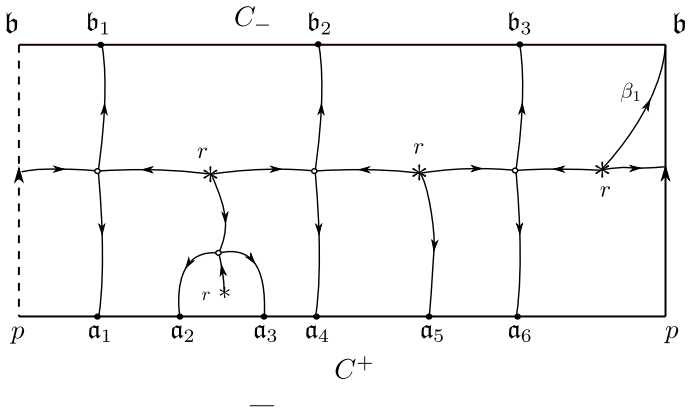


read the original abstract
In this paper the structural stability of generic families of vector fields of the PC-HC class on the two-dimensional sphere $S^2$ is proved. A classification of these families up to moderate equivalence in neighborhoods of their large bifurcation supports is presented, based on such invariants as the configuration and the characteristic set. The realization lemma is proved. Furthermore, bifurcation diagrams for the considered class of families are constructed.
Editorial analysis
A structured set of objections, weighed in public.
Referee Report
Summary. The paper proves the structural stability of generic families of vector fields of the PC-HC class on the two-dimensional sphere S². It classifies these families up to moderate equivalence near their large bifurcation supports using the configuration and characteristic set as invariants, proves the realization lemma, and constructs the associated bifurcation diagrams.
Significance. If the central claims hold, the work advances the classification of bifurcations for a concrete class of vector fields on a compact manifold. The explicit invariants, realization construction, and diagrams provide a usable framework that could template similar results for other generic families in low-dimensional dynamics.
major comments (2)
- [Realization lemma section] Realization lemma section: the construction of local models does not include an explicit verification that the models glue consistently on the compact S² without generating new periodic orbits or heteroclinic connections outside the large bifurcation support; this check is required for the structural-stability claim to follow from the local classification.
- [Classification section] Classification section: the assertion that configuration plus characteristic set form a complete set of invariants under moderate equivalence lacks an argument ruling out global topological obstructions on S² (e.g., linking numbers or Euler-class effects) that could separate orbits with identical local invariants.
minor comments (2)
- [Bifurcation diagrams] The bifurcation diagrams would be clearer if each panel were labeled with the precise parameter values at which the depicted bifurcations occur.
- [Main text] The definition of moderate equivalence is referenced repeatedly but is not restated in the main body after the preliminaries; a brief recall would aid readability.
Simulated Author's Rebuttal
We thank the referee for the careful reading and constructive comments on our manuscript. We address the two major comments point by point below. We will revise the manuscript to incorporate additional explicit arguments and verifications as outlined in our responses.
read point-by-point responses
-
Referee: [Realization lemma section] Realization lemma section: the construction of local models does not include an explicit verification that the models glue consistently on the compact S² without generating new periodic orbits or heteroclinic connections outside the large bifurcation support; this check is required for the structural-stability claim to follow from the local classification.
Authors: We agree that an explicit gluing verification strengthens the argument. In the revised version we will add a short paragraph immediately after the realization lemma stating that the local models are supported in disjoint neighborhoods whose union is the large bifurcation support; by the genericity conditions defining the PC-HC class (transversality of intersections and absence of other singularities or connections), any orbit leaving these neighborhoods cannot close or connect without violating the defining assumptions. Compactness of S² then guarantees no new periodic orbits or heteroclinic connections appear globally. This makes the passage from local classification to structural stability fully rigorous. revision: yes
-
Referee: [Classification section] Classification section: the assertion that configuration plus characteristic set form a complete set of invariants under moderate equivalence lacks an argument ruling out global topological obstructions on S² (e.g., linking numbers or Euler-class effects) that could separate orbits with identical local invariants.
Authors: The configuration invariant is constructed precisely to record the global combinatorial arrangement of all orbits on S², thereby encoding linking data and the overall topology. The characteristic set supplements this with local dynamical data. On the sphere the Euler class of the tangent bundle is fixed and the moderate equivalence relation preserves the global configuration, so no additional independent invariants arise. Nevertheless, to make the completeness argument fully explicit we will insert a brief subsection after the classification theorem that rules out linking-number or Euler-class obstructions by showing they are already determined by the configuration. This constitutes a partial revision: the claim remains unchanged, but its justification is expanded. revision: partial
Circularity Check
No circularity: classification and realization lemma rest on independent invariants and standard moderate equivalence
full rationale
The derivation proceeds by defining configuration and characteristic-set invariants for PC-HC families, proving they classify orbits under moderate equivalence near large bifurcation supports, and establishing a realization lemma that constructs the families from these invariants. None of these steps reduces by construction to a fitted parameter, a self-citation chain, or a renaming of the target stability statement; the local models and gluing arguments are presented as external to the final stability conclusion. The paper therefore remains self-contained against external benchmarks in bifurcation theory.
Axiom & Free-Parameter Ledger
axioms (2)
- domain assumption The PC-HC class of vector fields is a well-defined and standard object in the literature.
- domain assumption Moderate equivalence is an appropriate equivalence relation for classifying families near bifurcation supports.
Lean theorems connected to this paper
-
IndisputableMonolith/Foundation/AlexanderDuality.leanalexander_duality_circle_linking unclear?
unclearRelation between the paper passage and the cited Recognition theorem.
Theorem 1.2 … two glocal PC-HC families … same configuration and equivalent characteristic sets … weakly equivalent … Theorem 1.3. Generic glocal families of the PC-HC class are structurally stable.
-
IndisputableMonolith/Foundation/Cost/FunctionalEquation.leanwashburn_uniqueness_aczel unclear?
unclearRelation between the paper passage and the cited Recognition theorem.
Definition 1.4 … characteristic sets … marked sets L1,L2 on interval and A+,A− on circle together with liaison … Definition 1.5 … equivalent if … homeomorphism preserving partition …
What do these tags mean?
- matches
- The paper's claim is directly supported by a theorem in the formal canon.
- supports
- The theorem supports part of the paper's argument, but the paper may add assumptions or extra steps.
- extends
- The paper goes beyond the formal theorem; the theorem is a base layer rather than the whole result.
- uses
- The paper appears to rely on the theorem as machinery.
- contradicts
- The paper's claim conflicts with a theorem or certificate in the canon.
- unclear
- Pith found a possible connection, but the passage is too broad, indirect, or ambiguous to say the theorem truly supports the claim.
Reference graph
Works this paper leans on
-
[1]
Arnold, V. I.; Afrajmovich, V. S.; Ilyashenko, Yu. S.; Shilnikov, L. P. Bifurcation the- ory in Bifurcation theory and catastrophe theory. Translated from the 1986 Russian original by N. D. Kazarinoff, Reprint of the 1994 English edition from the series En- cyclopaedia of Mathematical Sciences [Dynamical systems. V, Encyclopaedia Math. Sci., 5, Springer, ...
work page 1986
-
[2]
Goncharuk, N.B.; Ilyashenko, Yu.S. Large bifurcation supports. Apr. 2018 arXiv: 1804.04596
work page internal anchor Pith review Pith/arXiv arXiv 2018
-
[3]
Global bifurcations in generic one-parameter families with a parabolic cycle on S2
Goncharuk, N.; Ilyashenko Yu.S.; Solodovnikov, N. Global bifurcations in generic one-parameter families with a parabolic cycle on S2. In: Moscow Mathematical Jour- nal 19.4 , pp. 709–737
-
[4]
Germs of bifurcation diagrams and SN-SN families
Ilyashenko, Yu. Germs of bifurcation diagrams and SN-SN families. Chaos. 2021 Jan;31(1):013103. doi: 10.1063/5.0030742. PMID: 33754753
-
[5]
Global bifurcations in the two-sphere: a new perspective, Invent
Ilyashenko, Yu.; Kudryashov, Yu; Schurov, I. Global bifurcations in the two-sphere: a new perspective, Invent. math., 2018, Volume 213, Issue 2, pp 461–506
work page 2018
-
[6]
Families of vector fields with finite modulus of stability, Lecture Notes in Math
Malta, I.P.; Palis, J. Families of vector fields with finite modulus of stability, Lecture Notes in Math. 1981, v. 898, p. 212–229
work page 1981
-
[7]
Publications Mathématiques de l’IHÉS, 43 (1974), p
SotomayorJ.Genericone-parameterfamiliesofvectorfieldsontwo-dimensionalman- ifolds. Publications Mathématiques de l’IHÉS, 43 (1974), p. 5–46
work page 1974
-
[8]
Global bifurcations in generic one-parameter families on S2, Regular and Chaotic Dynamics, 2018, vol
Starichkova, V. Global bifurcations in generic one-parameter families on S2, Regular and Chaotic Dynamics, 2018, vol. 23, no. 6, pp. 767–784
work page 2018
-
[9]
Ordinary Differential Equations 35
Bufetov, A.I.; Goncharuk, N.B.; Ilyashenko, Yu.S. Ordinary Differential Equations 35
discussion (0)
Sign in with ORCID, Apple, or X to comment. Anyone can read and Pith papers without signing in.