Recognition: unknown
Quantitative Spectroscopic Diagnostics for FU Orionis-Type Young Stellar Objects
Pith reviewed 2026-05-14 19:26 UTC · model grok-4.3
The pith
Near-infrared spectral features distinguish FU Orionis outburst disks from normal stars.
A machine-rendered reading of the paper's core claim, the machinery that carries it, and where it could break.
Core claim
The central discovery is that quantitative measurements of specific near-infrared atomic lines via equivalent widths and molecular band ratios can define parameter spaces where FU Orionis disks occupy distinct regions compared to normal stars, allowing spectroscopic confirmation of candidates.
What carries the argument
Equivalent width measurements of atomic features and custom band ratios for molecular features, serving as proxies for temperature, surface gravity, and disk wind activity.
If this is right
- The diagnostics enable confirmation or refutation of new FUOr candidates from photometric surveys.
- They provide a method to characterize the outburst state of young stellar objects spectroscopically.
- Application to larger samples will help determine the frequency and duration of FUOr outbursts.
- The parameter spaces separate disk-dominated spectra from stellar photospheres in the near-infrared.
Where Pith is reading between the lines
- These diagnostics could be extended to mid-infrared or optical wavelengths to increase applicability across different instruments.
- Combining them with photometric variability data might yield a more robust identification pipeline for outbursting stars.
- Similar approaches may apply to identifying other types of accreting young stars with disk signatures.
Load-bearing premise
The chosen atomic and molecular features stay distinctive no matter the viewing angle or evolutionary stage of the FUOr, and the control sample captures the main contaminants in candidate selections.
What would settle it
Finding a confirmed FU Orionis object whose spectral measurements fall within the normal star distributions in the proposed diagnostic spaces would falsify the separation method.
Figures




read the original abstract
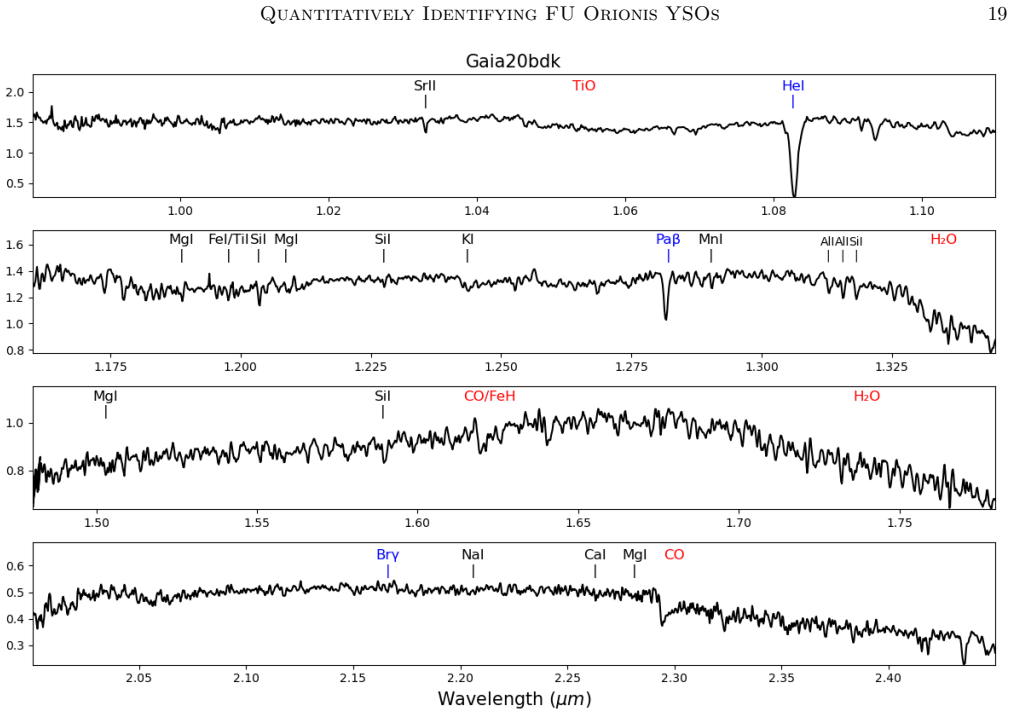
We present near-infrared spectroscopic diagnostics that can be used to identify FU Orionis stars (FUOrs). FUOrs are young stellar objects (YSOs) that are currently in a state of extreme outburst, caused by enhanced mass {inflow} from their accretion disks. The disks give FUOrs a distinct multi-temperature optical and infrared spectrum. Considering both the predicted spectrum from a disk atmosphere model, and existing spectral diagnostics from the literature, we identify key atomic and molecular features for characterizing FUOrs. Some of the chosen features are proxies for temperature, others are sensitive to surface gravity, and still others probe disk winds. Using the Palomar Observatory/Hale Telescope TripleSpec spectrograph, we gathered near-infrared spectra of 28 known FUOrs. We use standard equivalent widths to determine the strength of atomic lines and we design several band ratios for measuring molecular features. We compare the measurements between our spectra and a control sample of late-type dwarfs and evolved stars from the Infrared Telescope Facility Spectral Library. By considering the relative distributions of these samples in our defined spectral diagnostics, we propose a number of parameter spaces that can distinguish FUOr disks from normal stars. The rate of discovery of FUOr candidates has increased significantly in recent years, largely due to the increasing prevalence of time-domain surveys. Our proposed diagnostics will allow new photometric candidates to be confirmed or refuted as such.
Editorial analysis
A structured set of objections, weighed in public.
Referee Report
Summary. The manuscript collects near-infrared spectra of 28 known FU Orionis objects with Palomar TripleSpec, measures equivalent widths of selected atomic lines and constructs band ratios for molecular features, then compares the resulting distributions against an IRTF control sample of late-type dwarfs and evolved stars to define parameter spaces that separate FUOr disks from normal stars.
Significance. If the separation holds under broader testing, the diagnostics would supply a practical, observationally grounded tool for vetting the growing number of photometric FUOr candidates from time-domain surveys, building directly on disk-atmosphere predictions and existing literature features.
major comments (3)
- [§4] The control sample (§4 and Table 1) is limited to late-type dwarfs and giants from the IRTF Spectral Library; this leaves unquantified the overlap with other YSO classes (classical T Tauri stars, EXors, inclined or lower-accretion FUOr analogs) that are the realistic contaminants in photometric candidate lists and can exhibit similar temperature-sensitive lines and CO bandheads.
- [§5] The central claim that the defined parameter spaces cleanly distinguish the populations rests on visual or qualitative comparison of distributions; no quantitative separation metrics (e.g., KS-test p-values, overlap fractions, or ROC curves) are reported, so the false-positive rate for the intended application cannot be assessed from the presented data.
- [§3] The assumption that the chosen atomic and molecular features remain distinctive across the full range of disk inclinations and evolutionary stages is stated but not tested against synthetic spectra at varying viewing angles or against a grid of disk models, which is load-bearing for the diagnostics' robustness.
minor comments (2)
- [Abstract] Abstract contains a LaTeX artifact '{inflow}' that should be rendered as plain text.
- [Figures 3-6] Figure captions and axis labels for the diagnostic diagrams should explicitly state the exact equivalent-width and band-ratio definitions used, including any continuum windows.
Circularity Check
No circularity: purely empirical observational comparison
full rationale
The paper collects NIR spectra of 28 known FUOrs using TripleSpec, measures standard equivalent widths for atomic lines and defines band ratios for molecular features, then directly compares the resulting distributions to an external IRTF Spectral Library control sample of late-type dwarfs and evolved stars. No equations, derivations, fitted parameters, or self-citations are used to generate the proposed parameter spaces; the diagnostics are simple empirical separations based on observed data. The control-sample limitation noted by the skeptic is a question of external validity, not circularity in the derivation chain.
Axiom & Free-Parameter Ledger
axioms (1)
- domain assumption Near-infrared spectra of FUOrs can be characterized by standard equivalent width and band ratio measurements that trace disk temperature and gravity.
Reference graph
Works this paper leans on
-
[1]
Journal of Open Source Software , year = 2024, doi =
dust_extinction: Interstellar Dust Extinction Models. Journal of Open Source Software , year = 2024, doi =
2024
-
[2]
FUSE Measurements of Far-Ultraviolet Extinction. III. The Dependence of R(V) and Discrete Feature Limits From 75 Galactic Sightlines. , year = 2009, doi =
2009
-
[3]
, year = 2018, doi =
A Near-IR Spectroscopic Survey of FU Orionis Objects. , year = 2018, doi =
2018
-
[4]
, year = 2010, doi =
A Near-infrared Spectroscopic Survey of Class I Protostars. , year = 2010, doi =
2010
-
[5]
, year = 2021, doi =
New Infrared Spectral Indices of Luminous Cold Stars: From Early K to M Types. , year = 2021, doi =
2021
-
[6]
, year = 2004, doi =
The Spectroscopically Determined Substellar Mass Function of the Orion Nebula Cluster. , year = 2004, doi =
2004
-
[7]
Astronomische Nachrichten , year = 2006, doi =
Remarks on statistical errors in equivalent widths. Astronomische Nachrichten , year = 2006, doi =
2006
-
[8]
, year = 2010, doi =
F, G, K, M Spectral Standards in the Y Band (0.95-1.11 μm). , year = 2010, doi =
2010
-
[9]
, year = 2022, doi =
LkHα 225 (V1318 Cyg) South in Outburst. , year = 2022, doi =
2022
-
[10]
SPIE , year = 2008, doi =
The performance of TripleSpec at Palomar. SPIE , year = 2008, doi =
2008
-
[11]
, year = 2024, doi =
A Far-ultraviolet-detected Accretion Shock at the Star–Disk Boundary of FU Ori. , year = 2024, doi =
2024
-
[12]
, year = 2020, doi =
Global 3D radiation magnetohydrodynamic simulations for FU Ori’s accretion disc and observational signatures of magnetic fields. , year = 2020, doi =
2020
-
[13]
, year = 2012, doi =
Potential Drivers of Mid-Infrared Variability in Young Stars: Testing Physical Models with Multi-Epoch Near-Infrared Spectra of YSOs in ρ OPH. , year = 2012, doi =
2012
-
[14]
, year = 2025, doi =
The Near-Ultraviolet Spectra of FU Orionis Accretion Disks. , year = 2025, doi =
2025
-
[15]
Progress in Modeling Very Low Mass Stars, Brown Dwarfs, and Planetary Mass Objects
Progress in modeling very low mass stars, brown dwarfs, and planetary mass objects. Memorie della Societa Astronomica Italiana Supplementi , year = 2013, month = jan, volume =. doi:10.48550/arXiv.1302.6559 , archivePrefix =. 1302.6559 , primaryClass =
work page internal anchor Pith review Pith/arXiv arXiv doi:10.48550/arxiv.1302.6559 2013
-
[16]
Eruptive phenomena in early stellar evolution. , keywords =. doi:10.1086/155615 , adsurl =
-
[17]
Protostars and Planets VII
The Role of Magnetic Fields in the Formation of Protostars, Disks, and Outflows. Protostars and Planets VII
-
[18]
, year = 2024, doi =
New Insights on the Accretion Properties of Class 0 Protostars from 2 m Spectroscopy. , year = 2024, doi =
2024
-
[19]
, year = 2024, doi =
Spectroscopic confirmation of high-amplitude eruptive YSOs and dipping giants from the VVV survey. , year = 2024, doi =
2024
-
[20]
, year = 2024, doi =
An Automated Catalog of Long Period Variables using Infrared Lightcurves from Palomar Gattini-IR. , year = 2024, doi =
2024
-
[21]
, year = 2008, doi =
Line Structure in the Spectrum of FU Orionis. , year = 2008, doi =
2008
-
[22]
, year = 2015, doi =
Observations of Solids in Protoplanetary Disks. , year = 2015, doi =
2015
-
[23]
, year = 1996, doi =
Near-Infrared Spectra and the Evolutionary Status of Young Stellar Objects: Results of a 1.1-2.4 m Survey. , year = 1996, doi =
1996
-
[24]
, year = 1987, doi =
Spectral Energy Distributions of T Tauri Stars: Disk Flaring and Limits on Accretion. , year = 1987, doi =
1987
-
[25]
Protostars and Planets VII
Accretion Variability as a Guide to Stellar Mass Assembly. Protostars and Planets VII
-
[26]
, year = 2005, doi =
The photometric evolution of FU Orionis objects: disc instability and wind-envelope interaction. , year = 2005, doi =
2005
-
[27]
, year = 1996, doi =
The FU Orionis Phenomenon. , year = 1996, doi =
1996
-
[28]
, year = 2019, doi =
Determining the recurrence time-scale of long-lasting YSO outbursts. , year = 2019, doi =
2019
-
[29]
, year = 2023, doi =
The Gaia alerted fading of the FUor-type star Gaia21elv. , year = 2023, doi =
2023
-
[30]
, year = 2023, doi =
RNO 54: A Previously Unappreciated FU Ori Star. , year = 2023, doi =
2023
-
[31]
, year = 1992, doi =
Optical Spectroscopy of Z Canis Majoris, V1057 Cygni, and FU Orionis: Accretion Disks and Signatures of Disk Winds. , year = 1992, doi =
1992
-
[32]
, year = 2004, doi =
Spextool: A Spectral Extraction Package for SpeX, a 0.8-5.5 Micron Cross-Dispersed Spectrograph. , year = 2004, doi =
2004
-
[33]
, year = 2003, doi =
A Method of Correcting Near-Infrared Spectra for Telluric Absorption. , year = 2003, doi =
2003
-
[34]
, year = 2009, doi =
The Infrared Telescope Facility (IRTF) Spectral Library: Cool Stars. , year = 2009, doi =
2009
-
[35]
NLTE strontium abundance in a sample of extremely metal poor stars and the Sr/Ba ratio in the early Galaxy. , keywords =. doi:10.1051/0004-6361/201116591 , archivePrefix =. 1104.0476 , primaryClass =
work page internal anchor Pith review Pith/arXiv arXiv doi:10.1051/0004-6361/201116591
-
[36]
2026 , doi =
A Detailed Study of the Inner Disks of FU Ori Objects and the Star-Disk Boundary. 2026 , doi =
2026
-
[37]
An Infrared Spectroscopic Sequence of M, L and T Dwarfs
An Infrared Spectroscopic Sequence of M, L, and T Dwarfs. , keywords =. doi:10.1086/428040 , archivePrefix =. astro-ph/0412313 , primaryClass =
work page internal anchor Pith review Pith/arXiv arXiv doi:10.1086/428040
-
[38]
Diagnosing FU Ori-like Sources: The Parameter Space of Viscously Heated Disks in the Optical and Near-infrared. , keywords =. doi:10.3847/1538-4357/ac84d2 , archivePrefix =. 2207.13324 , primaryClass =
-
[39]
Instrumentation and Methods for Astrophysics , year = 2010, doi =
Dos and don'ts of reduced chi-squared. Instrumentation and Methods for Astrophysics , year = 2010, doi =
2010
-
[40]
, year = 2025, doi =
Gaia20bdk – New FU Ori-type star in the Sh 2-301 star-forming region. , year = 2025, doi =
2025
-
[41]
, year = 2020, doi =
Gaia 18dvy: A New FUor in the Cygnus OB3 Association. , year = 2020, doi =
2020
-
[42]
, year = 2021, doi =
Outbursting Young Stellar Object PGIR 20dci in the Perseus Arm. , year = 2021, doi =
2021
-
[43]
, year = 2018, doi =
Gaia 17bpi: An FU Ori–type Outburst. , year = 2018, doi =
2018
discussion (0)
Sign in with ORCID, Apple, or X to comment. Anyone can read and Pith papers without signing in.