No Measurable Changes in Radio and X-ray Emission Surrounding Glitches in the Young Pulsar PSR J2229+6114
Pith reviewed 2026-06-30 21:49 UTC · model grok-4.3
The pith
No measurable changes in radio or X-ray emission occur around four glitches in PSR J2229+6114.
A machine-rendered reading of the paper's core claim, the machinery that carries it, and where it could break.
Core claim
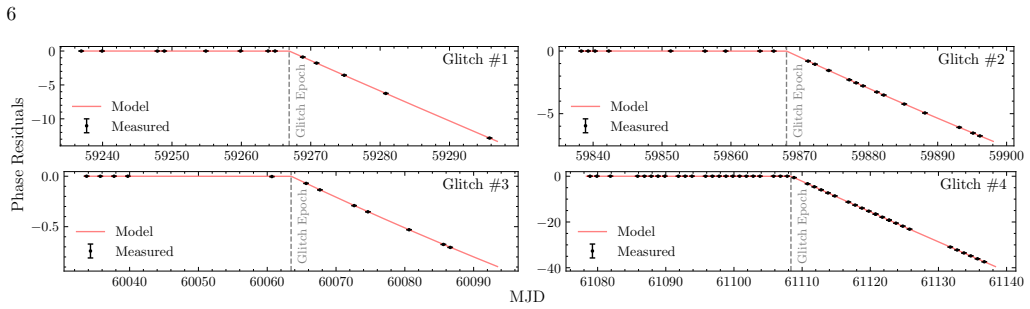
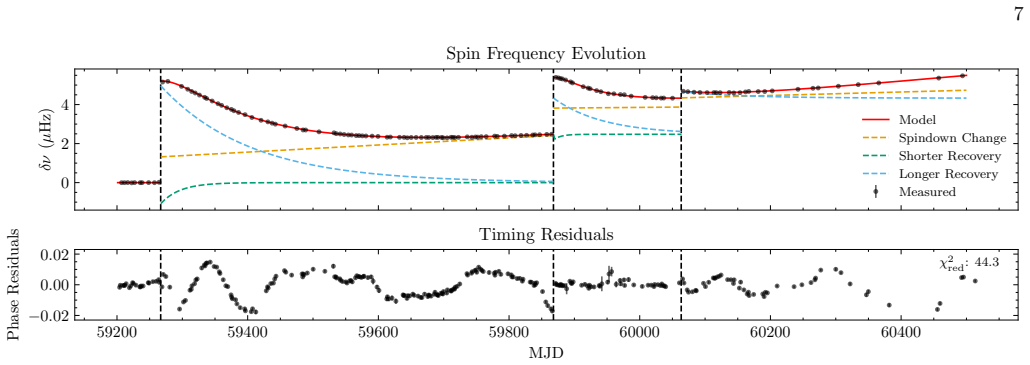
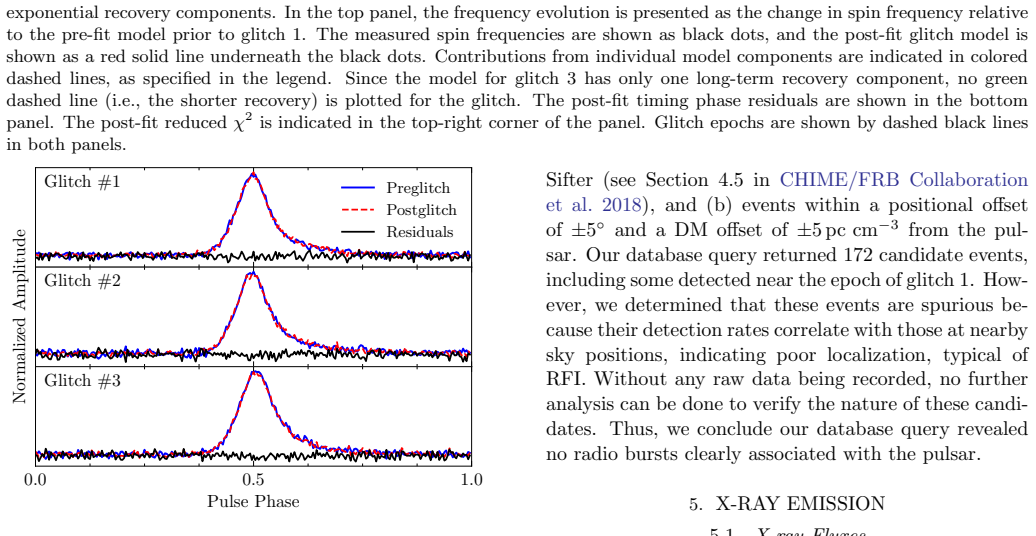
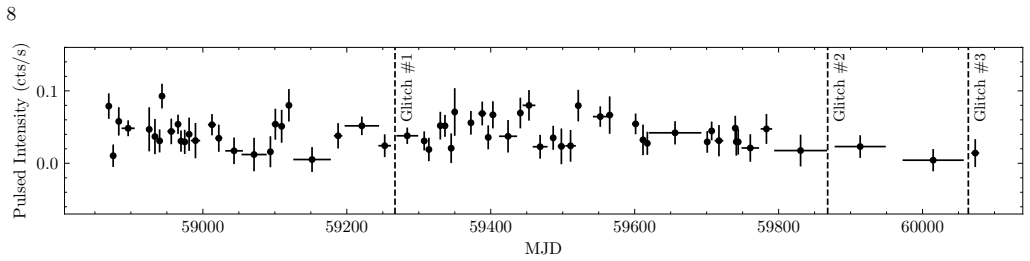
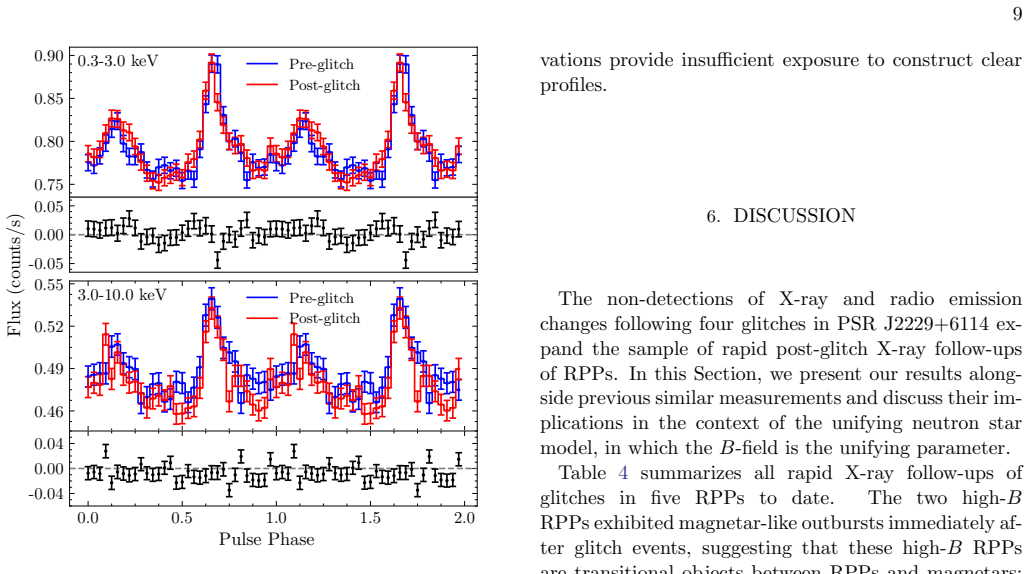
Daily CHIME observations detected a glitch in PSR J2229+6114 in near-real time and triggered NuSTAR X-ray follow-up two days later; three additional glitches were identified in archival CHIME/Pulsar data that overlapped with NICER observations. The combined radio and X-ray data show no measurable changes in emission during any of the four events, in stark contrast to the post-glitch magnetar-like X-ray outbursts seen in high-magnetic-field rotation-powered pulsars.
What carries the argument
The CHIME glitch-monitoring campaign that enables near-real-time detection and rapid X-ray follow-up with NuSTAR and NICER to test for emission changes.
If this is right
- Magnetar-like post-glitch activity is likely more common among high-B RPPs than among ordinary rotation-powered pulsars.
- The dipolar surface magnetic field strength functions as a unifying parameter separating ordinary RPPs from transitional objects.
- Constraints remain limited near the low-B end of the high-B regime, leaving the unifying neutron-star model incompletely tested.
- The absence of emission changes in this source supplies additional evidence that the transitional behavior is B-dependent.
Where Pith is reading between the lines
- Repeated monitoring of other young pulsars below the high-B threshold could map whether a sharp field-strength cutoff governs the appearance of post-glitch outbursts.
- If the lack of activity holds across more low-B glitches, models that tie outburst triggering directly to field strength would gain support over purely age-based explanations.
- The result suggests that real-time radio timing arrays paired with rapid X-ray response may systematically separate the two populations without requiring assumptions about source distance or age.
Load-bearing premise
The X-ray observations have enough sensitivity, timing coverage, and background control to have detected magnetar-like outbursts if they had happened at the levels seen in high-B sources.
What would settle it
Detection of an X-ray flux increase or outburst in the days after a future glitch in PSR J2229+6114 would contradict the reported absence of measurable changes.
Figures
read the original abstract
We present our first result from an ongoing pulsar glitch monitoring campaign at the Canadian Hydrogen Intensity Mapping Experiment (CHIME), in which we analyzed the radio and X-ray emission surrounding four glitches in PSR J2229+6114. Using daily CHIME observations, we detected a glitch in PSR J2229+6114 in near-real time and triggered an X-ray follow-up with NuSTAR two days after the glitch. We identified three additional glitch events in archival CHIME/Pulsar observations that coincided with an independent X-ray observing campaign with NICER. Our data show no measurable changes in the source's X-ray and radio emission during the four glitch events, in stark contrast to the post-glitch activity in high-magnetic-field, rotation-powered pulsars (RPPs), which have been observed to exhibit magnetar-like X-ray outbursts immediately after large glitches. Those high-magnetic-field (high-B) RPPs are considered transitional objects between ordinary RPPs and magnetars, thereby leading to a unifying neutron star model in which the inferred dipolar surface magnetic field strength serves as a unifying parameter. However, such a model remains challenged, in part, by the lack of constraints near the low-B end of the high-B regime, and our result provides additional evidence that magnetar-like post-glitch activity is likely more common among high-B RPPs.
Editorial analysis
A structured set of objections, weighed in public.
Referee Report
Summary. The manuscript reports results from a CHIME-based glitch monitoring campaign on PSR J2229+6114. One glitch was detected in near-real time, triggering NuSTAR observations two days later; three additional glitches were identified in archival CHIME data that overlapped with NICER observations. The central result is a non-detection of measurable changes in radio or X-ray emission around all four events, presented as contrasting with the magnetar-like X-ray outbursts seen immediately after glitches in high-B rotation-powered pulsars.
Significance. A robust non-detection at the low-B end of the high-B regime would strengthen the empirical case that post-glitch X-ray activity correlates with magnetic field strength, thereby tightening constraints on the transitional population between ordinary RPPs and magnetars.
major comments (3)
- [§3] §3 (X-ray follow-up and analysis): No quantitative flux upper limits, background-subtracted sensitivity curves, or direct scaling to the outburst amplitudes reported for PSR J1846-0258 are provided. Without these, the assertion of 'no measurable changes' and the 'stark contrast' with high-B RPPs cannot be evaluated against the two-day NuSTAR delay and the known short timescales of reference outbursts.
- [§2.2] §2.2 (NICER archival data): The cadence, exposure times, and exact temporal alignment of the three archival NICER pointings relative to the glitch epochs are not tabulated or compared to the timing of post-glitch activity in the reference high-B sources; this information is load-bearing for the claim that the non-detection is constraining.
- [Discussion] Discussion section: The argument that the result challenges the unifying model at the low-B end assumes the observations would have detected activity at the levels seen in high-B objects, yet no Monte-Carlo injection tests or reference-event scaling are shown to support this assumption.
minor comments (2)
- [Abstract] The abstract invokes the contrast with high-B RPPs but does not summarize the achieved sensitivity or upper limits that underpin the claim.
- [Figures] Figure captions for the radio timing residuals and X-ray light curves should explicitly state the glitch epochs and the NuSTAR trigger delay for immediate readability.
Simulated Author's Rebuttal
We thank the referee for their constructive comments, which highlight areas where additional quantitative detail will strengthen the manuscript. We respond to each major comment below.
read point-by-point responses
-
Referee: [§3] §3 (X-ray follow-up and analysis): No quantitative flux upper limits, background-subtracted sensitivity curves, or direct scaling to the outburst amplitudes reported for PSR J1846-0258 are provided. Without these, the assertion of 'no measurable changes' and the 'stark contrast' with high-B RPPs cannot be evaluated against the two-day NuSTAR delay and the known short timescales of reference outbursts.
Authors: We agree that quantitative limits are required to rigorously support the non-detection claim. In the revised manuscript we will add background-subtracted sensitivity curves for the NuSTAR and NICER observations, report 3σ upper limits on any post-glitch flux change, and scale these limits to the outburst amplitudes and durations reported for PSR J1846-0258, explicitly accounting for the two-day observational delay. revision: yes
-
Referee: [§2.2] §2.2 (NICER archival data): The cadence, exposure times, and exact temporal alignment of the three archival NICER pointings relative to the glitch epochs are not tabulated or compared to the timing of post-glitch activity in the reference high-B sources; this information is load-bearing for the claim that the non-detection is constraining.
Authors: We will add a table to §2.2 listing the exact NICER observation start times, exposure durations, and time offsets relative to each of the three archival glitch epochs. The table will also include a direct comparison to the post-glitch activity timescales documented for the reference high-B sources, thereby clarifying the constraining power of the non-detections. revision: yes
-
Referee: [Discussion] Discussion section: The argument that the result challenges the unifying model at the low-B end assumes the observations would have detected activity at the levels seen in high-B objects, yet no Monte-Carlo injection tests or reference-event scaling are shown to support this assumption.
Authors: We will incorporate a direct scaling of the reference high-B outburst amplitudes to the sensitivity limits of our NuSTAR and NICER data, together with a discussion of how the observation windows align with known outburst durations. Full Monte-Carlo injection tests lie outside the scope of this initial report; we will therefore present the scaling analysis as a quantitative basis for the interpretation while noting the limitation. revision: partial
Circularity Check
No circularity: direct observational non-detection with no derivations or self-referential reductions
full rationale
The paper presents timing and flux measurements from CHIME radio data and NuSTAR/NICER X-ray observations around four glitches in PSR J2229+6114. The central claim is a non-detection of changes in emission, stated as a direct result of the data analysis. No equations, fitted parameters renamed as predictions, ansatzes, or uniqueness theorems appear. The contrast to high-B RPPs is a qualitative literature comparison, not a derivation that reduces to the paper's own inputs. No self-citation load-bearing steps exist. The result is self-contained observational reporting.
Axiom & Free-Parameter Ledger
axioms (1)
- domain assumption Standard pulsar timing and X-ray data reduction procedures correctly identify glitches and measure emission levels without significant bias.
Reference graph
Works this paper leans on
-
[1]
Andrade, C., Boyle, P. J., Brar, C., et al. 2025, ApJ, 990, 50, doi: 10.3847/1538-4357/adeb51
-
[2]
Archibald, R. F., Kaspi, V. M., Tendulkar, S. P., & Scholz, P. 2016, ApJL, 829, L21, doi: 10.3847/2041-8205/829/1/L21
-
[3]
Arnaud, K. A. 1996, in Astronomical Society of the Pacific Conference Series, Vol. 101, Astronomical Data Analysis Software and Systems V, ed. G. H. Jacoby & J. Barnes, 17
1996
-
[4]
2022, MNRAS, 510, 4049, doi: 10.1093/mnras/stab3336
Basu, A., Shaw, B., Antonopoulou, D., et al. 2022, MNRAS, 510, 4049, doi: 10.1093/mnras/stab3336
-
[5]
R., Karastergiou, A., McLaughlin, M
Brook, P. R., Karastergiou, A., McLaughlin, M. A., et al. 2018, ApJ, 868, 122, doi: 10.3847/1538-4357/aae9e3
-
[6]
Camilo, F., Kaspi, V. M., Lyne, A. G., et al. 2000, ApJ, 541, 367, doi: 10.1086/309435 CHIME Collaboration, Amiri, M., Bandura, K., et al. 2022, ApJS, 261, 29, doi: 10.3847/1538-4365/ac6fd9 CHIME/FRB Collaboration, Amiri, M., Bandura, K., et al. 2018, ApJ, 863, 48, doi: 10.3847/1538-4357/aad188 12 CHIME/FRB Collaboration, Andersen, B. C., Bandura, K. M., ...
-
[7]
Dodson, R. G., McCulloch, P. M., & Lewis, D. R. 2002, ApJL, 564, L85, doi: 10.1086/339068
-
[8]
W., Lang, D., et al.\ 2013, , 125, 306
Foreman-Mackey, D., Hogg, D. W., Lang, D., & Goodman, J. 2013, PASP, 125, 306, doi: 10.1086/670067
-
[9]
Gavriil, F. P., Gonzalez, M. E., Gotthelf, E. V., et al. 2008, Science, 319, 1802, doi: 10.1126/science.1153465
-
[10]
Good, D. C., Andersen, B. C., Chawla, P., et al. 2021, ApJ, 922, 43, doi: 10.3847/1538-4357/ac1da6
-
[11]
V., Vasisht, G., Boylan-Kolchin, M., & Torii, K
Gotthelf, E. V., Vasisht, G., Boylan-Kolchin, M., & Torii, K. 2000, ApJL, 542, L37, doi: 10.1086/312923 G¨ ugercino˘ glu, E., Ge, M. Y., Yuan, J. P., & Zhou, S. Q. 2022, MNRAS, 511, 425, doi: 10.1093/mnras/stac026
-
[12]
Halpern, J. P., Camilo, F., Gotthelf, E. V., et al. 2001, ApJL, 552, L125, doi: 10.1086/320347
-
[13]
W., van Straten, W., & Manchester, R
Hotan, A. W., van Straten, W., & Manchester, R. N. 2004, PASA, 21, 302, doi: 10.1071/AS04022
-
[14]
Hu, C.-P., Kuiper, L., Harding, A. K., et al. 2023, ApJ, 952, 120, doi: 10.3847/1538-4357/acd850
-
[15]
Jennings, R. J., Cordes, J. M., Chatterjee, S., et al. 2024, ApJ, 964, 179, doi: 10.3847/1538-4357/ad2930
-
[16]
Kaspi, V. M. 2010, Proceedings of the National Academy of Science, 107, 7147, doi: 10.1073/pnas.1000812107
-
[17]
Kaspi, V. M., & Beloborodov, A. M. 2017, ARA&A, 55, 261, doi: 10.1146/annurev-astro-081915-023329
-
[18]
Kaspi, V. M., Gavriil, F. P., Woods, P. M., et al. 2003, ApJL, 588, L93, doi: 10.1086/375683
-
[19]
Livingstone, M. A., Kaspi, V. M., Gavriil, F. P., et al. 2007, Ap&SS, 308, 317, doi: 10.1007/s10509-007-9320-3
-
[20]
Gotthelf, E. V. 2011, apj, 730, 66, doi: 10.1088/0004-637X/730/2/66
-
[21]
R., & Kramer, M
Lorimer, D. R., & Kramer, M. 2004, Handbook of Pulsar
2004
-
[22]
2021, ApJ, 911, 45, doi: 10.3847/1538-4357/abe62f
Luo, J., Ransom, S., Demorest, P., et al. 2021, ApJ, 911, 45, doi: 10.3847/1538-4357/abe62f
-
[23]
Lyne, A. G., Jordan, C. A., Graham-Smith, F., et al. 2015, mnras, 446, 857, doi: 10.1093/mnras/stu2118
-
[24]
Manchester, R. N., Hobbs, G. B., Teoh, A., & Hobbs, M. 2005, AJ, 129, 1993, doi: 10.1086/428488
work page internal anchor Pith review doi:10.1086/428488 2005
-
[25]
Morello, V., Barr, E. D., Cooper, S., et al. 2019, MNRAS, 483, 3673, doi: 10.1093/mnras/sty3328
-
[26]
Perna, R., & Pons, J. A. 2011, ApJL, 727, L51, doi: 10.1088/2041-8205/727/2/L51
-
[27]
2022, AJ, 163, 84, doi: 10.3847/1538-3881/ac403e
Phillips, C., & Ransom, S. 2022, AJ, 163, 84, doi: 10.3847/1538-3881/ac403e
-
[28]
2024, ApJ, 960, 75, doi: 10.3847/1538-4357/ad0120
Pope, I., Mori, K., Abdelmaguid, M., et al. 2024, ApJ, 960, 75, doi: 10.3847/1538-4357/ad0120
-
[29]
Shaw, B., Lyne, A. G., Stappers, B. W., et al. 2018, MNRAS, 478, 3832, doi: 10.1093/mnras/sty1294
-
[30]
A., Abdollahi, S., Ajello, M., et al
Smith, D. A., Abdollahi, S., Ajello, M., et al. 2023, apj, 958, 191, doi: 10.3847/1538-4357/acee67
-
[31]
Weltevrede, P., Johnston, S., & Espinoza, C. M. 2011, MNRAS, 411, 1917, doi: 10.1111/j.1365-2966.2010.17821.x
-
[32]
2018, ApJ, 866, 82, doi: 10.3847/1538-4357/aade46
Zhang, X., Shuai, P., Huang, L., Chen, S., & Du, Y. 2018, ApJ, 866, 82, doi: 10.3847/1538-4357/aade46
-
[33]
2022, Universe, 8, 641, doi: 10.3390/universe8120641
Zhou, S., G¨ ugercino˘ glu, E., Yuan, J., Ge, M., & Yu, C. 2022, Universe, 8, 641, doi: 10.3390/universe8120641
discussion (0)
Sign in with ORCID, Apple, or X to comment. Anyone can read and Pith papers without signing in.