Recognition: 2 theorem links
· Lean TheoremResonant shear-flow instability in anisotropic supersonic plasmas with heat flux
Pith reviewed 2026-05-14 18:46 UTC · model grok-4.3
The pith
A resonant instability develops in supersonic shear flows of anisotropic collisionless plasmas and disappears in the vortex sheet limit.
A machine-rendered reading of the paper's core claim, the machinery that carries it, and where it could break.
Core claim
Within the 16-moment transport model for collisionless plasmas, the wave equation for disturbances in a homogeneous-density, uniform-field supersonic shear flow with a hyperbolic velocity profile reduces to an exactly solvable equation whose solutions form a discrete spectrum of complex frequencies. The resulting instability is resonant, attaining maximum growth when the phase velocity matches the flow speed, and the growth rate falls both with rising Mach number toward an asymptote and with increasing mode order; heat flux contributes negligibly. The unstable modes cease to exist in the vortex-sheet limit, unlike classical Kelvin-Helmholtz instability.
What carries the argument
Reduction of the governing wave equation to a solvable form with special functions for the hyperbolic shear velocity profile within the 16-moment closure.
If this is right
- The growth rate of the instability approaches a constant asymptotic value as the Mach number increases.
- Parallel heat flux exerts negligible influence on the instability under supersonic flow conditions.
- The instability is absent in the discontinuous vortex sheet limit, distinguishing it from the Kelvin-Helmholtz mechanism.
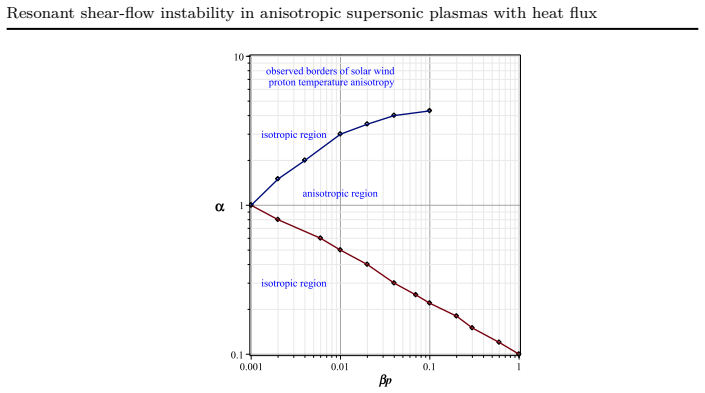
- This resonant instability can explain boundaries between isotropic and anisotropic proton temperature regions in low-beta solar wind plasma.
Where Pith is reading between the lines
- This mechanism could be tested in other astrophysical contexts involving smooth supersonic shears, such as in stellar winds or jet boundaries.
- Nonlinear saturation of these modes might lead to local isotropization of the proton temperature distribution.
- Extensions to time-dependent or inhomogeneous backgrounds could reveal how the discrete spectrum evolves in realistic solar wind conditions.
Load-bearing premise
The unperturbed state must have spatially homogeneous density and magnetic field together with a smooth hyperbolic velocity profile so that the wave equation reduces to an exactly solvable form.
What would settle it
Observation of growing waves in solar wind data where phase velocity matches the local flow velocity at boundaries between isotropic and anisotropic proton temperature regions would support the resonant instability; the absence of such waves in detailed observations would challenge the proposed explanation.
Figures




read the original abstract
This work is devoted to the study of the influence of temperature anisotropy and parallel heat flux on the stability of supersonic shear flow in collisionless plasmas. Within a fluid-based framework, we employ the 16-moment transport equations -- derived from the Vlasov-Maxwell system -- to describe the plasma dynamics. By performing a modal analysis we investigate the oblique propagation of linear disturbances within a magnetized plasma characterized by a shear flow of arbitrary profile aligned with the ambient magnetic field. In the unperturbed state, both the plasma density and the magnetic field are assumed to be homogeneous. For a smooth, hyperbolic velocity profile representing supersonic shear, the governing wave equation is reduced to a form amenable to an exact analytical solution. Analytical solutions are expressed in terms of special functions that yield an infinite discrete spectrum of complex eigenfrequencies ($n = 0, 1, 2, \dots$). The instability is identified as resonant, peaking when the wave phase velocity matches the mean flow velocity, with the growth rate decreasing for higher-order modes. The results indicate that, while heat flux exerts a negligible influence under conditions of supersonic flow, the growth rate decreases and approaches an asymptotic value as the Mach number increases. Notably, the instability vanishes in the vortex sheet limit, distinguishing it from the classical Kelvin-Helmholtz mechanism. These findings suggest that this specific instability holds significant potential for explaining the problem of observed boundaries between isotropic and anisotropic proton temperature regions in a low-beta solar wind plasma.
Editorial analysis
A structured set of objections, weighed in public.
Referee Report
Summary. The manuscript investigates the linear stability of supersonic shear flows in anisotropic collisionless plasmas using the 16-moment transport equations derived from the Vlasov-Maxwell system. For a hyperbolic velocity profile U(x) = U0 tanh(x/L) with uniform background density and magnetic field, the governing wave equation for oblique perturbations is reduced to a form solvable exactly in terms of special functions, producing an infinite discrete spectrum of complex eigenfrequencies. The resulting mode is identified as resonant, with maximum growth when the phase velocity equals the local flow velocity; growth rates decrease with mode order, become negligible with increasing Mach number, and vanish in the vortex-sheet limit, distinguishing the mechanism from classical Kelvin-Helmholtz instability. Heat-flux effects are reported as negligible under supersonic conditions, and the instability is proposed as a candidate explanation for observed boundaries between isotropic and anisotropic proton-temperature regions in low-beta solar wind.
Significance. If the analytical reduction is verified to satisfy the original 16-moment system and the closure remains valid, the work supplies an exactly solvable resonant instability with a discrete spectrum and clear parametric dependence on Mach number and anisotropy. This offers falsifiable predictions for growth rates and mode structure that could be tested against solar-wind observations, providing a potential fluid-based mechanism for temperature-anisotropy transitions without invoking kinetic effects.
major comments (2)
- [Derivation of the wave equation and eigenfrequency spectrum] The central claim rests on reducing the linearized 16-moment system to a wave equation solvable by special functions for the specific hyperbolic profile. The manuscript must supply the explicit intermediate steps of this reduction and a direct substitution verification showing that the obtained eigenfrequencies satisfy the original 16-moment equations (including the heat-flux and anisotropy evolution equations) rather than an approximated or truncated form.
- [Analysis of the vortex-sheet limit] The assertion that the instability vanishes in the vortex-sheet limit and is thereby distinct from Kelvin-Helmholtz relies on the exact solvability for the smooth profile. The limiting procedure (L → 0) must be shown explicitly, confirming that the growth rate approaches zero while preserving the resonance condition and that no singular KH-like branch emerges within the 16-moment closure.
minor comments (2)
- [Analytical solution] Clarify the precise definition and normalization of the special functions employed in the solution; include their recurrence relations or asymptotic forms used to extract the complex eigenfrequencies.
- [Parametric study] The statement that heat flux exerts negligible influence should be quantified by showing the scaling of the growth rate with the heat-flux parameter across the reported Mach-number range.
Simulated Author's Rebuttal
We thank the referee for the careful reading of the manuscript and the constructive major comments. We address each point below and agree that expanding the derivation details and the limiting analysis will improve clarity and rigor. The revised manuscript will incorporate these additions.
read point-by-point responses
-
Referee: [Derivation of the wave equation and eigenfrequency spectrum] The central claim rests on reducing the linearized 16-moment system to a wave equation solvable by special functions for the specific hyperbolic profile. The manuscript must supply the explicit intermediate steps of this reduction and a direct substitution verification showing that the obtained eigenfrequencies satisfy the original 16-moment equations (including the heat-flux and anisotropy evolution equations) rather than an approximated or truncated form.
Authors: We acknowledge that the current manuscript presents the final reduced wave equation and its special-function solutions without all intermediate algebraic steps. In the revised version we will add a dedicated appendix that starts from the linearized 16-moment equations, eliminates the perturbation variables step by step (including the heat-flux and anisotropy evolution equations), and arrives at the wave equation. We will also include an explicit substitution verification for the fundamental mode (n=0) that confirms the eigenfrequency satisfies the full original system; the structure of the solution ensures the same holds for higher modes. This addition directly addresses the request for verification beyond any possible truncation. revision: yes
-
Referee: [Analysis of the vortex-sheet limit] The assertion that the instability vanishes in the vortex-sheet limit and is thereby distinct from Kelvin-Helmholtz relies on the exact solvability for the smooth profile. The limiting procedure (L → 0) must be shown explicitly, confirming that the growth rate approaches zero while preserving the resonance condition and that no singular KH-like branch emerges within the 16-moment closure.
Authors: We agree that an explicit demonstration of the L → 0 limit is required. In the revised manuscript we will add a subsection that takes the analytic dispersion relation obtained from the special-function solution and shows that the imaginary part of the frequency tends to zero as L decreases while the resonance condition (phase velocity equal to local flow velocity) remains satisfied. We will further demonstrate that, within the 16-moment closure, the boundary conditions remain regular and no additional singular branch analogous to classical Kelvin-Helmholtz appears. This explicit limiting analysis will confirm the distinction from KH instability. revision: yes
Circularity Check
No significant circularity; analytical reduction is self-contained
full rationale
The paper starts from the standard 16-moment transport equations (derived from Vlasov-Maxwell), states the assumptions of homogeneous density and magnetic field in the unperturbed state, prescribes the hyperbolic velocity profile U(x) = U0 tanh(x/L), and reduces the resulting wave equation to an exactly solvable form in special functions. The discrete spectrum, resonant character (phase velocity matching mean flow), decreasing growth rates with mode number and Mach number, negligible heat-flux effect, and vanishing growth in the vortex-sheet limit all follow directly from this eigenvalue solution. None of these results are fitted to data, redefined by construction, or justified only via self-citation chains. The 16-moment closure and homogeneous-background assumptions are declared upfront rather than derived from the eigenfrequencies themselves. This is a standard analytical derivation with no load-bearing circular steps.
Axiom & Free-Parameter Ledger
axioms (1)
- domain assumption 16-moment transport equations derived from the Vlasov-Maxwell system constitute a valid fluid closure for collisionless anisotropic plasmas
Lean theorems connected to this paper
-
IndisputableMonolith/Foundation/AlexanderDuality.leanalexander_duality_circle_linking unclear?
unclearRelation between the paper passage and the cited Recognition theorem.
the instability vanishes in the vortex sheet limit, distinguishing it from the classical Kelvin-Helmholtz mechanism
What do these tags mean?
- matches
- The paper's claim is directly supported by a theorem in the formal canon.
- supports
- The theorem supports part of the paper's argument, but the paper may add assumptions or extra steps.
- extends
- The paper goes beyond the formal theorem; the theorem is a base layer rather than the whole result.
- uses
- The paper appears to rely on the theorem as machinery.
- contradicts
- The paper's claim conflicts with a theorem or certificate in the canon.
- unclear
- Pith found a possible connection, but the passage is too broad, indirect, or ambiguous to say the theorem truly supports the claim.
Reference graph
Works this paper leans on
-
[1]
G. K. Batchelor , title =. J. Fluid Mech. , year =
-
[2]
Blumen, W. and Drazin, P. G. and Billings, D. F. , title=. J. Fluid Mech. , volume =. 1975 , doi=
work page 1975
-
[3]
Hunana, P. and Zank, G. P. , title =. Astrophys. J. , volume =. 2017 , doi =
work page 2017
-
[4]
Hunana, P. and Tenerani, A. and Zank, G. P. and Khomenko, E. and Goldstein, M. L. and Webb, G. M. and Cally, P. S. and Collados, M. and Velli, M. and Adhikari, L. , title =. J. Plasma Phys. , volume =. 2019 , doi =
work page 2019
-
[5]
Malara, F. and Settino, A. and Perrone, D. and Pezzi, O. and Guzzi, G. and Valentini, F. , title =. Astrophys. J. , volume =. 2022 , doi =
work page 2022
-
[6]
Maiorano, T. and Settino, A. and Malara, F. and Pezzi, O. and Pucci, F. and Valentini, F. , title =. J. Plasma Phys. , volume =. 2020 , doi =
work page 2020
-
[7]
Drazin, P. G. and Reid, W. H. , title =
-
[8]
Henri, P. and Cerri, S. S. and Califano, F. and others , title =. Phys. Plasmas , volume =. 2013 , doi =
work page 2013
-
[9]
Ismayilli, R. F. and Dzhalilov, N. S. and Shergelashvili, B. M. and Poedts, S. and Pirguliyev, M. S. , title =. Phys. Plasmas , volume =. 2018 , doi =
work page 2018
-
[10]
Belyaev, M. A. and Rafikov, R. R. , title =. Astrophys. J. , volume =. 2012 , doi =
work page 2012
-
[11]
Ray, T. P. , title =. Mon. Not. R. Astron. Soc. , volume =
- [12]
-
[13]
Galtier, S and Nazarenko, SV and Newell, AC and Pouquet, A , Title =
-
[14]
C. J. Brownell and L. K. Su , title =. AIAA Paper 2004-2335 , year =
work page 2004
-
[15]
C. J. Brownell and L. K. Su , title =. AIAA Paper 2007-1314 , year =
work page 2007
-
[16]
S. C. R. Dennis , title =. Ninth Intl Conf. on Numerical Methods in Fluid Dynamics , publisher =. 1985 , editor =
work page 1985
-
[17]
Borovsky, J. E. and Denton, M. H. , title =. J. Geophys. Res. , volume =. 2010 , doi =
work page 2010
- [18]
-
[19]
M. G. Worster , title =. In Interactive dynamics of convection and solidification , publisher =. 1992 , editor =
work page 1992
- [20]
- [21]
-
[22]
C. M. Linton and D. V. Evans , title =. Phil.\ Trans.\ R. Soc.\ Lond. , year =
-
[23]
P. A. Martin , title =. 1980 , journal =
work page 1980
-
[24]
R. S. Rogallo , title =
- [25]
-
[26]
On the oscillations near and at resonance in open pipes , year =
L. On the oscillations near and at resonance in open pipes , year =. J. Engng Maths , volume =
-
[27]
P. L. Miller , title =. 1991 , address =
work page 1991
-
[28]
Miura, A. and Pritchett, P. L. , title =. J. Geophys. Res. , volume =. 1982 , doi =
work page 1982
-
[29]
Roy Choudhury, S. and Lovelace, R. V. E. , title =. Astrophys. J. , volume =. 1986 , doi =
work page 1986
- [30]
-
[31]
Kaghashvili, E. K. , journal =
-
[32]
Kaghashvili, E. K. and Esser, R. , title =. Astrophys. J. , volume =. 2000 , doi =
work page 2000
- [33]
-
[34]
Li, J. W. and Chen, Y. and Li, Z. Y. , title =. Phys. Plasmas , volume =. 2006 , doi =
work page 2006
-
[35]
Shergelashvili, B. M. and Poedts, S. and Pataraya, A. D. , title =. Astrophys. J. , volume =. 2006 , doi =
work page 2006
-
[36]
Camporeale, E. and Burgess, D. and Passot, T. , title =. Phys. Plasmas , volume =. 2009 , doi =
work page 2009
-
[37]
Osman, K. T. and Matthaeus, W. H. and Hnat, B. and Chapman, S. C. , title =. Phys. Rev. Lett. , volume =. 2012 , doi =
work page 2012
-
[38]
Talwar, S. P. , title =. Phys. Fluids , volume =. 1965 , doi =
work page 1965
- [39]
-
[40]
Peyrichon, G. and El-Rabii, H. and Ripoll, J.-F. and Casner, A. and Michael, A. and Merkin, V. G. and Hurricane, O. A. , title =. Phys. Plasmas , volume =. 2025 , doi =
work page 2025
-
[41]
Stverak, S. and Travnicek, P. and Maksimovic, M. , title =. J. Geophys. Res. , volume =. 2008 , doi =
work page 2008
-
[42]
Balbus, S. A. and Hawley, J. F. , title =. Astrophys. J. , volume =. 1991 , doi =
work page 1991
-
[43]
Maruca, B. A. and Kasper, J. C. and Bale, S. D. , title =. Phys. Rev. Lett. , volume =. 2011 , doi =
work page 2011
-
[44]
Lazar, M. and Shaaban, S. M. and Poedts, S. and Stverak, S. , title=. Mon. Not. R. Astron. Soc. , volume =. 2017 , doi=
work page 2017
-
[45]
Vafin, S. and Lazar, M. and Fichtner, H. and Schlickeiser, R. and Drillisch, M. , title =. Astron. Astrophys. , volume =. 2018 , doi =
work page 2018
-
[46]
Servidio, S. and Osman, K. T. and Valentini, F. , title=. Astrophys. J. , volume =. 2014 , doi=
work page 2014
-
[47]
Ibscher, D. and Schlickeiser, R. , title=. Phys. Plasmas , volume =. 2014 , doi =
work page 2014
-
[48]
Schlickeiser, R. and Skoda, T. , title =. Astrophys. J. , volume =. 2010 , doi =
work page 2010
-
[49]
Vafin, S. and Riazantseva, M. and Pohl, M. , title =. Astrophys. J. Lett. , volume =. 2019 , doi =
work page 2019
-
[50]
Yoon, P. H. and Lazar, M. and Salem, C. and Seough, J. and Martinovi. Boundary of the Distribution of Solar Wind Proton Beta versus Temperature Anisotropy , journal =. 2024 , doi =
work page 2024
-
[51]
Zhao, G. Q. and Li, H. and Feng, H. Q. and Wu, D. J. and Li, H. B. and Zhao, A. , title =. Astrophys. J. , volume =. 2019 , doi =
work page 2019
- [52]
-
[53]
Martinovic, M. M. and Klein, K. G. and Durovcova, T. and Alterman, B. L. , title =. Astrophys. J. , volume =. 2021 , doi =
work page 2021
-
[54]
Matteini, L. and Hellinger, P. and Landi, S. and Travn. Ion Kinetics in the Solar Wind: Coupling Global Expansion to Local Microphysics , journal =. 2012 , doi =
work page 2012
-
[55]
Cranmer, S. R. , title =. Astrophys. J. Suppl. , volume =. 2014 , doi =
work page 2014
-
[56]
Ozak, N. and Ofman, L. and Vi. Ion Heating in Inhomogeneous Expanding Solar Wind Plasma: The Role of Parallel and Oblique Ion-Cyclotron Waves , journal =. 2015 , doi =
work page 2015
-
[57]
Chen, C. H. K. and Matteini, L. and Schekochihin, A. A. and Stevens, M. L. and Salem, C. S. and Maruca, B. A. and Kunz, M. W. and Bale, S. D. , title =. Astrophys. J. Lett. , volume =. 2016 , doi =
work page 2016
-
[58]
Verscharen, D. and Klein, K. G. and Maruca, B. A. , title =. Living Rev. Sol. Phys. , volume =. 2019 , doi =
work page 2019
-
[59]
Kasper, J. C. and Lazarus, A. J. and Gary, S. P. , title =. AIP Conf. Proc. , pages =. 2003 , doi=
work page 2003
-
[60]
Bale, S. D. and Kasper, J. C. and Howes, G. G. , title =. Phys. Rev. Lett. , volume =. 2009 , doi =
work page 2009
-
[61]
Maruca, B. A. and Kasper, J. C. and Gary, S. P. , title =. Astrophys. J. , volume =. 2012 , doi =
work page 2012
-
[62]
Seough, J. and Yoon, P. H. and Kim, K. H. , title =. Phys. Rev. Lett. , volume =. 2013 , doi =
work page 2013
-
[63]
Huang, J. and Kasper, J. C. and Vech, D. , title =. Astrophys. J. Suppl. , volume =. 2020 , doi =
work page 2020
-
[64]
Hellinger, P. and Tr. Solar wind proton temperature anisotropy: Linear theory and WIND/SWE observations , journal =. 2006 , doi =
work page 2006
-
[65]
Hellinger, P. and Travnicek, P. M. , title =. Astrophys. J. Lett. , volume =. 2014 , doi =
work page 2014
-
[66]
Hillier, A. and Arregui, I. and Matsumoto, T. , title =. Astrophys. J. , volume =. 2024 , doi =
work page 2024
-
[67]
Phillips, J. L. and Gosling, J. T. , title =. J. Geophys. Res. , volume =. 1990 , doi =
work page 1990
-
[68]
Chus, T. and Belmont, G. , title =. Phys. Plasmas , volume =. 2006 , doi =
work page 2006
-
[69]
Coleman, P. J. , title =. Astrophys. J. , volume =. 1968 , doi =
work page 1968
-
[70]
Belcher, J. W. and Davis, L. , title =. J. Geophys. Res. , volume =. 1971 , doi =
work page 1971
-
[71]
Terry, P. W. , title =. Rev. Mod. Phys. , volume =. 2000 , doi =
work page 2000
-
[72]
Viall, N. M. and DeForest, C. E. and Kepko, L. , title =. Front. Astron. Space Sci. , volume =. 2021 , doi =
work page 2021
-
[73]
Birch, M. J. and Hargreaves, J. K. , title =. Adv. Space Res. , volume =. 2021 , doi =
work page 2021
-
[74]
Dzhalilov, N. S. and Kuznetsov, V. D. and Staude, J. , title =. Contrib. Plasma Phys. , volume =. 2011 , doi =
work page 2011
-
[75]
Cerri, S. S. and Pegoraro, F. and Califano, F. and Del Sarto, D. and Jenko, F. , title =. Phys. Plasmas , volume =. 2014 , doi =
work page 2014
-
[76]
Kuznetsov, V. D. and Dzhalilov, N. S. , title =. Plasma Phys. Rep. , volume =. 2009 , doi =
work page 2009
-
[77]
Dzhalilov, N. S. and Kuznetsov, V. D. , title =. Plasma Phys. Rep. , volume =
-
[78]
Fejer, J. A. , title =. Phys. Fluids , volume =. 1964 , doi =
work page 1964
-
[79]
Gerwin, R. A. , title =. Rev. Mod. Phys. , volume =
-
[80]
Chen, L. and Hasegawa, A. , title =. J. Geophys. Res. , volume =. 1974 , doi =
work page 1974
discussion (0)
Sign in with ORCID, Apple, or X to comment. Anyone can read and Pith papers without signing in.