Recognition: no theorem link
Spectropolarimetric analysis of waves linked to FIP
Pith reviewed 2026-05-14 17:55 UTC · model grok-4.3
The pith
Stokes V amplitude asymmetries diagnose Alfvénic waves relevant to FIP bias.
A machine-rendered reading of the paper's core claim, the machinery that carries it, and where it could break.
Core claim
The work establishes that Stokes V amplitude asymmetries can be used as an alternative diagnostic tool to investigate wave behavior relevant to compositional fractionation processes, specifically those associated with Alfvénic perturbations in the chromosphere that affect coronal plasma composition.
What carries the argument
Stokes V amplitude asymmetries, which capture imbalances in the circular polarization profiles of spectral lines and serve to detect the magnetic perturbations from Alfvénic waves driving the ponderomotive force.
If this is right
- If confirmed, this diagnostic enables mapping of wave activity in the chromosphere using standard spectropolarimetric measurements.
- It provides additional observational constraints on the role of waves in elemental fractionation between the photosphere and corona.
- Models of coronal composition can incorporate this new proxy for wave-induced effects.
- Future studies may combine this with other wave diagnostics for a more complete picture of chromospheric dynamics.
Where Pith is reading between the lines
- Similar asymmetry diagnostics could be tested on data from different instruments to verify robustness against observational biases.
- The approach might extend to studying wave effects in stellar atmospheres beyond the Sun.
- Quantitative modeling of how wave amplitude translates to asymmetry strength would strengthen the interpretive power of this tool.
Load-bearing premise
Observed Stokes V amplitude asymmetries result primarily from the Alfvénic wave perturbations connected to FIP bias rather than from unrelated velocity gradients or instrumental artifacts.
What would settle it
Finding no spatial correlation between strong Stokes V asymmetries in the chromosphere and enhanced FIP bias in the overlying corona would challenge the diagnostic value of these asymmetries for wave behavior.
Figures


read the original abstract
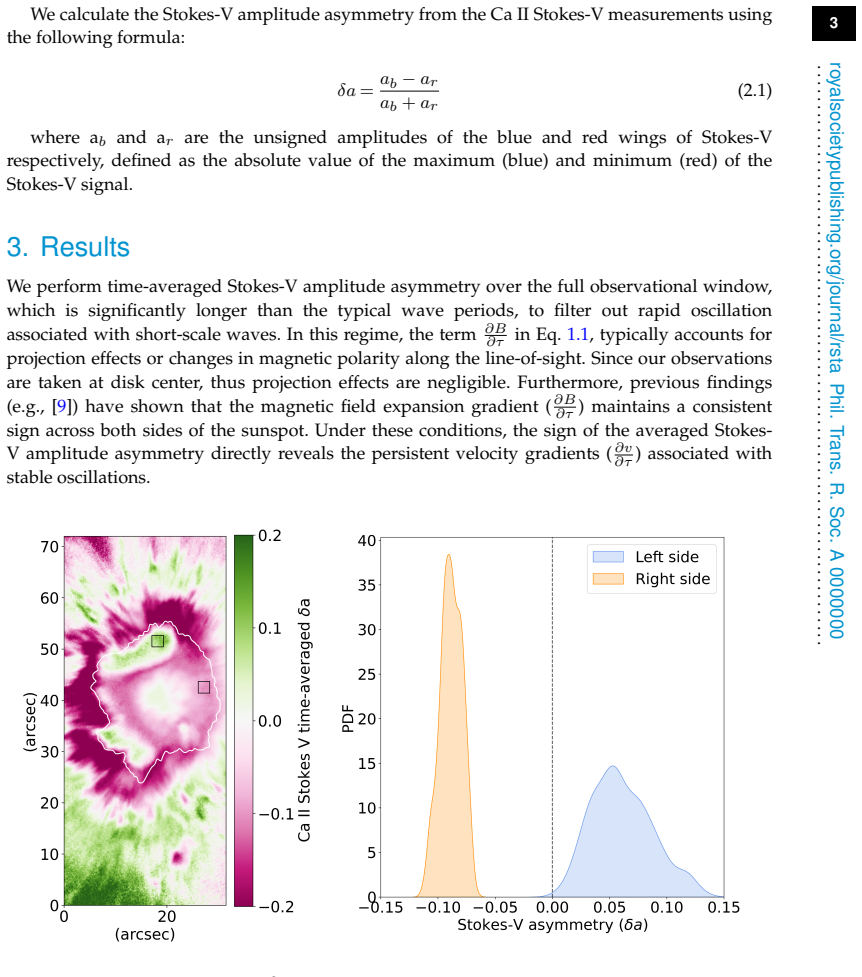
High-resolution spectropolarimetry has opened new avenues for understanding how chromospheric waves shape coronal plasma composition. All modeling efforts so far highlight wave activity and, in particular, the ponderomotive force associated to Alfv\'enic perturbations, as a key ingredient. Over recent years, studies based on spectropolarimetric measurements in the solar chromosphere have identified magnetic perturbations associated to waves linked to regions in the corona with enhanced FIP bias. Building on this established framework, the present work explores the diagnostic potential of Stokes V amplitude asymmetries as an alternative diagnostic tool for investigating wave behavior relevant to compositional fractionation processes.
Editorial analysis
A structured set of objections, weighed in public.
Referee Report
Summary. The manuscript explores the diagnostic potential of Stokes V amplitude asymmetries observed via high-resolution spectropolarimetry in the solar chromosphere as an alternative tool for investigating Alfvénic wave perturbations linked to the First Ionization Potential (FIP) fractionation effect in coronal plasma. It builds on an established framework from prior studies that identified magnetic perturbations associated with waves in regions showing enhanced FIP bias, without presenting new quantitative data, modeling, or tests in the provided text.
Significance. If the diagnostic link can be rigorously demonstrated, the work could introduce a useful observational proxy for wave-driven compositional fractionation, complementing existing modeling that emphasizes the ponderomotive force from Alfvénic perturbations. This would add to the toolkit for connecting chromospheric dynamics to coronal abundances in solar physics.
major comments (2)
- [Abstract] Abstract: The stated exploratory goal is not supported by any presented data, methods, quantitative results, or analysis, leaving the central claim that Stokes V asymmetries trace wave behavior relevant to FIP bias untested and unevaluated.
- [Main text] Main text: No forward synthesis, null tests, or controls are described to exclude alternative origins for the observed Stokes V amplitude asymmetries, such as static magnetic/velocity gradients across formation heights or residual instrumental polarization effects; this assumption is load-bearing for the proposed diagnostic.
Simulated Author's Rebuttal
We thank the referee for the constructive comments on our manuscript. We have revised the text to better reflect its exploratory character and to explicitly discuss limitations in the current analysis.
read point-by-point responses
-
Referee: [Abstract] Abstract: The stated exploratory goal is not supported by any presented data, methods, quantitative results, or analysis, leaving the central claim that Stokes V asymmetries trace wave behavior relevant to FIP bias untested and unevaluated.
Authors: We agree that the original wording could be read as implying a validated result. The work is conceptual and proposes Stokes V amplitude asymmetries as a potential new diagnostic on the basis of the established framework from prior spectropolarimetric studies. We have rewritten the abstract to state clearly that the manuscript explores the diagnostic potential without presenting new quantitative tests or validation in this paper. revision: yes
-
Referee: [Main text] Main text: No forward synthesis, null tests, or controls are described to exclude alternative origins for the observed Stokes V amplitude asymmetries, such as static magnetic/velocity gradients across formation heights or residual instrumental polarization effects; this assumption is load-bearing for the proposed diagnostic.
Authors: The referee is correct that alternative physical or instrumental origins have not been excluded by new modeling in the present manuscript. We have added a dedicated paragraph in the discussion section that acknowledges these possibilities (static gradients and residual polarization) and outlines why forward synthesis and null tests are required to strengthen the interpretation. Such modeling lies beyond the scope of the current exploratory note but is identified as a necessary follow-up. revision: partial
Circularity Check
Exploratory diagnostic study references prior framework without reducing claims to self-defined inputs
full rationale
The paper contains no derivation chain, equations, fitted parameters, or predictions. Its central claim is an exploration of Stokes V amplitude asymmetries as an alternative diagnostic for wave behavior tied to FIP fractionation, explicitly built on an 'established framework' from prior spectropolarimetric studies. No load-bearing step reduces by construction to the paper's own inputs, self-citations, or ansatzes; the work supplies no new modeling or null tests but also introduces no circular reductions. This qualifies as at most a minor self-citation that is not load-bearing, consistent with a low circularity score.
Axiom & Free-Parameter Ledger
Reference graph
Works this paper leans on
-
[1]
Widing, K. G. & Feldman, U. 1989 Abundance Variations in the Outer Solar Atmosphere Observed in SKYLAB Spectroheliograms.Astrophys. J.,344, 1046. (doi:10.1086/167871)
-
[2]
Sheeley, N. R. 1995 A Volcanic Origin for High-FIP Material in the Solar Atmosphere. Astrophys. J.,440, 884. (doi:10.1086/175326)
-
[3]
Sheeley, N. R. 1996 Elemental Abundance Variations in the Solar Atmosphere.Astrophys. J., 469, 423. (doi:10.1086/177792)
-
[4]
Laming, J. M. 2004 A Unified Picture of the First Ionization Potential and Inverse First Ionization Potential Effects.Astrophys. J.,614, 2, 1063. (doi:10.1086/423780)
-
[5]
2015 The FIP and Inverse FIP Effects in Solar and Stellar Coronae.Living Rev
Laming JM. 2015 The FIP and Inverse FIP Effects in Solar and Stellar Coronae.Living Rev. Solar Phys.12, 2. (doi:10.1007/lrsp-2015-2)
-
[7]
Stangalini, M., Baker, D., Valori, G.,et al.2021 Spectropolarimetric fluctuations in a sunspot chromosphere.Philosophical T ransactions of the Royal Society of London Series A,379, 2190, 20200216. (doi:10.1098/rsta.2020.0216)
-
[8]
Baker, D., Stangalini, M., Valori, G., et al. 2021 Alfvénic Perturbations in a Sunspot Chromosphere Linked to Fractionated Plasma in the Corona ,Astrophys. J.,907, 1, 16. (doi:10.3847/1538-4357/abcafd)
-
[9]
2021 Investigating the origin of magnetic perturbations associated with the FIP Effect.Astron
Murabito M, Stangalini M, Baker D, Valori G, Jess DB, Jafarzadeh S, Brooks DH, Ermolli I, Giorgi F, Grant SDT, Long DM, van Driel-Gesztelyi L. 2021 Investigating the origin of magnetic perturbations associated with the FIP Effect.Astron. Astrophys.,656, A87. (doi:10.1051/0004-6361/202141504)
-
[10]
Murabito, M., Stangalini, M., Laming, J. M.,et al.2024 Observation of Alfvén Wave Reflection in the Solar Chromosphere: Ponderomotive Force and First Ionization Potential Effect.Physical Review Letters,132, 21, 215201. (doi:10.1103/PhysRevLett.132.215201)
-
[11]
Illing, R. M. E., Landman, D. A., & Mickey, D. L. 1975 Broad-band circular polarization of sunspots: spectral dependence and theory.Astron. Astrophys.,41, 2, 183
1975
-
[12]
Solanki, S. K. 1993 Smallscale Solar Magnetic Fields - an Overview.Space Science Reviews,63, 1-2, 1. (doi:10.1007/BF00749277) 7royalsocietypublishing.org/journal/rsta Phil. T rans. R. Soc. A 0000000
-
[13]
Ploner, S. R. O. & Solanki, S. K. 1997 Influence of kink waves in solar magnetic flux tubes on spectral lines.Astron. Astrophys.,325, 1199
1997
-
[14]
Houston, S. J., Jess, D. B., Keppens, R.,et al.2020 Magnetohydrodynamic Nonlinearities in Sunspot Atmospheres: Chromospheric Detections of Intermediate Shocks .Astrophys. J.,892, 1, 49. (doi:10.3847/1538-4357/ab7a90)
-
[15]
2006 BIS: a new post-focus instrument for solar imaging spectroscopy.Solar Phys., 236, 2, 415
Cavallini, F. 2006 BIS: a new post-focus instrument for solar imaging spectroscopy.Solar Phys., 236, 2, 415. (doi:10.1007/s11207-006-0103-8)
-
[16]
Stangalini, M., Jafarzadeh, S., Ermolli, I.,et al.2018 Propagating spectropolarimetric disturbances in a large sunspot.Astrophys. J.,869, 2, 110. (doi:10.3847/1538-4357/aaec7b)
-
[17]
Murabito, M., Ermolli, I., Giorgi, F.,et al.2019 Height dependence of the penumbral fine- scale structure in the inner solar atmosphere.Astrophys. J.,873, 2, 126. (doi:10.3847/1538- 4357/aaf727)
-
[19]
Laming, J. M., Vourlidas, A., Korendyke, C.,et al.2019 Element Abundances: A New Diagnostic for the Solar Wind.Astrophys. J.,879, 2, 124. (doi:10.3847/1538-4357/ab23f1)
-
[20]
Berretti, M., Stangalini, M., Verth, G., et al. 2025 Umbral oscillations in the photosphere: A comprehensive statistical study.Astron. Astrophys.,697, A156. (doi:10.1051/0004- 6361/202453176)
discussion (0)
Sign in with ORCID, Apple, or X to comment. Anyone can read and Pith papers without signing in.