Recognition: 1 theorem link
· Lean TheoremThe KnotMosaics Package for SageMath
Pith reviewed 2026-05-15 01:32 UTC · model grok-4.3
The pith
KnotMosaics package represents knot mosaics as matrices of tile labels to validate and analyze them in SageMath.
A machine-rendered reading of the paper's core claim, the machinery that carries it, and where it could break.
Core claim
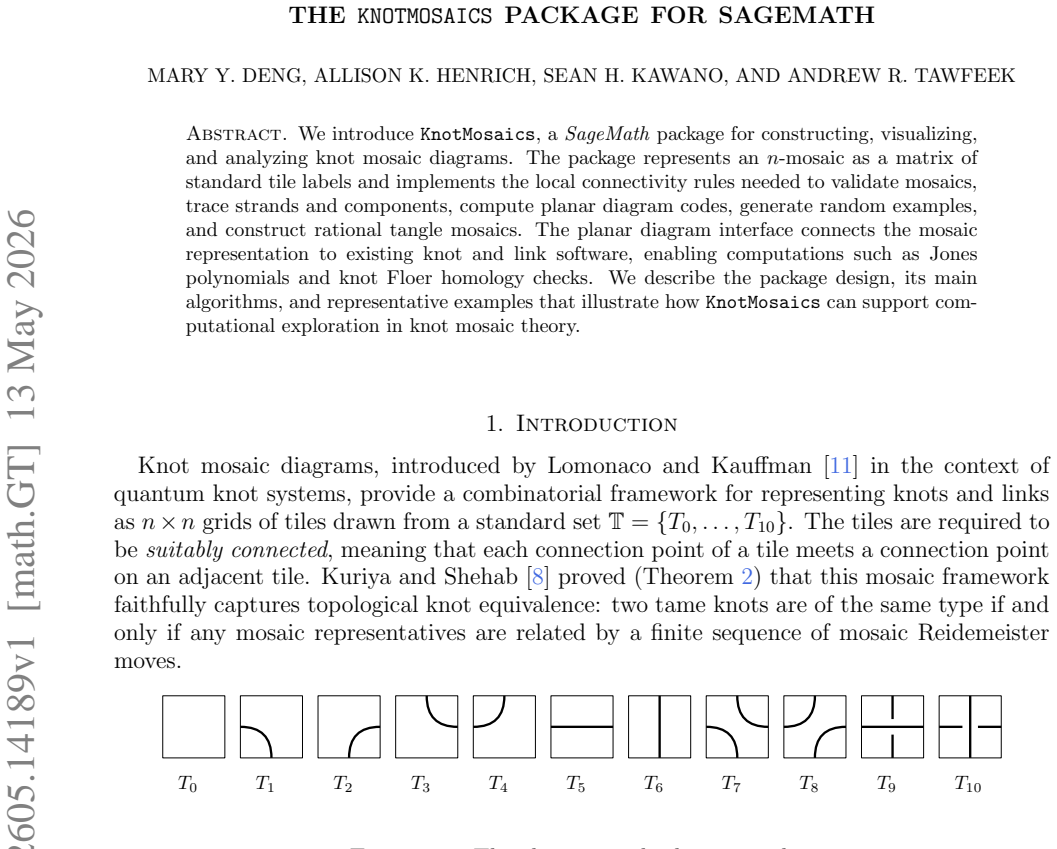
The package implements knot mosaics by representing an n-mosaic as a matrix of standard tile labels and enforcing the local connectivity rules needed to validate mosaics, trace strands and components, compute planar diagram codes, generate random examples, and construct rational tangle mosaics. This representation connects directly to existing knot and link software in SageMath, enabling further computations such as Jones polynomials and knot Floer homology checks.
What carries the argument
Matrix of standard tile labels for an n-mosaic together with the local connectivity rules that validate the diagram and permit strand tracing and component identification.
If this is right
- Random examples of knot mosaics can be generated automatically for further study.
- Rational tangle mosaics can be constructed using the package's dedicated routines.
- Planar diagram codes derived from mosaics enable direct computation of knot invariants such as the Jones polynomial.
- Knot Floer homology checks become available for links obtained from mosaic diagrams.
Where Pith is reading between the lines
- The package could support systematic enumeration of all valid mosaics up to small sizes.
- Users might apply it to test conjectures on the mosaic number of specific knots through computation.
- Integration with SageMath could encourage more researchers to run experiments on mosaic representations rather than hand-drawn diagrams.
Load-bearing premise
The chosen tile labels and local connectivity rules correctly reproduce the standard mathematical definition of knot mosaics.
What would settle it
A concrete mosaic diagram that the package accepts as valid but which fails to satisfy the connectivity conditions in the established knot mosaic literature, or vice versa.
Figures


read the original abstract
We introduce KnotMosaics, a SageMath package for constructing, visualizing, and analyzing knot mosaic diagrams. The package represents an n-mosaic as a matrix of standard tile labels and implements the local connectivity rules needed to validate mosaics, trace strands and components, compute planar diagram codes, generate random examples, and construct rational tangle mosaics. The planar diagram interface connects the mosaic representation to existing knot and link software, enabling computations such as Jones polynomials and knot Floer homology checks. We describe the package design, its main algorithms, and representative examples that illustrate how KnotMosaics can support computational exploration in knot mosaic theory.
Editorial analysis
A structured set of objections, weighed in public.
Referee Report
Summary. The paper introduces the KnotMosaics package for SageMath. It represents an n-mosaic as a matrix of standard tile labels and implements the local connectivity rules needed to validate mosaics, trace strands and components, compute planar diagram codes, generate random examples, and construct rational tangle mosaics. The planar diagram interface connects the mosaic representation to existing knot and link software, enabling computations such as Jones polynomials and knot Floer homology checks. The manuscript describes the package design, its main algorithms, and representative examples.
Significance. If the implementation faithfully matches the standard mosaic definitions in the literature, the package provides a useful computational tool for knot mosaic theory. It bridges mosaic diagrams with established invariant calculators in SageMath, supporting exploration, verification, and potentially new computational experiments in the field. The representative examples serve as an empirical check on core operations.
major comments (2)
- §3 (Main algorithms): The local connectivity rules and strand-tracing procedure are described at a high level without explicit enumeration or pseudocode. Since these rules are load-bearing for the claim of faithful reproduction of the mathematical definition, they should be listed in full or directly referenced to the literature so readers can verify correctness independently of the source code.
- §4 (Examples): The random-mosaic and rational-tangle examples illustrate functionality but do not report a side-by-side comparison of an invariant (e.g., Jones polynomial) computed from the mosaic PD code versus the same knot given by a standard diagram; such a check would directly test the end-to-end correctness of the PD-code extraction step.
minor comments (3)
- Abstract and §2: The phrase 'knot Floer homology checks' should specify the exact SageMath or external routine used, as the interface is a key claimed feature.
- References: Add citations to the foundational mosaic literature (e.g., the original tile-set definitions) so the chosen labels and rules can be cross-checked against the source definitions.
- Installation and reproducibility: Include a direct link to the package repository or a one-line installation command; this is standard for software papers and aids immediate testing.
Simulated Author's Rebuttal
We thank the referee for their careful reading and constructive comments on the manuscript. We address each major comment below.
read point-by-point responses
-
Referee: §3 (Main algorithms): The local connectivity rules and strand-tracing procedure are described at a high level without explicit enumeration or pseudocode. Since these rules are load-bearing for the claim of faithful reproduction of the mathematical definition, they should be listed in full or directly referenced to the literature so readers can verify correctness independently of the source code.
Authors: We agree that greater explicitness would strengthen verifiability. In the revised manuscript we will add a complete enumeration of the local connectivity rules (following the standard mosaic definitions) together with pseudocode for the strand-tracing procedure in §3, allowing readers to check correctness without inspecting the source code. revision: yes
-
Referee: §4 (Examples): The random-mosaic and rational-tangle examples illustrate functionality but do not report a side-by-side comparison of an invariant (e.g., Jones polynomial) computed from the mosaic PD code versus the same knot given by a standard diagram; such a check would directly test the end-to-end correctness of the PD-code extraction step.
Authors: We accept this suggestion as a useful empirical check. The revised §4 will include a side-by-side comparison of invariants (e.g., Jones polynomial) obtained from the mosaic-derived PD codes against the same knots presented by standard diagrams. revision: yes
Circularity Check
No significant circularity
full rationale
The paper describes a software package implementing the standard n-mosaic definition (matrix of tile labels plus local connectivity rules) taken directly from the existing literature, along with standard operations such as strand tracing, PD-code extraction, and rational tangle construction. No new mathematical derivations, fitted parameters, predictions, or self-referential claims are asserted; correctness reduces to faithful encoding of external definitions, which is checked via representative examples and interfaces to existing knot software. The derivation chain is therefore self-contained with no reductions to the package's own inputs.
Axiom & Free-Parameter Ledger
axioms (1)
- domain assumption Standard tile labels and local connectivity rules for knot mosaics as defined in the knot theory literature
Reference graph
Works this paper leans on
-
[1]
J. Alan Alewine, H. A. Dye, David Etheridge, Irina Gardu˜ no, and Amber Ramos. “Bounds on mosaic knots”. In:Pi Mu Epsilon J.14.1 (2014), pp. 1–8.issn: 0031-952X
work page 2014
-
[2]
On upper bounds for toroidal mosaic numbers
Michael Carlisle and Michael S Laufer. “On upper bounds for toroidal mosaic numbers”. In:Quantum information processing12.9 (2013), pp. 2935–2945
work page 2013
-
[3]
An Enumeration of Knots and Links, and Some of Their Algebraic Properties
John H. Conway. “An Enumeration of Knots and Links, and Some of Their Algebraic Properties”. In:Computational Problems in Abstract Algebra. Ed. by John Leech. Ox- ford: Pergamon Press, 1970, pp. 329–358.doi:10.1016/B978-0-08-012975-4.50034- 5
-
[4]
Taming Wild Knots with Recursive Mosaics
Mary Deng, Allison Henrich, Sean Kawano, and Andrew Tawfeek. “Taming Wild Knots with Recursive Mosaics”. In preparation. 2025
work page 2025
-
[5]
Sandy Ganzell and Allison Henrich. “Virtual mosaic knot theory”. In:Journal of Knot Theory and Its Ramifications29.14 (2020), p. 2050091
work page 2020
-
[6]
Tabulating knot mosaics: crossing number 10 or less
Aaron Heap, Douglas Baldwin, James Canning, and Greg Vinal. “Tabulating knot mosaics: crossing number 10 or less”. In:Involve18.1 (2025), pp. 91–104.doi:10 . 2140/involve.2025.18.91
work page 2025
-
[7]
Tile number and space-efficient knot mosaics
Aaron Heap and Douglas Knowles. “Tile number and space-efficient knot mosaics”. In: Journal of Knot Theory and Its Ramifications27.06 (2018), p. 1850041
work page 2018
-
[8]
The Lomonaco-Kauffman Conjecture
Takahito Kuriya and Omar Shehab. “The Lomonaco-Kauffman Conjecture”. In:Jour- nal of Knot Theory and Its Ramifications23.1 (2014), p. 1450003.doi:10 . 1142 / S0218216514500035
work page 2014
-
[9]
Hwa Jeong Lee, Kyungpyo Hong, Ho Lee, and Seungsang Oh. “Mosaic number of knots”. In:J. Knot Theory Ramifications23.13 (2014), pp. 1450069, 8.issn: 0218- 2165.doi:10 . 1142 / S0218216514500692.url:https : / / doi . org / 10 . 1142 / S0218216514500692
work page 2014
-
[10]
Hwa Jeong Lee, Lewis Ludwig, Joseph Paat, and Amanda Peiffer. “Knot mosaic tab- ulation”. In:Involve11.1 (2018), pp. 13–26.issn: 1944-4176.url:https://doi.org/ 10.2140/involve.2018.11.13
-
[11]
Samuel J Lomonaco and Louis H Kauffman. “Quantum knots and mosaics”. In:Quan- tum Information Processing7 (2008), pp. 85–115
work page 2008
-
[12]
An infinite family of knots whose mosaic number is realized in non-reduced projections
Lewis D. Ludwig, Erica L. Evans, and Joseph S. Paat. “An infinite family of knots whose mosaic number is realized in non-reduced projections”. In:J. Knot Theory Ramifica- tions22.7 (2013), pp. 1350036, 11.issn: 0218-2165.url:https://doi.org/10.1142/ S0218216513500363
work page 2013
-
[13]
Quantum knot mosaics and the growth constant
Seungsang Oh. “Quantum knot mosaics and the growth constant”. In:Topology and its Applications210 (2016), pp. 311–316. 12 REFERENCES
work page 2016
-
[14]
Quantum knots and the number of knot mosaics
Seungsang Oh, Kyungpyo Hong, Ho Lee, and Hwa Jeong Lee. “Quantum knots and the number of knot mosaics”. In:Quantum Inf. Process.14.3 (2015), pp. 801–811.issn: 1570-0755.doi:10.1007/s11128- 014- 0895- 7.url:https://doi.org/10.1007/ s11128-014-0895-7
-
[15]
Holomorphic disks and genus bounds
Peter Ozsv´ ath and Zolt´ an Szab´ o. “Holomorphic disks and genus bounds”. In:Geometry & Topology8 (2004), pp. 311–334.doi:10.2140/gt.2004.8.311
-
[16]
The Sage Developers.SageMath, the Sage Mathematics Software System (Version 10.4).https://www.sagemath.org. 2024. (M. Y. Deng)Dept. of Mathematics, University of W ashington, Seattle, W A 98195, USA Email address:marydeng@uw.edu (A. K. Henrich)Mathematics Department, Seattle University, Seattle, W A 98122, USA Email address:henricha@seattleu.edu URL:https...
work page 2024
discussion (0)
Sign in with ORCID, Apple, or X to comment. Anyone can read and Pith papers without signing in.