A Class of Higher-Order INAR Random Fields for Poisson Counts and Beyond
Pith reviewed 2026-06-30 20:14 UTC · model grok-4.3
The pith
Combined INAR models allow any discrete self-decomposable marginal distribution while retaining classical autoregressive dependence for count random fields.
A machine-rendered reading of the paper's core claim, the machinery that carries it, and where it could break.
Core claim
The CINAR construction combines the autoregressive thinning mechanism with an independent innovation process such that the stationary marginal remains any chosen discrete self-decomposable distribution and the conditional probability mass function retains a simple explicit form, removing the characterization barriers of earlier INAR random-field models.
What carries the argument
The CINAR construction, which merges autoregressive thinning with an independent innovation process to enforce a target discrete self-decomposable marginal.
If this is right
- Conditional probabilities admit an explicit formula usable directly in likelihood or composite-likelihood estimation.
- Random fields can be equipped with Poisson, negative-binomial, or other discrete self-decomposable marginals without altering the autoregressive dependence structure.
- Higher-order and multivariate extensions remain feasible under the same preservation property.
- Parameter estimation routines developed for the model class apply uniformly across the allowable marginal families.
Where Pith is reading between the lines
- The same preservation property may simplify specification of spatial dependence in lattice count data beyond the agricultural example.
- Overdispersion can be controlled directly through the marginal choice rather than through the dependence parameters.
- The construction suggests a route to non-stationary versions in which the marginal law stays fixed while the autoregressive coefficients vary with location or time.
Load-bearing premise
Merging the autoregressive thinning operator with an independent innovation process preserves both the chosen discrete self-decomposable marginal and the simple conditional probability expression.
What would settle it
A Monte Carlo simulation of a CINAR process with a Poisson marginal in which the long-run empirical distribution deviates from Poisson or the computed conditional probabilities fail to match the derived closed-form expression.
Figures
read the original abstract
Existing integer-valued autoregressive (INAR) models for count random fields suffer from difficulties in characterizing the stationary marginal distribution and in computing conditional probabilities (as required for likelihood inference). To overcome these drawbacks, the novel class of combined INAR (CINAR) models is proposed, which both exhibits the classical autoregressive dependence structure and allows to specify the marginal distribution within the wide class of discrete self-decomposable distributions. In particular, CINAR random fields can be equipped with a Poisson or negative-binomial marginal distribution. The CINAR's key stochastic properties are derived (including a simple expression for conditional probabilities), and special cases as well as possible extensions are discussed. Approaches for parameter estimation are developed and investigated, and the practical relevance of the novel CINAR family is demonstrated by an agricultural data application.
Editorial analysis
A structured set of objections, weighed in public.
Referee Report
Summary. The manuscript proposes a novel class of combined integer-valued autoregressive (CINAR) random fields. By combining the autoregressive thinning operator with an independent innovation process drawn from a discrete self-decomposable distribution, the models retain the classical autoregressive dependence structure while permitting the stationary marginal to be any member of the discrete self-decomposable class (in particular Poisson or negative binomial). The paper derives the key stochastic properties, including an explicit simple form for the conditional probabilities, discusses special cases and extensions, develops estimation procedures, and illustrates the approach on agricultural count data.
Significance. If the preservation of both the target marginal and the simple conditional-probability representation holds after the combination step, the construction removes two long-standing obstacles in INAR modeling of random fields and supplies a flexible, likelihood-friendly framework for spatial count data. The explicit derivation of stochastic properties, the development of estimation methods, and the real-data demonstration constitute concrete strengths.
minor comments (3)
- [Introduction] The abstract states that CINAR random fields 'exhibit the classical autoregressive dependence structure'; an explicit statement of the precise dependence order (first-order versus higher-order) and the lattice dimension should appear in the first paragraph of the introduction to match the title.
- [Model definition and properties] The claim that the conditional probability expression remains simple for arbitrary discrete self-decomposable innovations is central; placing the explicit formula (rather than only a verbal description) immediately after the model definition would improve readability.
- [Estimation] In the estimation section, the simulation study should report coverage probabilities or interval lengths for the marginal parameters in addition to point-estimate bias, to confirm that the marginal specification is recovered reliably.
Simulated Author's Rebuttal
We thank the referee for the positive summary, significance assessment, and recommendation of minor revision. The report does not list any specific major comments.
Circularity Check
No significant circularity detected
full rationale
The paper's central construction combines the standard INAR thinning operator with an independent innovation term to extend the model to random fields while preserving any discrete self-decomposable marginal. This rests on the external, pre-existing definition and representation properties of discrete self-decomposability rather than on any equation or parameter fitted inside the present work. No derivation step equates a claimed prediction to a fitted input by construction, and no load-bearing uniqueness claim is imported solely via self-citation. The derivation chain therefore remains self-contained against external benchmarks.
Axiom & Free-Parameter Ledger
axioms (1)
- domain assumption Discrete self-decomposable distributions remain closed under the CINAR combination of autoregressive thinning and independent innovation.
Reference graph
Works this paper leans on
-
[1]
doi: 10.1007/s00184-023-00934-0. Abdulhamid A. Alzaid and Mohamed A. Al-Osh. An integer-valued pth-order autoregressive structure (INAR(p)) process.Journal of Applied Probability, 27(2):314–324,
-
[2]
Sabyasachi Basu and Gregory C Reinsel
doi: 10.2307/3214650. Sabyasachi Basu and Gregory C Reinsel. Properties of the spatial unilateral first-order ARMA model.Advances in Applied Probability, 25(3): 631–648,
-
[3]
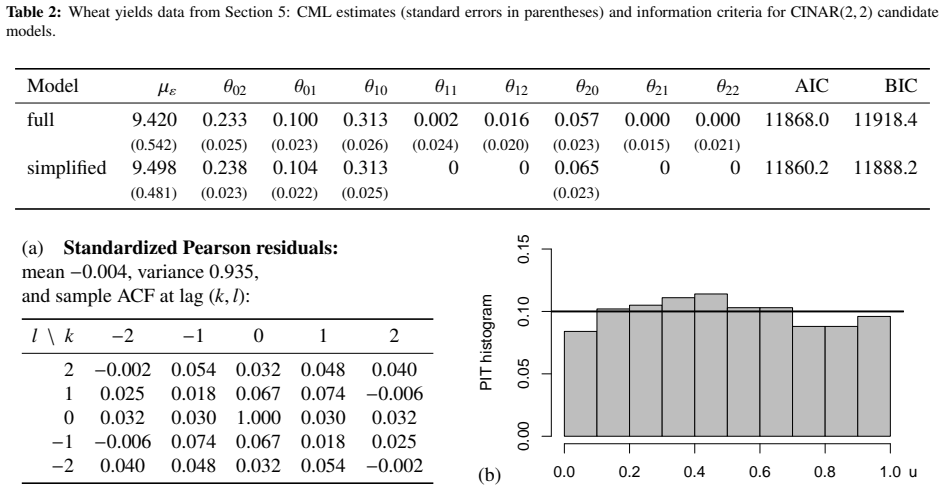
doi: 10.2307/1427527. 15 Table 2:Wheat yields data from Section 5: CML estimates (standard errors in parentheses) and information criteria for CINAR(2,2) candidate models. Modelµ ε θ02 θ01 θ10 θ11 θ12 θ20 θ21 θ22 AIC BIC full 9.420 0.233 0.100 0.313 0.002 0.016 0.057 0.000 0.000 11868.0 11918.4 (0.542) (0.025) (0.023) (0.026) (0.024) (0.020) (0.023) (0.01...
-
[4]
Patrick Billingsley.Probability and Measure
doi: 10.1111/j.2517-6161.1974.tb00999.x. Patrick Billingsley.Probability and Measure. John Wiley & Sons, Ltd, 3rd ed edition,
-
[5]
doi: 10.2436/20.8080.02.110. Jin-Guan Du and Yuan Li. The integer-valued autoregressive (INAR(p)) model.Journal of Time Series Analysis, 12(2):129–142,
-
[6]
doi: 10.1111/j.1467-9892.1991.tb00073.x. Alireza Ghodsi. Conditional maximum likelihood estimation of the first-order spatial integer-valued autoregressive (SINAR(1, 1)) model.Journal of the Iranian Statistical Society, 14(2):15–36,
-
[7]
doi: 10.7508/jirss.2015.02.002. Alireza Ghodsi and Hassan S. Bakouch. Spatial INAR(1,1) model based on mixing Pegram and binomial thinning operators with fitting striga counts.Communications in Statistics - Theory and Methods, 54(21):6988–6996,
-
[8]
Alireza Ghodsi, Mahendran Shitan, and Hassan S Bakouch
doi: 10.1080/03610926.2025.2465647. Alireza Ghodsi, Mahendran Shitan, and Hassan S Bakouch. A first-order spatial integer-valued autoregressive SINAR(1,
-
[9]
doi: 10.1080/03610926.2011.560739. Alireza Ghodsi, Hassan S. Bakouch, and Mahendran Shitan. First-order spatial dependent count integer-valued autoregressive (Sp-DCINAR(1,1)) process.Communications in Statistics - Simulation and Computation, 53(12):6050–6060,
-
[10]
doi: 10.1080/03610918.2023.2234681. Stephanie Glaser. A review of spatial econometric models for count data. Hohenheim Discussion Papers in Business, Economics and Social Sciences 19-2017, Universit ¨at Hohenheim, Fakult ¨at Wirtschafts- und Sozialwissenschaften, Stuttgart,
-
[11]
doi: 10.2307/622202. P. V . Krishna Iyer. Studies with wheat uniformity trial data. I. Size and shape of experimental plots and the relative efficiency of different layouts. The Indian Journal of Agricultural Science, 12(1):240–262,
- [12]
-
[13]
Gilberto Pereira Sassi and Carolina Costa Mota Para ´ıba
doi: 10.1111/stan.12298. Gilberto Pereira Sassi and Carolina Costa Mota Para ´ıba. Conditional least squares estimation for the SINAR(1,
-
[14]
Angelika Silbernagel and Christian H Weiß
doi: 10.1080/03610918.2020.1871489. Angelika Silbernagel and Christian H Weiß. The autocorrelation structure of integer-valued autoregressive random fields.Statistics&Probability Letters, 233:110681, 2026a. doi: 10.1016/j.spl.2026.110681. Angelika Silbernagel and Christian H Weiß. The integer-valued moving-average random field.Preprint, 2026b. URLhttps://...
-
[15]
doi: 10.1080/03610918.2022.2083164. Christian H Weiß. Thinning operations for modeling time series of counts–a survey.AStA Advances in Statistical Analysis, 92(3):319–341, 2008a. doi: 10.1007/s10182-008-0072-3. Christian H Weiß. The combined INAR(p) models for time series of counts.Statistics&Probability Letters, 78(13):1817–1822, 2008b. doi: 10.1016/j.sp...
-
[16]
Christian H Weiß.An Introduction to Discrete-Valued Time Series
doi: 10.1080/03610920802233937. Christian H Weiß.An Introduction to Discrete-Valued Time Series. John Wiley & Sons, Ltd, 1st ed edition,
-
[17]
doi: 10.1007/s11749-025-00994-6. P. Whittle. On stationary processes in the plane.Biometrika, 41(3–4):434–449,
-
[18]
Kai Yang, Mingming Jia, and Xiaogang Dong
doi: 10.1093/biomet/41.3-4.434. Kai Yang, Mingming Jia, and Xiaogang Dong. An integer-valued spatial autoregressive model with application to covid-19 counts.Journal of Applied Statistics, 0(0):1–33,
-
[19]
doi: 10.1080/02664763.2025.2565593. Rong Zhu and Harry Joe. A new type of discrete self-decomposability and its application to continuous-time Markov processes for modeling count data time series.Stochastic Models, 19(2):235–254,
-
[20]
doi: 10.1081/STM-120020388. Rong Zhu and Harry Joe. Modelling count data time series with Markov processes based on binomial thinning.Journal of Time Series Analysis, 27(5):725–738,
-
[21]
doi: 10.1111/j.1467-9892.2006.00485.x. Appendix A. Derivations Appendix A.1. Proof of Proposition 2.1.1 LetZ(s,t) denote all Bernoulli counting series involved inX s,t at “time” (s,t). From the model recursion in (4), we see thatX s,t can be understood as a function of (Ds,t, εs,t,Z(s,t)). Hence, we may write σ(Xs,t,X s−1,t,X s,t−1, . . .)⊆σ Ds,t, εs,t,Z(...
discussion (0)
Sign in with ORCID, Apple, or X to comment. Anyone can read and Pith papers without signing in.