Few-Attosecond electron pulse trains with tunable periods produced by two counter-propagating lasers
Pith reviewed 2026-06-30 19:41 UTC · model grok-4.3
The pith
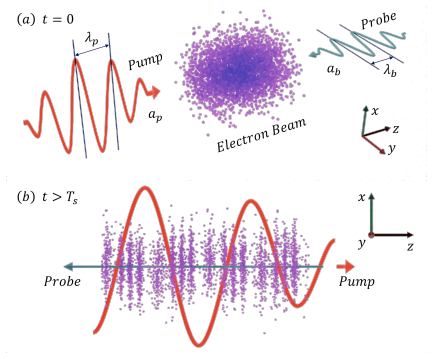
Two counter-propagating lasers create a stable parametric resonance that modulates electrons into periodic few-attosecond pulse trains while extending focal length by three orders of magnitude.
A machine-rendered reading of the paper's core claim, the machinery that carries it, and where it could break.
Core claim
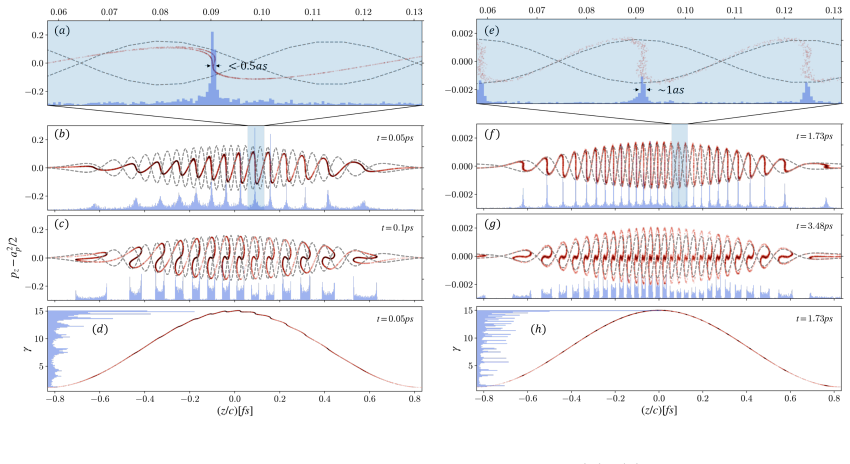
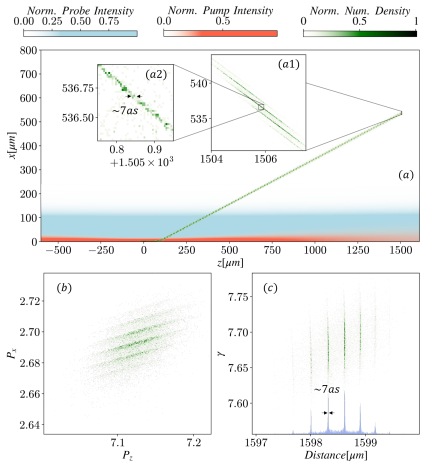
Contrary to established models of ponderomotive forces and stochastic acceleration in dual-laser fields, a specific parametric resonance condition permits the electron beam to be stably modulated into highly periodic attosecond trains with rapid energy gain. Using a sub-relativistic electron beam, simulations confirm the generation of ~1 as pulses with a Lorentz factor up to 15 and a relative energy spread below 0.02%, extending the focal length by three orders of magnitude compared with conventional approaches.
What carries the argument
The parametric resonance condition in the combined fields of two counter-propagating lasers, which stabilizes periodic modulation of the electron beam instead of driving stochastic acceleration.
If this is right
- Electron pulses reach durations of approximately 1 attosecond with Lorentz factors up to 15.
- Relative energy spread remains below 0.02 percent during the modulation process.
- Longitudinal focal length increases by three orders of magnitude relative to standard schemes.
- The transition from ordered modulation to stochastic acceleration occurs at a well-defined point in parameter space.
- Pulse periods remain tunable through adjustment of the laser and beam parameters.
Where Pith is reading between the lines
- The resonance condition might be combined with existing linear accelerators to produce attosecond bunches without new hardware.
- Similar dual-laser geometries could be tested in other plasma or vacuum environments to check if the stable regime persists at higher energies.
- Measuring the energy spectrum and temporal structure after propagation over extended distances would directly test the focal-length claim.
- The identified transition point offers a control knob for switching between periodic and chaotic electron acceleration regimes.
Load-bearing premise
The simulations accurately capture the transition from ordered modulation to stochastic acceleration and confirm the stable parametric resonance regime holds without unaccounted physical effects or post-hoc parameter tuning.
What would settle it
An experiment with a sub-relativistic electron beam and two counter-propagating lasers that shows either loss of pulse periodicity or focal lengths no longer than conventional methods by more than a factor of ten.
Figures
read the original abstract
Attosecond electron pulses enable real-time probing of ultrafast matter dynamics, yet conventional modulation schemes suffer from drastically shortened longitudinal focal lengths when targeting sub-attosecond durations. To address this bottleneck, we propose and demonstrate a compact scheme utilizing two counter-propagating lasers that reveals a previously unidentified stable modulation regime. Contrary to established models of ponderomotive forces and stochastic acceleration in dual-laser fields, we show that a specific parametric resonance condition permits the electron beam to be stably modulated into highly periodic attosecond trains with rapid energy gain. Using a sub-relativistic electron beam, simulations confirm the generation of ~1 as pulses with a Lorentz factor up to 15 and a relative energy spread below 0.02%, extending the focal length by three orders of magnitude compared with conventional approaches. This work identifies the critical transition from ordered modulation to stochastic acceleration, offering a viable route to overcoming the focal-length barrier in attosecond electron-pulse applications.
Editorial analysis
A structured set of objections, weighed in public.
Referee Report
Summary. The manuscript proposes a compact scheme using two counter-propagating lasers to generate few-attosecond electron pulse trains with tunable periods. It identifies a stable parametric resonance condition that allows the electron beam to be stably modulated into highly periodic attosecond trains with rapid energy gain, contrary to established models of ponderomotive forces and stochastic acceleration. Using a sub-relativistic electron beam, simulations are claimed to confirm the generation of ~1 as pulses with a Lorentz factor up to 15, relative energy spread below 0.02%, and focal length extended by three orders of magnitude compared with conventional approaches.
Significance. If the reported simulation outcomes hold and the identified parametric resonance regime is robust without unaccounted physical effects, this would address a key bottleneck in attosecond electron pulse generation by extending the longitudinal focal length while maintaining low energy spread and high periodicity, offering a viable route for applications in probing ultrafast matter dynamics.
major comments (1)
- The central claim that simulations confirm the performance metrics (~1 as pulses, Lorentz factor up to 15, relative energy spread below 0.02%) and the transition from ordered modulation to stochastic acceleration rests on unspecified simulations with no visible derivation, parameter values, numerical methods, validation, or error analysis (as noted in the abstract description of results). This is load-bearing for the assertion that the parametric resonance permits stable modulation.
minor comments (1)
- The abstract would benefit from a brief explicit reference or comparison to the 'established models of ponderomotive forces and stochastic acceleration in dual-laser fields' mentioned as being contradicted.
Simulated Author's Rebuttal
We thank the referee for their review and for highlighting the need for explicit simulation details to support the central claims. We agree this is essential and will revise the manuscript accordingly to include full numerical methods, parameters, validation, and error analysis.
read point-by-point responses
-
Referee: The central claim that simulations confirm the performance metrics (~1 as pulses, Lorentz factor up to 15, relative energy spread below 0.02%) and the transition from ordered modulation to stochastic acceleration rests on unspecified simulations with no visible derivation, parameter values, numerical methods, validation, or error analysis (as noted in the abstract description of results). This is load-bearing for the assertion that the parametric resonance permits stable modulation.
Authors: We agree that the simulation details must be fully specified to substantiate the performance metrics and the identified transition to stochastic acceleration. In the revised manuscript we will add a dedicated Methods section (and expand the main text) that reports: (i) the full set of laser and beam parameters (wavelengths, intensities, pulse durations, initial electron energy and emittance), (ii) the numerical scheme (particle-in-cell code, grid resolution, particle number, time step), (iii) convergence and validation tests against known ponderomotive and stochastic-acceleration limits, and (iv) quantitative error estimates on the reported pulse duration, Lorentz factor, and energy spread. These additions will make the evidence for the parametric-resonance regime explicit and reproducible. revision: yes
Circularity Check
No significant circularity detected
full rationale
The paper's central claim is a simulation-demonstrated parametric resonance regime in counter-propagating lasers that produces stable attosecond electron pulse trains. The abstract and description frame results as outcomes of numerical simulations distinguishing ordered modulation from stochastic acceleration, with no equations, self-definitional relations, fitted parameters renamed as predictions, or load-bearing self-citations presented. The derivation chain is self-contained against external benchmarks (simulation verification of physical regimes) and does not reduce any result to its inputs by construction.
Axiom & Free-Parameter Ledger
Reference graph
Works this paper leans on
-
[1]
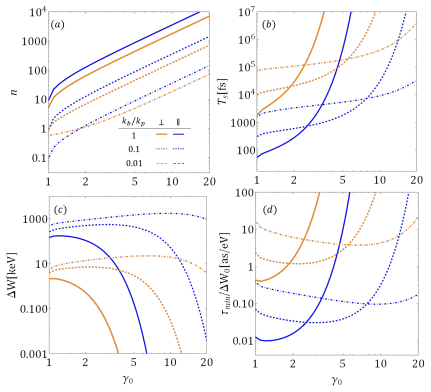
The parameter dependence predicted by the analytical model is illustrated in Fig
and possesses an initial energy spread ∆W 0. The parameter dependence predicted by the analytical model is illustrated in Fig. 2, which shows hown,T s, ∆W, andτ min vary with the probe wavenumberk b and the initial 5 FIG. 2. The variation of the resonance ordern, characteristic formation timeT s, energy modulation ∆W, and minimum pulse durationτ min with ...
-
[2]
Krausz and M
F. Krausz and M. Ivanov, Attosecond physics, Rev. Mod. Phys.81, 163 (2009)
2009
-
[3]
Borrego-Varillas, M
R. Borrego-Varillas, M. Lucchini, and M. Nisoli, Attosecond spectroscopy for the investigation of ultrafast dynamics in atomic, molecular and solid-state physics, Reports on Progress in Physics85, 66401 (2022)
2022
-
[4]
M. Kretschmar, E. Svirplys, M. Volkov, T. Witting, T. Nagy, M. J. J. Vrakking, and B. Sch¨ utte, Compact realization of all-attosecond pump-probe spectroscopy, Science Advances 11 10, 10.1126/sciadv.adk9605 (2024)
-
[5]
Liang, M
J. Liang, M. Han, Y. Liao, J.-b. Ji, C. S. Leung, W.-C. Jiang, K. Ueda, Y. Zhou, P. Lu, and H. J. W¨ orner, Attosecond-resolved non-dipole photoionization dynamics, Nature Photonics 18, 311 (2024)
2024
-
[6]
A. H. Zewail, Four-dimensional electron microscopy, Science328, 187 (2010)
2010
-
[7]
F. J. Garc´ ıa de Abajo, A. Polman, C. I. Velasco, M. Kociak, L. H. G. Tizei, O. St´ ephan, S. Meuret, T. Sannomiya, K. Akiba, Y. Auad, A. Feist, C. Ropers, P. Baum, J. H. Gaida, M. Sivis, H. Louren¸ co-Martins, L. Serafini, J. Verbeeck, A. Koneˇ cn´ a, N. Talebi, B. M. Ferrari, C. J. R. Duncan, M. G. Bravi, I. Ostroman, G. M. Vanacore, E. Nussinson, R. R...
2025
-
[8]
J. H. Gaida, H. Louren¸ co-Martins, M. Sivis, T. Rittmann, A. Feist, F. J. Garc´ ıa de Abajo, and C. Ropers, Attosecond electron microscopy by free-electron homodyne detection, Nature Photonics18, 509 (2024)
2024
-
[9]
D. Hui, H. Alqattan, M. Sennary, N. V. Golubev, and M. T. Hassan, Attosecond electron microscopy and diffraction, Science Advances10, eadp5805 (2024)
2024
-
[10]
Nisoli, P
M. Nisoli, P. Decleva, F. Calegari, A. Palacios, and F. Mart´ ın, Attosecond electron dynamics in molecules, Chemical Reviews117, 10760 (2017)
2017
-
[11]
Z. Liu, F. Wang, X. Sheng, J. Wang, L. Jiang, and Z. Wei, Ultrafast response of cubic silicon carbide to intense attosecond pulse light, Physical Review B104, 10.1103/phys- revb.104.064103 (2021)
-
[12]
D. Hui, H. Alqattan, S. Yamada, V. Pervak, K. Yabana, and M. T. Hassan, Attosecond electron motion control in dielectric, Nature Photonics16, 33 (2022)
2022
-
[13]
D. Jeong, T. R. Hopper, Y. Kim, X. Shen, P. L. Kramer, M. C. Hoffmann, R. Coffee, M. Fejer, A. M. Lindenberg, and C. S. Levin, Strong ultrafast nonlinear optical response from megaelec- tronvolt electrons in semiconductors, Nature Photonics 10.1038/s41566-026-01894-3 (2026)
-
[14]
K. E. Priebe, C. Rathje, S. V. Yalunin, T. Hohage, A. Feist, S. Sch¨ afer, and C. Ropers, Attosecond electron pulse trains and quantum state reconstruction in ultrafast transmission electron microscopy, Nature Photonics11, 793 (2017). 12
2017
-
[15]
Morimoto, Attosecond electron-beam technology: a review of recent progress, Microscopy 72, 2 (2022)
Y. Morimoto, Attosecond electron-beam technology: a review of recent progress, Microscopy 72, 2 (2022)
2022
-
[16]
Ruimy, A
R. Ruimy, A. Karnieli, and I. Kaminer, Free-electron quantum optics, Nature Physics21, 193 (2025)
2025
-
[17]
Dromey, S
B. Dromey, S. Rykovanov, M. Yeung, R. H¨ orlein, D. Jung, D. C. Gautier, T. Dzelzainis, D. Kiefer, S. Palaniyppan, R. Shah, J. Schreiber, H. Ruhl, J. C. Fernandez, C. L. S. Lewis, M. Zepf, and B. M. Hegelich, Coherent synchrotron emission from electron nanobunches formed in relativistic laser–plasma interactions, Nature Physics8, 804 (2012)
2012
-
[18]
I. Y. Dodin and N. J. Fisch, Stochastic extraction of periodic attosecond bunches from rela- tivistic electron beams, Phys. Rev. Lett.98, 234801 (2007)
2007
-
[19]
Baum and A
P. Baum and A. H. Zewail, Attosecond electron pulses for 4d diffraction and microscopy, Proceedings of the National Academy of Sciences104, 18409 (2007)
2007
-
[20]
Koz´ ak, N
M. Koz´ ak, N. Sch¨ onenberger, and P. Hommelhoff, Ponderomotive generation and detection of attosecond free-electron pulse trains, Phys. Rev. Lett.120, 103203 (2018)
2018
-
[21]
Koz´ ak, T
M. Koz´ ak, T. Eckstein, N. Sch¨ onenberger, and P. Hommelhoff, Inelastic ponderomotive scat- tering of electrons at a high-intensity optical travelling wave in vacuum, Nature Physics14, 121 (2018)
2018
-
[22]
Nabben, J
D. Nabben, J. Kuttruff, L. Stolz, A. Ryabov, and P. Baum, Attosecond electron microscopy of sub-cycle optical dynamics, Nature619, 63 (2023)
2023
-
[23]
Morimoto and P
Y. Morimoto and P. Baum, Diffraction and microscopy with attosecond electron pulse trains, Nature Physics14, 252 (2018)
2018
-
[24]
D. S. Black, U. Niedermayer, Y. Miao, Z. Zhao, O. Solgaard, R. L. Byer, and K. J. Leedle, Net acceleration and direct measurement of attosecond electron pulses in a silicon dielectric laser accelerator, Phys. Rev. Lett.123, 264802 (2019)
2019
-
[25]
Sch¨ onenberger, A
N. Sch¨ onenberger, A. Mittelbach, P. Yousefi, J. McNeur, U. Niedermayer, and P. Hommel- hoff, Generation and characterization of attosecond microbunched electron pulse trains via dielectric laser acceleration, Phys. Rev. Lett.123, 264803 (2019)
2019
-
[26]
Z. Li, Y. Leng, and R. Li, Further development of the short-pulse petawatt laser: Trends, technologies, and bottlenecks, Laser & Photonics Reviews17, 2100705 (2023)
2023
-
[27]
C. N. Danson, C. Haefner, J. Bromage, T. Butcher, J.-C. F. Chanteloup, E. A. Chowdhury, A. Galvanauskas, L. A. Gizzi, J. Hein, D. I. Hillier, and et al., Petawatt and exawatt class 13 lasers worldwide, High Power Laser Science and Engineering7, e54 (2019)
2019
-
[28]
Sheng, K
Z.-M. Sheng, K. Mima, Y. Sentoku, M. S. Jovanovi´ c, T. Taguchi, J. Zhang, and J. Meyer-ter Vehn, Stochastic heating and acceleration of electrons in colliding laser fields in plasma, Phys. Rev. Lett.88, 055004 (2002)
2002
-
[29]
Y. Zhang and S. Krasheninnikov, Electron dynamics in counter-propagating laser waves (2019), arXiv:1907.05539 [physics.plasm-ph]
-
[30]
Arefiev, A
A. Arefiev, A. Robinson, and V. Khudik, Novel aspects of direct laser acceleration of relativistic electrons, Journal of Plasma Physics81, 475810404 (2015)
2015
-
[31]
Fossen and H
T. Fossen and H. Nijmeijer,Parametric resonance in dynamical systems(Springer Science & Business Media, 2011)
2011
-
[32]
W. E. King, G. H. Campbell, A. Frank, B. Reed, J. F. Schmerge, B. J. Siwick, B. C. Stuart, and P. M. Weber, Ultrafast electron microscopy in materials science, biology, and chem- istry, Journal of Applied Physics97, 111101 (2005), https://pubs.aip.org/aip/jap/article- pdf/doi/10.1063/1.1927699/14936228/111101 1 online.pdf
-
[33]
LaGrange, P
T. LaGrange, P. Cattaneo, B. Barwick, D. J. Flannigan, J. Weissenrieder, and F. Carbone, Laser-driven ultrafast transmission electron microscopy, Nature Reviews Methods Primers5, 61 (2025)
2025
-
[34]
Bauer, P
D. Bauer, P. Mulser, and W. H. Steeb, Relativistic ponderomotive force, uphill acceleration, and transition to chaos, Phys. Rev. Lett.75, 4622 (1995)
1995
-
[35]
F. Wu, J. Hu, X. Liu, Z. Zhang, P. Bai, X. Wang, Y. Zhao, X. Yang, Y. Xu, C. Wang, and et al., Dispersion management for a 100 pw level laser using a mismatched-grating compressor, High Power Laser Science and Engineering10, e38 (2022)
2022
-
[36]
X. J. Wang, H. Peng, T. W. Huang, Z. H. Hu, R. Li, K. Jiang, D. K. Li, J. Yu, H. X. Ye, M. Y. Yu, L. F. Cao, C. T. Zhou, and S. C. Ruan, Three-dimensional nanoscale microbunching of relativistic electron beam via plasma wakefield for coherent euv radiation, Matter and Radiation at Extremes10, 057203 (2025)
2025
-
[37]
X. Xu, F. Li, F. S. Tsung, K. Miller, V. Yakimenko, M. J. Hogan, C. Joshi, and W. B. Mori, Generation of ultrahigh-brightness pre-bunched beams from a plasma cathode for x-ray free-electron lasers, Nature Communications13, 3364 (2022)
2022
-
[38]
Z. Wang, Z. Xu, Q. Ma, Y. Xia, L. Liu, C. Wang, T. Dalichaouch, X. Yan, X. Xu, and W. B. Mori, Nanometer-scale prebunched electron beams generated from all-optical plasma-based 14 acceleration, Phys. Rev. Accel. Beams29, 040702 (2026). 15 Appendix A: derivation of the Resonance Condition and Related Formulae in orthogonal configuration— For clarity in the...
2026
-
[39]
The average density is compressed by a fac- tor ofQ= 1 +a 2 p0/4
Considering an electron beam with an initial uni- form spatial distribution and densityN e, the pump laser modulates its longitudinal density profile to:n(ξ) =N e(1 +a2 p0(1 + cos(2kpξ))/4). The average density is compressed by a fac- tor ofQ= 1 +a 2 p0/4. Whena p0/2≫1, the beam is transformed into periodic pulses spaced byλ p/2, each with a full width at...
-
[40]
Letn= 2jfor the even case andn= 2j+ 1 for the odd case.nthus spans the natural numbers
Non-zero averages⟨cos(2k bµp)⟩or⟨sin(2k bµp)⟩occur when 2jk p = (a2 p0/2 + 1)kb or (2j+ 1)k p = (a2 p0/2 + 1)kb. Letn= 2jfor the even case andn= 2j+ 1 for the odd case.nthus spans the natural numbers. The two cases differ only by a phase shift ofπ. We analyze the even case as an example. As shown in Table II. For 4k bµ′ 0 mod 2π= 0, electrons oscillate ar...
discussion (0)
Sign in with ORCID, Apple, or X to comment. Anyone can read and Pith papers without signing in.