Pulsar scintillation arcs formed from branched flow
Pith reviewed 2026-06-30 20:07 UTC · model grok-4.3
The pith
Pulsar scintillation arcs arise from three-dimensional plasma structures rather than thin screens.
A machine-rendered reading of the paper's core claim, the machinery that carries it, and where it could break.
Core claim
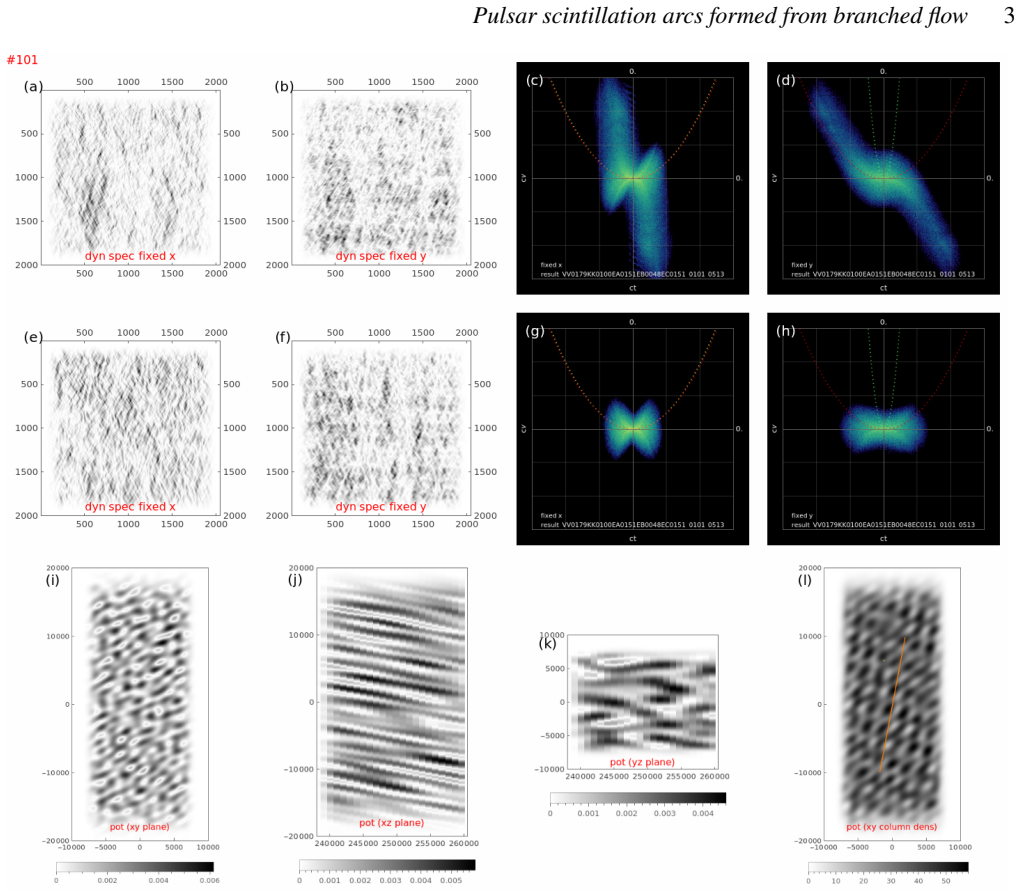
In the thin-screen approximation, radio-wave scintillation arcs are produced by Kirchhoff-Fresnel diffraction from a projected column-density phase screen, and arc curvature directly indicates distance to the plasma. A three-dimensional treatment without this reduction shows that curvature varies with the plasma's spatial structure and that volume propagation yields asymmetries plus additional spectral features absent from the screen model. These effects are conjectured to result from branched flow generated by a sequence of weak but correlated scattering events.
What carries the argument
Branched flow arising from a sequence of weak but correlated scattering events during three-dimensional volume propagation through plasma density variations.
If this is right
- Arc curvature ceases to be a reliable indicator of distance to the plasma concentration.
- Secondary spectra display asymmetries and a richer variety of features than thin-screen models predict.
- Scintillation patterns result from multiple weak, correlated scattering events distributed through volume rather than from a single localized disturbance.
- Distance estimates and plasma modeling require explicit three-dimensional propagation calculations.
Where Pith is reading between the lines
- If branched flow is the dominant mechanism, existing models of interstellar turbulence would need to incorporate correlated sequences of weak scatterers rather than isolated strong screens.
- Systematic comparison of observed spectral asymmetries with three-dimensional simulations could map the actual distribution of plasma along different lines of sight.
- This framework may alter how scintillation noise is subtracted in high-precision pulsar timing experiments that rely on the thin-screen distance scale.
Load-bearing premise
Plasma structures along the line of sight can be treated as an effective thin phase screen whose column density alone determines the observed diffraction pattern.
What would settle it
An observation showing arc curvature that changes with observing frequency or baseline geometry in a manner matching three-dimensional branched-flow simulations but contradicting any single thin-screen prediction.
Figures
read the original abstract
Radio waves propagating through the interstellar medium are influenced by variations in plasma density. For spatially localised plasma structures along the line of sight, time-delay Doppler analyses of pulsars often reveal scintillation arcs in the secondary spectrum, frequently exhibiting a parabolic morphology. In the thin-screen approximation, the arc curvature is commonly used to infer the distance to the plasma concentration, which is modelled - via Kirchhoff-Fresnel diffraction theory - as an effective phase screen imposed by the column density of a localised disturbance. Here, we identify several limitations of the thin-screen model that necessitate a fully three-dimensional treatment, without reducing the problem to a projected screen density. We show that the arc curvature can vary depending on the three-dimensional structure of the plasma, rendering it a less reliable indicator of distance. Moreover, when volume propagation is considered, asymmetries and a richer variety of features emerge in the secondary spectrum compared to those predicted by the thin-screen approximation. We conjecture that these phenomena are linked to the onset of branched flow produced by a sequence of weak but correlated scattering events.
Editorial analysis
A structured set of objections, weighed in public.
Referee Report
Summary. The manuscript argues that the thin-screen approximation for modeling pulsar scintillation arcs, based on Kirchhoff-Fresnel diffraction from an effective phase screen, has key limitations when applied to spatially localized plasma structures. It claims that arc curvature is not a unique indicator of distance to the scattering region because it depends on the three-dimensional plasma structure, that volume propagation produces asymmetries and a richer variety of features in the secondary spectrum, and conjectures that these phenomena arise from the onset of branched flow due to sequences of weak but correlated scattering events.
Significance. If the conjecture linking secondary-spectrum morphology to branched flow can be substantiated with quantitative modeling, the work would have substantial impact on the interpretation of interstellar scintillation observations. It would indicate that thin-screen-based distance inferences are less reliable than assumed and motivate fully three-dimensional treatments of plasma propagation for accurate characterization of interstellar medium structures.
major comments (2)
- [Abstract] Abstract: The central conjecture that asymmetries and varied arc curvatures 'are linked to the onset of branched flow produced by a sequence of weak but correlated scattering events' is presented without a derivation, error analysis, or numerical demonstration under the parabolic wave equation (or equivalent 3D propagator) showing how such a sequence produces caustics or the observed secondary-spectrum features. This step is load-bearing for elevating the claim beyond an interpretation.
- [Abstract] The manuscript asserts that 'the arc curvature can vary depending on the three-dimensional structure of the plasma' and that 'volume propagation' yields richer features, but provides no explicit comparison (e.g., via specific 3D realizations versus thin-screen cases) or quantitative measure of how much the curvature deviates from the thin-screen prediction, which is required to support the claim that curvature is 'a less reliable indicator of distance'.
Simulated Author's Rebuttal
We thank the referee for their careful reading and valuable comments on our manuscript. We address each major comment below and indicate where revisions will be made.
read point-by-point responses
-
Referee: [Abstract] Abstract: The central conjecture that asymmetries and varied arc curvatures 'are linked to the onset of branched flow produced by a sequence of weak but correlated scattering events' is presented without a derivation, error analysis, or numerical demonstration under the parabolic wave equation (or equivalent 3D propagator) showing how such a sequence produces caustics or the observed secondary-spectrum features. This step is load-bearing for elevating the claim beyond an interpretation.
Authors: The manuscript presents this as a conjecture rather than a fully derived result. Our analysis shows that 3D volume propagation leads to the described features in the secondary spectrum, which we interpret as consistent with the onset of branched flow from correlated weak scatterings. A complete derivation from the parabolic wave equation is not provided here, as the focus is on demonstrating the limitations of the thin-screen model. We will revise the abstract and discussion to emphasize the conjectural nature and the need for future quantitative modeling to substantiate the branched flow link. revision: partial
-
Referee: [Abstract] The manuscript asserts that 'the arc curvature can vary depending on the three-dimensional structure of the plasma' and that 'volume propagation' yields richer features, but provides no explicit comparison (e.g., via specific 3D realizations versus thin-screen cases) or quantitative measure of how much the curvature deviates from the thin-screen prediction, which is required to support the claim that curvature is 'a less reliable indicator of distance'.
Authors: The full manuscript includes sections with specific 3D plasma structure realizations and comparisons to thin-screen predictions, illustrating variations in arc curvature and additional spectral features. However, we agree that more explicit quantitative measures, such as tabulated curvature values for different 3D configurations and their deviations, would strengthen the argument. We will add these quantitative comparisons in the revised version. revision: yes
- A full derivation, error analysis, or numerical demonstration under the parabolic wave equation for the branched flow conjecture
Circularity Check
No circularity: conjecture presented without self-referential derivation or fitted predictions
full rationale
The paper's core contribution is an explicit conjecture linking observed scintillation features to branched flow from weak correlated scatterers. No equations, parameter fits, or derivation steps are shown that would reduce any claimed result to its own inputs by construction. The thin-screen limitations and volume-propagation effects are discussed as independent observations, with no self-citation chains or ansatz smuggling invoked to support the conjecture. This is a standard non-finding for an interpretive paper lacking quantitative derivations.
Axiom & Free-Parameter Ledger
Reference graph
Works this paper leans on
-
[1]
Arkadiew W., 1913, Physikalische Zeitschrift, 14, 832
1913
-
[2]
R., Mocz P., Federrath C., Klessen R
Beattie J. R., Mocz P., Federrath C., Klessen R. S., 2021, @doi [Monthly Notices of the Royal Astronomical Society] 10.1093/mnras/stab1037 , 504, 4354
-
[3]
Beattie J. R., Federrath C., Klessen R. S., Cielo S., Bhattacharjee A., 2025, @doi [Nature Astronomy] 10.1038/s41550-025-02551-5 , pp 1--11
-
[4]
Cordes J. M., Rickett B. J., Stinebring D. R., Coles W. A., 2006, @doi [The Astrophysical Journal] 10.1086/498332 , 637, 346
-
[5]
R., 2019, @doi [Monthly Notices of the Royal Astronomical Society] 10.1093/mnras/stz894 , 486, 2809
Gwinn C. R., 2019, @doi [Monthly Notices of the Royal Astronomical Society] 10.1093/mnras/stz894 , 486, 2809
-
[6]
J., Fleischmann R., Kramer T., 2021, @doi [Physics Today] 10.1063/PT.3.4902 , 74, 44
Heller E. J., Fleischmann R., Kramer T., 2021, @doi [Physics Today] 10.1063/PT.3.4902 , 74, 44
-
[7]
Hill A. S., Stinebring D. R., Barnor H. A., Berwick D. E., Webber A. B., 2003, @doi [The Astrophysical Journal] 10.1086/379191 , 599, 457
-
[8]
Kramer T., 2011, in AIP Conf . Proc .. pp 142--165, @doi 10.1063/1.3555481
-
[9]
Kramer T., Heller E. J., Parrott R. E., 2008, @doi [Journal of Physics: Conference Series] 10.1088/1742-6596/99/1/012010 , 99, 012010
-
[10]
Kramer T., Waltner D., Heller E. J., Stinebring D. R., 2024, @doi [Monthly Notices of the Royal Astronomical Society] 10.1093/mnras/stae1342 , 531, 3950
-
[11]
v., 1886, Die Beugungserscheinungen einer kreisrunden Oeffnung und eines kreisrunden Schirmchens
Lommel E. v., 1886, Die Beugungserscheinungen einer kreisrunden Oeffnung und eines kreisrunden Schirmchens . No. Bd. 15, Abth. 2 = [4] in Abhandlungen, Verlag der Bayerischen Akademie der Wissenschaften, München
-
[12]
Pen U.-L., Levin Y., 2014, @doi [Monthly Notices of the Royal Astronomical Society] 10.1093/mnras/stu1020 , 442, 3338
-
[13]
Perseus Books, Reading, Mass
Schwinger J., 1998, Classical electrodynamics. Perseus Books, Reading, Mass
1998
-
[14]
Sprenger T., Main R., Wucknitz O., Mall G., Wu J., 2022, @doi [Monthly Notices of the Royal Astronomical Society] 10.1093/mnras/stac2160 , 515, 6198
-
[15]
Stinebring D. R., McLaughlin M. A., Cordes J. M., Becker K. M., Goodman J. E. E., Kramer M. A., Sheckard J. L., Smith C. T., 2001, @doi [The Astrophysical Journal] 10.1086/319133 , 549, L97
-
[16]
R., et al., 2022, @doi [The Astrophysical Journal] 10.3847/1538-4357/ac8ea8 , 941, 34
Stinebring D. R., et al., 2022, @doi [The Astrophysical Journal] 10.3847/1538-4357/ac8ea8 , 941, 34
-
[17]
write newline
" write newline "" before.all 'output.state := FUNCTION fin.entry write newline FUNCTION new.block output.state before.all = 'skip after.block 'output.state := if FUNCTION new.sentence output.state after.block = 'skip output.state before.all = 'skip after.sentence 'output.state := if if FUNCTION not #0 #1 if FUNCTION and 'skip pop #0 if FUNCTION or pop #1...
discussion (0)
Sign in with ORCID, Apple, or X to comment. Anyone can read and Pith papers without signing in.