Asymptotically Self-Similar Blowup for 3D Incompressible Euler with C^(1, 1/3-) Velocity II: 3D Profiles, Blowup, and Limiting behavior
Pith reviewed 2026-05-20 20:19 UTC · model grok-4.3
The pith
Exact C^alpha self-similar blowup profiles for vorticity exist in the 3D Euler equations without swirl for every alpha below 1/3.
A machine-rendered reading of the paper's core claim, the machinery that carries it, and where it could break.
Core claim
For any alpha in (0, 1/3) exact C^alpha self-similar blowup profiles exist for the vorticity of the 3D incompressible Euler equation without swirl. From these profiles one obtains asymptotically self-similar blowup for initial data with compactly supported C^alpha vorticity and C^{1,alpha} intersect L^2 velocity. As alpha tends to one-third from below the spatial blowup rate diverges to infinity while the vorticity profile converges strongly in a weighted L^infty norm to a nonzero multiple of r to the power one-third times a smooth one-dimensional blowup profile.
What carries the argument
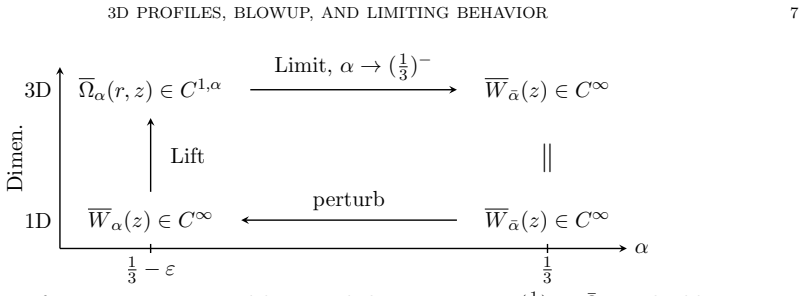
Fixed-point lifting of one-dimensional smooth blowup profiles to exact three-dimensional C^alpha profiles, implemented through anisotropic weighted estimates and double integration by parts along trajectories.
If this is right
- Finite-time singularity formation occurs for the 3D Euler equations from an open set of initial data at every regularity below the known global-regularity threshold.
- The blowup solutions become increasingly localized in space as alpha approaches one-third because the spatial rate diverges.
- The vorticity profiles factorize and converge to a specific one-dimensional shape in the limit, giving a precise description of the critical blowup.
- The same lifting technique yields stability of the profiles in a low-regularity topology, allowing construction of blowup from perturbed data.
- Singularity formation in three dimensions can be obtained by transferring exact solutions from a one-dimensional nonlocal model.
Where Pith is reading between the lines
- Similar lifting arguments may produce blowup examples for the axisymmetric Navier-Stokes equations at comparable regularity.
- High-resolution numerical simulations near alpha equal to one-third could test whether the predicted divergence of the blowup rate and profile factorization appear in computed solutions.
- The construction suggests that the critical regularity 1/3 separates regimes of global regularity from regimes permitting singularity formation for a wider class of axisymmetric flows.
- The method of repeated integration by parts along trajectories may extend to other nonlocal transport equations that lack radial decay.
Load-bearing premise
The one-dimensional approximate profiles can be corrected into exact three-dimensional profiles by a fixed-point argument even though they lack sufficient decay in the radial direction.
What would settle it
An explicit computation or numerical solution of the profile equation demonstrating that no C^alpha fixed-point solution exists for some alpha strictly less than one-third would disprove the claimed existence of the blowup profiles.
Figures

read the original abstract
For any $\alpha \in (0,1/3)$, we construct exact $C^{\alpha}$ self-similar blowup profiles for the vorticity of the 3D incompressible Euler equation without swirl, and build on them to prove asymptotically self-similar blowup from $C_c^\alpha$ initial vorticity and $C^{1,\alpha}\cap L^2$ initial velocity. Moreover, we provide a complete characterization of the limiting behavior of the $C^{\alpha}$ vorticity profiles and the associated blowup solutions as $\alpha\to(1/3)^-$. Specifically, as $\alpha \to(1/3)^-$, the spatial blowup rate $\mathsf{c}_{\mathsf{x},\alpha}$ diverges to $\infty$, while the $C^{\alpha}$ vorticity profile $\Omega_{*,\alpha}^{\theta}$ asymptotically factorizes and converges strongly in a weighted $L^\infty$ norm to a nonzero constant multiple of $r^{1/3}\bar W_{1/3}(z)$, where $\bar W_{1/3}$ is a $C^\infty$ 1D blowup profile. Our construction is inspired by the Hou--Zhang blowup scenario. Using a fixed-point argument, we lift the $C^\infty$ blowup profiles for a 1D model constructed in the companion work [11] to exact 3D blowup profiles. To overcome the lack of $r$-directional decay in the approximate profile and capture the anisotropic structure, we develop a family of anisotropic weighted estimates and introduce a crucial integration-by-parts method along trajectories that exploits the equation twice. We then develop a finite codimension stability argument in a low-regularity setting to prove stability of the 3D profiles and establish asymptotically self-similar blowup. This blowup result is sharp in view of the global regularity theory for axisymmetric Euler without swirl with $ C_c^{\alpha}$ initial vorticity for all $\alpha \geq 1/3$. To the best of our knowledge, our results provide the first example in which a singularity from a 1D nonlocal fluid model is lifted to construct blowup for incompressible fluid equations in $\mathbb{R}^2$ or $\mathbb{R}^3$.
Editorial analysis
A structured set of objections, weighed in public.
Referee Report
Summary. The manuscript constructs exact C^α self-similar blowup profiles for the vorticity of the 3D incompressible Euler equation without swirl for any α ∈ (0,1/3) by lifting C^∞ 1D profiles from the companion paper [11] via a fixed-point argument. It then proves asymptotically self-similar blowup from C_c^α initial vorticity and C^{1,α} ∩ L² initial velocity, and characterizes the limiting behavior as α → (1/3)^−, showing that the spatial blowup rate c_{x,α} diverges to ∞ while the profile Ω_{*,α}^θ factorizes and converges strongly in a weighted L^∞ norm to a nonzero multiple of r^{1/3} W̄_{1/3}(z). The construction employs anisotropic weighted estimates and a double integration-by-parts along trajectories that exploits the vorticity equation twice.
Significance. If the fixed-point construction closes, the work supplies the first explicit lifting of a singularity from a 1D nonlocal model to an exact 3D Euler blowup profile, and the limiting analysis as α approaches the critical threshold 1/3 provides a sharp complement to existing global regularity theorems for α ≥ 1/3. The finite-codimension stability argument in the low-regularity setting is a technically substantial contribution.
major comments (2)
- [Fixed-point argument for 3D profiles] Fixed-point construction: The central claim that the double integration-by-parts along trajectories, combined with the family of anisotropic weighted estimates, absorbs all commutator and remainder terms in the C^α topology for α < 1/3 rests on the approximate profile lacking r-directional decay. Explicit control of the second-order remainders (generated when the flow map is only C^{1,α}) must be verified uniformly down to α = 0 and independent of the r-cutoff; without such bounds the contraction mapping may fail to close.
- [Limiting behavior as α → (1/3)^−] Limiting analysis: The strong convergence of Ω_{*,α}^θ to a multiple of r^{1/3} W̄_{1/3}(z) in the weighted L^∞ norm as α → (1/3)^−, together with the divergence of c_{x,α}, is load-bearing for the complete characterization. The passage to the limit inside the finite-codimension stability argument requires uniform estimates that remain valid when the spatial blowup rate becomes arbitrarily large.
minor comments (2)
- [Notation and function spaces] The definition of the anisotropic weights and the precise function spaces in which the fixed-point map is shown to be a contraction should be stated at the beginning of the construction section for immediate readability.
- [Estimates] A short table summarizing the dependence of all constants on α would help the reader track the uniformity of the estimates as α approaches 1/3.
Simulated Author's Rebuttal
We thank the referee for the careful reading, positive assessment of significance, and constructive major comments. We respond point-by-point below, indicating revisions where appropriate to improve clarity and rigor.
read point-by-point responses
-
Referee: [Fixed-point argument for 3D profiles] Fixed-point construction: The central claim that the double integration-by-parts along trajectories, combined with the family of anisotropic weighted estimates, absorbs all commutator and remainder terms in the C^α topology for α < 1/3 rests on the approximate profile lacking r-directional decay. Explicit control of the second-order remainders (generated when the flow map is only C^{1,α}) must be verified uniformly down to α = 0 and independent of the r-cutoff; without such bounds the contraction mapping may fail to close.
Authors: We appreciate the referee's emphasis on this technical detail. The approximate profile indeed lacks r-decay by construction, as it is lifted directly from the 1D model. The anisotropic weights (Section 3) are chosen to grow in the r-direction while decaying rapidly in z, precisely to offset this. The double integration-by-parts along trajectories (detailed in the proof of Proposition 4.1) produces exact cancellation of the principal stretching terms from the vorticity equation, reducing the second-order remainders to integrals that are estimated via the C^{1,α} regularity of the flow map. These remainder bounds are derived in Lemmas 4.3–4.5 and are uniform for α ∈ (0,1/3), with constants that remain bounded as α → 0^+ and independent of the r-cutoff radius because the weights ensure sufficient decay outside a fixed compact set in z. We will add a short clarifying remark after Proposition 4.1 explicitly stating this uniformity and independence to make the closure of the contraction mapping fully transparent. revision: yes
-
Referee: [Limiting behavior as α → (1/3)^−] Limiting analysis: The strong convergence of Ω_{*,α}^θ to a multiple of r^{1/3} W̄_{1/3}(z) in the weighted L^∞ norm as α → (1/3)^−, together with the divergence of c_{x,α}, is load-bearing for the complete characterization. The passage to the limit inside the finite-codimension stability argument requires uniform estimates that remain valid when the spatial blowup rate becomes arbitrarily large.
Authors: We agree that uniformity in the limit is essential. The strong convergence of the profiles in the weighted L^∞ norm and the divergence of c_{x,α} are established in Theorem 6.1 via compactness in the weighted spaces together with the factorization property inherited from the 1D limiting profile. For the stability argument, the finite-codimension conditions are preserved under the limit because they are defined via continuous functionals on the weighted spaces. The estimates in Section 5 are obtained from the linearized operator around Ω_{*,α}, which converges to the operator around the limiting profile. To address the referee's concern directly, we will insert a new auxiliary result (Lemma 5.4) proving that the relevant operator norms and stability constants remain bounded uniformly for all sufficiently large c_x, using the scaling invariance of the Euler equations and the fact that the limiting profile satisfies the same 1D equation. This will be added in the revised manuscript. revision: yes
Circularity Check
Moderate circularity from self-citation load-bearing on companion 1D profiles for 3D lifting
specific steps
-
self citation load bearing
[Abstract]
"Using a fixed-point argument, we lift the C^∞ blowup profiles for a 1D model constructed in the companion work [11] to exact 3D blowup profiles. To overcome the lack of r-directional decay in the approximate profile and capture the anisotropic structure, we develop a family of anisotropic weighted estimates and introduce a crucial integration-by-parts method along trajectories that exploits the equation twice."
The existence of the exact 3D C^α self-similar vorticity profiles is obtained by lifting the 1D profiles whose construction is imported entirely from the self-cited companion paper [11]. While the lifting technique itself is new, the load-bearing premise (availability of the base 1D profiles) reduces to prior self-authored work without re-derivation or external verification in this manuscript.
full rationale
The paper's central construction of 3D C^α profiles and the subsequent stability/blowup results explicitly depend on lifting C^∞ 1D profiles constructed in companion work [11] (same authorship). This is a self-citation load-bearing step, but the fixed-point argument, anisotropic weighted estimates, double integration-by-parts along trajectories, and limiting analysis as α→(1/3)^- constitute substantial independent mathematical content. No self-definitional reductions, fitted inputs renamed as predictions, or ansatz smuggling are present. The derivation chain remains partially self-contained against external benchmarks once the 1D base is granted.
Axiom & Free-Parameter Ledger
axioms (1)
- domain assumption The companion paper [11] constructs C^∞ 1D blowup profiles W̄_{1/3} for the reduced model.
Lean theorems connected to this paper
-
IndisputableMonolith/Foundation/AlexanderDuality.leanalexander_duality_circle_linking echoes?
echoesECHOES: this paper passage has the same mathematical shape or conceptual pattern as the Recognition theorem, but is not a direct formal dependency.
Using a fixed-point argument, we lift the C^∞ blowup profiles for a 1D model ... to exact 3D blowup profiles. ... anisotropic weighted estimates and ... integration-by-parts method along trajectories that exploits the equation twice.
-
IndisputableMonolith/Foundation/Cost/FunctionalEquation.leanwashburn_uniqueness_aczel unclear?
unclearRelation between the paper passage and the cited Recognition theorem.
This blowup result is sharp in view of the global regularity theory for axisymmetric Euler without swirl with C^α_c initial vorticity for all α ≥ 1/3.
What do these tags mean?
- matches
- The paper's claim is directly supported by a theorem in the formal canon.
- supports
- The theorem supports part of the paper's argument, but the paper may add assumptions or extra steps.
- extends
- The paper goes beyond the formal theorem; the theorem is a base layer rather than the whole result.
- uses
- The paper appears to rely on the theorem as machinery.
- contradicts
- The paper's claim conflicts with a theorem or certificate in the canon.
- unclear
- Pith found a possible connection, but the passage is too broad, indirect, or ambiguous to say the theorem truly supports the claim.
Forward citations
Cited by 1 Pith paper
-
Self-similar blow-up solutions of incompressible Euler equations in $\mathbb R^d, d\geq 3$ with $C^{1,1-2/d-}$ velocity
Constructs self-similar blow-up solutions to axisymmetric Euler equations in d greater than or equal to 3 with initial data in C to the 1,alpha intersect smooth away from origin for alpha less than 1-2/d.
Reference graph
Works this paper leans on
-
[1]
Jacob Bedrossian, Jiajie Chen, Maria Pia Gualdani, Sehyun Ji, Vlad Vicol, and Jincheng Yang. Finite time singularities in the Landau equation with very hard potentials.arXiv preprint arXiv:2602.05981, 2026
-
[2]
Smooth imploding solutions for 3D com- pressible fluids
Tristan Buckmaster, Gonzalo Cao-Labora, and Javier G´ omez-Serrano. Smooth imploding solutions for 3D com- pressible fluids. InForum of Mathematics, Pi, volume 13, page e6. Cambridge University Press, 2025
work page 2025
-
[3]
American Mathematical Soc., 2018
Theo B¨ uhler and Dietmar A Salamon.Functional analysis, volume 191. American Mathematical Soc., 2018
work page 2018
- [4]
-
[5]
Jiajie Chen. Singularity formation and global well-posedness for the generalized Constantin–Lax–Majda equation with dissipation.Nonlinearity, 33(5):2502, 2020
work page 2020
-
[6]
On the slightly perturbed De Gregorio model onS 1.Arch
Jiajie Chen. On the slightly perturbed De Gregorio model onS 1.Arch. Ration. Mech. Anal., 241(3):1843–1869, 2021
work page 2021
-
[7]
Jiajie Chen. Nearly self-similar blowup of the slightly perturbed homogeneous Landau equation with very soft potentials.arXiv preprint arXiv:2311.11511, 2023
-
[8]
Jiajie Chen. On the regularity of the De Gregorio model for the 3D Euler equations.Journal of the European Mathematical Society, 27(4):1619–1677, 2023
work page 2023
-
[9]
Jiajie Chen. Remarks on the smoothness of theC 1,α asymptotically self-similar singularity in the 3D Euler and 2D Boussinesq equations.Nonlinearity, 37(6):065018, 2024
work page 2024
-
[10]
Vorticity blowup in Compressible Euler equations inR d, d≥3.Annals of PDE, 11(2):21, 2025
Jiajie Chen. Vorticity blowup in Compressible Euler equations inR d, d≥3.Annals of PDE, 11(2):21, 2025
work page 2025
-
[11]
Jiajie Chen. Asymptotically self-similar blowup for 3D incompressible Euler withC 1,1/3− velocity I:C ∞ 1D limiting profiles.preprint, 2026
work page 2026
-
[12]
Vorticity blowup in 2D compressible Euler equations
Jiajie Chen, Giorgio Cialdea, Steve Shkoller, and Vlad Vicol. Vorticity blowup in 2D compressible Euler equations. To appear in Duke Math. J., arXiv preprint arXiv:2407.06455, 2024
-
[13]
Jiajie Chen and Thomas Y Hou. Finite time blowup of 2D Boussinesq and 3D Euler equations withC 1,α velocity and boundary.Communications in Mathematical Physics, 383(3):1559–1667, 2021. 132 JIAJIE CHEN
work page 2021
-
[14]
Jiajie Chen and Thomas Y Hou. Stable nearly self-similar blowup of the 2D Boussinesq and 3D Euler equations with smooth data I: Analysis.arXiv preprint: arXiv:2210.07191v3, 2022
-
[15]
Jiajie Chen and Thomas Y Hou. Singularity formation in 3D Euler equations with smooth initial data and boundary.Proceedings of the National Academy of Sciences, 122(27):e2500940122, 2025
work page 2025
-
[16]
Jiajie Chen and Thomas Y Hou. Stable nearly self-similar blowup of the 2d boussinesq and 3d euler equations with smooth data ii: Rigorous numerics.Multiscale Modeling & Simulation, 23(1):25–130, 2025
work page 2025
-
[17]
Jiajie Chen, Thomas Y Hou, and De Huang. On the finite time blowup of the De Gregorio model for the 3D Euler equations.Communications on Pure and Applied Mathematics, 74(6):1282–1350, 2021
work page 2021
-
[18]
Jiajie Chen, Thomas Y Hou, and De Huang. Asymptotically self-similar blowup of the Hou–Luo model for the 3D Euler equations.Annals of PDE, 8(2):24, 2022
work page 2022
-
[19]
Smooth and stable Euler implosions.arXiv preprint, 2026
Jiajie Chen, Steve Shkoller, and Vlad Vicol. Smooth and stable Euler implosions.arXiv preprint, 2026
work page 2026
-
[20]
K Choi, TY Hou, A Kiselev, G Luo, V Sverak, and Y Yao. On the finite-time blowup of a 1D model for the 3D axisymmetric Euler equations.CPAM, 70(11):2218–2243, 2017
work page 2017
-
[21]
Finite time blow up for a 1D model of 2D Boussinesq system.Comm
K Choi, A Kiselev, and Y Yao. Finite time blow up for a 1D model of 2D Boussinesq system.Comm. Math. Phys., 334(3):1667–1679, 2015
work page 2015
-
[22]
P Constantin. On the Euler equations of incompressible fluids.Bulletin of the American Mathematical Society, 44(4):603–621, 2007
work page 2007
-
[23]
P Constantin, P. D. Lax, and A. Majda. A simple one-dimensional model for the three-dimensional vorticity equation.CPAM, 38(6):715–724, 1985
work page 1985
-
[24]
A C´ ordoba, D C´ ordoba, and MA Fontelos. Formation of singularities for a transport equation with nonlocal velocity.Annals of Mathematics, pages 1377–1389, 2005
work page 2005
-
[25]
Diego C´ ordoba, Andr´ es La´ ın-Sanclemente, and Luis Mart´ ınez-Zoroa. Finite-time singularity via multi-layer de- generate pendula for the 2D Boussinesq equation with uniformC 1, √ 4/3−1−ϵ ∩L2 force.Advances in Mathematics, 480:110480, 2025
work page 2025
-
[26]
Diego C´ ordoba and Luis Mart´ ınez-Zoroa. Blow-up for the incompressible 3D-Euler equations with uniformc1, 1 2 −ϵ∩ L2 force.arXiv preprint arXiv:2309.08495, 2023
-
[27]
Diego C´ ordoba and Luis Mart´ ınez-Zoroa. Finite time singularities of smooth solutions for the 2D incompressible porous media (ipm) equation with a smooth source.arXiv preprint arXiv:2410.22920, 2024
-
[28]
Diego Cordoba, Luis Martinez-Zoroa, and Fan Zheng. Finite time singularities to the 3D incompressible Euler equations for solutions inC 1,α ∩C ∞(R3\{0})∩L 2.arXiv preprint arXiv:2308.12197, 2023
-
[29]
Raphael Danchin. Axisymmetric incompressible flows with bounded vorticity.Russian Mathematical Surveys, 62(3):475–496, 2007
work page 2007
-
[30]
S De Gregorio. On a one-dimensional model for the three-dimensional vorticity equation.Journal of Statistical Physics, 59(5-6):1251–1263, 1990
work page 1990
-
[31]
Theodore D Drivas and Tarek M Elgindi. Singlarity formation in the incompressible Euler equation in finite and infinite time.arXiv:2203.17221v1, 2022
-
[32]
Tarek M Elgindi. Finite-time singularity formation forC 1,α solutions to the incompressible Euler equations on R3.Annals of Mathematics, 194(3):647–727, 2021
work page 2021
-
[33]
Tarek M Elgindi, Tej-Eddine Ghoul, and Nader Masmoudi. On the stability of self-similar blow-up forC 1,α solutions to the incompressible Euler equations onR 3.arXiv preprint arXiv:1910.14071, 2019
-
[34]
Tarek M Elgindi and In-Jee Jeong. Finite-time singularity formation for strong solutions to the axi-symmetric 3D Euler equations.Annals of PDE, 5(2):1–51, 2019
work page 2019
-
[35]
Tarek M. Elgindi and In-Jee Jeong. On the effects of advection and vortex stretching.Archive for Rational Mechanics and Analysis, Oct 2019
work page 2019
-
[36]
Finite-time singularity formation for strong solutions to the Boussinesq system
Tarek M Elgindi and In-Jee Jeong. Finite-time singularity formation for strong solutions to the Boussinesq system. Annals of PDE, 6:1–50, 2020
work page 2020
-
[37]
From instability to singularity formation in incompressible fluids
Tarek M Elgindi and Federico Pasqualotto. From instability to singularity formation in incompressible fluids. arXiv preprint arXiv:2310.19780, 2023
-
[38]
Springer-Verlag, New York, 2000
Klaus-Jochen Engel and Rainer Nagel.One-parameter semigroups for linear evolution equations, volume 194 of Graduate Texts in Mathematics. Springer-Verlag, New York, 2000. With contributions by S. Brendle, M. Campiti, T. Hahn, G. Metafune, G. Nickel, D. Pallara, C. Perazzoli, A. Rhandi, S. Romanelli and R. Schnaubelt
work page 2000
-
[39]
David Gilbarg, Neil S Trudinger, David Gilbarg, and NS Trudinger.Elliptic partial differential equations of second order, volume 2. Springer, 1998
work page 1998
-
[40]
R Grauer and TC Sideris. Numerical computation of 3D incompressible ideal fluids with swirl.Physical Review Letters, 67(25):3511, 1991
work page 1991
-
[41]
Thomas Y Hou and De Huang. A potential two-scale traveling wave singularity for 3D incompressible Euler equations.Physica D: Nonlinear Phenomena, page 133257, 2022
work page 2022
-
[42]
Thomas Y Hou and Shumao Zhang. Potential singularity of the axisymmetric euler equations with initial vorticity for a large range ofα.Multiscale Modeling & Simulation, 22(4):1326–1364, 2024. 3D PROFILES, BLOWUP, AND LIMITING BEHAVIOR 133
work page 2024
-
[43]
TY Hou. Blow-up or no blow-up? a unified computational and analytic approach to 3D incompressible Euler and Navier-Stokes equations.Acta Numerica, 18(1):277–346, 2009
work page 2009
-
[44]
TY Hou and Z Lei. On the stabilizing effect of convection in three-dimensional incompressible flows.Communi- cations on Pure and Applied Mathematics, 62(4):501–564, 2009
work page 2009
-
[45]
Dynamic stability of the three-dimensional axisymmetric Navier-Stokes equations with swirl
TY Hou and C Li. Dynamic stability of the three-dimensional axisymmetric Navier-Stokes equations with swirl. Communications on Pure and Applied Mathematics, 61(5):661–697, 2008
work page 2008
-
[46]
TY Hou and R Li. Dynamic depletion of vortex stretching and non-blowup of the 3D incompressible Euler equations.Journal of Nonlinear Science, 16(6):639–664, 2006
work page 2006
-
[47]
De Huang, Xiang Qin, Xiuyuan Wang, and Dongyi Wei. Self-similar finite-time blowups with smooth profiles of the generalized constantin–lax–majda model.Archive for Rational Mechanics and Analysis, 248(2):22, 2024
work page 2024
-
[48]
De Huang, Xiang Qin, Xiuyuan Wang, and Dongyi Wei. Exact self-similar finite-time blowup of the hou–luo model with smooth profiles.Communications in Mathematical Physics, 406(10):243, 2025
work page 2025
-
[49]
RM Kerr. Evidence for a singularity of the three-dimensional, incompressible Euler equations.Physics of Fluids A: Fluid Dynamics, 5(7):1725–1746, 1993
work page 1993
-
[50]
Small scale creation for solutions of the incompressible two dimensional Euler equation
A Kiselev and V Sverak. Small scale creation for solutions of the incompressible two dimensional Euler equation. Annals of Mathematics, 180:1205–1220, 2014
work page 2014
-
[51]
G Luo and TY Hou. Toward the finite-time blowup of the 3D incompressible Euler equations: a numerical investigation.SIAM Multiscale Modeling and Simulation, 12(4):1722–1776, 2014
work page 2014
-
[52]
Cambridge University Press, 2002
AJ Majda and AL Bertozzi.Vorticity and incompressible flow, volume 27. Cambridge University Press, 2002
work page 2002
-
[53]
On the implosion of a compressible fluid II: singularity formation.Ann
Frank Merle, Pierre Rapha¨ el, Igor Rodnianski, and Jeremie Szeftel. On the implosion of a compressible fluid II: singularity formation.Ann. of Math. (2), 196(2):779–889, 2022
work page 2022
-
[54]
On a generalization of the Constantin–Lax–Majda equation.Nonlinearity, 21(10):2447–2461, 2008
H Okamoto, T Sakajo, and M Wunsch. On a generalization of the Constantin–Lax–Majda equation.Nonlinearity, 21(10):2447–2461, 2008
work page 2008
-
[55]
A Pumir and ED Siggia. Development of singular solutions to the axisymmetric Euler equations.Physics of Fluids A: Fluid Dynamics (1989-1993), 4(7):1472–1491, 1992
work page 1989
-
[56]
X Saint Raymond. Remarks on axisymmetric solutions of the incompressible euler system.Communications in partial differential equations, 19(1-2):321–334, 1994
work page 1994
-
[57]
Feng Shao, Dongyi Wei, and Zhifei Zhang. Global regularity of axisymmetric euler equations without swirl in higher dimensions.Acta Mathematica Sinica, English Series, 42(3):663–679, 2026
work page 2026
-
[58]
Incompressible Euler Blowup at the $C^{1,\frac{1}{3}}$ Threshold
Steve Shkoller. Incompressible Euler blowup at theC 1, 1 3 threshold.arXiv preprint arXiv:2603.10945, 2026
work page internal anchor Pith review Pith/arXiv arXiv 2026
-
[59]
American Mathematical Soc., 2012
Gerald Teschl.Ordinary differential equations and dynamical systems, volume 140. American Mathematical Soc., 2012
work page 2012
-
[60]
Y. Wang, C.-Y. Lai, J. G´ omez-Serrano, and T. Buckmaster. Asymptotic self-similar blow-up profile for three- dimensional axisymmetric euler equations using neural networks.Physical Review Letters, 130(24):244002, 2023
work page 2023
-
[61]
Discovery of unstable singularities.arXiv preprint arXiv:2509.14185, 2025
Yongji Wang, Mehdi Bennani, James Martens, S´ ebastien Racani` ere, Sam Blackwell, Alex Matthews, Stanislav Nikolov, Gonzalo Cao-Labora, Daniel S Park, Martin Arjovsky, et al. Discovery of unstable singularities.arXiv preprint arXiv:2509.14185, 2025. Department of Mathematics, University of Chicago, Chicago, IL 60637. Email address:jiajiechen@uchicago.edu
discussion (0)
Sign in with ORCID, Apple, or X to comment. Anyone can read and Pith papers without signing in.