Strong Gravitational Lensing with the James Webb Space Telescope
Pith reviewed 2026-05-15 02:59 UTC · model grok-4.3
The pith
Strong gravitational lensing with JWST now permits detailed study of distant sources at levels previously unreachable.
A machine-rendered reading of the paper's core claim, the machinery that carries it, and where it could break.
Core claim
Strong gravitational lensing, where foreground mass curves spacetime and deflects light into magnified multiple images of background sources, combined with JWST's capabilities, now enables observation, detection, and study of distant sources like never before, extending prior uses of lensing to probe dark matter distributions and high-redshift galaxies.
What carries the argument
Strong gravitational lensing, the deflection of light by massive foreground galaxies or clusters that creates substantially magnified and multiply imaged background sources.
If this is right
- Higher-resolution images of magnified distant galaxies become routinely available for detailed morphological and spectroscopic analysis.
- Improved constraints on the dark matter content of lensing clusters and galaxies follow from better modeling of multiple images.
- Detection of fainter and more distant objects than possible with prior facilities extends the reach of studies of the early universe.
- Multiple images of the same variable or transient source allow cross-verification of distances and time-delay measurements.
Where Pith is reading between the lines
- Statistical samples from many lensed fields could tighten limits on the abundance of low-mass dark matter halos.
- Lensed transients detected with JWST might provide independent routes to measure the Hubble constant via time delays.
- The same data could test whether current lens models systematically underpredict magnifications at the highest redshifts.
Load-bearing premise
That JWST will deliver the expected magnification, resolution, and sensitivity gains for lensing studies without major unforeseen observational or modeling limitations.
What would settle it
JWST lensing fields that fail to yield the predicted increase in detected high-redshift sources or show large systematic mismatches between observed image positions and lens models.
Figures


read the original abstract
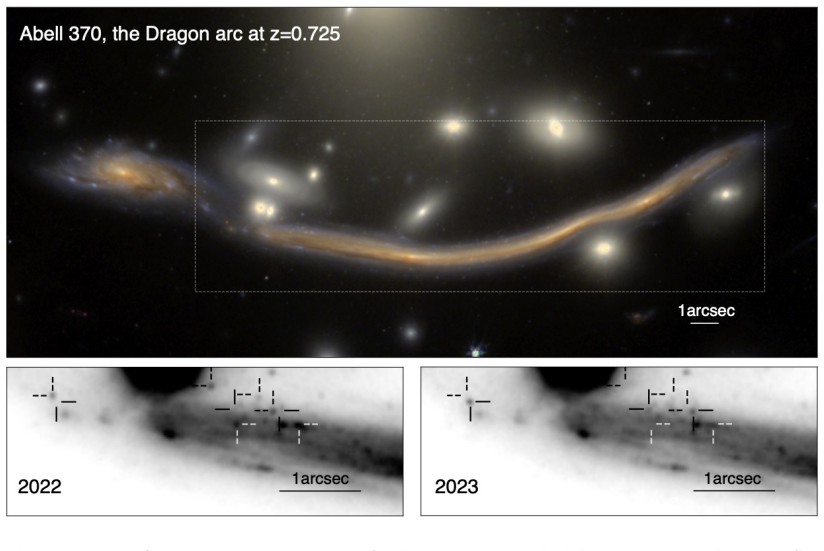
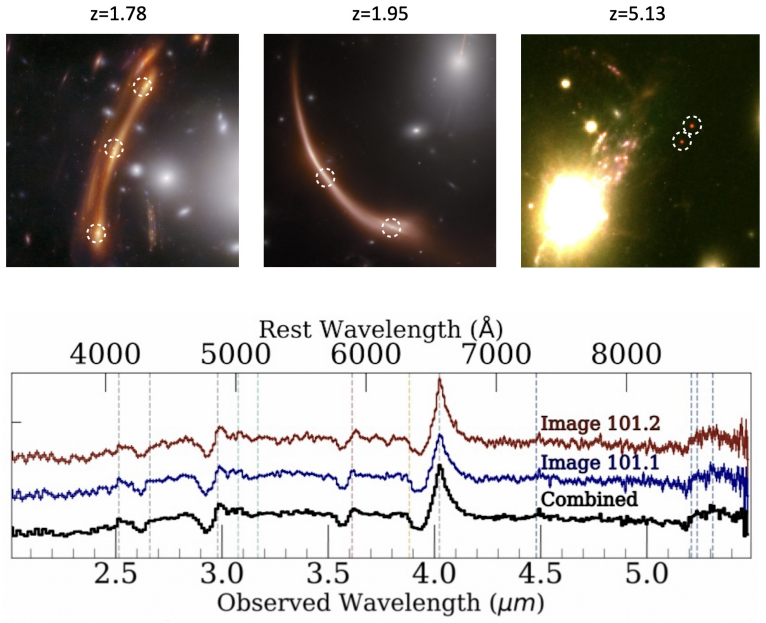
The theory of General Relativity predicts that, since massive bodies curve spacetime, light from a distant source would be deflected by a foreground massive object -- a phenomenon known as \emph{Gravitational Lensing}. Historically, the strength of deflection of light from background stars by the sun, during the 1919 solar eclipse, supplied one of the first proofs for the theory of General Relativity. However, it is only in the last few decades, with the advent of the Hubble Space Telescope and other large, ground-based facilities, that lensing has become a principal tool in modern astronomy. Lensing allows us to study both the matter content of the lensing bodies such as galaxies or clusters of galaxies, mainly dominated by the otherwise-invisible \emph{dark matter}, and the distant background sources that are being lensed by them. Strong gravitational lensing, where sources are substantially magnified and multiply imaged, is particularly useful to that end. The substantial magnification enables a high-resolution view of the sources and the detection of fainter and farther objects than would otherwise be possible; and image multiplicity helps in verifying the distance to them, and in studying variable or transient sources. Paired with the unprecedented capabilities of the James Webb Space Telescope (JWST), lensing now allows us to observe, detect, and study distant sources like never before. I summarise recent advances in strong-lensing applications and near-future prospects with JWST.
Editorial analysis
A structured set of objections, weighed in public.
Referee Report
Summary. The manuscript is a review summarizing the principles of strong gravitational lensing from general relativity, its historical validation, applications to studying dark matter in galaxies and clusters, and the magnification and multiplicity benefits for observing distant background sources. It concludes by highlighting near-future prospects when these established lensing techniques are paired with the James Webb Space Telescope's capabilities in resolution, sensitivity, and wavelength coverage.
Significance. If the descriptive overview holds, the paper provides a concise, accessible summary of established lensing applications that could serve as an entry point for researchers planning JWST observations. It correctly grounds claims in prior literature on Hubble-era lensing results without introducing new derivations, parameters, or predictions that would require internal validation.
minor comments (2)
- [Abstract] Abstract: The first-person phrasing ('I summarise') is acceptable in a review but could be revised to passive construction ('Recent advances... are summarised') to align with the formal tone of most astronomy journals.
- The manuscript would benefit from an explicit list of key recent JWST lensing papers cited, to make the 'recent advances' section more traceable for readers.
Simulated Author's Rebuttal
We thank the referee for their positive assessment of the manuscript and for recommending acceptance. We are pleased that the review is viewed as a concise and accessible entry point for researchers planning JWST observations, correctly grounded in prior literature.
Circularity Check
No significant circularity detected
full rationale
This is a qualitative review paper with no derivations, equations, fitted parameters, quantitative predictions, or load-bearing self-citations that reduce to internal inputs. The central claim is descriptive: JWST paired with strong lensing enables new observations of distant sources. It rests on established telescope specifications and prior literature rather than any self-referential construction. No steps qualify under the enumerated circularity patterns.
Axiom & Free-Parameter Ledger
axioms (1)
- standard math General Relativity predicts that massive bodies deflect light from distant sources
Lean theorems connected to this paper
-
IndisputableMonolith/Foundation/RealityFromDistinction.leanreality_from_one_distinction unclear?
unclearRelation between the paper passage and the cited Recognition theorem.
The theory of General Relativity predicts that... strong gravitational lensing... Paired with the unprecedented capabilities of the James Webb Space Telescope (JWST)
What do these tags mean?
- matches
- The paper's claim is directly supported by a theorem in the formal canon.
- supports
- The theorem supports part of the paper's argument, but the paper may add assumptions or extra steps.
- extends
- The paper goes beyond the formal theorem; the theorem is a base layer rather than the whole result.
- uses
- The paper appears to rely on the theorem as machinery.
- contradicts
- The paper's claim conflicts with a theorem or certificate in the canon.
- unclear
- Pith found a possible connection, but the passage is too broad, indirect, or ambiguous to say the theorem truly supports the claim.
discussion (0)
Sign in with ORCID, Apple, or X to comment. Anyone can read and Pith papers without signing in.