An L^(\#) Based Algorithm for Active Learning of Minimal Separating Automata
Pith reviewed 2026-05-19 15:47 UTC · model grok-4.3
The pith
A simple algorithm based on L# learns minimal DFAs that separate two disjoint languages.
A machine-rendered reading of the paper's core claim, the machinery that carries it, and where it could break.
Core claim
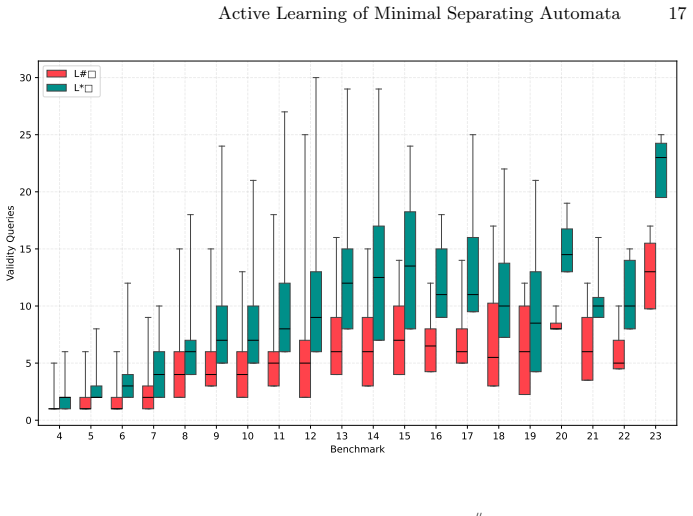
We propose a simple active learning algorithm, inspired by L#, that learns a minimal separating DFA for disjoint languages L1 and L2 if one exists. Experiments show that our algorithm significantly outperforms existing active learning algorithms on both randomly generated and industrial benchmarks.
What carries the argument
The L# inspired active learning algorithm that builds a minimal hypothesis DFA through targeted queries to an oracle.
Load-bearing premise
The two languages are disjoint and there exists a finite minimal DFA that separates them.
What would settle it
Take two disjoint regular languages with a known small minimal separating DFA and run the algorithm to see if it returns exactly that minimal DFA or a correct separator of that size.
Figures




read the original abstract
A DFA separates two disjoint languages $L_1$ and $L_2$ if it accepts every word in $L_1$ and rejects every word in $L_2$. Algorithms for active learning of small separating DFAs have many applications, e.g., for learning network invariants, learning contextual assumptions in compositional verification, learning state machines from large amounts of log data, and learning bug pattern descriptions. We propose a simple active learning algorithm, inspired by $L^{\#}$, that learns a minimal separating DFA for disjoint languages $L_1$ and $L_2$ if one exists. Experiments show that our algorithm significantly outperforms existing active learning algorithms on both randomly generated and industrial benchmarks.
Editorial analysis
A structured set of objections, weighed in public.
Referee Report
Summary. The manuscript proposes a simple active learning algorithm inspired by L# that constructs a minimal separating DFA for two disjoint languages L1 and L2 whenever a finite minimal separator exists. The central claim is conditional correctness under the stated preconditions together with empirical evidence of outperformance versus prior active-learning methods on random and industrial benchmarks.
Significance. If the algorithm is correct, the work supplies a practical tool for automata-learning tasks that arise in compositional verification, network-invariant inference, log-data mining, and bug-pattern extraction. The explicit focus on minimality and the reported experimental gains on both synthetic and real-world instances constitute a concrete contribution to the active-learning literature.
minor comments (2)
- Abstract: the statement that the algorithm 'learns a minimal separating DFA' should be accompanied by a brief indication of the query model (membership/equivalence) and the precise termination condition to avoid ambiguity for readers who consult only the abstract.
- The experimental section should report the precise performance metrics (e.g., number of queries, automaton size, runtime) and the baseline algorithms used, together with any statistical significance tests, so that the claimed outperformance can be independently assessed.
Simulated Author's Rebuttal
We thank the referee for the positive summary, the recognition of potential applications in compositional verification and related areas, and the recommendation for minor revision. We are pleased that the conditional correctness claim and experimental outperformance are viewed as a concrete contribution.
Circularity Check
No significant circularity detected
full rationale
The paper presents a conditional algorithmic construction: an active-learning procedure, derived from the existing L# algorithm, that returns a minimal separating DFA for disjoint languages L1 and L2 whenever at least one finite separating DFA exists. The stated preconditions (disjointness and existence of a finite minimal separator) directly match the claim's scope, and the algorithm is offered as a simple, terminating procedure under those preconditions rather than a derivation that reduces to its own fitted values or self-referential definitions. No equations, parameter fits, or load-bearing self-citations that would force the result by construction appear in the provided material; empirical outperformance on random and industrial benchmarks is reported separately. The derivation chain is therefore self-contained against external benchmarks and does not exhibit any of the enumerated circularity patterns.
Axiom & Free-Parameter Ledger
axioms (1)
- standard math Deterministic finite automata are closed under the operations needed to construct separators from query answers.
Reference graph
Works this paper leans on
-
[1]
Angluin, D.: Learning regular sets from queries and counterexamples. Inf. Comput. 75(2), 87–106 (1987).https://doi.org/10.1016/0890-5401(87)90052-6
-
[2]
Balle, B., Carreras, X., Luque, F.M., Quattoni, A.: Spectral learning of weighted automata - A forward-backward perspective. Mach. Learn.96(1-2), 33–63 (2014). https://doi.org/10.1007/S10994-013-5416-X
-
[3]
Bar-Sinai, M., Elyasaf, A., Weiss, G., Weiss, Y.: Provengo: A tool suite for scenario driven model-based testing. In: ASE. pp. 2062–2065. IEEE (2023).https://doi. org/10.48550/ARXIV.2308.15938
-
[4]
Biermann, A.W., Feldman, J.A.: On the synthesis of finite-state machines from samples of their behavior. IEEE Trans. Computers21(6), 592–597 (1972),https: //doi.org/10.1109/TC.1972.5009015
-
[5]
Bruy` ere, V., Garhewal, B., P´ erez, G.A., Staquet, G., Vaandrager, F.W.: Active learning of mealy machines with timers. In: Prabhakar, P., Vandin, A. (eds.) Quan- titative Evaluation of Systems and Formal Modeling and Analysis of Timed Sys- tems - Second International Joint Conference, QEST+FORMATS 2025, Aarhus, Active Learning of Minimal Separating Aut...
-
[6]
In: Kowalewski, S., Philippou, A
Chen, Y., Farzan, A., Clarke, E.M., Tsay, Y., Wang, B.: Learning minimal sepa- rating dfa’s for compositional verification. In: Kowalewski, S., Philippou, A. (eds.) Tools and Algorithms for the Construction and Analysis of Systems, 15th Interna- tional Conference, TACAS 2009, Held as Part of the Joint European Conferences on Theory and Practice of Softwar...
-
[7]
Chow, T.: Testing software design modeled by finite-state machines. IEEE Trans. Software Eng.4(3), 178–187 (1978).https://doi.org/10.1109/TSE.1978.231496
-
[8]
D’Antoni, L., Veanes, M.: Automata modulo theories. Commun. ACM64(5), 86– 95 (2021).https://doi.org/10.1145/3419404
-
[9]
In: Finkbeiner, B., Kov´ acs, L
Dierl, S., Fiterau-Brostean, P., Howar, F., Jonsson, B., Sagonas, K., T˚ aquist, F.: Scalable tree-based register automata learning. In: Finkbeiner, B., Kov´ acs, L. (eds.) Tools and Algorithms for the Construction and Analysis of Systems - 30th Interna- tional Conference, TACAS 2024, Held as Part of the European Joint Conferences on Theory and Practice o...
-
[10]
Geuvers, H., Jacobs, B.: Relating apartness and bisimulation. Logical Methods in Computer ScienceV olume 17, Issue 3(Jul 2021).https://doi.org/10.46298/ lmcs-17(3:15)2021
work page 2021
-
[11]
Gold, E.M.: Complexity of automaton identification from given data. Inf. Control. 37(3), 302–320 (1978).https://doi.org/10.1016/S0019-9958(78)90562-4
-
[12]
Grinchtein, O., Leucker, M., Piterman, N.: Inferring network invariants automat- ically. In: Furbach, U., Shankar, N. (eds.) Automated Reasoning, Third Interna- tional Joint Conference, IJCAR 2006, Seattle, WA, USA, August 17-20, 2006, Proceedings. Lecture Notes in Computer Science, vol. 4130, pp. 483–497. Springer (2006),https://doi.org/10.1007/11814771_40
-
[13]
Heule, M., Verwer, S.: Exact DFA identification using SAT solvers. In: ICGI. Lec- ture Notes in Computer Science, vol. 6339, pp. 66–79. Springer (2010).https: //doi.org/10.1007/978-3-642-15488-1_7
-
[14]
Cambridge University Press (Apr 2010).https://doi.org/10.1017/ CBO9781139194655
de la Higuera, C.: Grammatical Inference: Learning Automata and Gram- mars. Cambridge University Press (Apr 2010).https://doi.org/10.1017/ CBO9781139194655
work page 2010
-
[15]
Hopcroft, J., Ullman, J.: Introduction to Automata Theory, Languages and Com- putation. Addison-Wesley (1979)
work page 1979
-
[16]
Ishigami, Y., Tani, S.: VC-dimensions of finite automata and commutative finite automata with k letters and n states. Discret. Appl. Math.74(2), 123–134 (1997). https://doi.org/10.1016/S0166-218X(96)00025-X
-
[17]
Jasper, M., Mues, M., Murtovi, A., Schl¨ uter, M., Howar, F., Steffen, B., Schordan, M., Hendriks, D., Schiffelers, R.R.H., Kuppens, H., Vaandrager, F.W.: RERS 2019: Combining synthesis with real-world models. In: TACAS (3). Lecture Notes in Computer Science, vol. 11429, pp. 101–115. Springer (2019).https://doi.org/ 10.1007/978-3-030-17502-3_7
-
[18]
Lee, M., So, S., Oh, H.: Synthesizing regular expressions from examples for intro- ductory automata assignments. In: Fischer, B., Schaefer, I. (eds.) Proceedings of the 2016 ACM SIGPLAN International Conference on Generative Programming: Concepts and Experiences, GPCE 2016, Amsterdam, The Netherlands, October 31 22 Jasper Laumen, Leonne Snel, Frits Vaandr...
-
[19]
Leucker, M., Neider, D.: Learning minimal deterministic automata from inexpe- rienced teachers. In: Margaria, T., Steffen, B. (eds.) Leveraging Applications of Formal Methods, Verification and Validation. Technologies for Mastering Change - 5th International Symposium, ISoLA 2012, Heraklion, Crete, Greece, October 15-18, 2012, Proceedings, Part I. Lecture...
-
[20]
Moeller, M., Wiener, T., Solko-Breslin, A., Koch, C., Foster, N., Silva, A.: Au- tomata learning with an incomplete teacher. In: ECOOP. LIPIcs, vol. 263, pp. 21:1–21:30. Schloss Dagstuhl - Leibniz-Zentrum f¨ ur Informatik (2023).https: //doi.org/10.4230/LIPICS.ECOOP.2023.21
-
[21]
de Moura, L.M., Bjørner, N.S.: Z3: an efficient SMT solver. In: TACAS. Lecture Notes in Computer Science, vol. 4963, pp. 337–340. Springer (2008).https://doi. org/10.1007/978-3-540-78800-3_24
-
[22]
Muˇ skardin, E., Aichernig, B., Pferscher, A., Tappler, M.: Aalpy: an active automata learning library. Innovations in Systems and Software Engineering18, 1–10 (03 2022).https://doi.org/10.1007/s11334-022-00449-3
-
[23]
In: Chakraborty, S., Mukund, M
Neider, D.: Computing minimal separating dfas and regular invariants using SAT and SMT solvers. In: Chakraborty, S., Mukund, M. (eds.) Automated Technol- ogy for Verification and Analysis - 10th International Symposium, ATVA 2012, Thiruvananthapuram, India, October 3-6, 2012. Proceedings. Lecture Notes in Computer Science, vol. 7561, pp. 354–369. Springer...
work page 2012
-
[24]
Oliveira, A.L., Silva, J.P.M.: Efficient algorithms for the inference of minimum size DFAs. Mach. Learn.44(1/2), 93–119 (2001).https://doi.org/10.1023/A: 1010828029885
work page doi:10.1023/a: 2001
-
[25]
World Scientific (01 1992).https://doi.org/10.1142/9789812797902_0004
Oncina, J., Garc´ ıa, P.: Inferring regular languages in polynomial update time. World Scientific (01 1992).https://doi.org/10.1142/9789812797902_0004
-
[26]
Pena, J.M., Oliveira, A.L.: A new algorithm for exact reduction of incompletely specified finite state machines. IEEE Trans. Comput. Aided Des. Integr. Circuits Syst.18(11), 1619–1632 (1999),https://doi.org/10.1109/43.806807
-
[27]
Pfleeger, C.P.: State reduction in incompletely specified finite-state machines. IEEE Trans. Computers22(12), 1099–1102 (1973),https://doi.org/10.1109/ T-C.1973.223655
-
[28]
In: 10th Conference on Algebra and Coalgebra in Computer Science (CALCO 2023)
Rot, J., Wißmann, T.: Bisimilar states in uncertain structures. In: 10th Conference on Algebra and Coalgebra in Computer Science (CALCO 2023). pp. 12:1–12:17. Leibniz International Proceedings in Informatics (09 2023).https://doi.org/10. 4230/LIPIcs.CALCO.2023.12
work page 2023
- [29]
-
[30]
Cambridge University Press, July 2000.isbn: 9781139168717.doi: 10.1017/cbo9781139168717
Troelstra, A.S., Schwichtenberg, H.: Basic Proof Theory. Cambridge Tracts in The- oretical Computer Science, Cambridge University Press, 2 edn. (2000).https: //doi.org/10.1017/CBO9781139168717
-
[31]
Vaandrager, F.W., Garhewal, B., Rot, J., Wißmann, T.: A new approach for active automata learning based on apartness. In: Fisman, D., Rosu, G. (eds.) Tools and Algorithms for the Construction and Analysis of Systems - 28th International Conference, TACAS 2022, Munich, Germany, April 2-7, 2022, Proceedings, Part Active Learning of Minimal Separating Automa...
-
[32]
Vaandrager, F.W., Sanders, M.: L# for DFAs. In: Jansen, N., Junges, S., Kaminski, B.L., Matheja, C., Noll, T., Quatmann, T., Stoelinga, M., Volk, M. (eds.) Principles of Verification: Cycling the Probabilistic Landscape - Essays Dedicated to Joost- Pieter Katoen on the Occasion of His 60th Birthday, Part III. Lecture Notes in Computer Science, vol. 15262,...
-
[33]
Vasilevskii, M.: Failure diagnosis of automata. Cybernetics and System Analysis 9(4), 653–665 (1973).https://doi.org/https://doi.org/10.1007/BF01068590, (Translated from Kibernetika, No. 4, pp. 98-108, July-August, 1973.)
-
[34]
Verwer, S., Hammerschmidt, C.A.: flexfringe: A passive automaton learning pack- age. In: 2017 IEEE International Conference on Software Maintenance and Evo- lution, ICSME 2017, Shanghai, China, September 17-22, 2017. pp. 638–642. IEEE Computer Society (2017),https://doi.org/10.1109/ICSME.2017.58
-
[35]
CoRRabs/2406.07208(2024),https://doi.org/10.48550/arXiv.2406.07208
Walinga, H., Baumgartner, R., Verwer, S.: Database-assisted automata learning. CoRRabs/2406.07208(2024),https://doi.org/10.48550/arXiv.2406.07208
-
[36]
Yaacov, T., Weiss, G., Amram, G., Hayoun, A.: Automata models for effective bug pattern description. In: 28th ACM/IEEE International Conference on Model Driven Engineering Languages and Systems, MODELS 2025, Grand Rapids, MI, USA, October 5-10, 2025. pp. 119–129. IEEE (2025),https://doi.org/10.1109/ MODELS67397.2025.00017 24 Jasper Laumen, Leonne Snel, Fr...
discussion (0)
Sign in with ORCID, Apple, or X to comment. Anyone can read and Pith papers without signing in.