Population synthesis of Galactic middle-aged pulsar wind nebulae I. Detection prospects for current and future instruments
Pith reviewed 2026-05-19 15:34 UTC · model grok-4.3
pith:AY7ZHEH6 Add to your LaTeX paper
What is a Pith Number?\usepackage{pith}
\pithnumber{AY7ZHEH6}
Prints a linked pith:AY7ZHEH6 badge after your title and writes the identifier into PDF metadata. Compiles on arXiv with no extra files. Learn more
The pith
A population synthesis model that includes the reverberation phase predicts CTAO will detect an order of magnitude more TeV pulsar wind nebulae than currently known.
A machine-rendered reading of the paper's core claim, the machinery that carries it, and where it could break.
Core claim
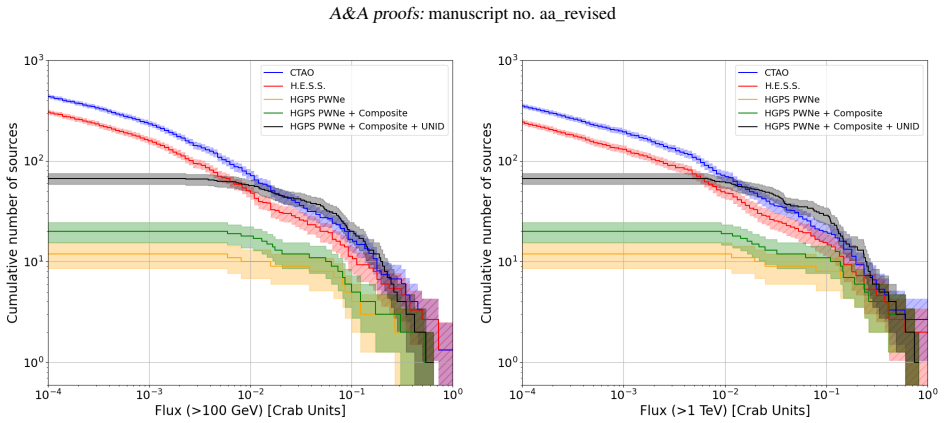
The hybrid TIDE+L framework evolves pulsar wind nebulae through all stages up to 10^5 years by combining a thin-shell dynamical model with a Lagrangian treatment of the supernova remnant during reverberation; when applied to a synthetic Galactic population, it predicts that the Cherenkov Telescope Array Observatory will detect an order of magnitude more PWNe than those firmly detected in the TeV range and will therefore dominate the forthcoming TeV census.
What carries the argument
The hybrid TIDE+L framework, which merges a thin-shell dynamical model with a Lagrangian description of supernova remnant structure during the reverberation phase to compute self-consistent evolution and gamma-ray output for thousands of sources.
Load-bearing premise
The chosen distributions of pulsar spin-down, supernova remnant, and environmental properties match the real Galactic population and the thin-shell plus Lagrangian reverberation treatment introduces no large systematic errors in the predicted fluxes.
What would settle it
The actual number of new TeV pulsar wind nebulae reported by CTAO after its first few years of operation; a count much lower than the model's prediction would show that the input distributions or the reverberation treatment are inaccurate.
Figures



read the original abstract
Pulsar wind nebulae (PWNe) constitute the largest population of Galactic very-high-energy (VHE; $E > 100$ GeV) $\gamma$-ray sources and are key laboratories for studying particle acceleration and pulsar--supernova remnant (SNR) interactions. However, realistic population-level predictions have so far lacked any detailed treatment of the reverberation phase, when the nebula is compressed by the SNR reverse shock, significantly altering its dynamics and radiative spectrum. We employ the hybrid \texttt{TIDE+L} framework, which combines a thin-shell dynamical model with a Lagrangian treatment of the SNR structure during reverberation, allowing self-consistent evolution of thousands of PWNe across all stages up to $10^5$ yr. Each source is evolved under distributions of pulsar spin-down, SNR, and environmental properties, and the resulting $\gamma$-ray fluxes are used to estimate the detectability by current and next-generation $\gamma$-ray observatories while accounting for their sensitivity and sky coverage. The model predicts that the upcoming Cherenkov Telescope Array Observatory (CTAO) will detect an order of magnitude more PWNe than those firmly detected in the TeV range, confirming its dominant contribution to the forthcoming TeV population census. Our results demonstrate that realistic modeling of reverberation is important for predicting the Galactic TeV PWNe population.
Editorial analysis
A structured set of objections, weighed in public.
Referee Report
Summary. The manuscript develops a population synthesis framework for Galactic middle-aged pulsar wind nebulae using the hybrid TIDE+L model, which combines thin-shell dynamical evolution with a Lagrangian treatment of SNR structure during the reverberation phase. Thousands of sources are evolved under literature-based distributions of pulsar spin-down properties, SNR parameters, and ambient conditions up to 10^5 yr; the resulting gamma-ray spectra are folded with instrument sensitivities and sky coverage to predict detection yields, with the central claim that CTAO will detect an order of magnitude more PWNe than the current firmly detected TeV sample.
Significance. If the central prediction holds, the work would be significant for observational planning with CTAO and for interpreting the forthcoming TeV source census, as it supplies the first population-level treatment that self-consistently includes reverberation-induced changes to dynamics and spectra. The scale of the simulation (thousands of sources across all evolutionary stages) and the explicit inclusion of the previously neglected reverberation phase constitute clear technical strengths.
major comments (2)
- [§3] §3 (Model Setup): The adopted distributions for pulsar spin-down luminosity, SNR properties, and environmental density are taken directly from prior literature without a dedicated sensitivity analysis or posterior calibration against the existing H.E.S.S./VERITAS/MAGIC PWN catalog; because the headline CTAO detection forecast is obtained by folding these priors through the reverberation flux calculation, changes in the input distributions can shift the predicted counts by a large factor.
- [§4.2] §4.2 (Reverberation phase): The thin-shell plus Lagrangian treatment is used to compute compression-induced particle losses and magnetic-field evolution, yet no quantitative comparison to full hydrodynamic simulations is presented to bound possible systematic biases in the resulting gamma-ray spectra; this directly affects the integrated fluxes that enter the detectability estimates.
minor comments (2)
- [Table 1] Table 1: the column headers for the current-instrument detection thresholds should explicitly state the assumed observation time and significance criterion.
- [Figure 5] Figure 5: the sky-coverage mask for CTAO could be shown explicitly rather than described only in the text.
Simulated Author's Rebuttal
We thank the referee for the constructive review and the recommendation for minor revision. We address each major comment below, providing clarifications and indicating revisions made to the manuscript.
read point-by-point responses
-
Referee: [§3] §3 (Model Setup): The adopted distributions for pulsar spin-down luminosity, SNR properties, and environmental density are taken directly from prior literature without a dedicated sensitivity analysis or posterior calibration against the existing H.E.S.S./VERITAS/MAGIC PWN catalog; because the headline CTAO detection forecast is obtained by folding these priors through the reverberation flux calculation, changes in the input distributions can shift the predicted counts by a large factor.
Authors: We agree that a dedicated sensitivity analysis would strengthen the robustness of the CTAO detection forecast. In the revised manuscript we have added a new subsection to §3 that quantifies the impact of varying the key input distributions (pulsar spin-down luminosity, SNR energy, and ambient density) within the ranges reported in the cited literature. The resulting variation in predicted CTAO detections is now explicitly stated as a factor of approximately 2–3. A full posterior calibration against the current TeV PWN catalog is complicated by strong observational selection effects and incomplete knowledge of the underlying population; we have therefore added a qualitative comparison of model outputs to the observed sample properties to support the adopted priors. revision: yes
-
Referee: [§4.2] §4.2 (Reverberation phase): The thin-shell plus Lagrangian treatment is used to compute compression-induced particle losses and magnetic-field evolution, yet no quantitative comparison to full hydrodynamic simulations is presented to bound possible systematic biases in the resulting gamma-ray spectra; this directly affects the integrated fluxes that enter the detectability estimates.
Authors: We acknowledge that a direct quantitative comparison to full hydrodynamic simulations would help bound systematic uncertainties in the reverberation-phase spectra. Performing such a comparison across thousands of sources is computationally prohibitive within the scope of this population study. In the revised §4.2 we have expanded the discussion of the TIDE+L hybrid model’s approximations, cited existing literature that compares thin-shell and hydrodynamical treatments for individual PWNe, and now provide an estimated systematic uncertainty of ≲50% on the gamma-ray fluxes during reverberation. This uncertainty is propagated into the final detection-yield ranges reported for CTAO. revision: partial
Circularity Check
No circularity: forward population synthesis from literature priors
full rationale
The derivation evolves thousands of PWNe by sampling spin-down, SNR and environmental distributions drawn from prior literature, applies the hybrid TIDE+L dynamical model, computes gamma-ray spectra, and folds the results with instrument sensitivity curves to obtain a detection count. This is a standard forward Monte-Carlo prediction; none of the output quantities (fluxes, detection numbers) are defined in terms of themselves or obtained by fitting the same data that is later 'predicted'. The central claim therefore remains independent of the paper's own fitted values or self-referential definitions.
Axiom & Free-Parameter Ledger
free parameters (2)
- Distributions of pulsar spin-down properties
- Distributions of SNR and environmental properties
axioms (1)
- domain assumption The thin-shell dynamical model combined with Lagrangian treatment of SNR structure during reverberation accurately captures the evolution of PWNe.
Reference graph
Works this paper leans on
-
[1]
Abe, S., Abhir, J., Abhishek, A., et al. 2024, J. Cosmology Astropart. Phys., 2024, 081
work page 2024
-
[2]
Abeysekara, A. U. et al. 2013, Astroparticle Physics, 50, 26
work page 2013
-
[3]
Abeysekara, A. U. et al. 2017, ApJ, 843, 39
work page 2017
- [4]
-
[5]
Aharonian, F., Ait Benkhali, F., Aschersleben, J., et al. 2024, A&A, 686, A308
work page 2024
-
[6]
Aharonian, F., Akhperjanian, A. G., Bazer-Bachi, A. R., et al. 2006, A&A, 457, 899
work page 2006
-
[7]
2020, ApJ, 905, 76 Aleksi´c, J., Ansoldi, S., Antonelli, L
Albert, A., Alfaro, R., Alvarez, C., et al. 2020, ApJ, 905, 76 Aleksi´c, J., Ansoldi, S., Antonelli, L. A., et al. 2015, Journal of High Energy Astrophysics, 5, 30
work page 2020
- [8]
- [9]
-
[10]
Anderhub, H., Antonelli, L. A., Antoranz, P., et al. 2010, ApJ, 710, 828 Angüner, E. O. & Ergin, T. 2024, Astroparticle Physics, 158, 102936
work page 2010
-
[11]
Bandiera, R., Bucciantini, N., Martín, J., Olmi, B., & Torres, D. F. 2020, MN- RAS, 499, 2051
work page 2020
-
[12]
Bandiera, R., Bucciantini, N., Martín, J., Olmi, B., & Torres, D. F. 2021, MN- RAS, 508, 3194
work page 2021
-
[13]
Batzofin, R., Cristofari, P., Egberts, K., Steppa, C., & Meyer, D. M. A. 2024, Astronomy & Astrophysics, 687, A279
work page 2024
-
[14]
Batzofin, R., Egberts, K., Meyer, D. M.-A., & Steppa, C. 2025, A&A, 701, L4
work page 2025
-
[15]
Becker, W. & Huang, H. H. 2007, 363rd WE-Heraeus Seminar on Neutron Stars and Pulsars: 40 Years after the Discovery. Posters and Contributed Talks
work page 2007
-
[16]
Blondin, J. M., Chevalier, R. A., & Frierson, D. M. 2001, ApJ, 563, 806
work page 2001
- [17]
-
[18]
Bucciantini, N., Blondin, J. M., Del Zanna, L., & Amato, E. 2003, A&A, 405, 617
work page 2003
-
[19]
2024, ApJS, 271, 25 Cherenkov Telescope Array Consortium
Cao, Z., Aharonian, F., An, Q., et al. 2024, ApJS, 271, 25 Cherenkov Telescope Array Consortium. 2019, Science with the Cherenkov Telescope Array Conceição, R. 2023, arXiv e-prints, arXiv:2309.04577
-
[20]
Cristofari, P., Gabici, S., Humensky, T. B., et al. 2017, MNRAS, 471, 201 de Oña-Wilhelmi, E., Rudak, B., Barrio, J. A., et al. 2013, Astroparticle Physics, 43, 287 De Sarkar, A., Zhang, W., Martín, J., et al. 2022, A&A, 668, A23 Del Zanna, L., V olpi, D., Amato, E., & Bucciantini, N. 2006, A&A, 453, 621
work page 2017
-
[21]
1986, Non-Uniform Random Variate Generation(originally pub- lished with (Springer-Verlag)
Devroye, L. 1986, Non-Uniform Random Variate Generation(originally pub- lished with (Springer-Verlag)
work page 1986
-
[22]
2008, Ap&SS, 316, 43 Ekström, S., Georgy, C., Eggenberger, P., et al
Eggenberger, P., Meynet, G., Maeder, A., et al. 2008, Ap&SS, 316, 43 Ekström, S., Georgy, C., Eggenberger, P., et al. 2012, Astronomy & Astro- physics, 537, A146
work page 2008
-
[23]
Fang, J. & Zhang, L. 2010, A&A, 515, A20 Faucher-Giguère, C.-A. & Kaspi, V . M. 2006, ApJ, 643, 332 Fermi-LAT Collaboration, Acharyya, A., Adelfio, A., et al. 2025, ApJ, 989, 110
work page 2010
-
[24]
Ferreira, S. E. S. & de Jager, O. C. 2008, A&A, 478, 17 Article number, page 15 A&A proofs:manuscript no. aa_revised
work page 2008
-
[25]
2022, Monthly Notices of the Royal Astro- nomical Society, 511, 1439
Fiori, M., Olmi, B., Amato, E., et al. 2022, Monthly Notices of the Royal Astro- nomical Society, 511, 1439
work page 2022
-
[26]
Fiori, M., Zampieri, L., Burtovoi, A., Caraveo, P., & Tibaldo, L. 2020, MNRAS, 499, 3494
work page 2020
-
[27]
Gaensler, B. M. & Slane, P. O. 2006, ARA&A, 44, 17
work page 2006
- [28]
-
[29]
2010, PhD thesis, University of Geneva, Switzerland Gullón, M., Pons, J
Georgy, C. 2010, PhD thesis, University of Geneva, Switzerland Gullón, M., Pons, J. A., Miralles, J. A., et al. 2015, MNRAS, 454, 615 H. E. S. S. Collaboration, Abdalla, H., Abramowski, A., et al. 2018a, A&A, 612, A2 H. E. S. S. Collaboration, Abdalla, H., Abramowski, A., et al. 2018b, A&A, 612, A1
work page 2010
-
[30]
Review on the Observed and Physical Properties of Core Collapse Supernovae
Hamuy, M. 2003, arXiv e-prints [arXiv:astro-ph/0301006]
work page internal anchor Pith review Pith/arXiv arXiv 2003
-
[31]
Horvath, J. E. 2019, MNRAS, 484, 1983
work page 2019
-
[32]
Hurt, R. et al. 2025, mw_plot documentation,https://milkyway-plot. readthedocs.io/en/stable/, accessed: 2026-03-28
work page 2025
-
[33]
A., Karastergiou, A., & Kramer, M
Johnston, S., Smith, D. A., Karastergiou, A., & Kramer, M. 2020, MNRAS, 497, 1957
work page 2020
-
[34]
2013, in The Universe Evolution: As- trophysical and Nuclear Aspects
Kargaltsev, O., Rangelov, B., & Pavlov, G. 2013, in The Universe Evolution: As- trophysical and Nuclear Aspects. Edited by I. Strakovsky and L. Blokhintsev. Nova Science Publishers, 359–406
work page 2013
- [35]
-
[36]
Komissarov, S. S. & Lyubarsky, Y . E. 2004, MNRAS, 349, 779
work page 2004
-
[37]
2008, in International Cosmic Ray Conference, V ol
Konopelko, A. 2008, in International Cosmic Ray Conference, V ol. 2, Interna- tional Cosmic Ray Conference, 767–770
work page 2008
-
[38]
Lyne, A. G., Jordan, C. A., Graham-Smith, F., et al. 2015, MNRAS, 446, 857
work page 2015
-
[39]
Martin, J. & Torres, D. F. 2022, Journal of High Energy Astrophysics, 36, 128 Martín, J., Torres, D. F., & Pedaletti, G. 2016, MNRAS, 459, 3868 Martín, J., Torres, D. F., & Rea, N. 2012, MNRAS, 427, 415
work page 2022
-
[40]
Martin, P., de Guillebon, L., Collard, E., et al. 2024, A&A, 690, A116
work page 2024
-
[41]
2025, arXiv e-prints, arXiv:2507.06627
Martin, P., Mertz, I., Kempf, J., et al. 2025, arXiv e-prints, arXiv:2507.06627
-
[42]
Martin, P., Tibaldo, L., Marcowith, A., & Abdollahi, S. 2022, A&A, 666, A7
work page 2022
-
[43]
Martinez, L., Anderson, J. P., Bersten, M. C., et al. 2022, Astronomy & Astro- physics, 660, A42
work page 2022
-
[44]
Meyer, D. M.-A. & Meliani, Z. 2022, MNRAS, 515, L29
work page 2022
-
[45]
M.-A., Meliani, Z., & Torres, D
Meyer, D. M.-A., Meliani, Z., & Torres, D. F. 2024, A&A, 692, A207
work page 2024
-
[46]
Meyer, D. M.-A. & Torres, D. F. 2025, MNRAS, 537, 186
work page 2025
- [47]
-
[48]
Mukherjee, R. 2016, Nuclear and Particle Physics Proceedings, 273-275, 367, 37th International Conference on High Energy Physics (ICHEP) Müller, B., Melson, T., Heger, A., & Janka, H.-T. 2017, MNRAS, 472, 491
work page 2016
-
[49]
Nadyozhin, D. K. 2003, MNRAS, 346, 97
work page 2003
- [50]
-
[51]
2016, Jour- nal of Plasma Physics, 82, 635820601
Olmi, B., Del Zanna, L., Amato, E., Bucciantini, N., & Mignone, A. 2016, Jour- nal of Plasma Physics, 82, 635820601
work page 2016
- [52]
- [53]
-
[54]
Porter, T. A., Moskalenko, I. V ., & Strong, A. W. 2006, The Astrophysical Jour- nal, 648, L29
work page 2006
- [55]
-
[56]
2009, Research in Astronomy and Astro- physics, 9, 449
Qiao, W.-F., Zhang, L., & Fang, J. 2009, Research in Astronomy and Astro- physics, 9, 449
work page 2009
-
[57]
Quintana, A. L., Wright, N. J., & Martínez García, J. 2025, MNRAS, 538, 1367
work page 2025
-
[58]
Renzo, M., Ott, C. D., Shore, S. N., & de Mink, S. E. 2017, A&A, 603, A118
work page 2017
-
[59]
Reynolds, S. P. & Chevalier, R. A. 1984, ApJ, 278, 630
work page 1984
-
[60]
Rico, J. 2016, Nuclear and Particle Physics Proceedings, 273-275, 328, 37th In- ternational Conference on High Energy Physics (ICHEP)
work page 2016
-
[61]
2021, New Astronomy, 83, 101498
Rozwadowska, K., Vissani, F., & Cappellaro, E. 2021, New Astronomy, 83, 101498
work page 2021
-
[62]
Scharrer, N., Spencer, S. T., Joshi, V ., & Mitchell, A. M. W. 2025, J. Cosmology Astropart. Phys., 2025, 096
work page 2025
-
[63]
2017, in Handbook of Supernovae, ed
Slane, P. 2017, in Handbook of Supernovae, ed. A. W. Alsabti & P. Murdin, 2159
work page 2017
-
[64]
Sukhbold, T., Ertl, T., Woosley, S. E., Brown, J. M., & Janka, H. T. 2016, ApJ, 821, 38 SWGO Collaboration et al. 2025, arXiv e-prints, arXiv:2506.01786
-
[65]
Tanaka, S. J. & Takahara, F. 2010, The Astrophysical Journal, 715, 1248
work page 2010
-
[66]
Tanaka, S. J. & Takahara, F. 2011, ApJ, 741, 40
work page 2011
- [67]
-
[68]
F., Cillis, A., Martín, J., & de Oña Wilhelmi, E
Torres, D. F., Cillis, A., Martín, J., & de Oña Wilhelmi, E. 2014, Journal of High Energy Astrophysics, 1, 31
work page 2014
-
[69]
Torres, D. F. & Lin, T. 2018, ApJ, 864, L2
work page 2018
-
[70]
Torres, D. F., Lin, T., & Coti Zelati, F. 2019, MNRAS, 486, 1019
work page 2019
-
[71]
F., Martín, J., de Oña Wilhelmi, E., & Cillis, A
Torres, D. F., Martín, J., de Oña Wilhelmi, E., & Cillis, A. 2013, MNRAS, 436, 3112
work page 2013
-
[72]
Truelove, J. K. & McKee, C. F. 1999, ApJS, 120, 299 van der Swaluw, E., Achterberg, A., Gallant, Y . A., & Tóth, G. 2001, A&A, 380, 309 van Rensburg, C., Krüger, P. P., & Venter, C. 2018, MNRAS, 477, 3853 V orster, M. J., Tibolla, O., Ferreira, S. E. S., & Kaufmann, S. 2013, ApJ, 773, 139
work page 1999
-
[73]
Watters, K. P. & Romani, R. W. 2011, ApJ, 727, 123
work page 2011
-
[74]
Zampieri, L., Pastorello, A., Turatto, M., et al. 2003, MNRAS, 338, 711
work page 2003
- [75]
-
[76]
Zhu, B.-T., Zhang, L., & Fang, J. 2018, A&A, 609, A110 Article number, page 16 De Sarkar et al.: Population synthesis of middle-aged PWNe - I 10 20 30 40 50 Zero-age main-sequence mass M (M ) 0.000 0.025 0.050 0.075 0.100 0.125 0.150 0.175Probability Density Inverse transform sampled Theoretical IMF M 2.35 20 40 60 80 100 120 Zero-age main-sequence mass M...
work page 2018
discussion (0)
Sign in with ORCID, Apple, or X to comment. Anyone can read and Pith papers without signing in.