A Pilot Study of Mildly Recycled Pulsars: A Case Study of PSR J2338+4818
Pith reviewed 2026-05-20 17:10 UTC · model grok-4.3
The pith
No pulse nulling is detected in the mildly recycled pulsar PSR J2338+4818 across multiple observing bands.
A machine-rendered reading of the paper's core claim, the machinery that carries it, and where it could break.
Core claim
The paper reports an updated timing solution for PSR J2338+4818 together with the result that no pulse nulling occurs during the observed epochs. A preliminary single-pulse search in the commissioning-phase ultra-wideband data and systematic searches in other bands find 27,228 pulses above S/N = 7. The MCMC analysis returns no nulling fraction, and the long-term nulling possibly seen in prior studies is absent from all current observations. Interstellar scintillation is detected, with the quoted ranges of timescale and bandwidth, yet the secondary spectra show no arcs.
What carries the argument
Markov Chain Monte Carlo analysis applied to single-pulse sequences to test for the presence of nulling states.
If this is right
- Any long-term nulling previously reported must be either transient or confined to epochs not covered here.
- The pulsar maintains steady emission across the sampled frequencies, consistent with a stable magnetospheric state.
- Scintillation parameters supply new constraints on the turbulence scale of the interstellar medium along this line of sight.
- Updated timing ephemeris supports continued precision monitoring to test evolutionary models for mildly recycled pulsars.
Where Pith is reading between the lines
- If nulling remains absent over longer baselines, this object may represent a cleaner example of emission from a partially recycled neutron star than objects that show nulling.
- The measured scintillation bandwidths and timescales can be combined with dispersion-measure variations to map small-scale structure in the local interstellar plasma.
- The absence of scintillation arcs suggests that the scattering screen geometry for this pulsar does not produce the usual parabolic signature, which could be checked with higher-resolution dynamic spectra.
Load-bearing premise
The limited set of observation epochs and frequency bands is sufficient to rule out the long-term nulling reported in earlier studies.
What would settle it
A future monitoring campaign that records one or more clear episodes of pulse nulling in PSR J2338+4818 would show that nulling can occur intermittently and was simply missed in the present data set.
Figures




read the original abstract
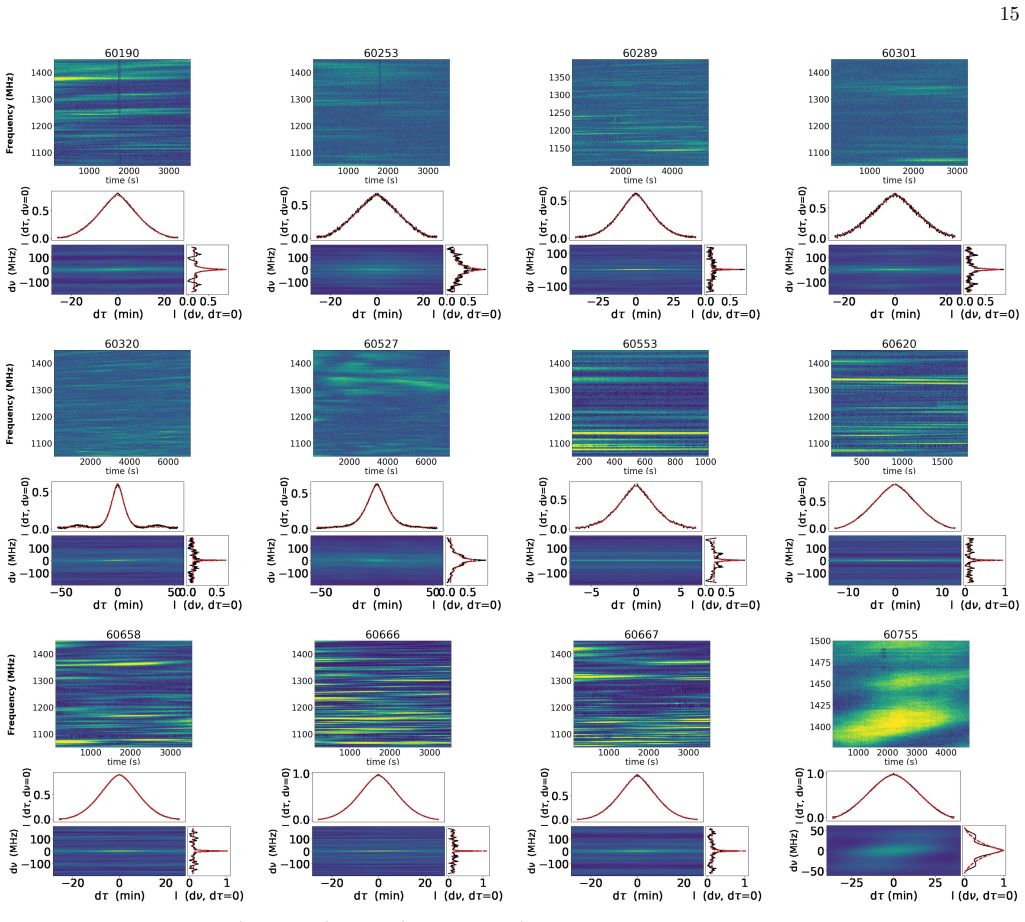
Mildly recycled pulsars are neutron stars partially spun up through relatively short mass-transfer phases, typically with massive carbon-oxygen (CO) or oxygen-neon-magnesium (ONeMg) white dwarf companions. PSR J2338+4818, a mildly recycled pulsar, was discovered with the Five-hundred-meter Aperture Spherical Telescope (FAST). As a pilot study on the formation and evolutionary pathways of mildly recycled pulsars, we present the updated timing solution for PSR J2338+4818 and examine its single pulses and scintillation properties. Aided by the sensitivity of FAST, the single pulses of PSR J2338+4818 were systematically studied. 27,228 single pulses with S/N > 7 have been detected in our observations. For the FAST ultra-wideband observation on MJD 61045, the receiver was still in the technical commissioning phase, and then only a preliminary single-pulse search was performed. Pulse nulling was examined using a Markov Chain Monte Carlo (MCMC) method, but no evidence for nulling was found. The possible long-term nulling reported by previous studies did not occur in any of our observations in either the 1.0 to 1.5 GHz band or the 300 to 600 MHz band. Interstellar scintillation is evident in our observations. The measured scintillation timescales and bandwidths range from 2.93 to 25.26 minutes and 1.68 to 27.41 MHz, respectively. In all observations, no clear scintillation arc was found in the secondary spectra of PSR J2338+4818.
Editorial analysis
A structured set of objections, weighed in public.
Referee Report
Summary. The paper presents a pilot study of the mildly recycled pulsar PSR J2338+4818, including an updated timing solution, analysis of 27,228 single pulses (S/N > 7) detected across observations in the 1.0-1.5 GHz and 300-600 MHz bands, an MCMC-based search finding no evidence for pulse nulling, and measurements of interstellar scintillation with timescales of 2.93-25.26 minutes and bandwidths of 1.68-27.41 MHz, noting no clear scintillation arcs and that previously reported long-term nulling was absent from the data.
Significance. If the non-detection of nulling and the scintillation parameters hold after verification of data quality and coverage, the work provides direct measurements from a large sample of single pulses that can inform models of emission and propagation in mildly recycled pulsars. The scale of the single-pulse dataset (over 27,000 pulses) is a clear strength for statistical robustness in this pilot study.
major comments (2)
- [Abstract and Results section on nulling analysis] The central claim that 'the possible long-term nulling reported by previous studies did not occur in any of our observations' is load-bearing for the nulling conclusion, yet the manuscript provides no quantitative details on the number of epochs, individual session lengths, total integration time, or MJD span. Without this, it is impossible to assess whether the temporal sampling is adequate to rule out long-term off-states (hours to days) even while detecting pulses during on-states.
- [Single-pulse and nulling analysis] The MCMC analysis for short-term nulling is presented as showing no evidence, but the manuscript should specify the priors, convergence diagnostics, and how the S/N > 7 threshold and pulse selection were handled to ensure the nulling fraction upper limit is robust and not affected by post-hoc choices.
minor comments (2)
- [Observations] Clarify the impact of the commissioning-phase status of the ultra-wideband receiver on MJD 61045 for the preliminary single-pulse search, including any differences in calibration or sensitivity relative to the other observations.
- [Scintillation properties] The scintillation parameters are reported as ranges; provide per-epoch values with uncertainties and the method used to measure timescales and bandwidths for reproducibility.
Simulated Author's Rebuttal
We thank the referee for their constructive feedback on our pilot study of PSR J2338+4818. The comments highlight areas where additional quantitative details and methodological transparency will strengthen the presentation of the nulling analysis. We address each point below and will revise the manuscript to incorporate the requested information.
read point-by-point responses
-
Referee: [Abstract and Results section on nulling analysis] The central claim that 'the possible long-term nulling reported by previous studies did not occur in any of our observations' is load-bearing for the nulling conclusion, yet the manuscript provides no quantitative details on the number of epochs, individual session lengths, total integration time, or MJD span. Without this, it is impossible to assess whether the temporal sampling is adequate to rule out long-term off-states (hours to days) even while detecting pulses during on-states.
Authors: We agree that a quantitative summary of the observational coverage is essential for evaluating the robustness of the long-term nulling non-detection. The current manuscript text is indeed limited in this regard. In the revised version, we will add a new subsection (or expanded table) in the Observations section that explicitly lists the number of epochs, individual session lengths, total integration time, and full MJD span across the 1.0-1.5 GHz and 300-600 MHz bands. This will include the specific FAST ultra-wideband observation on MJD 61045 and all other sessions, allowing direct assessment of whether the sampling adequately rules out long-term off-states. revision: yes
-
Referee: [Single-pulse and nulling analysis] The MCMC analysis for short-term nulling is presented as showing no evidence, but the manuscript should specify the priors, convergence diagnostics, and how the S/N > 7 threshold and pulse selection were handled to ensure the nulling fraction upper limit is robust and not affected by post-hoc choices.
Authors: We concur that the MCMC methodology requires fuller specification for reproducibility and to confirm the robustness of the nulling fraction upper limit. In the revised manuscript, we will expand the relevant paragraph in the Results or Methods section to detail the priors (e.g., uniform prior on the nulling fraction between 0 and 1), convergence diagnostics (such as Gelman-Rubin statistics and trace inspection), and confirm that the S/N > 7 threshold was applied uniformly to all 27,228 pulses prior to the MCMC fitting with no subsequent post-hoc adjustments to the selection. This will demonstrate that the analysis is not sensitive to arbitrary choices. revision: yes
Circularity Check
No circularity; results are direct observational measurements
full rationale
The paper presents empirical results from FAST telescope observations of PSR J2338+4818, including detection of 27,228 single pulses (S/N > 7), MCMC analysis finding no evidence for pulse nulling, and measured scintillation timescales (2.93 to 25.26 minutes) and bandwidths (1.68 to 27.41 MHz). No derivations, models, or predictions are present that reduce to fitted inputs by construction, self-definition, or self-citation chains. All values are direct data products from the observations, with the non-detection of nulling and scintillation properties reported as measurements rather than outputs of any closed-loop fitting or ansatz. The analysis is self-contained as straightforward reporting of telescope data without load-bearing reductions to prior fitted quantities or author-specific uniqueness theorems.
Axiom & Free-Parameter Ledger
Lean theorems connected to this paper
-
IndisputableMonolith/Cost/FunctionalEquation.leanwashburn_uniqueness_aczel unclear?
unclearRelation between the paper passage and the cited Recognition theorem.
Pulse nulling was examined using a Markov Chain Monte Carlo (MCMC) method... The possible long-term nulling reported by previous studies did not occur in any of our observations
-
IndisputableMonolith/Foundation/RealityFromDistinction.leanreality_from_one_distinction unclear?
unclearRelation between the paper passage and the cited Recognition theorem.
Interstellar scintillation... scintillation timescales and bandwidths range from 2.93 to 25.26 minutes and 1.68 to 27.41 MHz
What do these tags mean?
- matches
- The paper's claim is directly supported by a theorem in the formal canon.
- supports
- The theorem supports part of the paper's argument, but the paper may add assumptions or extra steps.
- extends
- The paper goes beyond the formal theorem; the theorem is a base layer rather than the whole result.
- uses
- The paper appears to rely on the theorem as machinery.
- contradicts
- The paper's claim conflicts with a theorem or certificate in the canon.
- unclear
- Pith found a possible connection, but the passage is too broad, indirect, or ambiguous to say the theorem truly supports the claim.
Reference graph
Works this paper leans on
-
[1]
Fichtenbauer, T. D. J. 2023, ApJ, 948, 32, doi: 10.3847/1538-4357/acbb68
-
[2]
Berezina, M., Champion, D. J., Freire, P. C. C., et al. 2017, MNRAS, 470, 4421, doi: 10.1093/mnras/stx1518
-
[3]
Bhat, N. D. R., Rao, A. P., & Gupta, Y. 1999, ApJS, 121, 483, doi: 10.1086/313198
-
[4]
Bhattacharya, D., & van den Heuvel, E. P. J. 1991, PhR, 203, 1, doi: 10.1016/0370-1573(91)90064-S
-
[5]
Cruces, M., Reisenegger, A., & Tauris, T. M. 2019, MNRAS, 490, 2013, doi: 10.1093/mnras/stz2701
-
[6]
Cruces, M., Champion, D. J., Li, D., et al. 2021, MNRAS, 508, 300, doi: 10.1093/mnras/stab2540
-
[7]
Dewi, J. D. M., Podsiadlowski, P., & Pols, O. R. 2005, MNRAS, 363, L71, doi: 10.1111/j.1745-3933.2005.00085.x
-
[8]
Foreman-Mackey, D., Hogg, D. W., Lang, D., & Goodman, J. 2013, PASP, 125, 306, doi: 10.1086/670067
-
[9]
Freire, P. C. C., & Ridolfi, A. 2018, MNRAS, 476, 4794, doi: 10.1093/mnras/sty524
-
[10]
1990, in Astronomical Society of the Pacific Conference Series, Vol
Iben, Jr., I. 1990, in Astronomical Society of the Pacific Conference Series, Vol. 11, Confrontation Between Stellar Pulsation and Evolution, ed. C. Cacciari & G. Clementini, 483–493
work page 1990
-
[11]
Iben, Jr., I., & Tutukov, A. V. 1984, ApJS, 54, 335, doi: 10.1086/190932
-
[12]
2020, Research in Astronomy and Astrophysics, 20, 064, doi: 10.1088/1674-4527/20/5/64
Jiang, P., Tang, N.-Y., Hou, L.-G., et al. 2020, Research in Astronomy and Astrophysics, 20, 064, doi: 10.1088/1674-4527/20/5/64
-
[13]
2018, ApJ, 855, 14, doi: 10.3847/1538-4357/aaab62
Vallisneri, M. 2018, ApJ, 855, 14, doi: 10.3847/1538-4357/aaab62
-
[14]
Karuppusamy, R., Stappers, B. W., & Lee, K. J. 2012, A&A, 538, A7, doi: 10.1051/0004-6361/201117667
-
[15]
2019, Journal of Astrophysics and Astronomy, 40, 42, doi: 10.1007/s12036-019-9608-z
Konar, S., & Deka, U. 2019, Journal of Astrophysics and Astronomy, 40, 42, doi: 10.1007/s12036-019-9608-z
-
[16]
2016, MNRAS, 458, 868, doi: 10.1093/mnras/stw189
Lazarus, P., Karuppusamy, R., Graikou, E., et al. 2016, MNRAS, 458, 868, doi: 10.1093/mnras/stw189
-
[17]
2002, ApJ, 564, 930, doi: 10.1086/324331
Li, X.-D. 2002, ApJ, 564, 930, doi: 10.1086/324331
- [18]
-
[19]
2021, ApJ, 911, 45, doi: 10.3847/1538-4357/abe62f
Luo, J., Ransom, S., Demorest, P., et al. 2021, ApJ, 911, 45, doi: 10.3847/1538-4357/abe62f
-
[20]
2024, A&A, 683, A183, doi: 10.1051/0004-6361/202348247
Men, Y., & Barr, E. 2024, A&A, 683, A183, doi: 10.1051/0004-6361/202348247
-
[21]
Nan, R., Li, D., Jin, C., et al. 2011, International Journal of Modern Physics D, 20, 989, doi: 10.1142/S0218271811019335 ¨Ozel, F., & Freire, P. 2016, ARA&A, 54, 401, doi: 10.1146/annurev-astro-081915-023322
-
[22]
Palliyaguru, N. T., Perera, B. B. P., McLaughlin, M. A., Os lowski, S., & Siebert, G. L. 2023, MNRAS, 520, 2747, doi: 10.1093/mnras/stad194
-
[23]
2020, The Innovation, 1, 100053, doi: 10.1016/j.xinn.2020.100053
Qian, L., Yao, R., Sun, J., et al. 2020, The Innovation, 1, 100053, doi: 10.1016/j.xinn.2020.100053
-
[24]
Reardon, D. J. 2020, Scintools: Pulsar scintillation data tools,, Astrophysics Source Code Library, record ascl:2011.019 http://ascl.net/2011.019
work page 2020
-
[25]
Reardon, D. J., Coles, W. A., Hobbs, G., et al. 2019, MNRAS, 485, 4389, doi: 10.1093/mnras/stz643
-
[26]
Reardon, D. J., Coles, W. A., Bailes, M., et al. 2020, ApJ, 904, 104, doi: 10.3847/1538-4357/abbd40 21
-
[27]
Reardon, D. J., Main, R., Ocker, S. K., et al. 2025, Nature Astronomy, 9, 1053, doi: 10.1038/s41550-025-02534-6
-
[28]
Rickett, B. J. 1990, ARA&A, 28, 561, doi: 10.1146/annurev.aa.28.090190.003021
- [29]
-
[30]
Ritchings, R. T. 1976, MNRAS, 176, 249, doi: 10.1093/mnras/176.2.249
-
[31]
2022, MNRAS, 512, 5782, doi: 10.1093/mnras/stac821
Sengar, R., Balakrishnan, V., Stevenson, S., et al. 2022, MNRAS, 512, 5782, doi: 10.1093/mnras/stac821
-
[32]
Stovall, K., Freire, P. C. C., Chatterjee, S., et al. 2018, ApJL, 854, L22, doi: 10.3847/2041-8213/aaad06
-
[33]
Susobhanan, A., Kaplan, D. L., Archibald, A. M., et al. 2024, ApJ, 971, 150, doi: 10.3847/1538-4357/ad59f7
-
[34]
Swiggum, J. K., Rosen, R., McLaughlin, M. A., et al. 2015, ApJ, 805, 156, doi: 10.1088/0004-637X/805/2/156
-
[35]
Tauris, T. M., Langer, N., & Kramer, M. 2011, MNRAS, 416, 2130, doi: 10.1111/j.1365-2966.2011.19189.x
-
[36]
Tauris, T. M., Langer, N., & Kramer, M. 2012, MNRAS, 425, 1601, doi: 10.1111/j.1365-2966.2012.21446.x
-
[37]
Tauris, T. M., & Sennels, T. 2000, A&A, 355, 236, doi: 10.48550/arXiv.astro-ph/9909149
work page internal anchor Pith review Pith/arXiv arXiv doi:10.48550/arxiv.astro-ph/9909149 2000
-
[38]
Tauris, T. M., & van den Heuvel, E. P. J. 2006, in Compact stellar X-ray sources, ed. W. H. G. Lewin & M. van der
work page 2006
-
[39]
Formation and Evolution of Compact Stellar X-ray Sources
Klis, Vol. 39, 623–665, doi: 10.48550/arXiv.astro-ph/0303456
work page internal anchor Pith review Pith/arXiv arXiv doi:10.48550/arxiv.astro-ph/0303456
-
[40]
Tauris, T. M., & van den Heuvel, E. P. J. 2023, Physics of Binary Star Evolution. From Stars to X-ray Binaries and Gravitational Wave Sources, doi: 10.48550/arXiv.2305.09388
-
[41]
Tauris, T. M., van den Heuvel, E. P. J., & Savonije, G. J. 2000, ApJL, 530, L93, doi: 10.1086/312496
-
[42]
Tauris, T. M., Kramer, M., Freire, P. C. C., et al. 2017, ApJ, 846, 170, doi: 10.3847/1538-4357/aa7e89
-
[43]
Taylor, J., Ransom, S., & Padmanabh, P. V. 2024, ApJ, 964, 128, doi: 10.3847/1538-4357/ad1ce9 van Straten, W., & Bailes, M. 2011, PASA, 28, 1, doi: 10.1071/AS10021 van Straten, W., Demorest, P., & Oslowski, S. 2012, Astronomical Research and Technology, 9, 237, doi: 10.48550/arXiv.1205.6276
work page internal anchor Pith review Pith/arXiv arXiv doi:10.3847/1538-4357/ad1ce9 2024
-
[44]
2008, in American Institute of Physics Conference Series, Vol
Willems, B., Andrews, J., Kalogera, V., & Belczynski, K. 2008, in American Institute of Physics Conference Series, Vol. 983, 40 Years of Pulsars: Millisecond Pulsars, Magnetars and More, ed. C. Bassa, Z. Wang, A. Cumming, & V. M. Kaspi (AIP), 464–468, doi: 10.1063/1.2900275
-
[45]
2023, Research in Astronomy and Astrophysics, 23, 075016, doi: 10.1088/1674-4527/acd58e
Zhang, C.-P., Jiang, P., Zhu, M., et al. 2023, Research in Astronomy and Astrophysics, 23, 075016, doi: 10.1088/1674-4527/acd58e
discussion (0)
Sign in with ORCID, Apple, or X to comment. Anyone can read and Pith papers without signing in.