GEMS -- Guided Evolutionary Molecule Design for Sustainable Chemicals
Pith reviewed 2026-05-20 16:16 UTC · model grok-4.3
The pith
Domain experts guide genetic algorithms to design sustainable molecules by editing scoring functions and populations through a visual interface without coding.
A machine-rendered reading of the paper's core claim, the machinery that carries it, and where it could break.
Core claim
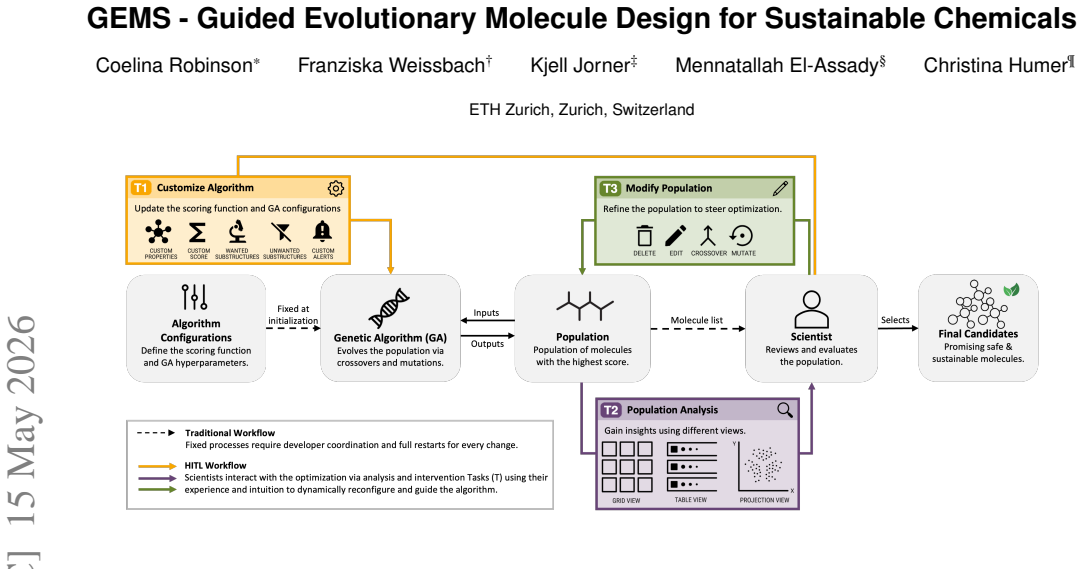
GEMS is an interactive visual analytics tool that enables domain experts to collaborate with a genetic algorithm for molecule design. Users integrate their knowledge by modifying the scoring function and the molecule population, guiding the evolutionary process without requiring programming knowledge or ML developer support. This addresses the shortcomings of low-fidelity ML oracles caused by sparse environmental impact data and the limits of purely numerical scoring functions in capturing nuanced chemical intuition. The system is demonstrated through a usage scenario focused on sustainable antioxidant alternatives and evaluated via interviews with domain scientists who provided feedback on其
What carries the argument
The visual interface allowing direct modification of the scoring function and molecule population to guide the genetic algorithm's evolutionary search for new molecules.
If this is right
- Chemists can contribute domain knowledge to molecule optimization without needing programming expertise or external ML support.
- Guidance from experts can offset the unreliability of low-fidelity oracles when data on environmental impacts is limited.
- The tool supports concrete applications such as identifying sustainable alternatives to antioxidants.
- Collected feedback from domain scientists indicates the interface successfully incorporates chemical intuition into the design loop.
Where Pith is reading between the lines
- Wider use of such guided systems could shorten the time from expert idea to testable sustainable chemical candidates in industrial settings.
- The same visual steering approach might extend to other evolutionary design tasks where expert intuition is hard to encode numerically.
- Pairing GEMS outputs with targeted laboratory validation experiments would provide direct evidence on whether guided designs reduce real-world environmental harm.
Load-bearing premise
Expert modifications to the scoring function and molecule population through the visual interface will produce meaningfully better or more sustainable molecule candidates than an unguided genetic algorithm or low-fidelity ML oracles.
What would settle it
A side-by-side evaluation where molecules generated after expert guidance in GEMS are tested for actual environmental metrics such as toxicity, persistence, or biodegradability and compared against candidates from the unguided algorithm or standard ML methods.
Figures


read the original abstract
Designing safe and sustainable chemicals is critical to combat chemical pollution in our environment. Machine learning (ML) methods have been developed to aid with de novo molecule design. However, data on the environmental impacts of chemical compounds are sparse, resulting in low-fidelity ML oracles and unreliable candidate proposals. Furthermore, generative ML models rely on numerical scoring functions that cannot fully capture the nuanced chemical intuition of expert scientists required for real-world molecular design. We present GEMS-an interactive visual analytics tool that enables domain experts to directly collaborate with a genetic algorithm for molecule design. Users can integrate their expert knowledge to guide the evolutionary process by modifying the scoring function and molecule population without programming knowledge or ML developer support. A usage scenario demonstrates the system's application in designing sustainable antioxidant alternatives. In an interview session with domain scientists, we collected feedback on the usefulness of GEMS.
Editorial analysis
A structured set of objections, weighed in public.
Referee Report
Summary. The manuscript introduces GEMS, an interactive visual analytics tool enabling domain experts to collaborate with a genetic algorithm for de novo design of sustainable chemicals. Users modify the scoring function and molecule population through the visual interface without programming or ML developer support. The paper presents a usage scenario for antioxidant alternatives and reports qualitative feedback from an interview session with domain scientists.
Significance. If the guided process demonstrably improves candidate quality on sustainability metrics, the approach could help address sparse environmental impact data and limitations of purely numerical oracles by incorporating expert chemical intuition directly into evolutionary search. The accessibility focus for non-programmers is a practical strength for interdisciplinary applications.
major comments (2)
- [Usage Scenario] Usage Scenario section: The description of expert modifications to the scoring function and population is presented narratively but contains no quantitative head-to-head comparison (e.g., predicted environmental impact scores, fraction of candidates meeting sustainability thresholds, or population diversity metrics) between guided and unguided GA runs. This is load-bearing for the claim that the interface enables meaningfully better outcomes.
- [Interview Feedback] Interview Feedback section: Feedback is reported qualitatively without specific examples or measures showing that expert-guided changes produced superior molecule candidates relative to the baseline genetic algorithm; this weakens support for the effectiveness of the visual guidance mechanism.
minor comments (2)
- [Abstract] The abstract and system description would benefit from a brief statement of the underlying genetic algorithm parameters (population size, mutation rate, etc.) to allow readers to understand the baseline before modifications.
- [Figures] Figure captions for the interface screenshots should explicitly label which visual elements correspond to scoring-function editing versus population curation.
Simulated Author's Rebuttal
We thank the referee for their detailed and constructive comments on our manuscript. We respond to each major comment below, clarifying the scope of our HCI-focused contribution while addressing concerns about evidence for the guidance mechanism.
read point-by-point responses
-
Referee: [Usage Scenario] Usage Scenario section: The description of expert modifications to the scoring function and population is presented narratively but contains no quantitative head-to-head comparison (e.g., predicted environmental impact scores, fraction of candidates meeting sustainability thresholds, or population diversity metrics) between guided and unguided GA runs. This is load-bearing for the claim that the interface enables meaningfully better outcomes.
Authors: We agree that the Usage Scenario is presented narratively without quantitative head-to-head comparisons. The section is intended to demonstrate the interactive workflow and how domain experts can apply chemical intuition to modify scoring and populations in the absence of reliable numerical oracles. The manuscript's core claim concerns the accessibility of the visual interface for non-programmers rather than algorithmic superiority on sustainability metrics. We have revised the manuscript to include an explicit statement of scope in the Usage Scenario and Discussion sections, noting that quantitative benchmarking of guided versus unguided runs would require a separate optimization-focused evaluation. revision: partial
-
Referee: [Interview Feedback] Interview Feedback section: Feedback is reported qualitatively without specific examples or measures showing that expert-guided changes produced superior molecule candidates relative to the baseline genetic algorithm; this weakens support for the effectiveness of the visual guidance mechanism.
Authors: The Interview Feedback section reports qualitative responses from domain scientists on the perceived usefulness of the visual guidance features. As is standard for HCI evaluations of interactive systems, the study focused on user experience and the ability to incorporate expert knowledge rather than on collecting quantitative measures of candidate superiority. The feedback supports that experts could effectively steer the process, which aligns with our goal of addressing limitations of purely numerical oracles. We have added more detailed paraphrased examples from the interview session to the revised manuscript to illustrate specific ways the interface supported expert input. revision: partial
Circularity Check
No significant circularity; descriptive system presentation with qualitative evaluation
full rationale
The paper presents GEMS as an interactive visual analytics tool for guiding a genetic algorithm in molecule design, illustrated via a usage scenario for antioxidant alternatives and supported by domain scientist interview feedback. No equations, fitted parameters, predictions, or derivation chains appear in the provided text. Claims about expert collaboration and guidance rest on system description and qualitative data rather than any self-referential logic, self-citations, or reductions of outputs to inputs by construction. The work is self-contained as a tool-building and evaluation contribution without circular elements.
Axiom & Free-Parameter Ledger
axioms (1)
- domain assumption Domain experts possess nuanced chemical intuition that numerical scoring functions cannot fully capture and that can usefully guide evolutionary molecule design.
invented entities (1)
-
GEMS interactive visual analytics tool
no independent evidence
Lean theorems connected to this paper
-
IndisputableMonolith/Foundation/AbsoluteFloorClosure.leanreality_from_one_distinction unclear?
unclearRelation between the paper passage and the cited Recognition theorem.
GEMS—an interactive visual analytics tool that enables domain experts to directly collaborate with a genetic algorithm for molecule design... modifying the scoring function and molecule population
What do these tags mean?
- matches
- The paper's claim is directly supported by a theorem in the formal canon.
- supports
- The theorem supports part of the paper's argument, but the paper may add assumptions or extra steps.
- extends
- The paper goes beyond the formal theorem; the theorem is a base layer rather than the whole result.
- uses
- The paper appears to rely on the theorem as machinery.
- contradicts
- The paper's claim conflicts with a theorem or certificate in the canon.
- unclear
- Pith found a possible connection, but the passage is too broad, indirect, or ambiguous to say the theorem truly supports the claim.
Reference graph
Works this paper leans on
-
[1]
D. M. Anstine and O. Isayev. Generative Models as an Emerging Paradigm in the Chemical Sciences.Journal of the American Chemi- cal Society, 145(16):8736–8750, 2023. doi:10.1021/jacs.2c134672
-
[2]
A. Bhattacharya, S. Stumpf, and K. Verbert. An Explanatory Model Steering System for Collaboration between Domain Experts and AI. InACM Proceedings of User Modeling, Adaptation and Personaliza- tion, pp. 75–79, 2024. doi:10.1145/3631700.36648862
-
[3]
B. Bienfait and P. Ertl. JSME: a free molecule editor in JavaScript. Journal of Cheminformatics, 5(1):24, 2013. doi:10.1186/1758-2946-5 -243
- [4]
-
[5]
H. Brunn, G. Arnold, W. K ¨orner, G. Rippen, K. G. Steinh ¨auser, and I. Valentin. PFAS: forever chemicals—persistent, bioaccumulative and mobile. Reviewing the status and the need for their phase out and remediation of contaminated sites.Environmental Sciences Europe, 35(1):20, 2023. doi:10.1186/s12302-023-00721-81
- [6]
-
[7]
M. Cihan Sorkun, D. Mullaj, J. M. V . A. Koelman, and S. Er. ChemPlot, a Python Library for Chemical Space Visualization.Chem- istry–Methods, 2(7):e202200005, 2022. doi:10.1002/cmtd.2022000052
-
[8]
K. Fenner and M. Scheringer. The Need for Chemical Simplifica- tion As a Logical Consequence of Ever-Increasing Chemical Pol- lution.Environmental Science & Technology, 55(21):14470–14472,
-
[9]
doi:10.1021/acs.est.1c049031
-
[10]
S. Fujii, Y . Murakami, T. Yoshizawa, S. Ishida, N. Cho, M. Ohta, T. Honma, K. Yoshizoe, M. Sumita, K. Tsuda, and K. Terayama. ChemTSv3: Generalizing Molecular Design via Flexible Search Space Control. 2025. doi:10.26434/chemrxiv-2025-kdvrt2
-
[11]
A. Goldszal, D. Calanzone, V . Taboga, and P.-L. Bacon. Discovery of Sustainable Refrigerants through Physics-Informed RL Fine-Tuning of Sequence Models, 2025. doi:10.48550/arXiv.2509.195881, 4
-
[12]
S. Gratzl, A. Lex, N. Gehlenborg, H. Pfister, and M. Streit. LineUp: Visual Analysis of Multi-Attribute Rankings.IEEE Transactions on Visualization and Computer Graphics, 19(12):2277–2286, 2013. doi: 10.1109/TVCG.2013.1732
-
[13]
J. He, C. Hua, Y . Wang, and Z. Zheng. Collaborative Intelligence in Sequential Experiments: A Human-in-the-Loop Framework for Drug Discovery.Information Systems Research, 2025. doi:10.1287/isre.2024 .11541
-
[14]
C. Humer, H. Heberle, F. Montanari, T. Wolf, F. Huber, R. Hender- son, J. Heinrich, and M. Streit. ChemInformatics Model Explorer (CIME): exploratory analysis of chemical model explanations.Jour- nal of Cheminformatics, 14(1):21, 2022. doi:10.1186/s13321-022-00600 -z2
-
[15]
C. Humer, R. Nicholls, H. Heberle, M. Heckmann, M. P ¨uhringer, T. Wolf, M. L¨ubbesmeyer, J. Heinrich, J. Hillenbrand, G. V olpin, and M. Streit. CIME4R: Exploring iterative, AI-guided chemical reaction optimization campaigns in their parameter space.Journal of Chemin- formatics, 16(1):51, 2024. doi:10.1186/s13321-024-00840-12
-
[16]
M. Jain, T. Deleu, J. Hartford, C.-H. Liu, A. Hernandez-Garcia, and Y . Bengio. GFlowNets for AI-driven scientific discovery.Digital Discovery, 2(3):557–577, 2023. doi:10.1039/D3DD00002H1, 2
-
[17]
J. H. Jensen. A graph-based genetic algorithm and generative model/Monte Carlo tree search for the exploration of chemical space. Chemical Science, 10(12):3567–3572, 2019. doi:10.1039/C8SC05372C 2
-
[18]
B. Kale, A. Clyde, M. Sun, A. Ramanathan, R. Stevens, and M. E. Papka. ChemoGraph: Interactive Visual Exploration of the Chemical Space.Computer Graphics Forum, 42(3):13–24, 2023. doi:10.1111/ cgf.148072
work page 2023
-
[19]
J. Menke, Y . Nahal, E. J. Bjerrum, M. Kabeshov, S. Kaski, and O. En- gkvist. Metis: a python-based user interface to collect expert feed- back for generative chemistry models.Journal of Cheminformatics, 16(1):100, 2024. doi:10.1186/s13321-024-00892-32
-
[20]
Mitchell.An introduction to genetic algorithms
M. Mitchell.An introduction to genetic algorithms. Complex adaptive systems. MIT Press, 1996. 2
work page 1996
-
[21]
E. Mosqueira-Rey, E. Hern ´andez-Pereira, D. Alonso-R´ıos, J. Bobes- Bascar´an, and ´A. Fern´andez-Leal. Human-in-the-loop machine learn- ing: a state of the art.Artificial Intelligence Review, 56(4):3005–3054,
-
[22]
doi:10.1007/s10462-022-10246-w2
-
[23]
Y . Nahal, J. Menke, J. Martinelli, M. Heinonen, M. Kabeshov, J. P. Janet, E. Nittinger, O. Engkvist, and S. Kaski. Human-in-the-loop ac- tive learning for goal-oriented molecule generation.Journal of Chem- informatics, 16(1):138, 2024. doi:10.1186/s13321-024-00924-y1, 2
-
[24]
K. Richardson et al. Earth beyond six of nine planetary boundaries. Science Advances, 9(37):eadh2458, 2023. doi:10.1126/sciadv.adh2458 1
-
[25]
R. Rodr ´ıguez-P´erez and J. Bajorath. Interpretation of Compound Ac- tivity Predictions from Complex Machine Learning Models Using Lo- cal Approximations and Shapley Values.Journal of Medicinal Chem- istry, 63(16):8761–8777, 2020. doi:10.1021/acs.jmedchem.9b011012
-
[26]
D. Rogers and M. Hahn. Extended-Connectivity Fingerprints.Journal of Chemical Information and Modeling, 50(5):742–754, 2010. doi:10 .1021/ci100050t3
work page 2010
-
[27]
B. S. Rubin. Bisphenol A: An endocrine disruptor with widespread exposure and multiple effects.The Journal of Steroid Biochemistry and Molecular Biology, 127(1-2):27–34, Oct. 2011. doi:10.1016/j.js- bmb.2011.05.0024
-
[28]
M. V . Sabando, P. Ulbrich, M. Selzer, J. Byska, J. Mican, I. Ponzoni, A. J. Soto, M. L. Ganuza, and B. Kozlikova. ChemV A: Interactive Visual Analysis of Chemical Compound Similarity in Virtual Screen- ing.IEEE Transactions on Visualization and Computer Graphics, 27(2):891–901, 2021. doi:10.1109/TVCG.2020.30304382
-
[29]
C. Seller-Brison, F. Weissbach, K. Jorner, M. Scheringer, and K. Fen- ner. Hazard Assessment of Antioxidants as Contaminants of Concern. Environmental Science & Technology Letters, 2026. doi:10.1021/acs. estlett.5c012171, 4
work page doi:10.1021/acs 2026
-
[30]
I. Sundin, A. V oronov, H. Xiao, K. Papadopoulos, E. J. Bjerrum, M. Heinonen, A. Patronov, S. Kaski, and O. Engkvist. Human-in-the- loop assisted de novo molecular design.Journal of Cheminformatics, 14(1):86, 2022. doi:10.1186/s13321-022-00667-82
-
[31]
A. Tripp and J. M. Hern ´andez-Lobato. Genetic algorithms are strong baselines for molecule generation, 2023. doi:10.48550/ARXIV.2310. 092672
-
[32]
D. C. Vieira, F. S. Paula, L. E. Yaginuma, and G. Fonseca. iMESc – an interactive machine learning app for environmental sciences.Frontiers in Environmental Science, 13, 2025. doi:10.3389/fenvs.2025.15332921
-
[33]
H. Wang, W. Liu, J. Chen, S. Ji, and G. Bi. ParetoGen: Genera- tive Machine Learning Models To Push the Pareto Optimal Frontier of Functionality-Hazard Trade-offs in Per- and Polyfluoroalkyl Sub- stances Green Alternative Designs.Environmental Science & Tech- nology, 2026. doi:10.1021/acs.est.6c003502
-
[34]
H. Wang, M. Skreta, C. T. Ser, W. Gao, L. Kong, F. Strieth-Kalthoff, C. Duan, Y . Zhuang, Y . Yu, Y . Zhu, Y . Du, A. Aspuru-Guzik, K. Nek- lyudov, and C. Zhang. Efficient Evolutionary Search Over Chemical Space with Large Language Models. InInternational Conference on Learning Representations, 2025. 2
work page 2025
-
[35]
Y . Wang, J. Dong, Y . Zhou, Y . Cheng, X. Zhao, W. J. G. M. Peij- nenburg, M. G. Vijver, K. M. Y . Leung, W. Fan, and F. Wu. Ad- dressing the Data Scarcity Problem in Ecotoxicology via Small Data Machine Learning Methods.Environmental Science & Technology, 59(12):5867–5871, 2025. doi:10.1021/acs.est.5c005101
-
[36]
Y . Wang, L. Wang, Y . Du, B. Sundaralingam, X. Yang, Y .-W. Chao, C. P´erez-D’Arpino, D. Fox, and J. Shah. Inference-Time Policy Steer- ing Through Human Interactions. InIEEE International Conference on Robotics and Automation, pp. 15626–15633, 2025. doi:10.1109/ ICRA55743.2025.111279312
-
[37]
Y . Yang, Z. Yang, X. Pang, H. Cao, Y . Sun, L. Wang, Z. Zhou, P. Wang, Y . Liang, and Y . Wang. Molecular designing of potential environmentally friendly PFAS based on deep learning and generative models.Science of The Total Environment, 953:176095, 2024. doi:10 .1016/j.scitotenv.2024.1760952
discussion (0)
Sign in with ORCID, Apple, or X to comment. Anyone can read and Pith papers without signing in.