Kinematic hints of a nuclear bar in the Milky Way
Pith reviewed 2026-05-20 16:28 UTC · model grok-4.3
The pith
Kinematic measurements indicate the Milky Way nuclear stellar disc contains a bar tilted at 60 to 75 degrees to the line of sight.
A machine-rendered reading of the paper's core claim, the machinery that carries it, and where it could break.
Core claim
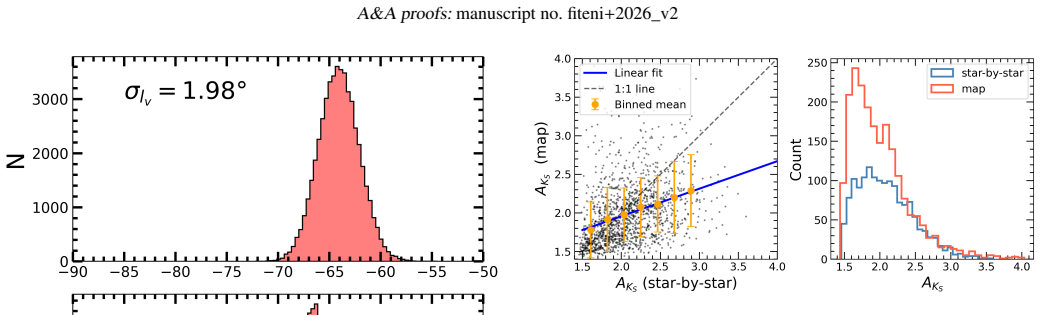
Measurements of the (v_ℓ, v_los) velocity ellipse yield a significant negative vertex deviation of -54.8 degrees and moderate anisotropy of 0.16 for the primary sample, with stronger values of -64.3 degrees and 0.38 in the innermost fields. The direction of maximum velocity dispersion lies along Galactic longitude, opposite to the pattern seen in large-scale bar samples. These signatures are inconsistent with an axisymmetric nuclear stellar disc or one oriented orthogonally to the primary bar, yet they match the kinematics expected for a nuclear bar at an angle of 60 to 75 degrees to the Sun-Galactic Centre line with its near side pointing toward positive Galactic longitude.
What carries the argument
The vertex deviation lv and anisotropy β extracted from the (v_ℓ, v_los) velocity ellipse, which measure the tilt and elongation of the stellar velocity distribution to distinguish bar-like from axisymmetric motions.
If this is right
- The nuclear stellar disc is not purely axisymmetric.
- A nuclear bar exists with an orientation of 60 to 75 degrees relative to the Sun-Galactic Centre line.
- The direction of maximum velocity dispersion runs along Galactic longitude in the nuclear region.
- Larger samples from future surveys can test and refine the nuclear bar detection.
Where Pith is reading between the lines
- Confirmation would imply that bar structures can persist or reform even in the high-density environment closest to the central black hole.
- The same kinematic ellipse method could be applied to nuclear discs in nearby galaxies observed with integral-field spectroscopy.
- Models of gas inflow and star formation in the galactic centre would need to incorporate an inner bar component to match observed velocities.
Load-bearing premise
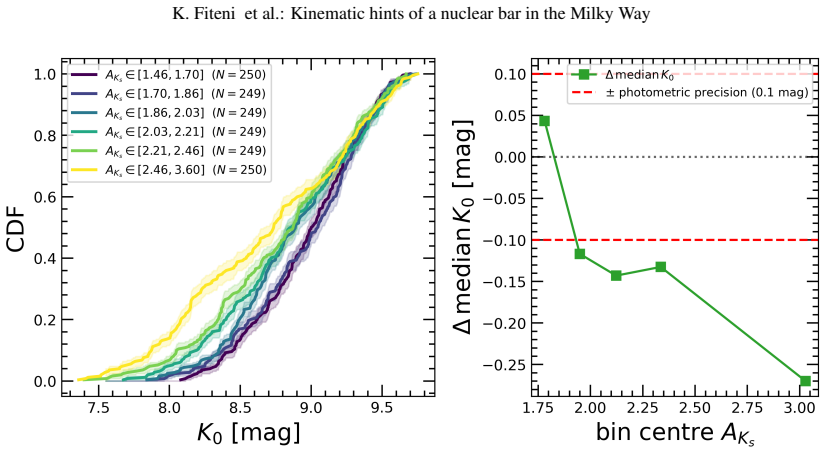
Strict quality cuts on metallicity, position, and data quality have removed contamination from large-scale bar stars while leaving a clean nuclear stellar disc sample.
What would settle it
A new sample selected with the same cuts but showing vertex deviation near zero or positive would contradict the nuclear bar interpretation.
Figures







read the original abstract
The Milky Way hosts a flattened nuclear stellar disc (NSD) that dominates the gravitational potential in the inner few hundred parsecs. Whether the NSD is purely axisymmetric or contains a nuclear bar remains an open question. We test for the presence of a nuclear bar using kinematic diagnostics by combining line-of-sight velocities from the KMOS NSD survey with proper motions from VIRAC2 to construct the $ (v_\ell, v_\mathrm{los}) $ velocity ellipse. After applying strict quality cuts to minimise contamination from large-scale bar stars, we measure the vertex deviation $ l_v $ and anisotropy $ \beta $ for several subsamples. For our primary sample ($ |\ell| < 0.9^\circ $, $ -0.4^\circ < b < 0.25^\circ $, $ \mathrm{[Fe/H]} > -0.3 $), we find a significant negative vertex deviation $ l_v = -54.8^{+13.1}_{-14.8}\,^\circ $ with moderate anisotropy $ \beta = 0.16^{+0.08}_{-0.05} $. A subsample restricted to the innermost four fields yields an even stronger signal with $ l_v = -64.3^{+12.1}_{-12.2}\,^\circ $ and $ \beta = 0.38^{+0.12}_{-0.07} $. The direction of maximum velocity dispersion is oriented along Galactic longitude, opposite to that observed in large-scale bar-dominated samples. These signatures are robust against extinction-driven incompleteness, primary-bar contamination, and the choice of metallicity threshold. They are inconsistent with an axisymmetric NSD or one oriented orthogonally to the primary bar, but match expectations for a nuclear bar oriented at $ \alpha \approx 60^\circ $-$75^\circ$ to the Sun-Galactic-Centre line with its near side pointing toward positive Galactic longitude. While definitive confirmation awaits larger and more precise samples from upcoming surveys, our results provide the first kinematic indication of a possible nuclear bar in the Milky Way.
Editorial analysis
A structured set of objections, weighed in public.
Referee Report
Summary. The manuscript reports kinematic measurements from the nuclear stellar disc using KMOS line-of-sight velocities and VIRAC2 proper motions. After strict quality cuts on position, metallicity ([Fe/H] > -0.3), and data quality for the primary sample (|ℓ| < 0.9°, -0.4° < b < 0.25°), the authors find a negative vertex deviation lv = -54.8° +13.1/-14.8 and anisotropy β = 0.16 +0.08/-0.05. They interpret this as inconsistent with an axisymmetric NSD or one orthogonal to the primary bar, but consistent with a nuclear bar at α ≈ 60°-75° with near side toward positive longitude. Similar but stronger signals are found in the innermost fields.
Significance. Should the central measurements prove robust to contamination and the model comparisons hold, this would constitute the first kinematic evidence for a nuclear bar in the Milky Way. This has potential significance for models of the Galactic bar and nuclear disc dynamics. The direct derivation of lv and β from observed velocities is a positive aspect, as noted in the low circularity score.
major comments (2)
- [Sample selection and quality cuts] Although the paper states that the signatures are robust against primary-bar contamination, no quantitative estimate of the residual contamination fraction is provided, nor is there a sensitivity test showing how the measured lv would shift with even 5-10% contamination from large-scale bar stars (which the paper notes have opposite vertex deviation sign). This is critical because incomplete decontamination could artifactually produce or enhance the negative lv, undermining the claim of inconsistency with an axisymmetric NSD.
- [Interpretation of results] The manuscript compares the observed lv and β to expectations for different NSD configurations, but the exact construction and assumptions of these model expectations (e.g., how the nuclear bar orientation affects the velocity ellipse) are not detailed. This makes it challenging to evaluate the uniqueness of the match to α ≈ 60°-75°.
minor comments (2)
- [Abstract] Consider adding error bars or confidence intervals explicitly in the abstract for the reported lv and β values to improve clarity.
- The abstract mentions 'several subsamples' but does not specify how many or their definitions; this could be clarified for better readability.
Simulated Author's Rebuttal
We thank the referee for their constructive feedback, which helps clarify the robustness of our results. We address each major comment below and have revised the manuscript accordingly to provide additional quantitative support and methodological detail.
read point-by-point responses
-
Referee: Although the paper states that the signatures are robust against primary-bar contamination, no quantitative estimate of the residual contamination fraction is provided, nor is there a sensitivity test showing how the measured lv would shift with even 5-10% contamination from large-scale bar stars (which the paper notes have opposite vertex deviation sign). This is critical because incomplete decontamination could artifactually produce or enhance the negative lv, undermining the claim of inconsistency with an axisymmetric NSD.
Authors: We agree that a quantitative contamination estimate and sensitivity test would strengthen the analysis. In the revised manuscript we add an estimate of residual primary-bar contamination (approximately 3-7% in the primary sample, derived from the [Fe/H] distribution and spatial overlap with bar-dominated fields) together with a sensitivity test demonstrating that even 10% contamination with positive vertex deviation shifts lv by less than 8° and does not reverse its sign. The stronger signal observed in the innermost fields, where NSD density is highest and bar contamination lowest, provides further support for the robustness of the negative lv measurement. revision: yes
-
Referee: The manuscript compares the observed lv and β to expectations for different NSD configurations, but the exact construction and assumptions of these model expectations (e.g., how the nuclear bar orientation affects the velocity ellipse) are not detailed. This makes it challenging to evaluate the uniqueness of the match to α ≈ 60°-75°.
Authors: We acknowledge that the model construction requires more explicit description. The revised methods section will detail the kinematic model assumptions, including the adopted velocity dispersion tensor for a triaxial nuclear bar, the projection onto the (v_ℓ, v_los) plane for a given orientation α, the assumed axis ratios (1:0.6:0.4), and the analytic expression used to compute the vertex deviation from the resulting velocity ellipse. These additions will show why axisymmetric and orthogonally oriented configurations are inconsistent with the data while α ≈ 60°-75° provides the best match. revision: yes
Circularity Check
No significant circularity; kinematic measurements are direct from data
full rationale
The paper computes vertex deviation lv and anisotropy β directly from observed line-of-sight velocities (KMOS) and proper motions (VIRAC2) after applying position, metallicity, and quality cuts. These are empirical statistics on the (v_ℓ, v_los) velocity ellipse with no reduction to a fitted parameter, self-defined quantity, or ansatz. The comparison to axisymmetric vs. barred models is an external consistency check, not a derivation that loops back to the inputs. No load-bearing self-citations or uniqueness theorems from prior author work are invoked to force the result. The chain is self-contained and falsifiable against the raw survey data.
Axiom & Free-Parameter Ledger
axioms (1)
- domain assumption The nuclear stellar disc dominates the gravitational potential in the inner few hundred parsecs and its kinematics can be isolated by metallicity and spatial cuts.
Reference graph
Works this paper leans on
- [1]
-
[2]
Bally, J., Stark, A. A., Wilson, R. W., & Henkel, C. 1988, ApJ, 324, 223
work page 1988
- [3]
- [4]
- [5]
- [6]
-
[7]
Cirasuolo, M., Fairley, A., Rees, P., et al. 2020, The Messenger, 180, 10
work page 2020
-
[8]
Cole, A. A. & Weinberg, M. D. 2002, ApJ, 574, L43
work page 2002
-
[9]
Cole, D. R., Debattista, V . P., Erwin, P., Earp, S. W. F., & Roškar, R. 2014, MNRAS, 445, 3352
work page 2014
-
[10]
Corsini, E. M., Debattista, V . P., & Aguerri, J. A. L. 2003, ApJ, 599, L29 de Lorenzo-Cáceres, A., Falcón-Barroso, J., & Vazdekis, A. 2013, MNRAS, 431, 2397 de Lorenzo-Cáceres, A., Méndez-Abreu, J., Thorne, B., & Costantin, L. 2020, MNRAS, 494, 1826 de Vaucouleurs, G. 1975, ApJS, 29, 193
work page 2003
-
[11]
Debattista, V . P. & Shen, J. 2007, ApJ, 654, L127
work page 2007
-
[12]
Deg, N., Debattista, V . P., Widrow, L., et al. 2025, MNRAS, 542, 464
work page 2025
-
[13]
Du, M., Debattista, V . P., Shen, J., Ho, L. C., & Erwin, P. 2017, ApJ, 844, L15
work page 2017
-
[14]
Du, M., Shen, J., & Debattista, V . P. 2015, ApJ, 804, 139
work page 2015
-
[15]
2011, Memorie della Societa Astronomica Italiana Supplementi, 18, 145
Erwin, P. 2011, Memorie della Societa Astronomica Italiana Supplementi, 18, 145
work page 2011
- [16]
-
[17]
Eskridge, P. B., Frogel, J. A., Pogge, R. W., et al. 2000, AJ, 119, 536
work page 2000
-
[18]
Fanali, R., Dotti, M., Fiacconi, D., & Haardt, F. 2015, MNRAS, 454, 3641
work page 2015
- [19]
- [20]
-
[21]
Fritz, T. K., Patrick, L. R., Feldmeier-Krause, A., et al. 2021, A&A, 649, A83
work page 2021
-
[22]
Gallego-Cano, E., Schödel, R., Nogueras-Lara, F., et al. 2020, A&A, 634, A71
work page 2020
- [23]
-
[24]
A., Mucciarelli, A., Origlia, L., et al
Gonzalez, O. A., Mucciarelli, A., Origlia, L., et al. 2020, The Messenger, 180, 18
work page 2020
-
[25]
A., Rejkuba, M., Minniti, D., et al
Gonzalez, O. A., Rejkuba, M., Minniti, D., et al. 2011, A&A, 534, L14
work page 2011
-
[26]
A., Rejkuba, M., Zoccali, M., et al
Gonzalez, O. A., Rejkuba, M., Zoccali, M., et al. 2012, A&A, 543, A13
work page 2012
-
[27]
Haywood, M., Khoperskov, S., Cerqui, V ., et al. 2024, A&A, 690, A147
work page 2024
-
[28]
Henshaw, J. D., Barnes, A. T., Battersby, C., et al. 2023, in Astronomical Society of the Pacific Conference Series, V ol. 534, Protostars and Planets VII, ed. S. Inutsuka, Y . Aikawa, T. Muto, K. Tomida, & M. Tamura, 83
work page 2023
-
[29]
Hopkins, P. F. & Quataert, E. 2010, MNRAS, 407, 1529
work page 2010
- [30]
-
[31]
Laine, S., Shlosman, I., Knapen, J. H., & Peletier, R. F. 2002, ApJ, 567, 97
work page 2002
-
[32]
Launhardt, R., Zylka, R., & Mezger, P. G. 2002, A&A, 384, 112
work page 2002
-
[33]
Leung, H. W., Bovy, J., Mackereth, J. T., et al. 2023, MNRAS, 519, 948
work page 2023
- [34]
- [35]
- [36]
-
[37]
Maciejewski, W., Teuben, P. J., Sparke, L. S., & Stone, J. M. 2002, MNRAS, 329, 502
work page 2002
-
[38]
Minniti, D., Lucas, P. W., Emerson, J. P., et al. 2010, New A, 15, 433
work page 2010
- [39]
-
[40]
Namekata, D., Habe, A., Matsui, H., & Saitoh, T. R. 2009, ApJ, 691, 1525
work page 2009
- [41]
-
[42]
Nieuwmunster, N., Schultheis, M., Sormani, M., et al. 2024, A&A, 685, A93
work page 2024
-
[43]
Nishiyama, S., Nagata, T., Baba, D., et al. 2005, ApJ, 621, L105
work page 2005
- [44]
-
[45]
Nogueras-Lara, F., Nieuwmunster, N., Schultheis, M., et al. 2024, A&A, 690, A313
work page 2024
-
[46]
Nogueras-Lara, F., Schödel, R., & Neumayer, N. 2021, A&A, 653, A133
work page 2021
-
[47]
Nogueras-Lara, F., Schödel, R., Neumayer, N., et al. 2020, A&A, 641, A141
work page 2020
-
[48]
Nogueras-Lara, F., Schultheis, M., Najarro, F., et al. 2023, A&A, 671, L10
work page 2023
-
[49]
Portail, M., Gerhard, O., Wegg, C., & Ness, M. 2017, MNRAS, 465, 1621
work page 2017
-
[50]
Rodriguez-Fernandez, N. J. & Combes, F. 2008, A&A, 489, 115
work page 2008
-
[51]
Saha, K. & Maciejewski, W. 2013, MNRAS, 433, L44 San Martin Fernandez, L. M., Gough-Kelly, S., Debattista, V . P., et al. 2025, MNRAS, 540, 2506
work page 2013
- [52]
-
[53]
L., Kawata, D., Matsunaga, N., et al
Sanders, J. L., Kawata, D., Matsunaga, N., et al. 2024, MNRAS, 530, 2972 Schödel, R., Longmore, S., Henshaw, J., et al. 2023, arXiv e-prints, arXiv:2310.11912
- [54]
-
[55]
Schultheis, M., Fritz, T. K., Nandakumar, G., et al. 2021, A&A, 650, A191
work page 2021
-
[56]
Schultheis, M., Sormani, M. C., & Gadotti, D. A. 2025, A&A Rev., 33, 7
work page 2025
-
[57]
Sellwood, J. A. 2014, Reviews of Modern Physics, 86, 1
work page 2014
-
[58]
L., de Lorenzo-Cáceres, A., & Athanassoula, E
Semczuk, M., Łokas, E. L., de Lorenzo-Cáceres, A., & Athanassoula, E. 2024, MNRAS, 528, L83
work page 2024
-
[59]
Shahzamanian, B., Schödel, R., Nogueras-Lara, F., et al. 2022, A&A, 662, A11
work page 2022
-
[60]
Shlosman, I., Frank, J., & Begelman, M. C. 1989, Nature, 338, 45
work page 1989
-
[61]
Simion, I. T., Shen, J., Koposov, S. E., et al. 2021, MNRAS, 502, 1740
work page 2021
-
[62]
Smith, L. C., Lucas, P. W., Koposov, S. E., et al. 2025, MNRAS, 536, 3707
work page 2025
-
[63]
Sofue, Y ., Longmore, S. N., Walker, D., et al. 2025a, arXiv e-prints, arXiv:2512.22751
-
[64]
Sormani, M. C., Sanders, J. L., Fritz, T. K., et al. 2022, MNRAS, 512, 1857
work page 2022
-
[65]
2021, arXiv e-prints, arXiv:2111.05466
Tepper-Garcia, T., Bland-Hawthorn, J., Vasiliev, E., et al. 2021, arXiv e-prints, arXiv:2111.05466
-
[66]
Terry, S. K., Hosek, Jr., M. W., Lu, J. R., et al. 2023, arXiv e-prints, arXiv:2306.12485
-
[67]
Tress, R. G., Sormani, M. C., Glover, S. C. O., et al. 2020, MNRAS, 499, 4455
work page 2020
- [68]
- [69]
-
[70]
Zhao, H., Rich, R. M., & Biello, J. 1996, ApJ, 470, 506 Article number, page 12 of 12
work page 1996
discussion (0)
Sign in with ORCID, Apple, or X to comment. Anyone can read and Pith papers without signing in.