No Stream Left Unscathed: The imprint of a host galaxy
Pith reviewed 2026-05-20 16:14 UTC · model grok-4.3
The pith
The host galaxy's potential alone imprints spurs, kinks, and gaps on most stellar streams.
A machine-rendered reading of the paper's core claim, the machinery that carries it, and where it could break.
Core claim
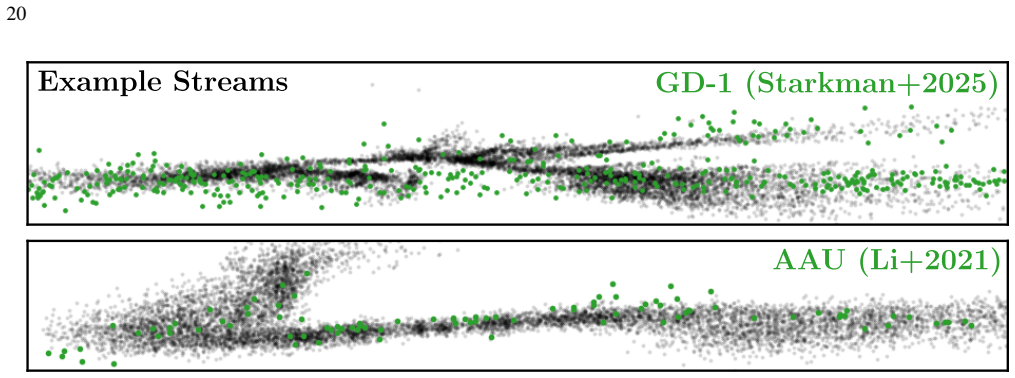
When globular cluster streams are integrated in basis function expansion potentials drawn from FIRE-2 halos that include the evolving disk and halo but exclude all small-scale perturbers, approximately three quarters develop complex morphology including spurs, kinks, and cocoon-like envelopes. Even the remaining smooth streams exhibit 10-25 percent width fluctuations along their tracks together with overdensities and gaps at scales of roughly 2 degrees. Only about 70 streams out of 15,000 remain free of detectable wiggles at any scale, and analogs to observed structures such as the GD-1 spur appear without any subhalo encounters.
What carries the argument
Basis function expansion potentials derived from FIRE-2 halos that evolve the disk, halo, and large-scale structure while excluding small-scale perturbers.
If this is right
- Pericentric distance near 15 kpc marks the boundary between mostly smooth and mostly disturbed streams.
- Circular orbits beyond roughly 20 kpc produce the streams least affected by the host potential.
- Features such as the GD-1 spur and ATLAS-Aliqa Uma kink can form from the host galaxy alone.
- Next-generation surveys must subtract this host-induced baseline before using stream morphology to constrain dark matter substructure.
Where Pith is reading between the lines
- Streams on wide, circular orbits may offer cleaner probes of subhalo encounters because they suffer less host-induced complexity.
- Some fraction of currently observed stream gaps could be reinterpreted as natural outcomes of the Milky Way's own potential rather than subhalo passages.
- Refining the basis function expansion models against real Milky Way kinematics could tighten the distinction between host and subhalo effects.
Load-bearing premise
The basis function expansion potentials accurately represent the time-evolving disk, halo, and large-scale structure while correctly excluding all small-scale perturbers, and the sample of streams is representative of the observed Milky Way population.
What would settle it
A large survey catalog that measures the fraction of streams showing spurs or 10-25 percent width variation in the absence of known subhalos or giant molecular clouds; if that observed fraction is far below three quarters, the claim that host potential alone accounts for most features would be challenged.
Figures








read the original abstract
Stellar streams from disrupted globular clusters are excellent probes of dark matter (DM) subhalos. Observed Milky Way streams display a remarkable diversity of features: spurs, gaps, kinks, cocoons, and density variations, many attributed to subhalo encounters. But how much of this diversity arises from the host itself? We simulate $\sim$15,000 globular cluster streams across four Milky Way-mass halos from the FIRE-2 cosmological simulations, evolved in basis function expansion potentials capturing the evolving disk, halo, and large-scale structure while excluding small-scale perturbers such as DM subhalos and giant molecular clouds. We find that roughly three quarters of streams develop complex features from the host potential, such as spurs, kinks, and cocoon-like envelopes. Even the smoothest streams exhibit 10--25\% width variation along their track and host overdensities and gaps at scales of ${\sim}2^\circ$, squarely in the $1^\circ$--$5^\circ$ range predicted for subhalo-induced gaps. Pericentric distance is the primary predictor of stream morphology, with ${\sim}15$ kpc separating smooth from disturbed streams and circular orbits beyond $\sim$20 kpc producing the smoothest streams. Only $\sim$70 out of $\sim$15,000 streams are free of detectable wiggles in the track at any scale. Analogs to observed features, such as the GD-1 spur and the ATLAS--Aliqa Uma kink, emerge even without the presence of subhalos. As next-generation surveys (LSST, Euclid, and Roman) resolve stream structure across hundreds of streams, the baseline established here, streams evolved without small-scale perturbers, becomes essential for extracting DM substructure constraints.
Editorial analysis
A structured set of objections, weighed in public.
Referee Report
Summary. The paper simulates ~15,000 globular cluster streams in four FIRE-2 Milky Way-mass halos using basis-function expansion (BFE) potentials that evolve the disk, halo, and large-scale structure while excluding small-scale perturbers. It reports that roughly three-quarters of streams develop spurs, kinks, and cocoon-like envelopes from the host potential alone; even the smoothest streams show 10–25% width variations and ~2° gaps/overdensities. Pericentric distance (~15 kpc threshold) is the dominant predictor of morphology, with only ~70 streams entirely free of detectable wiggles. Analogs to observed features (GD-1 spur, ATLAS–Aliqa Uma kink) appear without subhalos, establishing a baseline for future DM-substructure inferences.
Significance. If the BFE potentials faithfully reproduce time-dependent host effects without numerical artifacts, the result supplies a critical null model for stream morphology. This would imply that many features currently attributed to subhalos can arise from the smooth, evolving galactic potential, directly affecting how LSST/Euclid/Roman data are interpreted for dark-matter constraints. The large sample size and direct comparison to observed scales strengthen the potential impact.
major comments (2)
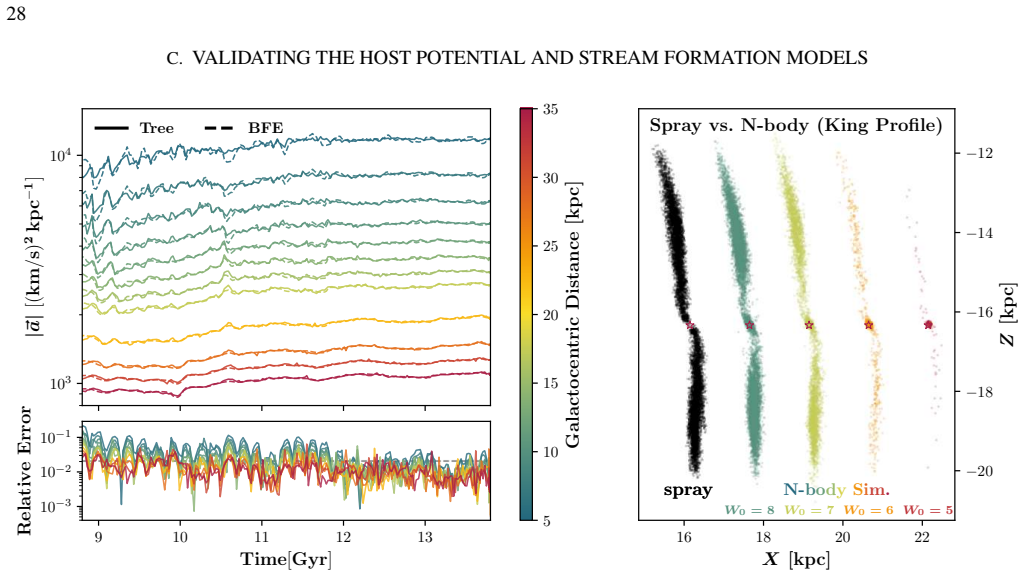
- [Methods] Methods (BFE construction and validation): The central claim that host-induced features dominate requires that the BFE expansion accurately captures non-axisymmetric disk and halo evolution while introducing no spurious wiggles. No quantitative comparison (e.g., orbit integration residuals or stream morphology metrics) between BFE-evolved streams and the original FIRE-2 particle data is presented for the pericenter <15 kpc population that drives the disturbed/smooth separation. This is load-bearing for the headline 3/4 fraction.
- [Results] Results (§3 or equivalent): The reported ~75% fraction of streams developing complex features and the 10–25% width variation statistic lack error bars, sensitivity tests to the feature-detection threshold, or robustness checks against BFE truncation order and time-interpolation scheme. Without these, it is unclear whether the quantitative conclusions are stable under reasonable variations in the potential representation.
minor comments (2)
- [Abstract and Results] The abstract states 'roughly three quarters' while the text uses '~15,000'; a precise count or fraction with uncertainty should be given in the results section for reproducibility.
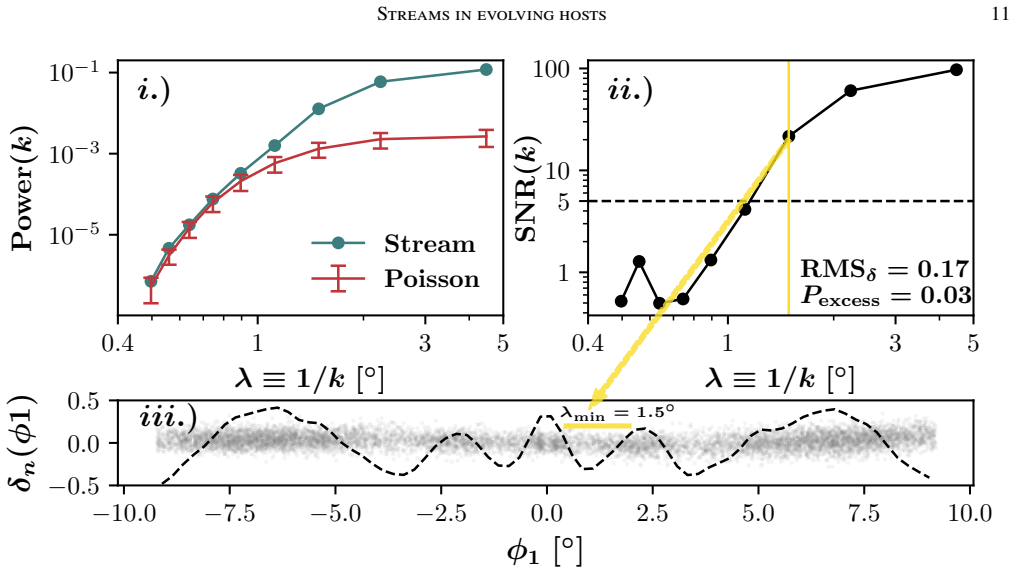
- [Figures] Figure captions and text should explicitly state the angular scale and detection method used to identify gaps/overdensities at ~2° so readers can assess overlap with subhalo predictions.
Simulated Author's Rebuttal
We thank the referee for their detailed and constructive report. We address each of the major comments below. We agree that additional validation and robustness checks will strengthen the manuscript and will incorporate these in the revised version.
read point-by-point responses
-
Referee: [Methods] Methods (BFE construction and validation): The central claim that host-induced features dominate requires that the BFE expansion accurately captures non-axisymmetric disk and halo evolution while introducing no spurious wiggles. No quantitative comparison (e.g., orbit integration residuals or stream morphology metrics) between BFE-evolved streams and the original FIRE-2 particle data is presented for the pericenter <15 kpc population that drives the disturbed/smooth separation. This is load-bearing for the headline 3/4 fraction.
Authors: We recognize the importance of validating the BFE potentials against the original FIRE-2 simulation data to ensure no spurious features are introduced. Although the BFE approach is intended to faithfully reproduce the time-dependent large-scale potential, we will add quantitative comparisons, including orbit integration residuals and stream morphology metrics, for a sample of streams with pericenters less than 15 kpc. These will be presented in the Methods section of the revised manuscript. revision: yes
-
Referee: [Results] Results (§3 or equivalent): The reported ~75% fraction of streams developing complex features and the 10–25% width variation statistic lack error bars, sensitivity tests to the feature-detection threshold, or robustness checks against BFE truncation order and time-interpolation scheme. Without these, it is unclear whether the quantitative conclusions are stable under reasonable variations in the potential representation.
Authors: We agree that providing uncertainties and performing sensitivity analyses is necessary for the robustness of our quantitative results. In the revision, we will include error bars on the reported fractions and statistics, and conduct tests varying the feature detection threshold, BFE truncation order, and time interpolation scheme. The outcomes of these tests will be reported to confirm the stability of our findings. revision: yes
Circularity Check
Direct simulation outputs establish host-induced stream features with no definitional or self-citation circularity
full rationale
The paper evolves ~15,000 streams in BFE potentials extracted from FIRE-2 snapshots and reports morphology statistics (spurs/kinks in ~3/4 of streams, 10-25% width variation, ~2° gaps) as direct numerical results. These quantities are not defined in terms of the outputs themselves, not obtained by fitting parameters to the target statistics, and not reduced to a self-citation chain. Comparisons to observed streams (GD-1 spur, ATLAS kink) are external validation rather than inputs. Methodological citations to BFE or FIRE-2 work supply context but do not carry the load of the central claim, which remains falsifiable against independent simulations or observations.
Axiom & Free-Parameter Ledger
axioms (1)
- domain assumption FIRE-2 cosmological simulations supply realistic Milky Way-mass halos whose disk, halo, and large-scale structure can be captured by basis function expansions.
Reference graph
Works this paper leans on
-
[1]
Monthly Notices of the Royal Astronomical Society , volume=
A new class of accurate, mesh-free hydrodynamic simulation methods , author=. Monthly Notices of the Royal Astronomical Society , volume=. 2015 , publisher=
work page 2015
-
[3]
Monthly Notices of the Royal Astronomical Society , volume=
FIRE-2 simulations: physics versus numerics in galaxy formation , author=. Monthly Notices of the Royal Astronomical Society , volume=. 2018 , publisher=
work page 2018
-
[4]
The Astrophysical Journal Letters , volume=
Reconciling dwarf galaxies with CDM cosmology: simulating a realistic population of satellites around a Milky Way--mass galaxy , author=. The Astrophysical Journal Letters , volume=. 2016 , publisher=
work page 2016
-
[6]
Monthly Notices of the Royal Astronomical Society , volume=
Disc settling and dynamical heating: histories of Milky Way-mass stellar discs across cosmic time in the FIRE simulations , author=. Monthly Notices of the Royal Astronomical Society , volume=. 2024 , publisher=
work page 2024
-
[7]
The Astrophysical Journal , volume=
Bar formation and destruction in the FIRE-2 simulations , author=. The Astrophysical Journal , volume=. 2025 , publisher=
work page 2025
-
[8]
The Astrophysical Journal Supplement Series , volume=
Public data release of the FIRE-2 cosmological zoom-in simulations of galaxy formation , author=. The Astrophysical Journal Supplement Series , volume=. 2023 , publisher=
work page 2023
-
[9]
The Astrophysical Journal Supplement Series , volume=
Starburst99: synthesis models for galaxies with active star formation , author=. The Astrophysical Journal Supplement Series , volume=. 1999 , publisher=
work page 1999
-
[10]
arXiv preprint arXiv:2508.06608 , year=
Second public data release of the FIRE-2 cosmological zoom-in simulations of galaxy formation , author=. arXiv preprint arXiv:2508.06608 , year=
-
[11]
The Astrophysical Journal Supplement Series , volume=
Synthetic gaia surveys from the fire cosmological simulations of milky way-mass galaxies , author=. The Astrophysical Journal Supplement Series , volume=. 2020 , publisher=
work page 2020
-
[12]
Monthly Notices of the Royal Astronomical Society , volume=
The origin of the diverse morphologies and kinematics of Milky Way-mass galaxies in the FIRE-2 simulations , author=. Monthly Notices of the Royal Astronomical Society , volume=. 2018 , publisher=
work page 2018
-
[13]
IEEE Transactions on audio and electroacoustics , volume=
The use of fast Fourier transform for the estimation of power spectra: A method based on time averaging over short, modified periodograms , author=. IEEE Transactions on audio and electroacoustics , volume=
-
[14]
An invariance principle for certain probability limit theorems , author=. 1951 , series=
work page 1951
-
[15]
Monthly Notices of the Royal Astronomical Society , volume=
Orbital phase-driven biases in galactic mass constraints from stellar streams , author=. Monthly Notices of the Royal Astronomical Society , volume=. 2022 , publisher=
work page 2022
-
[16]
Monthly Notices of the Royal Astronomical Society , volume=
The number and size of subhalo-induced gaps in stellar streams , author=. Monthly Notices of the Royal Astronomical Society , volume=. 2016 , publisher=
work page 2016
-
[17]
Monthly Notices of the Royal Astronomical Society , volume=
The dynamics of satellite disruption in cold dark matter haloes , author=. Monthly Notices of the Royal Astronomical Society , volume=. 2009 , publisher=
work page 2009
-
[18]
Monthly Notices of the Royal Astronomical Society , volume=
Using multichannel singular spectrum analysis to study galaxy dynamics , author=. Monthly Notices of the Royal Astronomical Society , volume=. 2021 , publisher=
work page 2021
-
[19]
Monthly Notices of the Royal Astronomical Society , volume=
New dipole instabilities in spherical stellar systems , author=. Monthly Notices of the Royal Astronomical Society , volume=. 2023 , publisher=
work page 2023
-
[20]
The Astrophysical Journal , volume=
Substructure depletion in the Milky Way halo by the disk , author=. The Astrophysical Journal , volume=. 2010 , publisher=
work page 2010
-
[21]
Monthly Notices of the Royal Astronomical Society , volume=
Lessons from the Auriga discs: the hunt for the Milky Way's ex situ disc is not yet over , author=. Monthly Notices of the Royal Astronomical Society , volume=. 2017 , publisher=
work page 2017
-
[22]
Monthly Notices of the Royal Astronomical Society , volume=
Vertical density waves in the Milky Way disc induced by the Sagittarius dwarf galaxy , author=. Monthly Notices of the Royal Astronomical Society , volume=. 2013 , publisher=
work page 2013
-
[23]
The Astrophysical Journal Letters , volume=
Tilted dark halos are common and long-lived, and can warp galactic disks , author=. The Astrophysical Journal Letters , volume=. 2023 , publisher=
work page 2023
-
[24]
Monthly Notices of the Royal Astronomical Society , volume=
Warps and waves in the stellar discs of the Auriga cosmological simulations , author=. Monthly Notices of the Royal Astronomical Society , volume=. 2016 , publisher=
work page 2016
-
[25]
Monthly Notices of the Royal Astronomical Society , volume=
A family of potential--density pairs for spherical galaxies and bulges , author=. Monthly Notices of the Royal Astronomical Society , volume=. 1993 , publisher=
work page 1993
-
[26]
A numerical convergence study , author=
The inner structure of CDM haloes—I. A numerical convergence study , author=. Monthly Notices of the Royal Astronomical Society , volume=. 2003 , publisher=
work page 2003
-
[27]
Star cluster formation in cosmological simulations. I. Properties of young clusters , author=. The Astrophysical Journal , volume=. 2017 , publisher=
work page 2017
-
[29]
Monthly Notices of the Royal Astronomical Society , volume=
Catalogue of model star clusters in the Milky Way and M31 galaxies , author=. Monthly Notices of the Royal Astronomical Society , volume=. 2024 , publisher=
work page 2024
-
[32]
Monthly Notices of the Royal Astronomical Society , volume=
The E-MOSAICS project: simulating the formation and co-evolution of galaxies and their star cluster populations , author=. Monthly Notices of the Royal Astronomical Society , volume=. 2018 , publisher=
work page 2018
-
[34]
Astrophysical Journal, Part 1 (ISSN 0004-637X), vol
The structure of cold dark matter halos , author=. Astrophysical Journal, Part 1 (ISSN 0004-637X), vol. 378, Sept. 10, 1991, p. 496-503. Research supported by Pittsburgh Supercomputing Center and NSERC. , volume=
work page 1991
-
[35]
Simulations of the formation, evolution and clustering of galaxies and quasars , author=. nature , volume=. 2005 , publisher=
work page 2005
-
[36]
Monthly Notices of the Royal Astronomical Society , volume=
What's up in the Milky Way? The orientation of the disc relative to the triaxial halo , author=. Monthly Notices of the Royal Astronomical Society , volume=. 2013 , publisher=
work page 2013
-
[37]
The Astrophysical Journal , volume=
The shape of the inner milky way halo from observations of the Pal 5 and GD--1 Stellar Streams , author=. The Astrophysical Journal , volume=. 2016 , publisher=
work page 2016
-
[38]
Galactic Dynamics: Second Edition
-
[39]
The Astrophysical Journal Supplement Series , volume=
Improved particle spray algorithm for modeling globular cluster streams , author=. The Astrophysical Journal Supplement Series , volume=. 2025 , publisher=
work page 2025
-
[40]
Monthly Notices of the Royal Astronomical Society , volume=
The effect of the deforming dark matter haloes of the Milky Way and the Large Magellanic Cloud on the Orphan--Chenab stream , author=. Monthly Notices of the Royal Astronomical Society , volume=. 2023 , publisher=
work page 2023
-
[41]
The Astrophysical Journal , volume=
Tidal streams as probes of the Galactic potential , author=. The Astrophysical Journal , volume=. 1999 , publisher=
work page 1999
-
[42]
Monthly Notices of the Royal Astronomical Society , volume=
The total mass of the Large Magellanic Cloud from its perturbation on the Orphan stream , author=. Monthly Notices of the Royal Astronomical Society , volume=. 2019 , publisher=
work page 2019
-
[43]
Monthly Notices of the Royal Astronomical Society , volume=
Constraining the Milky Way halo potential with the GD-1 stellar stream , author=. Monthly Notices of the Royal Astronomical Society , volume=. 2019 , publisher=
work page 2019
-
[44]
The Astrophysical Journal , volume=
Hunting for the dark matter wake induced by the large magellanic cloud , author=. The Astrophysical Journal , volume=. 2019 , publisher=
work page 2019
-
[45]
The Astrophysical Journal , volume=
Shaping the Milky Way: The interplay of mergers and cosmic filaments , author=. The Astrophysical Journal , volume=. 2025 , publisher=
work page 2025
-
[46]
Astronomy & Astrophysics , volume=
Basis function expansions for galactic dynamics: Spherical versus cylindrical coordinates , author=. Astronomy & Astrophysics , volume=. 2020 , publisher=
work page 2020
-
[48]
The Astrophysical Journal , volume=
Measuring the Mass of the Large Magellanic Cloud with Stellar Streams Observed by S 5 , author=. The Astrophysical Journal , volume=. 2021 , publisher=
work page 2021
-
[49]
Charting the galactic acceleration field. II. A Global Mass Model of the Milky Way from the STREAMFINDER Atlas of Stellar Streams detected in Gaia DR3 , author=. The Astrophysical Journal , volume=. 2024 , publisher=
work page 2024
-
[50]
Monthly Notices of the Royal Astronomical Society , volume=
S 5: Probing the Milky Way and Magellanic Clouds potentials with the 6D map of the Orphan--Chenab stream , author=. Monthly Notices of the Royal Astronomical Society , volume=. 2023 , publisher=
work page 2023
-
[51]
The Astrophysical Journal , volume=
LMC-driven anisotropic boosts in stream--subhalo interactions , author=. The Astrophysical Journal , volume=. 2024 , publisher=
work page 2024
-
[52]
The Astrophysical Journal , volume=
On the stability of tidal streams in action space , author=. The Astrophysical Journal , volume=. 2022 , publisher=
work page 2022
-
[53]
The Astrophysical Journal , volume=
On the Corotation of Milky Way Satellites: LMC-mass Satellites Induce Apparent Motions in Outer Halo Tracers , author=. The Astrophysical Journal , volume=. 2024 , publisher=
work page 2024
-
[54]
The Astrophysical Journal , volume=
Efficient and accurate force replay in cosmological-baryonic simulations , author=. The Astrophysical Journal , volume=. 2024 , publisher=
work page 2024
-
[55]
Monthly Notices of the Royal Astronomical Society , volume=
Dear Magellanic Clouds, welcome back! , author=. Monthly Notices of the Royal Astronomical Society , volume=. 2024 , publisher=
work page 2024
-
[56]
Detection of the Milky Way reflex motion due to the Large Magellanic Cloud infall , author=. Nature Astronomy , volume=. 2021 , publisher=
work page 2021
-
[57]
Monthly Notices of the Royal Astronomical Society , volume=
The influence of Sagittarius and the Large Magellanic Cloud on the stellar disc of the Milky Way Galaxy , author=. Monthly Notices of the Royal Astronomical Society , volume=. 2018 , publisher=
work page 2018
-
[58]
Monthly Notices of the Royal Astronomical Society , volume=
A new code for orbit analysis and Schwarzschild modelling of triaxial stellar systems , author=. Monthly Notices of the Royal Astronomical Society , volume=. 2013 , publisher=
work page 2013
-
[59]
Monthly Notices of the Royal Astronomical Society , volume=
The total stellar halo mass of the Milky Way , author=. Monthly Notices of the Royal Astronomical Society , volume=. 2019 , publisher=
work page 2019
-
[60]
Monthly Notices of the Royal Astronomical Society , volume=
Galactic stellar haloes in the CDM model , author=. Monthly Notices of the Royal Astronomical Society , volume=. 2010 , publisher=
work page 2010
-
[61]
The propagation of uncertainties in stellar population synthesis modeling. I. The relevance of uncertain aspects of stellar evolution and the initial mass function to the derived physical properties of galaxies , author=. The Astrophysical Journal , volume=. 2009 , publisher=
work page 2009
-
[62]
The Astrophysical Journal , volume=
Stream members only: Data-driven characterization of stellar streams with mixture density networks , author=. The Astrophysical Journal , volume=. 2025 , publisher=
work page 2025
-
[63]
The Astrophysical Journal , volume=
Dark matter sub-halo counts via star stream crossings , author=. The Astrophysical Journal , volume=. 2012 , publisher=
work page 2012
-
[64]
The Disruption of the Sagittarius Dwarf Galaxy.
The disruption of the Sagittarius dwarf galaxy. , author=. arXiv preprint astro-ph/9502005 , year=
work page internal anchor Pith review Pith/arXiv arXiv
-
[65]
The Astrophysical Journal , volume=
Are the Magellanic Clouds on their first passage about the Milky Way? , author=. The Astrophysical Journal , volume=. 2007 , publisher=
work page 2007
-
[66]
All-sky dynamical response of the Galactic halo to the Large Magellanic Cloud , author=. Nature , volume=. 2021 , publisher=
work page 2021
-
[67]
Monthly Notices of the Royal Astronomical Society , volume=
Tango for three: Sagittarius, LMC, and the Milky Way , author=. Monthly Notices of the Royal Astronomical Society , volume=. 2021 , publisher=
work page 2021
-
[68]
Monthly Notices of the Royal Astronomical Society , volume=
Models of distorted and evolving dark matter haloes , author=. Monthly Notices of the Royal Astronomical Society , volume=. 2020 , publisher=
work page 2020
-
[69]
Monthly Notices of the Royal Astronomical Society , volume=
A halo expansion technique for approximating simulated dark matter haloes , author=. Monthly Notices of the Royal Astronomical Society , volume=. 2011 , publisher=
work page 2011
-
[70]
The Effect of the LMC on the Milky Way System. Galaxies , keywords =. doi:10.3390/galaxies11020059 , archivePrefix =. 2304.09136 , primaryClass =
-
[71]
The Astrophysical Journal , volume=
Exploring the Sgr--Milky Way--disk Interaction Using High-resolution N-body Simulations , author=. The Astrophysical Journal , volume=. 2022 , publisher=
work page 2022
-
[72]
Tracing galaxy formation with stellar halos. II. Relating substructure in phase and abundance space to accretion histories , author=. The Astrophysical Journal , volume=. 2008 , publisher=
work page 2008
-
[73]
The Astrophysical Journal , volume=
Symfind: Addressing the fragility of subhalo finders and revealing the durability of subhalos , author=. The Astrophysical Journal , volume=. 2024 , publisher=
work page 2024
-
[74]
Monthly Notices of the Royal Astronomical Society , volume=
Haunted haloes: tracking the ghosts of subhaloes lost by halo finders , author=. Monthly Notices of the Royal Astronomical Society , volume=. 2024 , publisher=
work page 2024
-
[75]
The Astrophysical Journal , volume=
Milky Way-est: Cosmological Zoom-in Simulations with Large Magellanic Cloud and Gaia--Sausage--Enceladus Analogs , author=. The Astrophysical Journal , volume=. 2024 , publisher=
work page 2024
-
[76]
New Astronomy Reviews , pages=
Milky Way dynamics in light of Gaia , author=. New Astronomy Reviews , pages=. 2025 , publisher=
work page 2025
-
[77]
The Astrophysical Journal , volume=
The Distant Milky Way Halo from the Southern Hemisphere: Characterization of the LMC-induced Dynamical Friction Wake , author=. The Astrophysical Journal , volume=. 2025 , publisher=
work page 2025
-
[78]
The Astrophysical Journal Letters , volume=
Simulations of the Magellanic stream in a first infall scenario , author=. The Astrophysical Journal Letters , volume=. 2010 , publisher=
work page 2010
-
[79]
The Astrophysical Journal , volume=
Orientations of Dark Matter Halos in FIRE-2 Milky Way--mass Galaxies , author=. The Astrophysical Journal , volume=. 2023 , publisher=
work page 2023
-
[80]
The Astrophysical Journal , volume=
The Milky Way’s Rowdy Neighbors: The Effects of the Large Magellanic Cloud and Sagittarius Dwarf on the Milky Way Disk , author=. The Astrophysical Journal , volume=. 2024 , publisher=
work page 2024
-
[81]
Monthly Notices of the Royal Astronomical Society , volume=
Resolving local and global kinematic signatures of satellite mergers with billion particle simulations , author=. Monthly Notices of the Royal Astronomical Society , volume=. 2021 , publisher=
work page 2021
-
[82]
Monthly Notices of the Royal Astronomical Society , volume=
AGAMA: action-based galaxy modelling architecture , author=. Monthly Notices of the Royal Astronomical Society , volume=. 2019 , publisher=
work page 2019
-
[83]
Monthly Notices of the Royal Astronomical Society , volume=
Some like it triaxial: the universality of dark matter halo shapes and their evolution along the cosmic time , author=. Monthly Notices of the Royal Astronomical Society , volume=. 2014 , publisher=
work page 2014
-
[84]
Monthly Notices of the Royal Astronomical Society , volume=
More on the structure of tidal tails , author=. Monthly Notices of the Royal Astronomical Society , volume=. 2012 , publisher=
work page 2012
-
[86]
The Astrophysical Journal , volume=
Breaking Down the CosmoGEMS: Toward Modeling and Understanding Globular Cluster Stellar Streams in a Fully Cosmological Context , author=. The Astrophysical Journal , volume=. 2026 , publisher=
work page 2026
-
[87]
Monthly Notices of the Royal Astronomical Society , volume=
Separatrix divergence of stellar streams in galactic potentials , author=. Monthly Notices of the Royal Astronomical Society , volume=. 2021 , publisher=
work page 2021
-
[88]
The Astrophysical Journal , volume=
Stream Fanning and Bifurcations: Observable Signatures of Resonances in Stellar Stream Morphology , author=. The Astrophysical Journal , volume=. 2023 , publisher=
work page 2023
discussion (0)
Sign in with ORCID, Apple, or X to comment. Anyone can read and Pith papers without signing in.