Lithium Experimental Application Platform (LEAP): Secondary-Containment Architecture for Flowing Liquid Lithium in Fusion Systems
Pith reviewed 2026-05-21 00:15 UTC · model grok-4.3
The pith
An inert airtight secondary enclosure without scrubbers balances hazard reduction and facility complexity for flowing liquid lithium systems.
A machine-rendered reading of the paper's core claim, the machinery that carries it, and where it could break.
Core claim
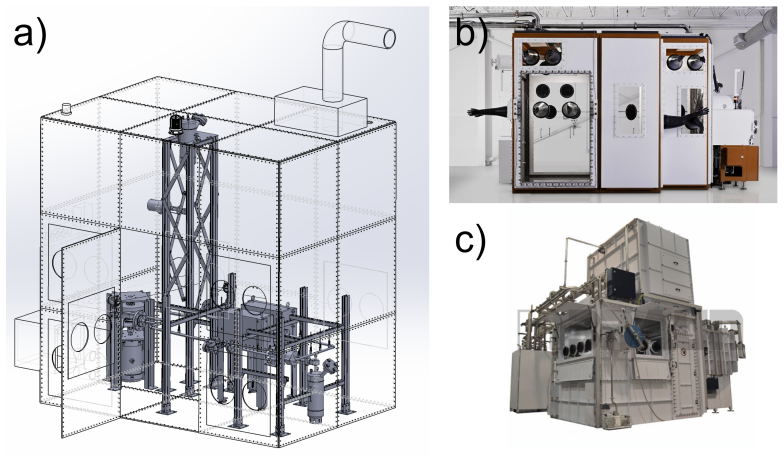
The paper establishes that an inert, airtight secondary enclosure without scrubbers around a liquid lithium loop provides a practical balance between hazard reduction and facility complexity, as defined by the design requirements. LEAP implements this with a modular argon gloveroom for a staged flowing lithium program that includes heating, diagnostics, magnetic field exposure, and future device interface capability.
What carries the argument
The semi-quantitative hazard complexity framework that scores containment scenarios on categories such as chemical reactivity, fire, aerosols, inert gas operation, maintainability, and experimental iteration.
If this is right
- The LEAP architecture supports modular experiments with heating, diagnostics, magnetic fields, and device interfaces.
- This containment choice provides a deployable path for developing lithium plasma-facing components in fusion systems.
- The framework supplies transferable design logic for other reactive or conductive liquid metal systems.
- Rapid experimental iteration becomes feasible through the room-scale, modular gloveroom setup.
Where Pith is reading between the lines
- The same enclosure logic could reduce scrubber infrastructure needs in larger-scale fusion test facilities.
- Applying the framework to non-fusion liquid metal experiments would test whether the hazard weighting remains valid outside plasma environments.
- Integrating the lithium loop directly with fuel recovery hardware inside the enclosure might further lower overall system risk.
- Future work could compare this inert gloveroom against active scrubber systems using actual operational data from similar setups.
Load-bearing premise
The chosen hazard categories and weighting factors accurately capture real-world risks for flowing lithium without needing full quantitative probabilistic risk assessment or experimental validation of the scores.
What would settle it
Collecting incident rates or measured hazard levels from an operating lithium loop inside the proposed argon gloveroom and finding that they deviate substantially from the framework's predicted complexity scores would undermine the balance claim.
Figures
read the original abstract
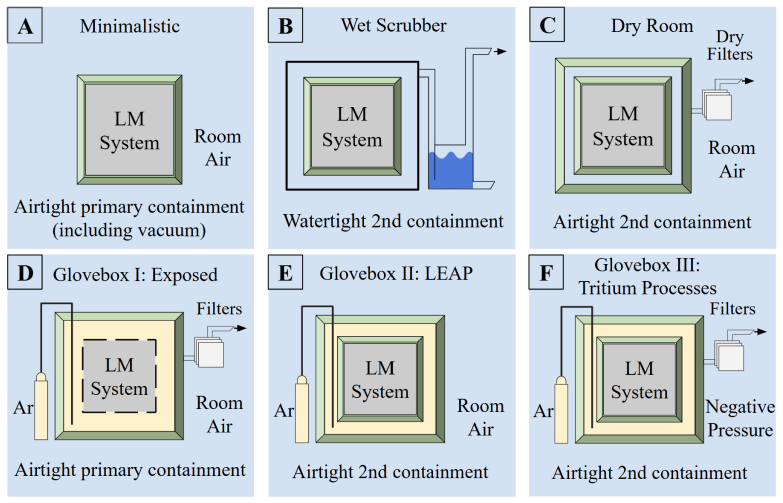
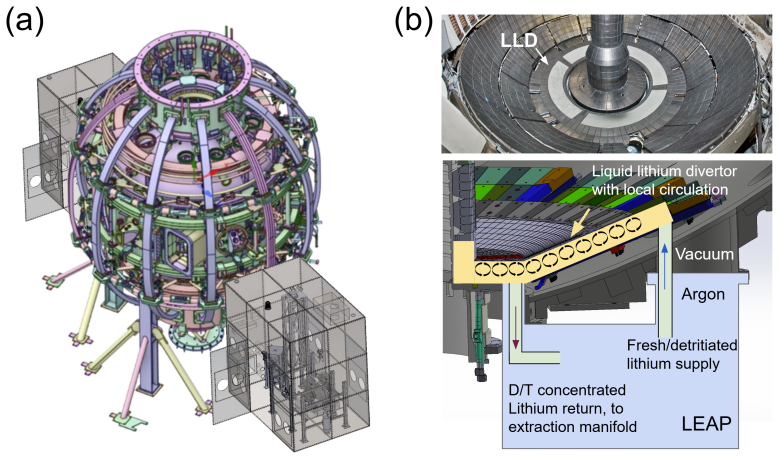
Flowing liquid lithium is a promising fusion technology because it can provide a renewable Plasma-Facing Component (PFC) surface, modify recycling, support power exhaust, and potentially connect plasma-facing components with fuel recovery. Its deployment, however, is limited by the need to manage chemical reactivity, fire and aerosol hazards, inert gas operation, maintainability, and rapid experimental iteration. This paper develops a semi-quantitative hazard complexity framework for selecting secondary containment architectures for flowing liquid lithium systems. The framework is applied to six representative containment scenarios and to the Lithium Experimental Application Platform (LEAP) at Princeton Plasma Physics Laboratory. LEAP is under construction with a modular, room-scale argon gloveroom as an inert secondary containment boundary for a staged flowing lithium program with heating, diagnostics, magnetic field exposure, and future device interface capability. The analysis shows that an inert, airtight secondary enclosure without scrubbers around a liquid lithium loop provides a practical balance between hazard reduction and facility complexity, as defined by the design requirements. The resulting architecture offers a deployable path for lithium PFC development and a transferable design logic for other reactive or conductive liquid metal systems.
Editorial analysis
A structured set of objections, weighed in public.
Referee Report
Summary. The manuscript develops a semi-quantitative hazard complexity framework for selecting secondary containment architectures for flowing liquid lithium systems. It applies the framework to six representative scenarios and to the Lithium Experimental Application Platform (LEAP) under construction at PPPL, which uses a modular room-scale argon gloveroom as an inert secondary boundary. The analysis concludes that an inert, airtight secondary enclosure without scrubbers provides a practical balance between hazard reduction and facility complexity for the LEAP design requirements, offering a deployable path for lithium PFC development.
Significance. If the framework rankings hold, the work supplies a structured, transferable design logic for managing reactivity, fire, and aerosol risks in liquid lithium loops, which is relevant to advancing plasma-facing component technology in fusion. The modular, iteration-friendly architecture and emphasis on inert operation without added scrubber complexity are practical strengths for experimental facilities.
major comments (2)
- [Hazard Complexity Framework and Scenario Evaluation] The semi-quantitative hazard complexity framework (as described in the methods for evaluating the six scenarios) selects hazard categories including reactivity, fire, aerosol, and maintainability along with unspecified weighting factors to generate scores. These choices are not derived from quantitative probabilistic risk assessment, historical lithium incident databases, or sensitivity analysis, yet the central recommendation for the no-scrubber inert enclosure rests directly on the resulting ranking. If the relative weighting of fire or aerosol hazards is miscalibrated for flowing lithium under magnetic fields and heating, the preferred architecture could change.
- [Application to LEAP] No quantitative validation data, error estimates on the hazard scores, or direct comparison against measured incident rates from lithium systems are provided. This leaves the claim that the selected LEAP architecture achieves the practical balance (as defined by the design requirements) dependent on the untested accuracy of the framework outputs.
minor comments (2)
- The abstract and introduction could more explicitly list the quantitative design requirements (e.g., target hazard reduction thresholds or iteration speed metrics) used to judge the 'practical balance' among scenarios.
- Consider adding a table or figure that tabulates the raw category scores and weights for all six scenarios to improve traceability of the final ranking.
Simulated Author's Rebuttal
We thank the referee for the constructive comments, which help clarify the scope and limitations of the semi-quantitative hazard complexity framework. We respond to each major comment below, indicating planned revisions where appropriate.
read point-by-point responses
-
Referee: [Hazard Complexity Framework and Scenario Evaluation] The semi-quantitative hazard complexity framework (as described in the methods for evaluating the six scenarios) selects hazard categories including reactivity, fire, aerosol, and maintainability along with unspecified weighting factors to generate scores. These choices are not derived from quantitative probabilistic risk assessment, historical lithium incident databases, or sensitivity analysis, yet the central recommendation for the no-scrubber inert enclosure rests directly on the resulting ranking. If the relative weighting of fire or aerosol hazards is miscalibrated for flowing lithium under magnetic fields and heating, the preferred architecture could change.
Authors: The framework is presented as a semi-quantitative decision-support tool for architecture selection under defined design requirements (modularity, rapid iteration, inert operation), not as a full probabilistic risk assessment. Hazard categories were chosen to capture the dominant concerns for flowing lithium systems based on established literature and operational considerations. Weighting factors were assigned to reflect priorities for the LEAP program, such as balancing hazard reduction with maintainability. We agree that explicit documentation and sensitivity testing would strengthen the presentation. In the revised manuscript we will state the specific weighting values, describe their derivation from design requirements, and add a sensitivity analysis demonstrating how variations in fire or aerosol weights affect scenario rankings. revision: yes
-
Referee: [Application to LEAP] No quantitative validation data, error estimates on the hazard scores, or direct comparison against measured incident rates from lithium systems are provided. This leaves the claim that the selected LEAP architecture achieves the practical balance (as defined by the design requirements) dependent on the untested accuracy of the framework outputs.
Authors: We acknowledge that the manuscript does not include quantitative validation against incident databases or error estimates on the scores. Such data for flowing liquid lithium under combined magnetic-field, heating, and vacuum conditions remain limited in the open literature, which is why the framework is positioned as an engineering heuristic rather than a statistically validated model. The six scenarios serve to illustrate application of the framework, and the LEAP conclusion is tied directly to the stated design requirements rather than to absolute risk numbers. In revision we will add an explicit limitations subsection discussing assumptions, the absence of error propagation, and the framework's intended use as a transferable design logic rather than a predictive tool. revision: partial
- Comprehensive quantitative validation data and direct comparison to measured incident rates for flowing liquid lithium systems under fusion-relevant conditions with magnetic fields and heating are not currently available in sufficient detail for inclusion.
Circularity Check
No significant circularity; framework developed and applied independently
full rationale
The paper constructs a new semi-quantitative hazard complexity framework from design requirements for lithium reactivity, fire, aerosol, and maintainability hazards, then applies the resulting scores to rank six containment scenarios including the LEAP inert airtight enclosure. No equations, fitted parameters, or self-citations are shown to reduce the final architecture recommendation back to the framework inputs by construction. The derivation remains self-contained because the framework categories and weights are presented as chosen inputs rather than outputs forced by the target conclusion.
Axiom & Free-Parameter Ledger
axioms (2)
- domain assumption Liquid lithium poses significant chemical reactivity, fire, and aerosol hazards that must be mitigated by secondary containment.
- domain assumption Inert-gas operation and maintainability are primary design constraints for experimental lithium systems.
Lean theorems connected to this paper
-
IndisputableMonolith/Cost/FunctionalEquation.leanwashburn_uniqueness_aczel unclear?
unclearRelation between the paper passage and the cited Recognition theorem.
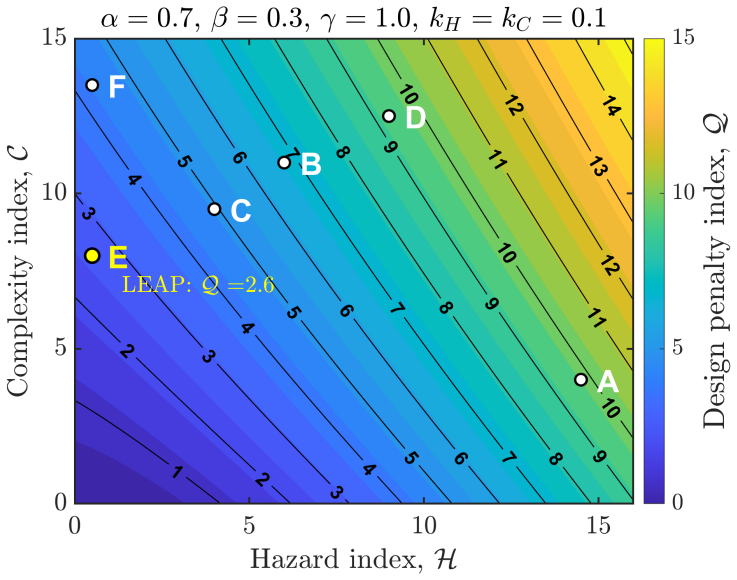
We introduce a generalized design framework ... design penalty index Q that balances hazard reduction against system complexity. Q = αH(1−γ_eff) + βC
-
IndisputableMonolith/Foundation/RealityFromDistinction.leanreality_from_one_distinction unclear?
unclearRelation between the paper passage and the cited Recognition theorem.
Table 1: List of hazards ... Table 2: List of safety features ... Scenario E ... gives the lowest penalty index Q ≈ 2.6
What do these tags mean?
- matches
- The paper's claim is directly supported by a theorem in the formal canon.
- supports
- The theorem supports part of the paper's argument, but the paper may add assumptions or extra steps.
- extends
- The paper goes beyond the formal theorem; the theorem is a base layer rather than the whole result.
- uses
- The paper appears to rely on the theorem as machinery.
- contradicts
- The paper's claim conflicts with a theorem or certificate in the canon.
- unclear
- Pith found a possible connection, but the passage is too broad, indirect, or ambiguous to say the theorem truly supports the claim.
Reference graph
Works this paper leans on
- [1]
-
[2]
P. A. Davidson, Introduction to magnetohydrodynamics, Cambridge university press, 2017
work page 2017
-
[3]
S.-Y. Tang, C. Tabor, K. Kalantar-Zadeh, M. D. Dickey, Gallium liquid metal: the devil’s elixir, Annual Review of Materials Research 51 (1) (2021) 381–408
work page 2021
-
[4]
J. Coenen, G. De Temmerman, G. Federici, V. Philipps, G. Sergienko, G. Strohmayer, A. Terra, B. Unterberg, T. Wegener, D. Van den Bekerom, Liquid metals as alternative solution for the power exhaust of future fusion devices: status and perspective, Physica Scripta 159 (1) (2014) 014037
work page 2014
-
[5]
M. Ono, R. Majeski, M. A. Jaworski, Y. Hirooka, R. Kaita, T. K. Gray, R. Maingi, C. H. Skinner, M. Christenson, D. N. Ruzic, Liquid lithium loop system to solve challenging technology issues for fusion power plant, Nuclear Fusion 57 (11) (2017) 116056
work page 2017
-
[6]
R. Kaita, Fusion applications for lithium: wall conditioning in mag- netic confinementdevices, PlasmaPhysics and ControlledFusion 61(11) (2019) 113001
work page 2019
-
[7]
A.DeCastro, C.Moynihan, S.Stemmley, M.Szott, D.Ruzic, Lithium, a path to make fusion energy affordable, Physics of Plasmas 28 (5) (2021)
work page 2021
-
[8]
F. R. Urgorri, S. Smolentsev, I. Fernández-Berceruelo, D. Rapisarda, I. Palermo, A. Ibarra, Magnetohydrodynamic and thermal analysis of pbli flows in poloidal channels with flow channel insert for the eu-dcll blanket, Nuclear fusion 58 (10) (2018) 106001
work page 2018
-
[9]
Department of Energy, Fusion science & technology roadmap, Tech
U.S. Department of Energy, Fusion science & technology roadmap, Tech. rep., U.S. Department of Energy (2025). URLhttps://www.energy.gov/sites/default/files/2025-10/ fusion-s%26t-roadmap-101625.pdf
work page 2025
-
[10]
L. Golubchikov, V. Evtikhin, I. Lyublinski, V. Pistunovich, I. Potapov, A. Chumanov, Development of a liquid-metal fusion reactor divertor with a capillary-pore system, Journal of nuclear materials 233 (1996) 667–672. 43
work page 1996
- [11]
-
[12]
A. Herrmann, H. Greuner, N. Jaksic, M. Balden, A. Kallenbach, K. Krieger, P. De Marné, V. Rohde, A. Scarabosio, G. Schall, et al., Solid tungsten divertor-iii for asdex upgrade and contributions to iter, Nuclear Fusion 55 (6) (2015) 063015
work page 2015
-
[13]
R. E. Nygren, D. L. Rudakov, C. Murphy, J. D. Watkins, E. A. Unter- berg, J. L. Barton, P. C. Stangeby, Thermal management of tungsten leading edges in diii-d, Fusion Engineering and Design 124 (2017) 271– 275
work page 2017
- [14]
-
[15]
G. Sinclair, J. Tripathi, P. Diwakar, A. Hassanein, Melt layer erosion during elm-like heat loading on molybdenum as an alternative plasma- facing material, Scientific reports 7 (1) (2017) 12273
work page 2017
-
[16]
S. Wang, J. Li, Y. Wang, X. Zhang, R. Wang, Y. Wang, J. Cao, Thermal damage of tungsten-armored plasma-facing components under high heat flux loads, Scientific Reports 10 (1) (2020) 1359
work page 2020
-
[17]
A. Fisher, Z. Sun, E. Kolemen, Liquid metal “divertorlets” concept for fusion reactors, Nuclear Materials and Energy 25 (2020) 100855
work page 2020
- [18]
-
[19]
N. B. Morley, M. A. Abdou, Modeling of fully-developed, liquid metal, thin film flows for fusion divertor applications, Fusion engineering and design 30 (4) (1995) 339–356
work page 1995
- [20]
- [21]
- [22]
- [23]
-
[24]
R. J. Goldston, R. Myers, J. Schwartz, The lithium vapor box divertor, Physica Scripta 167 (1) (2016) 014017
work page 2016
- [25]
-
[26]
D. Ruzic, M. Szott, C. Sandoval, M. Christenson, P. Fiflis, S. Hammouti, K. Kalathiparambil, I. Shchelkanov, D. Andruczyk, R. Stubbers, et al., Flowing liquid lithium plasma-facing components–physics, technology and system analysis of the limit system, Nuclear Materials and Energy 12 (2017) 1324–1329
work page 2017
-
[27]
M. S. Islam, J. D. Lore, S. Smolentsev, C. E. Kessel, R. Maingi, Analysis and design of fast flow liquid li divertor for fusion nuclear science facility (fnsf) using coupled plasma boundary and lm mhd/heat transfer codes, Nuclear Fusion 64 (5) (2024) 056036
work page 2024
- [28]
- [29]
-
[30]
J. Nolen, et al., Argonne physics division 2000 annual report, Argonne National Laboratory, Lemont, USA, Rep. ANL-01/19 (2001). 45
work page 2000
-
[31]
J. Wei, H. Ao, S. Beher, N. Bultman, F. Casagrande, S. Cogan, C. Compton, J. Curtin, L. Dalesio, K. Davidson, et al., Advances of the frib project, International Journal of Modern Physics E 28 (3) (2019) 1930003
work page 2019
-
[32]
Y. Momozaki, C. B. Reed, J. A. Nolen, J. R. Specht, D. B. Chojnowski, J. Song, F. Marti, P. Guetschow, J. Sherman, Proton beam-on-liquid lithiumstripperfilmexperiment, JournalofRadioanalyticalandNuclear Chemistry 305 (3) (2015) 843–849
work page 2015
-
[33]
T. Kanemura, M. LaVere, R. Madendorp, F. Marti, T. Maruta, Y. Mo- mozaki, P. Ostroumov, A. S. Plastun, J. Wei, Q. Zhao, Experimen- tal demonstration of the thin-film liquid-metal jet as a charge stripper, Physical Review Letters 128 (21) (2022) 212301
work page 2022
-
[34]
T. Furukawa, Y. Hirakawa, S. Kato, M. Iijima, M. Ohtaka, H. Kondo, T. Kanemura, E. Wakai, Current status of the technology development on lithium safety handling under ifmif/eveda, Fusion Engineering and Design 89 (12) (2014) 2902–2909
work page 2014
- [35]
-
[36]
J. Knaster, T. Kanemura, K. Kondo, An assessment of the evaporation and condensation phenomena of lithium during the operation of a li (d, xn) fusion relevant neutron source, Heliyon 2 (12) (2016)
work page 2016
-
[37]
J. Knaster, P. Favuzza, Assessment of corrosion phenomena in liquid lithium at t< 873 k. a li (d, n) neutron source as case study, Fusion Engineering and Design 118 (2017) 135–141
work page 2017
- [38]
-
[39]
R. Majeski, R. Doerner, T. Gray, R. Kaita, R. Maingi, D. Mansfield, J. Spaleta, V. Soukhanovskii, J. Timberlake, L. Zakharov, Enhanced en- ergy confinement and performance in a low-recycling tokamak, Physical review letters 97 (7) (2006) 075002. 46
work page 2006
-
[40]
D. P. Boyle, J. Anderson, S. Banerjee, R. Bell, W. Capecchi, D. Elliott, C. Hansen, S. Kubota, B. LeBlanc, A. Maan, et al., Extending the low-recycling, flat temperature profile regime in the lithium tokamak experiment-β(ltx-β) with ohmic and neutral beam heating, Nuclear Fusion 63 (5) (2023) 056020
work page 2023
- [41]
-
[42]
G. Mazzitelli, M. Apicella, D. Frigione, G. Maddaluno, M. Marinucci, C.Mazzotta, V.PericoliRidolfini, M.Romanelli, G.Szepesi, O.Tudisco, et al., Ftu results with a liquid lithium limiter, Nuclear Fusion 51 (7) (2011) 073006
work page 2011
-
[43]
F. Tabarés, M. Ochando, F. Medina, D. Tafalla, J. Ferreira, E. Ascasi- bar, R. Balbín, T. Estrada, C. Fuentes, I. García-Cortés, et al., Plasma performance and confinement in the tj-ii stellarator with lithium-coated walls, Plasma Physics and Controlled Fusion 50 (12) (2008) 124051
work page 2008
-
[44]
G. Zuo, J. Hu, J. Li, N. Luo, L. Zakharov, L. Zhang, A. Ti, First results of lithium experiments on east and ht-7, Journal of Nuclear Materials 415 (1) (2011) S1062–S1066
work page 2011
-
[45]
R. Maingi, T. Osborne, B. LeBlanc, R. Bell, J. Manickam, P. Snyder, J. Menard, D.Mansfield, H. Kugel, R. Kaita, et al., Edge-localized-mode suppression through density-profile modification with lithium-wall coat- ings in the national spherical torus experiment, Physical review letters 103 (7) (2009) 075001
work page 2009
-
[46]
G. Zuo, J. Hu, J. Li, Z. Sun, D. Mansfield, L. Zakharov, Lithium coating for h-mode and high performance plasmas on east in asipp, Journal of Nuclear Materials 438 (2013) S90–S95
work page 2013
- [47]
- [48]
-
[49]
C. Baus, P. Barron, A. D’Angiò, Y. Hirata, S. Konishi, J. Mund, T. Na- gao, D. Nakahara, R. Pearson, M. Sakaguchi, et al., Kyoto fusioneering’s mission to accelerate fusion energy: Technologies, challenges and role in industrialisation, Journal of Fusion Energy 42 (1) (2023) 10
work page 2023
-
[50]
T. D. Bohm, A. Davis, M. S. Harb, E. P. Marriott, P. P. Wilson, Initial neutronics investigation of a liquid-metal plasma-facing fusion nuclear science facility, Fusion Science and Technology 75 (6) (2019) 429–437
work page 2019
-
[51]
J. A. Lane, H. G. MacPherson, F. Maslan, Fluid fuel reactors: Molten salt reactors, aqueous homogeneous reactors, fluoride reactors, chloride reactors, liquid metal reactors and why liquid fission, Addison-Wesley Pub. Co., 1958
work page 1958
-
[52]
R. Michal, Fifty years ago in december: Atomic reactor ebr-i produced first electricity, Nuclear News 44 (12) (2001) 28–29
work page 2001
-
[53]
D. Kultgen, M. Weathered, E. Kent, J. Rein, A. Grannan, C. Grandy, Mechanisms engineering test loop (metl) operations and testing report (fy2022), Tech. rep., Argonne National Laboratory (ANL), Argonne, IL (United States) (2022)
work page 2022
-
[54]
Generation IV International Forum, Sodium fast reactor (sfr),https: //www.gen-4.org/generation-iv-criteria-and-technologies/ sodium-fast-reactor-sfr, accessed 2026-05-02 (n.d.)
work page 2026
-
[55]
A. C. Marshall, An assessment of reactor types for thermochemical hy- drogen production, Tech. Rep. SAND2002-0513, Sandia National Labo- ratories (02 2002). URLhttps://www.osti.gov/servlets/purl/793338
work page 2002
- [56]
- [57]
-
[58]
A. Miyakawa, H. Maeda, Y. Kani, K. Ito, Sodium leakage experience at the prototype fbr monju, IAEA. (2000)
work page 2000
- [59]
-
[60]
G. D’Ovidio, F. Martín-Fuertes, J. C. Marugán, S. Bermejo, F. S. Nitti, Lithium fire protection design approach in ifmif-dones facility, Fusion Engineering and Design 189 (2023) 113446
work page 2023
- [61]
-
[62]
R. Nygren, Sandia plasma materials test facility (pmtf) and actions after li fire on 26 aug 2011, Technical report/presentation, Sandia National Laboratories (2012)
work page 2011
- [63]
-
[64]
International Code Council, 2021 International Building Code, section 307, Hazardous Materials (2021). URLhttps://codes.iccsafe.org/s/IBC2021P1/ chapter-3-occupancy-classification-and-use/ IBC2021P1-Ch03-Sec307.8
work page 2021
-
[65]
URLhttps://www.nfpa.org/product/nfpa-484-standard/ p0484code 49
National Fire Protection Association, NFPA 484: Standard for Com- bustible Metals (2022). URLhttps://www.nfpa.org/product/nfpa-484-standard/ p0484code 49
work page 2022
-
[66]
URLhttps://codes.iccsafe.org/content/IFC2024P1
International Code Council, 2024 International Fire Code (2024). URLhttps://codes.iccsafe.org/content/IFC2024P1
work page 2024
-
[67]
URLhttps://www.iaea.org/publications/14797/ fire-protection-in-nuclear-power-plants
International Atomic Energy Agency, Fire Protection in Nuclear Power Plants (2021). URLhttps://www.iaea.org/publications/14797/ fire-protection-in-nuclear-power-plants
work page 2021
-
[68]
URLhttps://www.asme.org/codes-standards/ find-codes-standards/b313-2018-process-piping
The American Society of Mechanical Engineers, ASME B31.3: Process Piping (2024). URLhttps://www.asme.org/codes-standards/ find-codes-standards/b313-2018-process-piping
work page 2024
-
[69]
URLhttps://www.asme.org/codes-standards/bpvc-standards/ bpvc-2025
The American Society of Mechanical Engineers, ASME Boiler and Pressure Vessel Code (2025). URLhttps://www.asme.org/codes-standards/bpvc-standards/ bpvc-2025
work page 2025
-
[70]
D. Gertman, H. Blackman, J. Marble, J. Byers, C. Smith, et al., The spar-h human reliability analysis method, US Nuclear Regulatory Com- mission 230 (4) (2005) 35
work page 2005
-
[71]
D. Bernoulli, Exposition of a new theory on the measurement of risk, in: The Kelly capital growth investment criterion: Theory and practice, World Scientific, 2011, pp. 11–24
work page 2011
-
[72]
H. W. Davison, Compilation of thermophysical properties of liquid lithium, Vol. 4650, National Aeronautics and Space Administration, 1968
work page 1968
-
[73]
K. Miyazaki, K. Konishi, S. Inoue, Mhd pressure drop of liquid metal flow in circular duct under variable transverse magnetic field, Journal of Nuclear Science and Technology 28 (2) (1991) 159–161
work page 1991
-
[74]
G. R. Kinsley Jr, Properly purge and inert storage vessels, Natural gas (Pittsburgh) 12 (2001) 14–5
work page 2001
-
[75]
S. Wei, S. Lampman, Centrifugal casting, in: Casting, ASM Interna- tional, 2008, pp. 667–673. 50
work page 2008
-
[76]
Q. Wang, Y. Yu, J. Liu, Preparations, characteristics and applications of the functional liquid metal materials, Advanced Engineering Materials 20 (5) (2018) 1700781
work page 2018
-
[77]
M. D. Dickey, Stretchable and soft electronics using liquid metals, Ad- vanced materials 29 (27) (2017) 1606425
work page 2017
-
[78]
M. M. Adams, D. R. Stone, D. S. Zimmerman, D. P. Lathrop, Liquid sodium models of the earth’s core, Progress in Earth and Planetary Science 2 (1) (2015) 29
work page 2015
-
[79]
F. Stefani, A. Gailitis, G. Gerbeth, A. Giesecke, T. Gundrum, G. Rüdi- ger, M. Seilmayer, T. Vogt, The dresdyn project: liquid metal experi- ments on dynamo action and magnetorotational instability, Geophysical & Astrophysical Fluid Dynamics 113 (1-2) (2019) 51–70
work page 2019
-
[80]
Y. Xu, S. Horn, J. M. Aurnou, Thermoelectric precession in turbulent magnetoconvection, Journal of Fluid Mechanics 930 (2022) A8
work page 2022
discussion (0)
Sign in with ORCID, Apple, or X to comment. Anyone can read and Pith papers without signing in.