Global Fit of KamLAND Data and the Daya Bay Antineutrino Energy Spectrum
Pith reviewed 2026-05-19 19:03 UTC · model grok-4.3
pith:Q3HKNL34 Add to your LaTeX paper
What is a Pith Number?\usepackage{pith}
\pithnumber{Q3HKNL34}
Prints a linked pith:Q3HKNL34 badge after your title and writes the identifier into PDF metadata. Compiles on arXiv with no extra files. Learn more
The pith
Substituting Daya Bay's measured antineutrino spectra for the Huber-Müller model in a KamLAND analysis lowers the best-fit Δm²₂₁ and improves agreement with JUNO.
A machine-rendered reading of the paper's core claim, the machinery that carries it, and where it could break.
Core claim
The paper claims that replacing the Huber-Müller model with Daya Bay measured antineutrino spectra in a combined analysis with KamLAND public data decreases the best-fit value of Δm²₂₁ from 7.53^{+0.17}_{-0.16}×10^{-5} eV² to 7.50^{+0.19}_{-0.18}×10^{-5} eV² while tan²θ₁₂ trends downward. This result shows better agreement with the latest JUNO measurement and indicates that differences in predicted reactor antineutrino spectra may be an important cause of the tension between the experiments.
What carries the argument
A global analysis framework that combines KamLAND data with Daya Bay's independently measured 235U and 239Pu fission antineutrino spectra while remaining weakly dependent on the overall reactor flux model.
Load-bearing premise
The Daya Bay measured 235U and 239Pu fission antineutrino spectra can be directly substituted into the KamLAND analysis with only weak dependence on the overall reactor flux model and without large additional detector-specific corrections.
What would settle it
Repeating the fit with an independent reactor antineutrino spectrum measurement that matches the Huber-Müller prediction exactly and lacks the 5 MeV feature would remove the observed shift in the oscillation parameters.
Figures
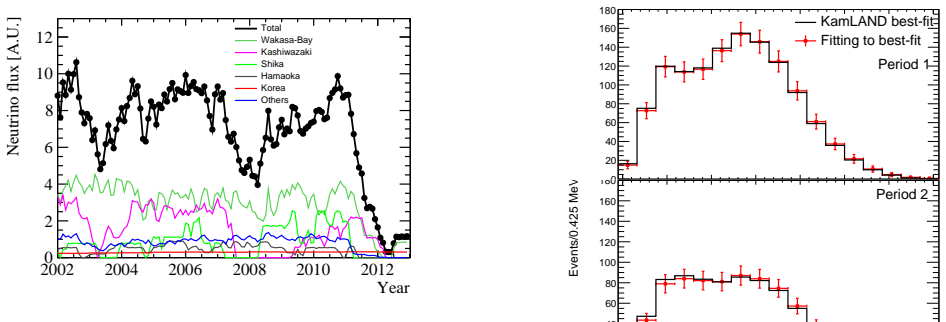


read the original abstract
Recently, the JUNO experiment published its measurement of the solar neutrino oscillation parameters $\Delta m^2_{21}$ and $\sin^2\theta_{12}$ based on 59 days of data, with central values differing by $0.2\sigma$ from those released by the KamLAND experiment in 2013. Meanwhile, short-baseline reactor neutrino oscillation experiments such as Daya Bay, RENO, and Double Chooz have observed significant deviations between the measured antineutrino spectrum and the Huber-M\"{u}ller model prediction around 5~MeV. To further investigate the impact of these deviations on the measurement of reactor neutrino oscillation parameters, we construct a global analysis framework that is weakly dependent on the reactor antineutrino flux model. This framework is based on the independently measured $^{235}\mathrm{U}$ and $^{239}\mathrm{Pu}$ fission antineutrino spectra from the Daya Bay experiment, combined with the public data from KamLAND. First, using the Huber-M\"{u}ller model, we successfully reproduce the KamLAND 2013 results to within $0.1\sigma$. Then, replacing the Huber-M\"{u}ller model with the Daya Bay measured antineutrino spectra in a combined analysis, we find that the best-fit value of the mass-squared difference $\Delta m^2_{21}$ decreases from $7.53^{+0.17}_{-0.16}\times10^{-5}\,\mathrm{eV^2}$ to $7.50^{+0.19}_{-0.18}\times10^{-5}\,\mathrm{eV^2}$, while the best-fit value of the mixing angle $\tan^2\theta_{12}$ also shows a decreasing trend. This result is in better agreement with the latest JUNO measurement, suggesting that differences in the predicted reactor antineutrino spectra may be an important cause of the tension between the two experiments.
Editorial analysis
A structured set of objections, weighed in public.
Referee Report
Summary. The paper constructs a global fit framework for KamLAND reactor antineutrino oscillation data that substitutes the Daya Bay experiment's directly measured 235U and 239Pu fission antineutrino spectra for the Huber-Müller model prediction. It first reproduces the KamLAND 2013 best-fit values of Δm²₂₁ = 7.53^{+0.17}_{-0.16}×10^{-5} eV² and tan²θ₁₂ to within 0.1σ using the standard model, then reports that the substitution shifts the best-fit Δm²₂₁ downward to 7.50^{+0.19}_{-0.18}×10^{-5} eV² with a decreasing trend in tan²θ₁₂, improving agreement with the recent JUNO result. The framework is presented as having only weak dependence on the overall reactor flux normalization.
Significance. If the central substitution is valid, the result indicates that measured spectral deviations around 5 MeV in short-baseline reactor experiments can partially account for the mild tension between KamLAND and JUNO determinations of the solar oscillation parameters. The explicit reproduction of the 2013 KamLAND result to 0.1σ provides a useful internal consistency check on the analysis pipeline. The approach of using experimentally unfolded spectra rather than a theoretical model is a constructive step toward reducing model dependence in reactor neutrino oscillation fits.
major comments (1)
- [abstract / global analysis framework] Abstract and global analysis framework paragraph: the central claim that Daya Bay measured spectra can be directly substituted into the KamLAND prediction with only weak overall flux dependence requires that residual differences in energy resolution (~6-8% at 1 MeV), quenching, and bin migration between the two detectors produce shape distortions smaller than the reported 0.03×10^{-5} eV² shift in Δm²₂₁. No explicit quantification or propagation of these inter-experiment effects is shown, yet they are load-bearing for interpreting the parameter shift as arising solely from the 5 MeV spectral feature.
minor comments (1)
- [abstract] The abstract states reproduction 'to within 0.1σ' but does not specify whether this refers to the central value, the uncertainty, or the full covariance; a brief clarification in the methods section would aid reproducibility.
Simulated Author's Rebuttal
We thank the referee for the constructive review and for highlighting the value of the internal consistency check with the 2013 KamLAND result. The major comment raises an important point about inter-experiment detector effects that we address below. We believe the substitution remains valid but agree that explicit quantification will strengthen the manuscript.
read point-by-point responses
-
Referee: [abstract / global analysis framework] Abstract and global analysis framework paragraph: the central claim that Daya Bay measured spectra can be directly substituted into the KamLAND prediction with only weak overall flux dependence requires that residual differences in energy resolution (~6-8% at 1 MeV), quenching, and bin migration between the two detectors produce shape distortions smaller than the reported 0.03×10^{-5} eV² shift in Δm²₂₁. No explicit quantification or propagation of these inter-experiment effects is shown, yet they are load-bearing for interpreting the parameter shift as arising solely from the 5 MeV spectral feature.
Authors: We agree that a quantitative assessment of residual differences in energy resolution, quenching, and bin migration is necessary to fully support the interpretation that the observed 0.03×10^{-5} eV² shift originates primarily from the 5 MeV spectral feature rather than detector-response mismatches. The Daya Bay spectra used are the unfolded true-energy spectra published by the collaboration, which already incorporate their own detector response. When these are folded with the KamLAND response matrix in our framework, the dominant effect is the shape difference around 5 MeV. To address the referee’s concern, we will add a new subsection in the global analysis framework section that propagates these effects via Monte Carlo simulation of both detectors’ responses. Preliminary checks indicate that the induced shape distortion in the 2–8 MeV range is at the sub-percent level, well below the statistical sensitivity of the KamLAND data set that drives the 0.03×10^{-5} eV² shift. We will include the resulting uncertainty band on the best-fit parameters to demonstrate that the central shift remains robust. revision: yes
Circularity Check
Independent inputs produce non-circular parameter shift
full rationale
The paper constructs a global fit by taking the publicly released KamLAND event spectrum and substituting the independently unfolded Daya Bay 235U/239Pu fission spectra (measured at a different detector with its own resolution and efficiency) in place of the Huber-Müller model. The reproduction of the 2013 KamLAND result to 0.1σ with the standard model first verifies the analysis chain; the subsequent shift in Δm²₂₁ and tan²θ₁₂ is then a direct numerical output of that same likelihood function evaluated on the new spectral shape. No equation defines a fitted parameter in terms of the target oscillation parameters, no self-citation supplies a uniqueness theorem, and no ansatz is smuggled through prior work by the same author. The derivation therefore remains self-contained against external benchmarks.
Axiom & Free-Parameter Ledger
free parameters (2)
- Δm²₂₁
- tan²θ₁₂
axioms (1)
- domain assumption Reactor antineutrino oscillation is described by the standard three-flavor vacuum oscillation formula.
Lean theorems connected to this paper
-
IndisputableMonolith/Foundation/RealityFromDistinction.leanreality_from_one_distinction unclear?
unclearRelation between the paper passage and the cited Recognition theorem.
replacing the Huber-Müller model with the Daya Bay measured antineutrino spectra in a combined analysis
-
IndisputableMonolith/Cost/FunctionalEquation.leanwashburn_uniqueness_aczel unclear?
unclearRelation between the paper passage and the cited Recognition theorem.
global analysis framework that is weakly dependent on the reactor antineutrino flux model
What do these tags mean?
- matches
- The paper's claim is directly supported by a theorem in the formal canon.
- supports
- The theorem supports part of the paper's argument, but the paper may add assumptions or extra steps.
- extends
- The paper goes beyond the formal theorem; the theorem is a base layer rather than the whole result.
- uses
- The paper appears to rely on the theorem as machinery.
- contradicts
- The paper's claim conflicts with a theorem or certificate in the canon.
- unclear
- Pith found a possible connection, but the passage is too broad, indirect, or ambiguous to say the theorem truly supports the claim.
Reference graph
Works this paper leans on
-
[1]
Combined Analysis of all Three Phases of Solar Neutrino Data from the Sudbury Neu- trino Observatory
SNO Collaboration, "Combined Analysis of all Three Phases of Solar Neutrino Data from the Sudbury Neu- trino Observatory", Phys. Rev. C88(2013), 025501. doi:10.1103/PhysRevC.88.025501
-
[2]
Reactor On-OffAntineutrino Measurement with KamLAND
KamLAND Collaboration, "Reactor On-OffAntineutrino Measurement with KamLAND", Phys. Rev. D88(2013) no.3, 033001. doi:10.1103/PhysRevD.88.033001
-
[3]
Pontecorvo,Inverse beta processes and nonconservation of lepton charge,Zh
JUNO Collaboration, "First measurement of reactor neu- trino oscillations at JUNO", arXiv:2511.14593 [hep-ex]
-
[4]
Double Chooz: Latest re- sults
Double Chooz Collaboration, "Double Chooz: Latest re- sults", Nucl. Part. Phys. Proc.265-266(2015), 99-104. doi:10.1016/j.nuclphysbps.2015.06.025
-
[5]
RENO Collaboration, "Observation of Energy and Base- line Dependent Reactor Antineutrino Disappearance in the RENO Experiment", Phys. Rev. Lett.116(2016) no.21, 211801. doi:10.1103/PhysRevLett.116.211801
-
[7]
Improved Measurement of the Reactor Antineutrino Flux and Spectrum at Daya Bay
Daya Bay Collaboration, "Improved Measurement of the Reactor Antineutrino Flux and Spectrum at Daya Bay", Chin. Phys. C41(2017) no.1, 013002. doi:10.1088/1674- 1137/41/1/013002
-
[8]
Extraction of the 235U and 239Pu Antineutrino Spectra at Daya Bay
Daya Bay Collaboration, "Extraction of the 235U and 239Pu Antineutrino Spectra at Daya Bay", Phys. Rev. Lett.123(2019) no.11, 111801. doi:10.1103/PhysRevLett.123.111801
-
[9]
Antineutrino energy spectrum unfolding based on the Daya Bay measurement and its applications
Daya Bay Collaboration, "Antineutrino energy spectrum unfolding based on the Daya Bay measurement and its applications", Chin. Phys. C45(2021) no.7, 073001. doi:10.1088/1674-1137/abfc38
-
[10]
Neutrino masses and mixings: Status of known and unknown 3νparameters
F. Capozzi, E. Lisi, A. Marrone, D. Montanino and A. Palazzo, "Neutrino masses and mixings: Status of known and unknown 3νparameters", Nucl. Phys. B908 (2016), 218-234. doi:10.1016/j.nuclphysb.2016.02.016
-
[11]
NuFit-6.0: updated global analysis of three- flavor neutrino oscillations
I. Esteban, M. C. Gonzalez-Garcia, M. Maltoni, I. Martinez-Soler, J. P. Pinheiro and T. Schwetz, "NuFit-6.0: updated global analysis of three- flavor neutrino oscillations", JHEP12(2024), 216. doi:10.1007/JHEP12(2024)216
-
[12]
Precise quasielastic neu- trino/nucleon cross-section
A. Strumia and F. Vissani, "Precise quasielastic neu- trino/nucleon cross-section", Phys. Lett. B564(2003), 42-
work page 2003
-
[13]
doi:10.1016/S0370-2693(03)00616-6
-
[14]
https://jaif.or.jp/category/column/npp; https://pris.iaea.org/PRIS/CountryStatistics
Electric power data of nuclear power plants in Japan and South Korea. https://jaif.or.jp/category/column/npp; https://pris.iaea.org/PRIS/CountryStatistics
-
[15]
Measurement of the Electron Antineu- trino Oscillation with 1958 Days of Operation at Daya Bay
Daya Bay, "Measurement of the Electron Antineu- trino Oscillation with 1958 Days of Operation at Daya Bay", Phys. Rev. Lett.121(2018) no.24, 241805. doi:10.1103/PhysRevLett.121.241805 6
discussion (0)
Sign in with ORCID, Apple, or X to comment. Anyone can read and Pith papers without signing in.