SN 2023dbc in M108: Optical and Near-Infrared Observations of a Highly-Obscured, Moderately Energetic Stripped-Envelope Supernova
Pith reviewed 2026-05-19 20:00 UTC · model grok-4.3
The pith
SN 2023dbc originated from an aspherical explosion with partial core fallback from a 15 solar mass binary progenitor that retained its helium envelope.
A machine-rendered reading of the paper's core claim, the machinery that carries it, and where it could break.
Core claim
SN 2023dbc is a moderately energetic stripped-envelope supernova whose light-curve timescale, expansion velocities, and low nickel yield are best explained by an aspherical explosion with partial core fallback arising from a progenitor of initial mass about 15 solar masses that retained its helium envelope within a binary system.
What carries the argument
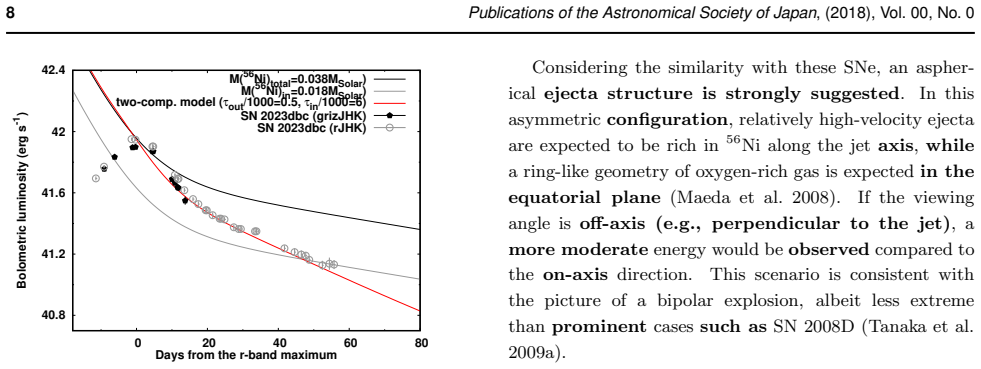
Two-component model fitted to the light-curve timescale and velocity data that separates a steep outer density profile from a dense inner core and thereby implies ejecta asphericity.
If this is right
- The progenitor must have lost its hydrogen but kept helium through binary interaction rather than single-star winds.
- Partial core fallback naturally accounts for the modest nickel mass without requiring unusual nucleosynthesis.
- The event sits spectroscopically between ordinary Type Ib and broad-lined Type Ic supernovae, suggesting a continuous sequence of explosion energies and asymmetries.
- Similar two-component density structures may appear in other moderately energetic stripped-envelope events observed at late times.
Where Pith is reading between the lines
- If asphericity is common in this mass range, polarization surveys of future Type Ib events could reveal a larger fraction of non-spherical explosions than currently assumed.
- Binary population synthesis models may need to increase the fraction of 15-solar-mass systems that retain helium envelopes at core collapse.
- The same density-profile diagnostic could be applied to archival light curves of other reddened supernovae to test how often partial fallback occurs.
Load-bearing premise
The two-component model applied to the light-curve timescale and velocity data accurately captures a steep outer density profile versus dense inner core and that this structure directly implies ejecta asphericity rather than viewing-angle effects or incomplete line identification.
What would settle it
Spectropolarimetry showing no significant polarization or a full 3D hydrodynamic simulation reproducing the light curve and spectra with a spherical geometry would falsify the asphericity claim.
Figures


read the original abstract
We present near-infrared (NIR) and optical observations of the highly reddened and moderately energetic Type Ib supernova (SN) 2023dbc, {\bf covering a period from} 2 to 136 days after the explosion. By comparing its color {\bf evolution}, specifically in $r-JHK_{\mathrm{s}}$ and $i-JHK_{\mathrm{s}}$, with those of broad-lined Type Ic (Ic-BL) and Type IIb SNe, we estimate a significant extinction of $A_{V}=4.1\pm0.1$\,mag toward the SN. The extinction-corrected peak absolute magnitudes are $M_{J} = -16.8\pm0.2$\,mag, $M_{H} = -16.8\pm0.2$\,mag, and $M_{K_{\mathrm{s}}} = -17.0\pm0.2$\,mag. The SN {\bf exhibited} an $r$-band rise time of 14.9 days. The spectra {\bf display} broad features {\bf indicative of} high expansion velocities; the He~{\sc i} line velocity was measured at $16,000\,\mathrm{km\,s^{-1}}$ at $t=-4$\,d. Its spectral profile is broader than {\bf those} of typical moderately energetic Type Ib SNe, {\bf yet narrower than those of Type Ic-BL SNe, placing it in an intermediate category}. Based on the light-curve timescale and velocity, we estimate {\bf a} kinetic energy of $E_k = (4.1\pm0.7) \times 10^{51}$\,erg, {\bf an} ejecta mass of $M_{\mathrm{ej}} = 2.3\pm0.7\,M_{\odot}$, and a radioactive $^{56}\mathrm{Ni}$ mass of $(3.8\pm0.1) \times 10^{-2}\,M_{\odot}$. {\bf An} analysis using a two-component model suggests a steep density profile in the outer layer {\bf contrasted with} a dense inner core, {\bf which implies} ejecta asphericity. The low $^{56}\mathrm{Ni}$ mass is consistent with a partial fallback scenario. We conclude that SN 2023dbc originated from an aspherical explosion with partial core fallback, {\bf arising} from a progenitor ($M_{\mathrm{ini}} \simeq 15\,M_{\odot}$) that had retained {\bf its} helium envelope {\bf within} a binary system.
Editorial analysis
A structured set of objections, weighed in public.
Referee Report
Summary. The manuscript reports optical and NIR observations of the highly reddened Type Ib supernova SN 2023dbc spanning 2 to 136 days post-explosion. Extinction is estimated at A_V = 4.1 ± 0.1 mag via color comparisons to Ic-BL and IIb SNe, yielding extinction-corrected peak magnitudes M_J ≈ -16.8, M_H ≈ -16.8, M_Ks ≈ -17.0 mag. An r-band rise time of 14.9 days and He I velocity of 16,000 km s^{-1} at t = -4 d are measured. Scaling from light-curve timescale and velocity gives E_k = (4.1 ± 0.7) × 10^{51} erg, M_ej = 2.3 ± 0.7 M_⊙, and ^{56}Ni mass = (3.8 ± 0.1) × 10^{-2} M_⊙. A two-component model is applied to infer a steep outer density profile versus dense inner core, interpreted as implying ejecta asphericity; the low Ni mass supports partial core fallback. The authors conclude the event arose from an aspherical explosion with partial fallback from a ~15 M_⊙ binary progenitor that retained its helium envelope.
Significance. If the two-component modeling and its geometric interpretation hold, the work adds a well-observed, moderately energetic example to the sample of obscured stripped-envelope SNe and provides constraints on asphericity and fallback scenarios. The direct observational anchors (extinction, magnitudes, velocities) are solid; the derived parameters and progenitor inference could inform binary evolution and explosion asymmetry models if the density-profile-to-asphericity step is strengthened.
major comments (2)
- [two-component model analysis] In the two-component model analysis (abstract and the section deriving physical parameters from light-curve timescale and velocity): the statement that the model 'suggests a steep density profile in the outer layer contrasted with a dense inner core, which implies ejecta asphericity' is load-bearing for the central claim but rests on an untested mapping. No comparison to 1D spherical radiative-transfer models with broken power-law density profiles, no polarization data, and no hydrodynamic simulations are referenced to exclude alternatives such as viewing-angle effects or incomplete line identification, as highlighted by the stress-test concern.
- [conclusions and progenitor discussion] In the concluding synthesis of progenitor properties: the assignment of M_ini ≃ 15 M_⊙ and a binary system retaining the helium envelope chains the low ^{56}Ni mass and asphericity inference through multiple scaling relations whose applicability to this specific object (with its derived parameters) is stated but not independently validated against the observed rise time and line velocities.
minor comments (2)
- [physical parameter estimation] The scaling relations used for E_k, M_ej, and Ni mass (based on light-curve timescale and velocity) should include explicit citations to the source papers at the point of application rather than relying on general references.
- [abstract and observations] Minor grammatical phrasing in the abstract (e.g., 'The SN exhibited an r-band rise time of 14.9 days') could be tightened for clarity, and the exact epochs used for the r-JHK_s and i-JHK_s color comparisons should be tabulated or stated.
Simulated Author's Rebuttal
We thank the referee for the constructive and detailed report on our manuscript. We have addressed each major comment point by point below, providing clarifications and revisions where warranted to strengthen the presentation of our results on SN 2023dbc.
read point-by-point responses
-
Referee: In the two-component model analysis (abstract and the section deriving physical parameters from light-curve timescale and velocity): the statement that the model 'suggests a steep density profile in the outer layer contrasted with a dense inner core, which implies ejecta asphericity' is load-bearing for the central claim but rests on an untested mapping. No comparison to 1D spherical radiative-transfer models with broken power-law density profiles, no polarization data, and no hydrodynamic simulations are referenced to exclude alternatives such as viewing-angle effects or incomplete line identification, as highlighted by the stress-test concern.
Authors: We agree that the two-component decomposition offers an indirect constraint on the density structure rather than a definitive proof of asphericity. The approach follows standard techniques applied to other stripped-envelope events in the literature, where a steep outer profile paired with a dense core is commonly interpreted as evidence for asymmetry. We have revised the relevant section and abstract to include explicit caveats, added references to prior studies employing analogous modeling, and briefly discuss possible alternatives including viewing-angle effects and line-identification uncertainties. Full hydrodynamic simulations or new polarization data lie outside the scope of this observational study, but the revised text now frames the asphericity inference more cautiously as suggestive rather than conclusive. revision: partial
-
Referee: In the concluding synthesis of progenitor properties: the assignment of M_ini ≃ 15 M_⊙ and a binary system retaining the helium envelope chains the low ^{56}Ni mass and asphericity inference through multiple scaling relations whose applicability to this specific object (with its derived parameters) is stated but not independently validated against the observed rise time and line velocities.
Authors: The progenitor mass and binary configuration are inferred by placing the observationally derived ejecta mass (2.3 M_⊙), kinetic energy, and low nickel mass onto standard binary-evolution tracks for stars that retain a helium envelope. These tracks predict rise times and expansion velocities consistent with the measured 14.9-day r-band rise and 16,000 km s^{-1} He I velocity at t = -4 d. We have expanded the discussion section to include a direct side-by-side comparison of the observed rise time and line velocities with the model predictions for a ~15 M_⊙ binary progenitor, thereby providing the requested independent validation of the scaling relations for this specific event. revision: yes
Circularity Check
No significant circularity in derivation chain
full rationale
The paper derives kinetic energy, ejecta mass, and 56Ni mass from observed rise time and line velocities using established external scaling relations. The two-component model is then applied to infer a steep outer density profile versus dense inner core, which is interpreted as implying asphericity and partial fallback; this interpretive step does not reduce the final progenitor conclusion to the inputs by construction, self-definition, or a self-citation chain. No load-bearing uniqueness theorem, ansatz smuggling, or renaming of known results is present. The overall chain remains self-contained against the observational data and standard methods.
Axiom & Free-Parameter Ledger
free parameters (2)
- A_V extinction
- scaling constants in kinetic energy and mass estimates
axioms (2)
- domain assumption The two-component model provides a valid description of the outer steep density profile and inner dense core for this event.
- domain assumption Line velocities measured from He I features represent the characteristic expansion velocity of the ejecta.
Lean theorems connected to this paper
-
IndisputableMonolith/Foundation/AlexanderDuality.leanalexander_duality_circle_linking unclear?
unclearRelation between the paper passage and the cited Recognition theorem.
An analysis using a two-component model suggests a steep density profile in the outer layer contrasted with a dense inner core, which implies ejecta asphericity.
What do these tags mean?
- matches
- The paper's claim is directly supported by a theorem in the formal canon.
- supports
- The theorem supports part of the paper's argument, but the paper may add assumptions or extra steps.
- extends
- The paper goes beyond the formal theorem; the theorem is a base layer rather than the whole result.
- uses
- The paper appears to rely on the theorem as machinery.
- contradicts
- The paper's claim conflicts with a theorem or certificate in the canon.
- unclear
- Pith found a possible connection, but the passage is too broad, indirect, or ambiguous to say the theorem truly supports the claim.
Reference graph
Works this paper leans on
-
[1]
Afsariardchi, N., Drout, M. R., Khatami, D. K., et al. 2021, ApJ, 918, 89
work page 2021
- [2]
-
[3]
Aramyan, L. S., Hakobyan, A. A., Petrosian, A. R., et al. 2016, MNRAS, 459, 3130
work page 2016
-
[4]
Arnett, W. D. 1982, ApJ, 253, 785
work page 1982
-
[5]
Bellm, E. C., Kulkarni, S. R., Graham, M. J., et al. 2019, PASP, 131, 018002
work page 2019
-
[6]
B., Modjaz, M., Hicken, M., et al
Bianco, F. B., Modjaz, M., Hicken, M., et al. 2014, ApJS, 213, 19
work page 2014
-
[7]
Bottinelli, L., Gouguenheim, L., Paturel, G., & de Vaucouleurs, G. 1984, A&AS, 56, 381 —. 1985, A&AS, 59, 43
work page 1984
-
[8]
Bottinelli, L., Gouguenheim, L., Paturel, G., & Teerikorpi, P. 1986, A&A, 156, 157
work page 1986
- [9]
- [10]
-
[11]
Cao, Y., Kasliwal, M. M., Arcavi, I., et al. 2013, ApJL, 775, L7
work page 2013
- [12]
- [13]
-
[14]
Chambers, K. C., Magnier, E. A., Metcalfe, N., et al. 2016, 10Publications of the Astronomical Society of Japan, (2018), Vol. 00, No. 0 Table 1.Log of NIR photometry of SN 2023dbc obtained with kSIRIUS. MJDJerr(J) H err(H)K s err(Ks) 60018.6 15.209 0.011 14.795 0.022 14.463 0.030 60022.6 14.546 0.012 14.083 0.028 13.746 0.025 60031.5 14.039 0.007 13.692 0...
work page internal anchor Pith review Pith/arXiv arXiv 2016
-
[15]
Cutri, R. M., Skrutskie, M. F., van Dyk, S., et al. 2003, VizieR Online Data Catalog, II/246 de Vaucouleurs, G., Peters, W. L., Bottinelli, L., Gouguenheim, L., & Paturel, G. 1981, ApJ, 248, 408
work page 2003
-
[16]
Dessart, L., Hillier, D. J., Li, C., & Woosley, S. 2012, MNRAS, 424, 2139
work page 2012
-
[17]
Dessart, L., Yoon, S.-C., Aguilera-Dena, D. R., & Langer, N. 2020, A&A, 642, A106
work page 2020
- [18]
-
[19]
Filippenko, A. V. 1997, ARA&A, 35, 309
work page 1997
-
[20]
Foley, R. J., Papenkova, M. S., Swift, B. J., et al. 2003, PASP, 115, 1220
work page 2003
- [21]
-
[22]
Galama, T. J., Vreeswijk, P. M., van Paradijs, J., et al. 1998, Nature, 395, 670
work page 1998
- [23]
-
[24]
Graur, O., Bianco, F. B., Modjaz, M., et al. 2017, ApJ, 837, 121
work page 2017
-
[25]
H., Georgy, C., & Ekstr¨ om, S
Groh, J. H., Georgy, C., & Ekstr¨ om, S. 2013, A&A, 558, L1
work page 2013
-
[26]
Hachinger, S., Mazzali, P. A., Taubenberger, S., et al. 2012, MNRAS, 422, 70
work page 2012
-
[27]
Hakobyan, A. A., Mamon, G. A., Petrosian, A. R., Kunth, D., & Turatto, M. 2009, A&A, 508, 1259
work page 2009
-
[28]
H., Pfahler, P., Pastorello, A., et al
Harutyunyan, A. H., Pfahler, P., Pastorello, A., et al. 2008, A&A, 488, 383
work page 2008
-
[29]
Ho, A. Y. Q. 2023, Transient Name Server Discovery Report, 2023-533, 1
work page 2023
-
[30]
J., Valenti, S., Kotak, R., et al
Hunter, D. J., Valenti, S., Kotak, R., et al. 2009, A&A, 508, 371
work page 2009
-
[31]
Iwamoto, K., Mazzali, P. A., Nomoto, K., et al. 1998, Nature, 395, 672
work page 1998
-
[32]
Iwamoto, K., Nakamura, T., Nomoto, K., et al. 2000, ApJ, 534, 660
work page 2000
-
[33]
Jencson, J. E., Kasliwal, M. M., Johansson, J., et al. 2017, ApJ, 837, 167
work page 2017
-
[34]
Jencson, J. E., Kasliwal, M. M., Adams, S. M., et al. 2018, ApJ, 863, 20
work page 2018
-
[35]
Kankare, E., Efstathiou, A., Kotak, R., et al. 2021, A&A, 649, A134
work page 2021
-
[36]
Mitronova, S. N. 2006, Astrophysics, 49, 450
work page 2006
-
[37]
Karachentsev, I. D., Makarov, D. I., & Kaisina, E. I. 2013, AJ, 145, 101
work page 2013
-
[38]
Kashibadze, O. G. 2008, Astrophysics, 51, 336
work page 2008
-
[39]
Kilpatrick, C. D., Takaro, T., Foley, R. J., et al. 2018, MNRAS, 480, 2072
work page 2018
-
[40]
Kinugasa, K., Kawakita, H., Ayani, K., et al. 2002, ApJL, 577, L97
work page 2002
-
[41]
C., Ryder, S., Kankare, E., et al
Kool, E. C., Ryder, S., Kankare, E., et al. 2018, MNRAS, 473, 5641
work page 2018
- [42]
-
[43]
2023, Transient Name Server Classification Report, 2023-559, 1
Li, L., Zhai, Q., Zhang, J., & Wang, X. 2023, Transient Name Server Classification Report, 2023-559, 1
work page 2023
-
[44]
Li, W., Leaman, J., Chornock, R., et al. 2011, MNRAS, 412, 1441
work page 2011
-
[45]
Lyman, J. D., Bersier, D., & James, P. A. 2014, MNRAS, 437, 3848
work page 2014
-
[46]
Lyman, J. D., Bersier, D., James, P. A., et al. 2016, MNRAS, 457, 328
work page 2016
- [47]
- [48]
- [49]
-
[50]
Malesani, D., Tagliaferri, G., Chincarini, G., et al. 2004, ApJL, 609, L5
work page 2004
-
[51]
Marion, G. H., Vinko, J., Kirshner, R. P., et al. 2014, ApJ, 781, 69
work page 2014
-
[52]
Mattila, S., Dahlen, T., Efstathiou, A., et al. 2012, ApJ, 756, 111
work page 2012
-
[53]
A., Deng, J., Maeda, K., et al
Mazzali, P. A., Deng, J., Maeda, K., et al. 2002, ApJL, 572, L61
work page 2002
-
[54]
A., Deng, J., Tominaga, N., et al
Mazzali, P. A., Deng, J., Tominaga, N., et al. 2003, ApJL, 599, L95
work page 2003
-
[55]
Mazzali, P. A., Kawabata, K. S., Maeda, K., et al. 2007, ApJ, 670, 592
work page 2007
- [56]
-
[57]
2024, in Society of Photo-Optical Instrumentation Engineers (SPIE) Conference Series, Vol
Nagayama, T., & Nakaya, H. 2024, in Society of Photo-Optical Instrumentation Engineers (SPIE) Conference Series, Vol. 13096, Ground-based and Airborne Instrumentation for Astronomy X, ed. J. J. Bryant, K. Motohara, & J. R. D. Vernet, 130963I
work page 2024
-
[58]
Nasonova, O. G., de Freitas Pacheco, J. A., & Karachentsev, I. D. 2011, A&A, 532, A104
work page 2011
- [59]
-
[60]
Pastorello, A., Kasliwal, M. M., Crockett, R. M., et al. 2008, MNRAS, 389, 955
work page 2008
-
[61]
2023, Transient Name Server Classification Report, 2023-607, 1
Perley, D., Qin, Y., Sharma, Y., & Sollerman, J. 2023, Transient Name Server Classification Report, 2023-607, 1
work page 2023
-
[62]
Prentice, S. J., Mazzali, P. A., Pian, E., et al. 2016, MNRAS, 458, 2973
work page 2016
- [63]
-
[64]
Sahu, D. K., Gurugubelli, U. K., Anupama, G. C., & Nomoto, K. 2011, MNRAS, 413, 2583
work page 2011
- [65]
-
[66]
Shingles, L., Smith, K. W., Young, D. R., et al. 2021, Transient Name Server AstroNote, 7, 1
work page 2021
-
[67]
Smith, K. W., Smartt, S. J., Young, D. R., et al. 2020, PASP, 132, 085002
work page 2020
-
[68]
Springob, C. M., Haynes, M. P., Giovanelli, R., & Kent, B. R. 2005, ApJS, 160, 149
work page 2005
-
[69]
Springob, C. M., Masters, K. L., Haynes, M. P., Giovanelli, R., & Marinoni, C. 2009, ApJS, 182, 474
work page 2009
-
[70]
Z., Matheson, T., Garnavich, P
Stanek, K. Z., Matheson, T., Garnavich, P. M., et al. 2003, 12Publications of the Astronomical Society of Japan, (2018), Vol. 00, No. 0 ApJL, 591, L17
work page 2003
- [71]
- [72]
- [73]
-
[74]
Takaki, K., Kawabata, K. S., Yamanaka, M., et al. 2013, ApJL, 772, L17
work page 2013
-
[75]
M., Langer, N., & Podsiadlowski, P
Tauris, T. M., Langer, N., & Podsiadlowski, P. 2015, MNRAS, 451, 2123
work page 2015
- [76]
-
[77]
Tonry, J. L., Denneau, L., Heinze, A. N., et al. 2018, PASP, 130, 064505
work page 2018
- [78]
- [79]
-
[80]
Tully, R. B., Rizzi, L., Shaya, E. J., et al. 2009, AJ, 138, 323
work page 2009
discussion (0)
Sign in with ORCID, Apple, or X to comment. Anyone can read and Pith papers without signing in.