Magnetised CGM Gas at z~1 revealed by SPICE-RACS
Pith reviewed 2026-05-19 20:53 UTC · model grok-4.3
pith:7CE6SBY5 Add to your LaTeX paper
What is a Pith Number?\usepackage{pith}
\pithnumber{7CE6SBY5}
Prints a linked pith:7CE6SBY5 badge after your title and writes the identifier into PDF metadata. Compiles on arXiv with no extra files. Learn more
The pith
Quasar sightlines through Mg II absorbers at z~1 show excess Faraday rotation dispersion indicating magnetized circumgalactic gas.
A machine-rendered reading of the paper's core claim, the machinery that carries it, and where it could break.
Core claim
In this foreground-cleaned sample, Mg II sightlines exhibit a 4.5σ excess in the residual RM dispersion of 4.13 ± 0.91 rad m^{-2} relative to the control sample, at a median absorber redshift of z∼1.14. This implies model-dependent CGM magnetic field strengths of ∼0.4 - 0.8 μG over projected radii of 20 - 150 kpc. This indicates that substantial CGM magnetisation was already established by z∼1.
What carries the argument
Excess residual Faraday rotation measure dispersion between Mg II absorber sightlines and control sightlines after Galactic subtraction and Milky Way HI/Hα cuts.
If this is right
- Substantial magnetic fields of 0.4-0.8 microgauss already exist in the CGM at redshifts around 1.
- Magnetic field amplification in galaxy halos must occur early enough to reach these strengths by z~1.
- Projected radii of 20-150 kpc are magnetized, providing a new benchmark for halo field models.
- Future RM surveys can track the redshift evolution of CGM magnetization directly.
Where Pith is reading between the lines
- Extending the same RM comparison to higher-redshift absorbers would test when CGM magnetization first appears.
- Matching the RM excess against galaxy simulations could distinguish between seeding and dynamo amplification mechanisms.
- Applying the method to other absorber species might reveal whether magnetization depends on galaxy mass or environment.
Load-bearing premise
The measured excess in residual RM dispersion is produced by magnetized gas in the circumgalactic medium of the foreground galaxies rather than by residual contamination or selection effects.
What would settle it
A larger or cleaner sample in which Mg II absorber sightlines show no excess residual RM dispersion relative to matched controls would falsify the CGM magnetization claim.
Figures


read the original abstract
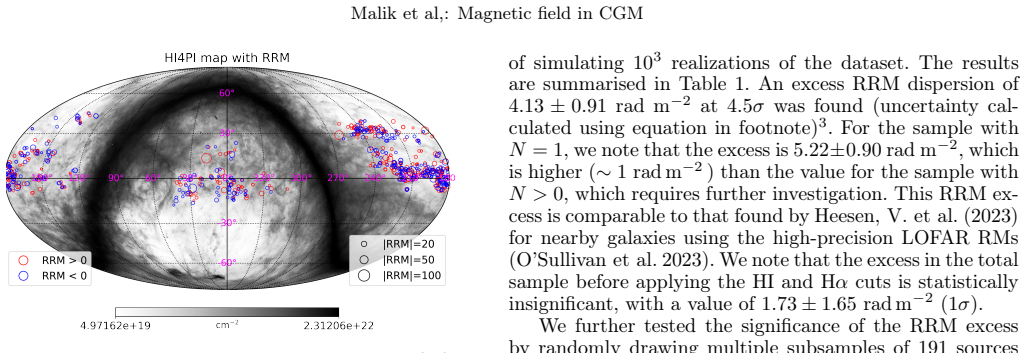
Magnetic fields are expected to permeate the circumgalactic medium (CGM) of galaxies, yet direct constraints at high redshift remain limited by the lack of high-quality Faraday rotation measure (RM) data. Using the RMs from SPICE-RACS DR2 combined with the DESI DR1 quasar catalogue, we compile the largest sample to date of 2483 quasar sightlines with associated RMs, including 612 with intervening Mg II absorbers tracing foreground galaxies and 1871 control sightlines without Mg II absorbers. After subtracting the Galactic RM contribution and restricting the analysis to sightlines with low Milky Way HI column density and H$\alpha$ intensity, we obtain a foreground-cleaned sample of 757 quasars (191 Mg II / 566 control) spanning redshifts $0.13<z<3.45$. In this foreground-cleaned sample, Mg II sightlines exhibit a $4.5\sigma$ excess in the residual RM dispersion of $4.13 \pm 0.91~\mathrm{rad\,m^{-2}}$ relative to the control sample, at a median absorber redshift of $z\sim1.14$. This implies model-dependent CGM magnetic field strengths of $\sim0.4 - 0.8\, \mu$G over projected radii of $20 - 150$ kpc. This indicates that substantial CGM magnetisation was already established by $z\sim1$, enabling new constraints on the growth and amplification of magnetic fields in galaxy halos over cosmic time.
Editorial analysis
A structured set of objections, weighed in public.
Referee Report
Summary. The manuscript reports a 4.5σ excess in residual Faraday rotation measure (RM) dispersion of 4.13 ± 0.91 rad m^{-2} for 191 quasar sightlines with intervening Mg II absorbers (median z ∼ 1.14) relative to 566 control sightlines in a foreground-cleaned sample of 757 quasars drawn from SPICE-RACS DR2 and DESI DR1. After Galactic RM subtraction and cuts on low Milky Way HI column density and Hα intensity, this excess is interpreted as arising from magnetized circumgalactic medium (CGM) gas, implying model-dependent magnetic field strengths of ∼0.4–0.8 μG over projected radii of 20–150 kpc and indicating substantial CGM magnetisation already in place by z ∼ 1.
Significance. If robust, the result would offer one of the largest-sample constraints to date on CGM magnetic fields at intermediate redshift using a direct statistical comparison of RM dispersions. The compilation of 2483 sightlines from public catalogs is a clear strength that enables the reported excess to be measured with quoted significance. The model dependence of the B-field conversion is appropriately flagged in the abstract, so the primary advance is the detection of the residual dispersion difference rather than a model-independent field measurement.
major comments (2)
- [§3] §3 (foreground subtraction and sample cleaning): The Galactic RM subtraction procedure together with the specific thresholds applied for Milky Way HI column density and Hα intensity cuts are described, but no quantitative robustness tests (e.g., results with alternative RM foreground maps or varying cut values) or explicit error propagation details for the residual dispersion are provided. Because the central 4.5σ excess claim rests on these steps fully removing non-CGM contributions, such tests are required to demonstrate that the 4.13 ± 0.91 rad m^{-2} difference cannot be produced by residual Galactic or other foreground variance.
- [§4] §4 (statistical comparison): The foreground-cleaned Mg II (191) and control (566) subsamples are stated to span 0.13 < z < 3.45, yet no table or figure directly compares their redshift distributions, impact-parameter sampling, or quasar intrinsic properties, nor reports a statistical test (e.g., KS p-value) confirming they are drawn from the same parent population. Any mismatch in these observables would undermine the attribution of the excess specifically to magnetized gas at the absorber redshifts rather than selection effects.
minor comments (3)
- [Abstract] Abstract: The quoted significance and excess value are clear, but a one-sentence reference to the exact cuts or the section containing the foreground-cleaning details would improve immediate context for readers.
- [Discussion] Discussion: The range of CGM B-field strengths (0.4–0.8 μG) is presented as model-dependent; adding a short paragraph or table showing how the conversion varies with the assumed electron density and path length would make the model assumptions more transparent.
- Notation: Ensure consistent use of “residual RM dispersion” versus “RM dispersion” throughout; a brief definition in the methods would eliminate any ambiguity for readers unfamiliar with the exact subtraction steps.
Simulated Author's Rebuttal
We thank the referee for their constructive and positive assessment of our manuscript. We appreciate the recognition that our work provides one of the largest-sample constraints on CGM magnetic fields at intermediate redshift. We address each major comment point by point below, agreeing where additional material is needed to strengthen the robustness of the analysis and outlining the specific revisions we will make.
read point-by-point responses
-
Referee: [§3] §3 (foreground subtraction and sample cleaning): The Galactic RM subtraction procedure together with the specific thresholds applied for Milky Way HI column density and Hα intensity cuts are described, but no quantitative robustness tests (e.g., results with alternative RM foreground maps or varying cut values) or explicit error propagation details for the residual dispersion are provided. Because the central 4.5σ excess claim rests on these steps fully removing non-CGM contributions, such tests are required to demonstrate that the 4.13 ± 0.91 rad m^{-2} difference cannot be produced by residual Galactic or other foreground variance.
Authors: We agree that quantitative robustness tests are essential to support the claim that the observed excess arises from the CGM rather than residual foregrounds. In the revised manuscript we will add a dedicated subsection (or appendix) presenting the following tests: (i) repetition of the full analysis using an independent Galactic RM map (e.g., Oppermann et al. 2015), (ii) variation of the Milky Way HI column-density and Hα intensity thresholds by ±20 % around the adopted values, and (iii) explicit propagation of uncertainties from the Galactic RM subtraction into the final residual dispersion error budget. These additions will directly address the referee’s concern and demonstrate that the 4.13 ± 0.91 rad m^{-2} excess remains statistically significant under reasonable variations of the foreground-cleaning procedure. revision: yes
-
Referee: [§4] §4 (statistical comparison): The foreground-cleaned Mg II (191) and control (566) subsamples are stated to span 0.13 < z < 3.45, yet no table or figure directly compares their redshift distributions, impact-parameter sampling, or quasar intrinsic properties, nor reports a statistical test (e.g., KS p-value) confirming they are drawn from the same parent population. Any mismatch in these observables would undermine the attribution of the excess specifically to magnetized gas at the absorber redshifts rather than selection effects.
Authors: We acknowledge that a direct statistical comparison of the two subsamples is required to exclude selection biases. In the revised manuscript we will insert a new figure that overlays the redshift, projected impact-parameter, and quasar-magnitude distributions for the Mg II and control samples. We will also report two-sample Kolmogorov-Smirnov p-values for each distribution, confirming that the samples are statistically consistent with being drawn from the same parent population. These additions will be placed in Section 4 and will strengthen the attribution of the excess RM dispersion to the intervening Mg II systems. revision: yes
Circularity Check
No significant circularity; central result is direct data comparison
full rationale
The paper performs an observational comparison of residual RM dispersion between Mg II absorber sightlines and a control sample after applying standard Galactic RM subtraction plus cuts on Milky Way HI column density and Hα intensity. The reported 4.5σ excess of 4.13 ± 0.91 rad m^{-2} is obtained by direct statistical differencing of the two subsamples in the foreground-cleaned data; it is not fitted to, defined in terms of, or predicted from the target CGM B-field value. The subsequent inference of model-dependent B-field strengths (∼0.4–0.8 μG) is a post-hoc interpretation using external scaling relations, not a closed loop that re-derives the input dispersion. No self-definitional steps, fitted-input predictions, or load-bearing self-citations appear in the derivation chain. The analysis is self-contained against external public catalogs and benchmarks.
Axiom & Free-Parameter Ledger
free parameters (1)
- RM-to-B conversion model parameters
axioms (1)
- domain assumption Residual RM dispersion after Galactic subtraction originates from magnetized CGM gas associated with Mg II absorbers
Lean theorems connected to this paper
-
IndisputableMonolith/Foundation/RealityFromDistinction.leanreality_from_one_distinction unclear?
unclearRelation between the paper passage and the cited Recognition theorem.
After subtracting the Galactic RM contribution and restricting ... to low Milky Way HI column density and Hα intensity
What do these tags mean?
- matches
- The paper's claim is directly supported by a theorem in the formal canon.
- supports
- The theorem supports part of the paper's argument, but the paper may add assumptions or extra steps.
- extends
- The paper goes beyond the formal theorem; the theorem is a base layer rather than the whole result.
- uses
- The paper appears to rely on the theorem as machinery.
- contradicts
- The paper's claim conflicts with a theorem or certificate in the canon.
- unclear
- Pith found a possible connection, but the passage is too broad, indirect, or ambiguous to say the theorem truly supports the claim.
Reference graph
Works this paper leans on
-
[1]
Anderson , C. S., McClure-Griffiths , N. M., Rudnick , L., et al. 2024, , 533, 4068
work page 2024
-
[2]
Basu , A., Mao , S. A., Fletcher , A., et al. 2018, , 477, 2528
work page 2018
-
[3]
Bernet, M. L., Miniati, F., & Lilly, S. J. 2010, ApJ, 711, 380
work page 2010
-
[4]
Bernet, M. L., Miniati, F., & Lilly, S. J. 2013, ApJL, 772, L28
work page 2013
-
[5]
Bernet, M. L., Miniati, F., Lilly, S. J., Kronberg, P. P., & Dessauges-Zavadsky, M. 2008, Nature, 454, 302 – 304, cited by: 243; All Open Access, Green Open Access
work page 2008
-
[6]
2024, Journal of Cosmology and Astroparticle Physics, 2024, 063
Burman, S., Sharma, P., Malik, S., & Singh, S. 2024, Journal of Cosmology and Astroparticle Physics, 2024, 063
work page 2024
- [7]
-
[8]
Chen, H.-W., Helsby, J. E., Gauthier, J.-R., et al. 2010, ApJ, 714, 1521
work page 2010
- [9]
- [10]
-
[11]
Dutta , A., Bisht , M. S., Sharma , P., et al. 2024, , 531, 5117
work page 2024
-
[12]
Farnes, J. S., O'Sullivan, S. P., Corrigan, M. E., & Gaensler, B. M. 2014, ApJ, 795, 63
work page 2014
-
[13]
Gaensler , B. M., Dickey , J. M., McClure-Griffiths , N. M., et al. 2001, , 549, 959
work page 2001
-
[14]
Gaensler , B. M., Heald , G. H., McClure-Griffiths , N. M., et al. 2025, , 42, e091
work page 2025
-
[15]
E., Lopez-Rodriguez , E., Doherty , M
Geach , J. E., Lopez-Rodriguez , E., Doherty , M. J., et al. 2023, , 621, 483
work page 2023
-
[16]
Haffner , L. M., Reynolds , R. J., Tufte , S. L., et al. 2003, , 149, 405
work page 2003
-
[17]
Heesen, V. , O\' Sullivan, S. P. , Br\"uggen, M. , et al. 2023, A&A, 670, L23
work page 2023
-
[18]
HI4PI Collaboration , Ben Bekhti , N., Fl \"o er , L., et al. 2016, , 594, A116
work page 2016
-
[19]
Hutschenreuter, S. , Anderson, C. S. , Betti, S. , et al. 2022, A&A, 657, A43
work page 2022
-
[20]
Kacprzak, G. G., Churchill, C. W., Steidel, C. C., & Murphy, M. T. 2008, AJ, 135, 922
work page 2008
-
[21]
Khrykin , I. S., Tejos , N., Prochaska , J. X., et al. 2025, arXiv e-prints, arXiv:2509.08896
- [22]
-
[23]
Kovacs , T. O., Mao , S. A., Basu , A., Ma , Y. K., & Gaensler , B. M. 2026, , 705, A28
work page 2026
- [24]
- [25]
-
[26]
Kronberg, P. P. & Perry, J. J. 1982, ApJ, 263, 518, aDS Bibcode: 1982ApJ...263..518K
work page 1982
- [27]
-
[28]
Malik, S., Chand, H., & Seshadri, T. R. 2020, ApJ, 890, 132
work page 2020
-
[29]
A., Carilli , C., Gaensler , B
Mao , S. A., Carilli , C., Gaensler , B. M., et al. 2017, Nature Astronomy, 1, 621
work page 2017
- [30]
-
[31]
O'Sullivan , S. P., Shimwell , T. W., Hardcastle , M. J., et al. 2023, , 519, 5723
work page 2023
-
[32]
Planck Collaboration , Aghanim , N., Akrami , Y., et al. 2020, , 641, A6
work page 2020
-
[33]
Prochaska, J. X. & Zheng, Y. 2019, MNRAS
work page 2019
-
[34]
Ramesh , R., Nelson , D., Heesen , V., & Br \"u ggen , M. 2023, , 526, 5483
work page 2023
- [35]
- [36]
- [37]
-
[38]
Thomson , A. J. M. e. a. 2026, under review
work page 2026
- [39]
- [40]
-
[41]
CHANG-ES. XXII. Coherent magnetic fields in the halos of spiral galaxies. , keywords =. doi:10.1051/0004-6361/202037780 , archivePrefix =. 2004.14383 , primaryClass =
-
[42]
CHANG-ES. IV. Radio Continuum Emission of 35 Edge-on Galaxies Observed with the Karl G. Jansky Very Large Array in D Configuration Data Release 1. , keywords =. doi:10.1088/0004-6256/150/3/81 , archivePrefix =. 1508.05153 , primaryClass =
work page internal anchor Pith review Pith/arXiv arXiv doi:10.1088/0004-6256/150/3/81
-
[43]
Faraday Rotation Measure Synthesis of intermediate redshift quasars as a probe of intervening matter
Faraday Rotation Measure Synthesis of Intermediate Redshift Quasars as a Probe of Intervening Matter. , keywords =. doi:10.3847/0004-637X/829/2/133 , archivePrefix =. 1604.00028 , primaryClass =
work page internal anchor Pith review Pith/arXiv arXiv doi:10.3847/0004-637x/829/2/133
-
[44]
ApJ , author =. 2013 , pages =. doi:10.1088/0004-637X/776/2/114 , abstract =
-
[45]
ApJL , author =. 2013 , pages =. doi:10.1088/2041-8205/772/2/L28 , abstract =
-
[46]
Exploring the dispersion measure of the. MNRAS: Letters , author =. 2020 , pages =. doi:10.1093/mnrasl/slaa095 , abstract =
-
[47]
A. ApJ , author =. 2008 , pages =. doi:10.1086/527281 , language =
-
[48]
Nature of the galaxies on top of quasars producing. MNRAS , author =. 2023 , pages =. doi:10.1093/mnras/stac3788 , abstract =
-
[49]
and Schaye, Joop and Steidel, Charles C
Turner, Monica L. and Schaye, Joop and Steidel, Charles C. and Rudie, Gwen C. and Strom, Allison L. , title = ". MNRAS , volume =. 2014 , month =. doi:10.1093/mnras/stu1801 , url =
-
[50]
The Structure and Kinematics of the Circum-Galactic Medium from Far-UV Spectra of z~2-3 Galaxies
The Structure and Kinematics of the Circumgalactic Medium from Far-ultraviolet Spectra of z -0.5ex = 2-3 Galaxies. , keywords =. doi:10.1088/0004-637X/717/1/289 , archivePrefix =. 1003.0679 , primaryClass =
work page internal anchor Pith review Pith/arXiv arXiv doi:10.1088/0004-637x/717/1/289
-
[51]
, year = 2012, month = sep, volume =
Magnetic Fields in Molecular Clouds. , year = 2012, month = sep, volume =. doi:10.1146/annurev-astro-081811-125514 , adsurl =
-
[52]
Beck, Rainer. Magnetic Fields in Galaxies. Cosmic Magnetic Fields. 2005. doi:10.1007/3540313966_3
-
[53]
Ruzmaikin, A. A. and Shukurov, A. M. and Sokoloff, D. D. Origin of Magnetic Fields. Magnetic Fields of Galaxies. 1988. doi:10.1007/978-94-009-2835-0_5
-
[54]
doi:10.1088/0034-4885/79/7/076901 , url =
Kandaswamy Subramanian , title =. doi:10.1088/0034-4885/79/7/076901 , url =
- [55]
-
[56]
Krumholz and Eduardo Telles and Renato Dupke and Daniela Lazzaro , title =
Mark R. Krumholz and Eduardo Telles and Renato Dupke and Daniela Lazzaro , title =. doi:10.1063/1.3636038 , year = 2011, publisher =
-
[57]
doi:10.1016/j.physrep.2005.06.005 , url =
Axel Brandenburg and Kandaswamy Subramanian , title =. doi:10.1016/j.physrep.2005.06.005 , url =
-
[58]
and Miniati, Francesco and Lilly, Simon J
Bernet, Martin L. and Miniati, Francesco and Lilly, Simon J. and Kronberg, Philipp P. and Dessauges-Zavadsky, Miroslava , title =. 2008 , journal =. doi:10.1038/nature07105 , url =
- [59]
-
[60]
M. L. Bernet and F. Miniati and S. J. Lilly , title =. ApJ , abstract =. 2010 , month =. doi:10.1088/0004-637X/711/1/380 , url =
-
[61]
Bernet, M. L. and Miniati, F. and Lilly, S. J. , title =. ApJ , volume =. 2012 , month =. doi:10.1088/0004-637X/761/2/144 , url =
-
[62]
Lan, Ting-Wen and Prochaska, J Xavier , title = ". MNRAS , volume =. 2020 , month =. doi:10.1093/mnras/staa1750 , url =
-
[63]
Detection of magnetic fields in the circumgalactic medium of nearby galaxies using Faraday rotation , DOI= "10.1051/0004-6361/202346008", url= "https://doi.org/10.1051/0004-6361/202346008", journal =
-
[64]
Hammond and Timothy Robishaw and B
Alison M. Hammond and Timothy Robishaw and B. M. Gaensler , year=. 1209.1438 , archivePrefix=
-
[65]
A Faraday Rotation Search for Magnetic Fields in Quasar-damped LY alpha Absorption Systems. , keywords =. doi:10.1086/175726 , adsurl =
-
[66]
R. Bordoloi and S. J. Lilly and C. Knobel and M. Bolzonella and P. Kampczyk and C. M. Carollo and A. Iovino and E. Zucca and T. Contini and J.-P. Kneib and O. Le Fevre and V. Mainieri and A. Renzini and M. Scodeggio and G. Zamorani and I. Balestra and S. Bardelli and A. Bongiorno and K. Caputi and O. Cucciati and S. de la Torre and L. de Ravel and B. Gari...
-
[67]
arXiv , author =:2102.01709 , journal =
The Galactic Faraday rotation sky 2020 , DOI= "10.1051/0004-6361/202140486", url= "https://doi.org/10.1051/0004-6361/202140486", journal =
-
[68]
Amaral, A D and Vernstrom, T and Gaensler, B M , title = ". MNRAS , volume =. 2021 , month =. doi:10.1093/mnras/stab564 , url =
-
[69]
An improved map of the Galactic Faraday sky , DOI= "10.1051/0004-6361/201118526", url= "https://doi.org/10.1051/0004-6361/201118526", journal =
-
[70]
Sandhya M. Rao and David A. Turnshek and Daniel B. Nestor , title =. ApJ , abstract =. 2006 , month =. doi:10.1086/498132 , url =
-
[71]
J. S. Farnes and L. Rudnick and B. M. Gaensler and M. Haverkorn and S. P. O’Sullivan and S. J. Curran , title =. ApJ , abstract =. 2017 , month =. doi:10.3847/1538-4357/aa7060 , url =
-
[72]
Imprint of the magnetised circumgalactic medium around Milky Way-like galaxies , author=
Sampling Faraday rotation sky of IllustrisTNG50: I. Imprint of the magnetised circumgalactic medium around Milky Way-like galaxies , author=. 2023 , eprint=
work page 2023
-
[73]
Elizabeth Lovegrove and Robert A. Simcoe , title =. doi:10.1088/0004-637x/740/1/30 , url =
-
[74]
doi:10.1007/s00159-015-0084-4 , url =
Rainer Beck , title =. doi:10.1007/s00159-015-0084-4 , url =
-
[75]
Daniel B. Nestor and David A. Turnshek and Sandhya M. Rao , title =. ApJ , abstract =. 2005 , month =. doi:10.1086/427547 , url =
-
[76]
Andrew C. Mshar and Jane C. Charlton and Ryan S. Lynch and Chris Churchill and Tae-Sun Kim , title =. ApJ , abstract =. 2007 , month =. doi:10.1086/520792 , url =
-
[77]
Charlton and Toru Misawa and Rebecca E
Anand Narayanan and Jane C. Charlton and Toru Misawa and Rebecca E. Green and Tae-Sun Kim , title =. ApJ , abstract =. 2008 , month =. doi:10.1086/592763 , url =
-
[78]
Helsby and Jean-René Gauthier and Stephen A
Hsiao-Wen Chen and Jennifer E. Helsby and Jean-René Gauthier and Stephen A. Shectman and Ian B. Thompson and Jeremy L. Tinker , title =. 2010 , month =. doi:10.1088/0004-637X/714/2/1521 , url =
-
[79]
On the Redshift Evolution of MgII Absorption Systems
On the Redshift Evolution of Mg II Absoprtion Systems. , keywords =. doi:10.1088/0004-637X/709/1/1 , archivePrefix =. 0908.3691 , primaryClass =
work page internal anchor Pith review Pith/arXiv arXiv doi:10.1088/0004-637x/709/1/1
-
[80]
Kimball and Željko Ivezić , title =
Amy E. Kimball and Željko Ivezić , title =. AJ , abstract =. 2008 , month =. doi:10.1088/0004-6256/136/2/684 , url =
discussion (0)
Sign in with ORCID, Apple, or X to comment. Anyone can read and Pith papers without signing in.