Meta-Bayesian Nash Equilibrium: Existence via Kakutani's Fixed Point Theorem
Pith reviewed 2026-05-19 19:06 UTC · model grok-4.3
The pith
Meta-Bayesian Nash equilibrium exists when each transformed game has a unique Bayesian Nash equilibrium.
A machine-rendered reading of the paper's core claim, the machinery that carries it, and where it could break.
Core claim
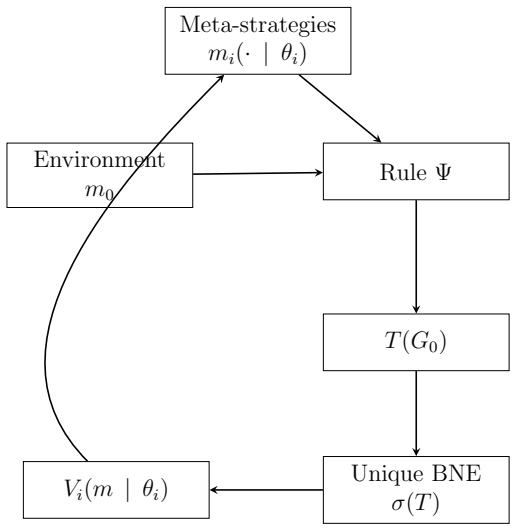
A meta-Bayesian Nash equilibrium is a profile of type-dependent mixed meta-strategies together with an environmental move such that no player type can profitably deviate and the environment cannot improve its expected payoff. For each transformed game, meta-payoffs are determined by the unique Bayesian Nash equilibrium of that game. Using Kakutani's fixed point theorem, existence is established under finiteness assumptions on type spaces, meta-actions, and transformations, together with the assumption that each transformed game admits a unique Bayesian Nash equilibrium.
What carries the argument
Kakutani's fixed point theorem applied to the best-response correspondence of the meta-game whose payoffs are supplied by the unique Bayesian Nash equilibrium of each transformed game.
If this is right
- The framework contains both classical Bayesian games and complete-information meta-games as special cases.
- Private information at the meta-level determines the endogenous transformation of the game.
- The existence result applies directly to adaptive subsidy competition, cybersecurity protocol selection, and platform rule formation.
- Finiteness of type spaces, meta-actions and transformations is sufficient for the fixed-point argument.
Where Pith is reading between the lines
- Relaxing uniqueness would require an alternative selection rule or a different fixed-point theorem for the meta-game.
- The finite-case result suggests a natural approximation route for continuous type spaces.
- The same construction could be used to study how private types shape regulatory or platform rule changes.
Load-bearing premise
Each transformed game admits a unique Bayesian Nash equilibrium.
What would settle it
A finite example in which at least one transformed game possesses multiple Bayesian Nash equilibria and the resulting meta-game possesses no equilibrium of the defined form.
Figures
read the original abstract
We extend the concept of meta-Nash equilibrium, introduced by Eshaghi Gordji and Bagha [2026] for complete-information games, to environments with incomplete information. We define a meta-Bayesian Nash equilibrium as a profile of type-dependent mixed meta-strategies together with an environmental move such that no player type can profitably deviate and the environment cannot improve its expected payoff. For each transformed game, meta-payoffs are determined by the unique Bayesian Nash equilibrium of that game. Using Kakutani's fixed point theorem, we establish existence under finiteness assumptions on type spaces, meta-actions, and transformations, together with the assumption that each transformed game admits a unique Bayesian Nash equilibrium. Several illustrative examples, including adaptive subsidy competition, cybersecurity protocol selection, and platform rule formation, demonstrate that private information at the meta-level plays an essential role in endogenous game transformation. The framework contains both classical Bayesian games and complete-information meta-games as special cases.
Editorial analysis
A structured set of objections, weighed in public.
Referee Report
Summary. The paper extends the meta-Nash equilibrium concept from complete-information games to Bayesian games with incomplete information. It defines a meta-Bayesian Nash equilibrium as a profile of type-dependent mixed meta-strategies together with an environmental move such that no player type can profitably deviate and the environment cannot improve its expected payoff. Meta-payoffs are determined by the unique Bayesian Nash equilibrium of each transformed game. The central result establishes existence of this equilibrium via Kakutani's fixed point theorem under finiteness assumptions on type spaces, meta-actions, and transformations, plus the assumption that each transformed game has a unique BNE. The framework includes classical Bayesian games and complete-information meta-games as special cases, with illustrative examples including adaptive subsidy competition, cybersecurity protocol selection, and platform rule formation.
Significance. If the central existence result holds, the paper offers a framework for endogenous game transformation in settings with private information at the meta-level, which could be relevant for applications in mechanism design, regulatory competition, and information economics. The unification of standard Bayesian games as special cases is a strength, and the examples illustrate the role of meta-level private information. However, the significance is conditional on resolving the load-bearing uniqueness assumption, as the result does not currently provide conditions guaranteeing it under the stated finiteness restrictions.
major comments (1)
- [Abstract / Main Theorem] Abstract and main existence argument: the proof applies Kakutani's theorem to the meta-game after defining meta-payoffs via the unique BNE of each transformed game. Under the paper's finiteness assumptions alone, Bayesian games routinely admit multiple equilibria (e.g., coordination games or games with indifferent types). No additional conditions (such as strict supermodularity, potential-game structure, or generic payoff perturbations) are imposed to ensure uniqueness. When multiplicity occurs, meta-payoffs become set-valued, so the meta-game best-response correspondence may fail to be upper hemicontinuous or convex-valued, rendering Kakutani inapplicable. This assumption is therefore load-bearing for the central claim.
minor comments (1)
- [Examples] Examples section: the illustrative cases (adaptive subsidy competition, etc.) would benefit from explicit verification that the uniqueness assumption holds in each transformed game, or from a brief discussion of how the framework behaves if it fails.
Simulated Author's Rebuttal
We thank the referee for the careful reading of the manuscript and for highlighting the role of the uniqueness assumption in the existence argument. We address the major comment below.
read point-by-point responses
-
Referee: [Abstract / Main Theorem] Abstract and main existence argument: the proof applies Kakutani's theorem to the meta-game after defining meta-payoffs via the unique BNE of each transformed game. Under the paper's finiteness assumptions alone, Bayesian games routinely admit multiple equilibria (e.g., coordination games or games with indifferent types). No additional conditions (such as strict supermodularity, potential-game structure, or generic payoff perturbations) are imposed to ensure uniqueness. When multiplicity occurs, meta-payoffs become set-valued, so the meta-game best-response correspondence may fail to be upper hemicontinuous or convex-valued, rendering Kakutani inapplicable. This assumption is therefore load-bearing for the central claim.
Authors: We agree that uniqueness of the Bayesian Nash equilibrium in each transformed game is essential for the meta-payoffs to be single-valued and for the best-response correspondence to satisfy the conditions of Kakutani's theorem. The main existence result is explicitly stated as holding under the finiteness assumptions together with this uniqueness hypothesis; the manuscript does not claim that finiteness alone guarantees uniqueness. In the revision we will add a dedicated paragraph after the statement of the theorem that (i) acknowledges the load-bearing nature of the assumption, (ii) recalls standard sufficient conditions from the Bayesian-games literature (strict supermodularity, potential-game structure, or generic payoff perturbations) that deliver uniqueness, and (iii) verifies that uniqueness obtains in each of the three illustrative examples. These changes will clarify the scope of the result without altering the theorem itself. revision: yes
Circularity Check
No significant circularity; existence is conditional on explicit assumptions and standard theorem
full rationale
The paper defines meta-Bayesian Nash equilibrium by extending the complete-information meta-Nash concept from a 2026 citation and applies Kakutani's fixed point theorem to a correspondence over finite type spaces, meta-actions, and transformations. Meta-payoffs are defined using the Bayesian Nash equilibrium of each transformed game, but the paper states the uniqueness of that equilibrium as an explicit prerequisite assumption rather than deriving or fitting it. No equation reduces the claimed existence result to its own inputs by construction, no parameters are fitted and relabeled as predictions, and the self-citation introduces only the base definition while the incomplete-information extension and fixed-point application remain independent. The result is therefore a conditional existence theorem under the stated finiteness and uniqueness hypotheses, with no load-bearing circular step.
Axiom & Free-Parameter Ledger
axioms (1)
- domain assumption Each transformed game admits a unique Bayesian Nash equilibrium
Lean theorems connected to this paper
-
IndisputableMonolith/Foundation/ArithmeticFromLogic.leanLogicNat ≃ Nat recovery; J-cost uniqueness via washburn_uniqueness_aczel unclear?
unclearRelation between the paper passage and the cited Recognition theorem.
For each transformation T, the transformed game T(G0) has a unique Bayesian Nash equilibrium, denoted by σ(T). ... Using Kakutani’s fixed-point theorem, we prove existence under finiteness of types, meta-actions, and transformations, together with the assumption that each transformed game admits a unique Bayesian Nash equilibrium.
What do these tags mean?
- matches
- The paper's claim is directly supported by a theorem in the formal canon.
- supports
- The theorem supports part of the paper's argument, but the paper may add assumptions or extra steps.
- extends
- The paper goes beyond the formal theorem; the theorem is a base layer rather than the whole result.
- uses
- The paper appears to rely on the theorem as machinery.
- contradicts
- The paper's claim conflicts with a theorem or certificate in the canon.
- unclear
- Pith found a possible connection, but the passage is too broad, indirect, or ambiguous to say the theorem truly supports the claim.
Reference graph
Works this paper leans on
- [1]
- [2]
- [3]
- [4]
- [5]
- [6]
-
[7]
Fudenberg, Drew and Tirole, Jean , title =
-
[8]
Duke Mathematical Journal , volume =
Kakutani, Shizuo , title =. Duke Mathematical Journal , volume =
-
[9]
Berge, Claude , title =
-
[10]
Changing the Game: Status-Quo Inertia, Institutional Design, and Equilibrium Transition
Madjid Eshaghi Gordji and Esmaiel Abounoori and Mohamadali Berahman , title =. arXiv preprint , year =. 2605.09083 , archivePrefix =
work page internal anchor Pith review Pith/arXiv arXiv
discussion (0)
Sign in with ORCID, Apple, or X to comment. Anyone can read and Pith papers without signing in.