Semi-analytical Model of Multi-tile Rectangular Waveguide-fed Metasurfaces using Coupled Dipole Modeling Framework
Pith reviewed 2026-05-19 22:44 UTC · model grok-4.3
The pith
A coupled-dipole framework paired with multi-port network analysis forms a self-consistent semi-analytical model for multi-tile waveguide-fed metasurface antennas.
A machine-rendered reading of the paper's core claim, the machinery that carries it, and where it could break.
Core claim
The central claim is that a coupled-dipole description of intra-tile interactions among the metamaterial radiators and coupling slots, combined with a multi-port network treatment of inter-tile and tile-to-divider coupling, yields a self-consistent formulation that accurately predicts the S-parameters, radiation patterns, and gain of the complete multi-tile antenna.
What carries the argument
The coupled-dipole framework that solves for interactions among polarizable elements inside each tile, together with multi-port network analysis that accounts for coupling between tiles and the power divider.
If this is right
- The model directly computes overall S-parameters, radiation patterns, and gain for the assembled antenna.
- Computational effort scales far more slowly with aperture size than full-wave methods, enabling analysis of electrically large structures.
- Rapid evaluation supports iterative optimization of tile layouts and feed networks.
- The framework serves as an efficient forward model for designing metasurface antennas in remote sensing and next-generation wireless systems.
Where Pith is reading between the lines
- The same dipole-plus-network structure could be adapted to tiles of different shapes or to feeds using microstrip rather than waveguide.
- Embedding the model inside a gradient-based optimizer would allow automated synthesis of desired beam shapes without repeated full-wave runs.
- Extending the formulation to include time-varying or reconfigurable elements could support dynamic beam steering in communication links.
Load-bearing premise
The radiators etched into the waveguide walls and the coupling slots can be treated as polarizable dipoles whose interactions are fully captured by the coupled-dipole equations.
What would settle it
Full-wave simulation or measurement of a multi-tile structure showing radiation patterns or gain values that differ substantially from the model's predictions at the design frequency would demonstrate that the dipole approximation or the network coupling treatment is insufficient.
Figures


read the original abstract
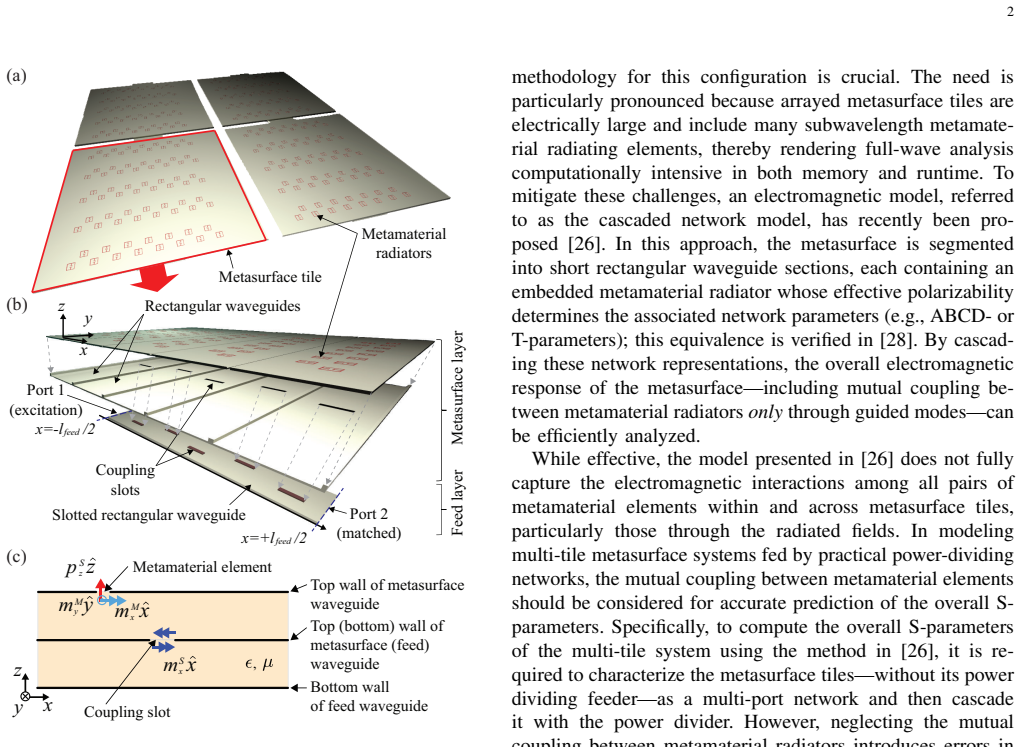
We present a semi-analytical model to analyze multi-tile metasurface antennas consisting of a set of metasurface tiles and a practical power-dividing network that excites the tiles. The metasurface tiles consist of arrays of rectangular waveguides with subwavelength metamaterial radiators etched into their top walls, each of which can be accurately modeled as polarizable dipoles. The feed structure for the arrays comprises a slotted waveguide attached to their bottom wall, with coupling slots inserted into the common wall that are likewise modeled as polarizable dipoles. The proposed semi-analytical model employs a coupled-dipole framework that accurately captures dipolar interactions among constituent elements within the metasurface tiles, along with a multi-port network analysis technique that accounts for electromagnetic interactions between the tiles and the power divider, thereby forming a self-consistent formulation. The proposed model enables the prediction of key performance metrics, including overall S-parameters, radiation patterns, and gain, and is validated through full-wave numerical simulations. By significantly reducing the computational complexity associated with electrically large apertures, the proposed framework enables rapid and efficient modeling of the overall structure, thereby facilitating iterative optimization. The proposed model has potential applications as an efficient forward model for the design of wireless systems requiring large-aperture metasurface antennas, including remote sensing and next-generation wireless communication networks.
Editorial analysis
A structured set of objections, weighed in public.
Referee Report
Summary. The manuscript presents a semi-analytical model for multi-tile rectangular waveguide-fed metasurface antennas. Metasurface tiles are modeled as arrays of rectangular waveguides with subwavelength metamaterial radiators etched in the top walls, each treated as polarizable dipoles; coupling slots in the common wall of the slotted-waveguide feed are likewise modeled as dipoles. A coupled-dipole framework captures intra-tile interactions while a multi-port network analysis accounts for interactions between tiles and the power divider, yielding predictions of overall S-parameters, radiation patterns, and gain. The model is asserted to be validated against full-wave simulations and to reduce computational cost for electrically large apertures.
Significance. If the polarizable-dipole representation remains accurate across the intended geometries and coupling regimes, the framework would supply a computationally efficient forward model that enables rapid iterative optimization of large-aperture metasurface antennas for remote sensing and next-generation wireless systems.
major comments (2)
- [Abstract] Abstract: the claim that the model 'is validated through full-wave numerical simulations' is made without any quantitative agreement metrics (e.g., maximum |S11| error, pattern RMS difference, or gain deviation), error bars, or specification of the test cases (number of tiles, frequency points, or aperture sizes). This omission leaves the accuracy of the central dipole-based predictions unquantified.
- [Model description] Model description (Abstract and subsequent formulation sections): the replacement of both the etched metamaterial radiators and the coupling slots by equivalent electric/magnetic dipoles whose polarizabilities are extracted once and inserted into the interaction matrix is load-bearing, yet no discussion is provided of the approximation's range of validity (e.g., when element size approaches λ/4 or when strong near-field coupling excites higher-order modes). Any systematic error in this step propagates directly into all reported S-parameters, patterns, and gain.
minor comments (1)
- [Abstract] Abstract: the phrase 'self-consistent formulation' is used without a brief clarification of how self-consistency is enforced beyond the coupled-dipole matrix and multi-port network.
Simulated Author's Rebuttal
We thank the referee for their constructive and detailed review of our manuscript. The comments highlight important aspects of clarity and rigor that we will address in the revision. Below we respond point-by-point to the major comments.
read point-by-point responses
-
Referee: [Abstract] Abstract: the claim that the model 'is validated through full-wave numerical simulations' is made without any quantitative agreement metrics (e.g., maximum |S11| error, pattern RMS difference, or gain deviation), error bars, or specification of the test cases (number of tiles, frequency points, or aperture sizes). This omission leaves the accuracy of the central dipole-based predictions unquantified.
Authors: We agree that the abstract would benefit from explicit quantitative metrics to strengthen the validation statement. In the revised manuscript we will update the abstract to specify the test cases (including the number of tiles, aperture sizes, and frequency points examined) and report quantitative agreement figures such as the maximum |S11| error, radiation-pattern RMS difference, and gain deviation between the semi-analytical model and full-wave simulations. These values will be drawn directly from the comparative results already presented in the results section. revision: yes
-
Referee: [Model description] Model description (Abstract and subsequent formulation sections): the replacement of both the etched metamaterial radiators and the coupling slots by equivalent electric/magnetic dipoles whose polarizabilities are extracted once and inserted into the interaction matrix is load-bearing, yet no discussion is provided of the approximation's range of validity (e.g., when element size approaches λ/4 or when strong near-field coupling excites higher-order modes). Any systematic error in this step propagates directly into all reported S-parameters, patterns, and gain.
Authors: The referee correctly notes that the dipole approximation is foundational. Although the manuscript focuses on subwavelength radiators for which the dipole model is standard, we acknowledge the absence of an explicit discussion of its validity limits. In the revision we will insert a concise paragraph in the model-description section that states the operating regime (element size << λ/4 and moderate coupling strengths) under which higher-order modes remain negligible, supported by references to established dipole-approximation literature and by a brief additional comparison with full-wave results at the boundary of the assumed regime. revision: yes
Circularity Check
No significant circularity; derivation is self-contained with external validation
full rationale
The paper constructs a coupled-dipole model for intra-tile interactions plus multi-port network analysis for tile-to-feed coupling, with polarizabilities treated as extracted inputs from individual element modeling. These feed into a forward computation of S-parameters, patterns, and gain that is then compared against independent full-wave simulations. No equations reduce the output to the inputs by construction, no load-bearing self-citations appear, and the framework remains falsifiable against external benchmarks rather than tautological.
Axiom & Free-Parameter Ledger
axioms (1)
- domain assumption Subwavelength metamaterial radiators and coupling slots can be accurately modeled as polarizable dipoles
Lean theorems connected to this paper
-
IndisputableMonolith/Cost/FunctionalEquation.leanwashburn_uniqueness_aczel unclear?
unclearRelation between the paper passage and the cited Recognition theorem.
each of which can be accurately modeled as polarizable dipoles... coupled-dipole framework that accurately captures dipolar interactions... multi-port network analysis technique
-
IndisputableMonolith/Foundation/AlexanderDuality.leanalexander_duality_circle_linking unclear?
unclearRelation between the paper passage and the cited Recognition theorem.
subwavelength metamaterial radiators... coupling slots... modeled as polarizable dipoles
What do these tags mean?
- matches
- The paper's claim is directly supported by a theorem in the formal canon.
- supports
- The theorem supports part of the paper's argument, but the paper may add assumptions or extra steps.
- extends
- The paper goes beyond the formal theorem; the theorem is a base layer rather than the whole result.
- uses
- The paper appears to rely on the theorem as machinery.
- contradicts
- The paper's claim conflicts with a theorem or certificate in the canon.
- unclear
- Pith found a possible connection, but the passage is too broad, indirect, or ambiguous to say the theorem truly supports the claim.
Reference graph
Works this paper leans on
-
[1]
Analysis of a waveguide-fed metasurface antenna,
D. R. Smith, O. Yurduseven, L. P. Mancera, P. Bowen, and N. B. Kundtz, “Analysis of a waveguide-fed metasurface antenna,”Phys. Rev. Appl., vol. 8, no. 5, p. 054048, 2017
work page 2017
-
[2]
Leaky-wave based interpretation of the radiation from holographic surfaces,
M. Nannetti, F. Caminita, and S. Maci, “Leaky-wave based interpretation of the radiation from holographic surfaces,” inProc. IEEE Antennas Propag. Soc. Int. Symp., Honolulu, HI, USA. IEEE, 2007, pp. 5813– 5816
work page 2007
-
[3]
Scalar and tensor holographic artificial impedance surfaces,
B. H. Fong, J. S. Colburn, J. J. Ottusch, J. L. Visher, and D. F. Sieven- piper, “Scalar and tensor holographic artificial impedance surfaces,” IEEE Trans. Antennas Propag., vol. 58, no. 10, pp. 3212–3221, 2010
work page 2010
-
[4]
Metasurfing: Ad- dressing waves on impenetrable metasurfaces,
S. Maci, G. Minatti, M. Casaletti, and M. Bosiljevac, “Metasurfing: Ad- dressing waves on impenetrable metasurfaces,”IEEE Antennas Wireless Propag. Lett., vol. 10, pp. 1499–1502, 2011
work page 2011
-
[5]
Modeling and analysis of printed-circuit tensor impedance surfaces,
A. M. Patel and A. Grbic, “Modeling and analysis of printed-circuit tensor impedance surfaces,”IEEE Trans. Antennas Propag., vol. 61, no. 1, pp. 211–220, 2013
work page 2013
-
[6]
Artificial tensor impedance surface waveguides,
R. Quarfoth and D. Sievenpiper, “Artificial tensor impedance surface waveguides,”IEEE Trans. Antennas Propag., vol. 61, no. 7, pp. 3597– 3606, 2013
work page 2013
-
[7]
Effective surface impedance of a printed- circuit tensor impedance surface (PCTIS),
A. M. Patel and A. Grbic, “Effective surface impedance of a printed- circuit tensor impedance surface (PCTIS),”IEEE Trans. Micro. Theory and Techn., vol. 61, no. 4, pp. 1403–1413, 2013
work page 2013
-
[8]
Modulated metasurface antennas for space: Synthesis, analysis and realizations,
G. Minatti, M. Faenzi, E. Martini, F. Caminita, P. De Vita, D. Gonz ´alez- Ovejero, M. Sabbadini, and S. Maci, “Modulated metasurface antennas for space: Synthesis, analysis and realizations,”IEEE Trans. Antennas Propag., vol. 63, no. 4, pp. 1288–1300, 2015
work page 2015
-
[9]
A. Epstein, J. P. Wong, and G. V . Eleftheriades, “Cavity-excited huy- gens’ metasurface antennas for near-unity aperture illumination effi- ciency from arbitrarily large apertures,”Nature commun., vol. 7, p. 10360, 2016
work page 2016
-
[10]
A. Epstein and G. V . Eleftheriades, “Arbitrary antenna arrays without feed networks based on cavity-excited omega-bianisotropic metasur- faces,”IEEE Trans. on Antennas and Propag., vol. 65, no. 4, pp. 1749– 1756, 2017
work page 2017
-
[11]
J. Lee and D. F. Sievenpiper, “Method for extracting the effective tensor surface impedance function from nonuniform, anisotropic, conductive patterns,”IEEE Trans. Antennas Propag., vol. 67, no. 5, pp. 3171–3177, 2019
work page 2019
-
[12]
J. Budhu and A. Grbic, “Perfectly reflecting metasurface reflectarrays: Mutual coupling modeling between unique elements through homoge- nization,”IEEE Trans. Antennas Propag., vol. 69, no. 1, pp. 122–134, 2020
work page 2020
-
[13]
Metamaterial apertures for computational imaging,
J. Hunt, T. Driscoll, A. Mrozack, G. Lipworth, M. Reynolds, D. Brady, and D. R. Smith, “Metamaterial apertures for computational imaging,” Science, vol. 339, no. 6117, pp. 310–313, 2013
work page 2013
-
[14]
D. R. Smith, V . R. Gowda, O. Yurduseven, S. Larouche, G. Lipworth, Y . Urzhumov, and M. S. Reynolds, “An analysis of beamed wireless power transfer in the Fresnel zone using a dynamic, metasurface aperture,”J. Appl. Phys., vol. 121, no. 1, p. 014901, 2017
work page 2017
-
[15]
Sidelobe canceling for reconfigurable holographic metamaterial antenna,
M. C. Johnson, S. L. Brunton, N. B. Kundtz, and J. N. Kutz, “Sidelobe canceling for reconfigurable holographic metamaterial antenna,”IEEE Trans. Antennas and Propag., vol. 63, no. 4, pp. 1881–1886, 2015
work page 2015
-
[16]
I. Yoo, M. F. Imani, T. Sleasman, H. D. Pfister, and D. R. Smith, “En- hancing capacity of spatial multiplexing systems using reconfigurable cavity-backed metasurface antennas in clustered mimo channels,”IEEE Trans. on Commun., vol. 67, no. 2, pp. 1070–1084, 2018
work page 2018
-
[17]
Synthetic aperture radar with dynamic metasurface antennas: a conceptual development,
M. Boyarsky, T. Sleasman, L. Pulido-Mancera, T. Fromenteze, A. Pedross-Engel, C. M. Watts, M. F. Imani, M. S. Reynolds, and D. R. Smith, “Synthetic aperture radar with dynamic metasurface antennas: a conceptual development,”J. Opt. Soc. Amer . A, vol. 34, no. 5, pp. A22–A36, 2017
work page 2017
-
[18]
Large metasurface aperture for millimeter wave computational imaging at the human-scale,
J. Gollub, O. Yurduseven, K. Trofatter, D. Arnitz, M. Imani, T. Sleasman, M. Boyarsky, A. Rose, A. Pedross-Engel, H. Odabasiet al., “Large metasurface aperture for millimeter wave computational imaging at the human-scale,”Sci. Rep., vol. 7, p. 42650, 2017
work page 2017
-
[19]
Re- view of metasurface antennas for computational microwave imaging,
M. F. Imani, J. N. Gollub, O. Yurduseven, A. V . Diebold, M. Boyarsky, T. Fromenteze, L. Pulido-Mancera, T. Sleasman, and D. R. Smith, “Re- view of metasurface antennas for computational microwave imaging,” IEEE Trans.Antennas Propag., vol. 68, no. 3, pp. 1860–1875, 2020
work page 2020
-
[20]
Dynamic metasurface antennas for 6G extreme massive mimo communications,
N. Shlezinger, G. C. Alexandropoulos, M. F. Imani, Y . C. Eldar, and D. R. Smith, “Dynamic metasurface antennas for 6G extreme massive mimo communications,”IEEE Wireless Commun., vol. 28, no. 2, pp. 106–113, 2021
work page 2021
-
[21]
I. Yoo and D. R. Smith, “Sub-6-ghz uplink massive mimo system using holographic beamforming metasurfaces: A conceptual development,” IEEE Wireless Commun. Lett., vol. 12, no. 4, pp. 644–648, 2023
work page 2023
-
[22]
Hierarchical codebook design with dynamic metasurface antennas for energy-efficient arrays,
J. Carlson, M. R. Castellanos, and R. W. Heath, “Hierarchical codebook design with dynamic metasurface antennas for energy-efficient arrays,” IEEE Trans. Wireless Commun., vol. 23, no. 10, pp. 14 790–14 804, 2024
work page 2024
-
[23]
Embracing reconfigurable antennas in the tri-hybrid mimo architecture for 6G and beyond,
M. R. Castellanos, S. Yang, C.-B. Chae, and R. W. Heath, “Embracing reconfigurable antennas in the tri-hybrid mimo architecture for 6G and beyond,”IEEE Trans. Commun., 2025
work page 2025
-
[24]
Near-field beam tracking with extremely large dynamic metasurface antennas,
P. Gavriilidis and G. C. Alexandropoulos, “Near-field beam tracking with extremely large dynamic metasurface antennas,”IEEE Trans. Wireless Commun., 2025
work page 2025
-
[25]
Electronically steered metasurface antenna,
M. Boyarsky, T. Sleasman, M. F. Imani, J. N. Gollub, and D. R. Smith, “Electronically steered metasurface antenna,”Sci. Rep., vol. 11, no. 1, pp. 1–10, 2021
work page 2021
-
[26]
Cascaded modeling of metasurface antennas for microwave applications,
M. Boyarsky, A. Diebold, and D. Smith, “Cascaded modeling of metasurface antennas for microwave applications,” inProc. IEEE Conf. Antenna Meas. Appl. (CAMA). IEEE, 2023, pp. 640–643
work page 2023
-
[27]
Grating lobe suppression in metasurface antenna arrays with a waveguide feed layer,
M. Boyarsky, M. F. Imani, and D. R. Smith, “Grating lobe suppression in metasurface antenna arrays with a waveguide feed layer,”Opt. Express, vol. 28, no. 16, pp. 23 991–24 004, 2020
work page 2020
-
[28]
Equivalence of polarizability and circuit models for waveguide-fed metamaterial elements,
D. R. Smith, M. Sazegar, and I. Yoo, “Equivalence of polarizability and circuit models for waveguide-fed metamaterial elements,”IEEE Trans. Antennas Propag., vol. 73, no. 1, pp. 7–21, 2024
work page 2024
-
[29]
R. E. Collin,Field Theory of Guided Waves. McGraw-Hill, 1960
work page 1960
-
[30]
Theory of diffraction by small holes,
H. A. Bethe, “Theory of diffraction by small holes,”Phys. Rev., vol. 66, no. 7-8, p. 163, 1944
work page 1944
-
[31]
L. Pulido-Mancera, P. T. Bowen, M. F. Imani, N. Kundtz, and D. Smith, “Polarizability extraction of complementary metamaterial elements in 15 waveguides for aperture modeling,”Phys. Rev. B, vol. 96, no. 23, p. 235402, 2017
work page 2017
-
[32]
Analytical Modeling of a Two-Dimensional Waveguide-Fed Metasurface
L. Pulido-Mancera, M. F. Imani, P. T. Bowen, N. Kundtz, and D. R. Smith, “Analytical modeling of a two-dimensional waveguide-fed meta- surface,”arXiv preprint arXiv:1807.11592, 2018
work page internal anchor Pith review Pith/arXiv arXiv 2018
-
[33]
I. Yoo, D. R. Smith, and M. Boyarsky, “Experimental characterization of a waveguide-fed varactor-tuned metamaterial element using the coupled dipole framework,”IEEE Antennas Wireless Propag. Lett., vol. 22, no. 2, pp. 387–391, 2022
work page 2022
-
[34]
The discrete-dipole approximation and its application to interstellar graphite grains,
B. T. Draine, “The discrete-dipole approximation and its application to interstellar graphite grains,”Astrophys. J., Part 1 (ISSN 0004-637X), vol. 333, Oct. 15, 1988, p. 848-872., vol. 333, pp. 848–872, 1988
work page 1988
-
[35]
Using a dis- crete dipole approximation to predict complete scattering of complicated metamaterials,
P. T. Bowen, T. Driscoll, N. B. Kundtz, and D. R. Smith, “Using a dis- crete dipole approximation to predict complete scattering of complicated metamaterials,”New J. Phys., vol. 14, no. 3, p. 033038, 2012
work page 2012
-
[36]
D. M. Pozar,Microwave Engineering. John Wiley & Sons, 2009
work page 2009
-
[37]
Design of conformal array of rectangular waveguide-fed metasurfaces,
I. Yoo and D. R. Smith, “Design of conformal array of rectangular waveguide-fed metasurfaces,”IEEE Trans. Ant. Propag., vol. 70, no. 7, pp. 6060–6065, 2022
work page 2022
-
[38]
J. D. Jackson,Classical Electrodynamics. John Wiley & Sons, 2007
work page 2007
-
[39]
Segmentation method using impedance ma- trices for analysis of planar microwave circuits,
R. Chadha and K. Gupta, “Segmentation method using impedance ma- trices for analysis of planar microwave circuits,”IEEE Trans. Microwave Theory Techn., vol. 29, no. 1, pp. 71–74, 1981
work page 1981
-
[40]
Planar circuits, waveguide models, and segmentation method,
R. Sorrentino, “Planar circuits, waveguide models, and segmentation method,”IEEE Trans. Microw. Theory and Tech., vol. 33, no. 10, pp. 1057–1066, 2003
work page 2003
-
[41]
Multiports-parameter andt-parameter conversion with symmetry extension,
J. Frei, X.-D. Cai, and S. Muller, “Multiports-parameter andt-parameter conversion with symmetry extension,”IEEE Trans. on Microw. Theory and Tech, vol. 56, no. 11, pp. 2493–2504, 2008
work page 2008
-
[42]
R. F. Harrington,Time-Harmonic Electromagnetic Fields. Mc- Graw–Hill, 1961
work page 1961
-
[43]
Small aperture coupling between dissimilar regions,
R. Collin, “Small aperture coupling between dissimilar regions,”Elec- tromagnetics, vol. 2, no. 1, pp. 1–24, 1982
work page 1982
-
[44]
An admittance solution for electro- magnetic coupling through a small aperture,
J. R. Mautz and R. F. Harrington, “An admittance solution for electro- magnetic coupling through a small aperture,”Appl. Sci. Res., vol. 40, no. 1, pp. 39–69, 1983
work page 1983
-
[45]
Generalized network representations for small-aperture coupling between dissimilar regions,
C.-H. Liang and D. Cheng, “Generalized network representations for small-aperture coupling between dissimilar regions,”IEEE Trans. An- tennas and Propag., vol. 31, no. 1, pp. 177–182, 1983
work page 1983
-
[46]
Analysis of generalized pattern searches,
C. Audet and J. E. Dennis Jr, “Analysis of generalized pattern searches,” SIAM J. Optim., vol. 13, no. 3, pp. 889–903, 2002
work page 2002
-
[47]
An improved design procedure for small arrays of shunt slots,
R. Elliott, “An improved design procedure for small arrays of shunt slots,”IEEE Trans. Antennas Propag., vol. 31, no. 1, pp. 48–53, 1983
work page 1983
-
[48]
The design of slot arrays including internal mutual coupling,
R. Elliott and W. O’Loughlin, “The design of slot arrays including internal mutual coupling,”IEEE Trans. Antennas Propag., vol. 34, no. 9, pp. 1149–1154, 1986
work page 1986
-
[49]
Electromagnetic coupling through apertures by the generalized admittance approach,
R. F. Harrington and J. R. Mautz, “Electromagnetic coupling through apertures by the generalized admittance approach,”Computer Physics Communications, vol. 68, pp. 19–42, 1991
work page 1991
-
[50]
The design of waveguide-fed slot arrays,
R. S. Elliott, “The design of waveguide-fed slot arrays,” inAntenna Handbook: Theory, Applications, and Design. Cham, Switzerland: Springer, 1988, pp. 805–842
work page 1988
-
[51]
S. R. Rengarajan, “An optimization procedure for including the higher order mode coupling between coupling slots in the design of a planar slot array,”IEEE Antennas Wireless Propag. Lett., vol. 7, pp. 785–787, 2008
work page 2008
-
[52]
Efficient comple- mentary metamaterial element for waveguide-fed metasurface antennas,
I. Yoo, M. F. Imani, T. Sleasman, and D. R. Smith, “Efficient comple- mentary metamaterial element for waveguide-fed metasurface antennas,” Opt. Exp., vol. 24, no. 25, pp. 28 686–28 692, 2016
work page 2016
-
[53]
Dynamic metamaterial aperture for microwave imaging,
T. Sleasman, M. F. Imani, J. N. Gollub, and D. R. Smith, “Dynamic metamaterial aperture for microwave imaging,”Appl. Phys. Lett., vol. 107, no. 20, p. 204104, 2015
work page 2015
-
[54]
Toward design of electrically large array of rectangular waveguide-fed metasurfaces,
I. Yoo, M. Boyarsky, and D. Smith, “Toward design of electrically large array of rectangular waveguide-fed metasurfaces,” inProc. 19th Int. Congr . Artif. Mater . Novel Wave Phenomena (Metamaterials), Sep. 2025, pp. X–368
work page 2025
-
[55]
Generative model for the inverse design of metasurfaces,
Z. Liu, D. Zhu, S. P. Rodrigues, K.-T. Lee, and W. Cai, “Generative model for the inverse design of metasurfaces,”Nano Lett., vol. 18, no. 10, pp. 6570–6576, 2018
work page 2018
-
[56]
Empowering metasurfaces with inverse design: Principles and applications,
Z. Li, R. Pestourie, Z. Lin, S. G. Johnson, and F. Capasso, “Empowering metasurfaces with inverse design: Principles and applications,”ACS Photon., vol. 9, no. 7, pp. 2178–2192, 2022
work page 2022
-
[57]
W. Ji, J. Chang, H.-X. Xu, J. R. Gao, S. Gr ¨oblacher, H. P. Urbach, and A. J. Adam, “Recent advances in metasurface design and quantum optics applications with machine learning, physics-informed neural networks, and topology optimization methods,”Light, Sci. Appl., vol. 12, no. 1, p. 169, 2023
work page 2023
-
[58]
W. Ma, F. Cheng, Y . Xu, Q. Wen, and Y . Liu, “Probabilistic representa- tion and inverse design of metamaterials based on a deep generative model with semi-supervised learning strategy,”Adv. Mater ., vol. 31, no. 35, p. 1901111, 2019
work page 2019
-
[59]
Morphogenetic metasurfaces: Unlocking the potential of turing patterns,
T. Fromenteze, O. Yurduseven, C. Uche, E. Arnaud, D. R. Smith, and C. Decroze, “Morphogenetic metasurfaces: Unlocking the potential of turing patterns,”Nature Commun., vol. 14, no. 1, p. 6249, 2023
work page 2023
-
[60]
Surrogate-based analysis and optimization,
N. V . Queipo, R. T. Haftka, W. Shyy, T. Goel, R. Vaidyanathan, and P. K. Tucker, “Surrogate-based analysis and optimization,”Prog. Aerosp. Sci., vol. 41, no. 1, pp. 1–28, 2005
work page 2005
-
[61]
Analysis of a centered-inclined waveguide slot coupler,
S. R. Rengarajan, “Analysis of a centered-inclined waveguide slot coupler,”IEEE Trans. Microw. Theory Tech., vol. 37, no. 5, pp. 884–889, 1989
work page 1989
discussion (0)
Sign in with ORCID, Apple, or X to comment. Anyone can read and Pith papers without signing in.