BISTRO Survey: Gravity-Dominated and Magnetically Regulated Star Formation in M17 SW
Pith reviewed 2026-05-19 22:59 UTC · model grok-4.3
The pith
Gravity globally drives star formation in M17 SW while the magnetic field structure regulates it locally.
A machine-rendered reading of the paper's core claim, the machinery that carries it, and where it could break.
Core claim
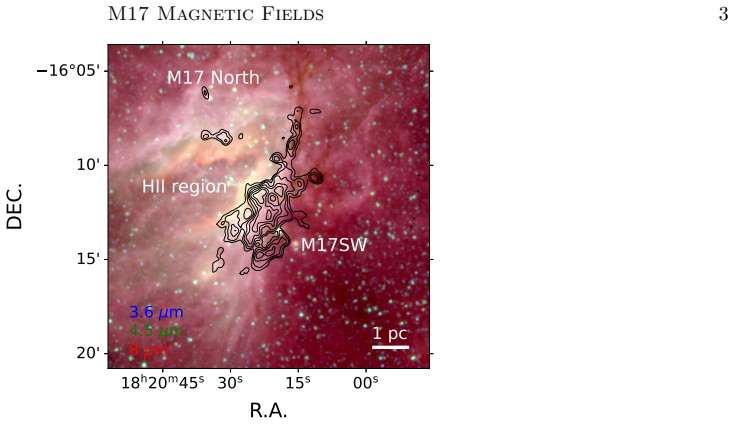
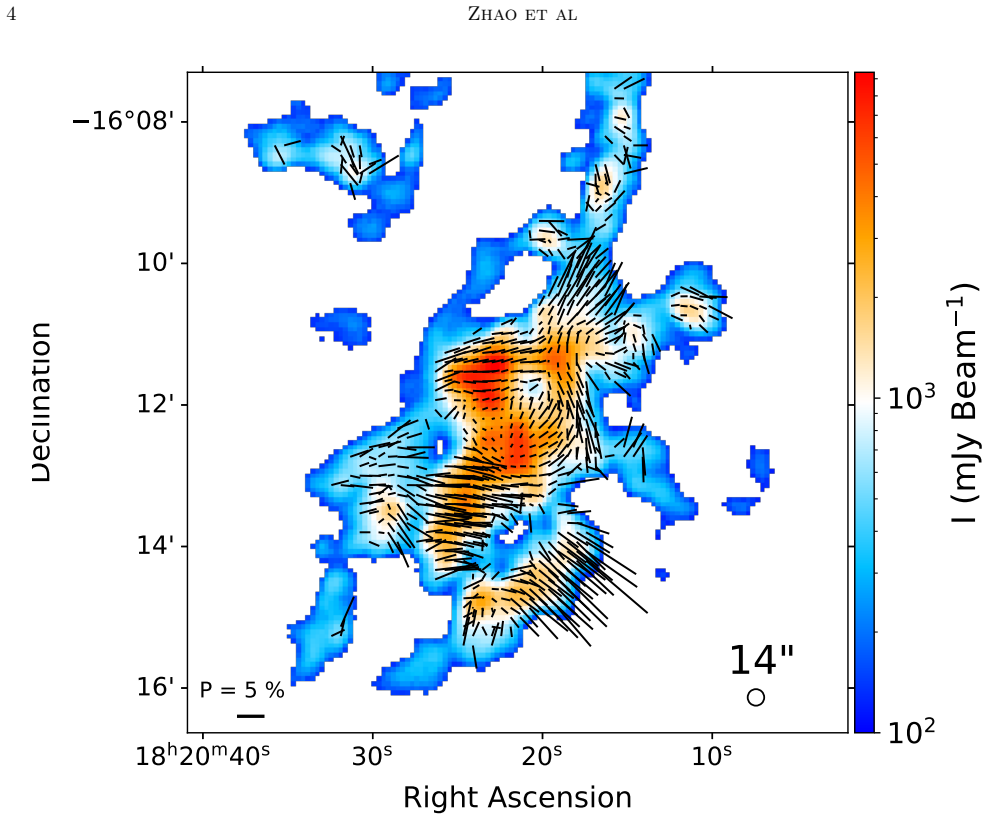
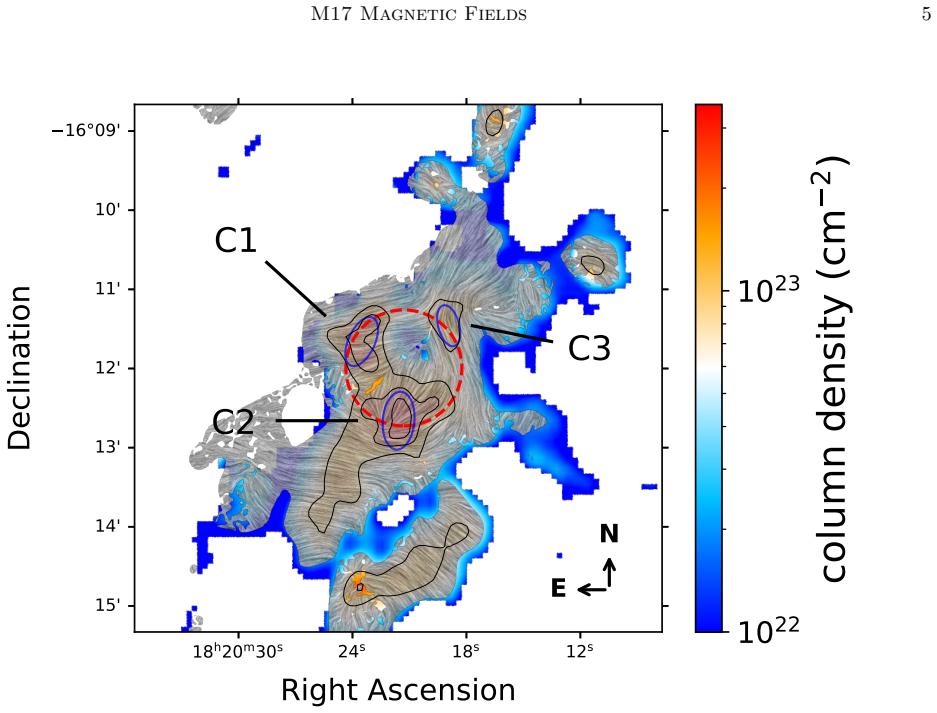
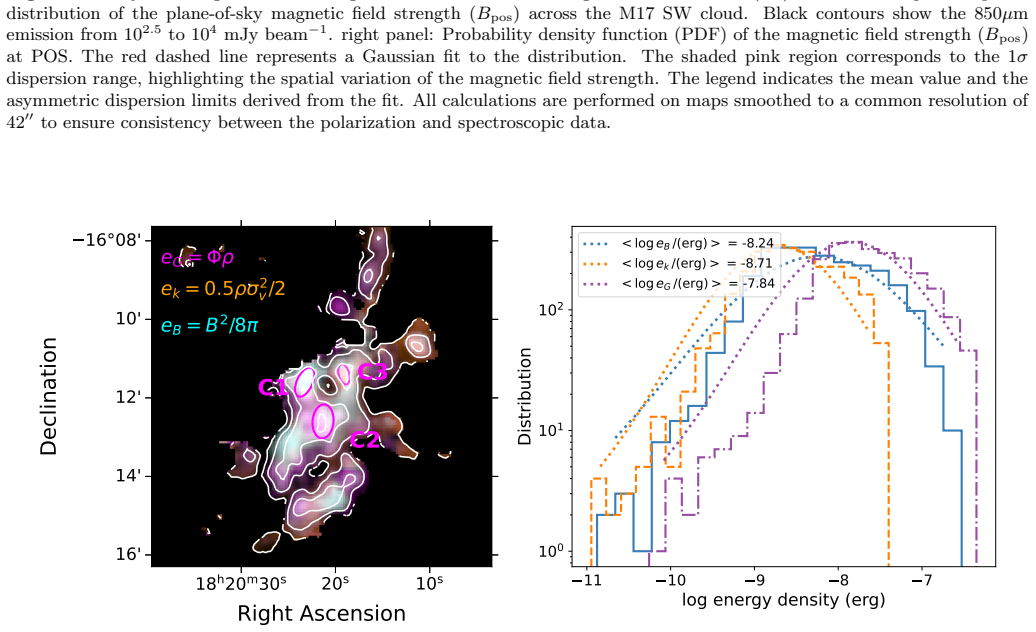
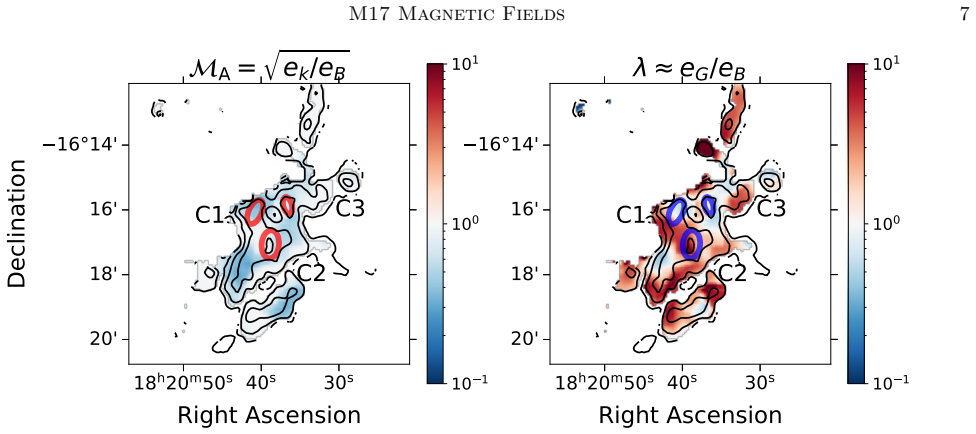
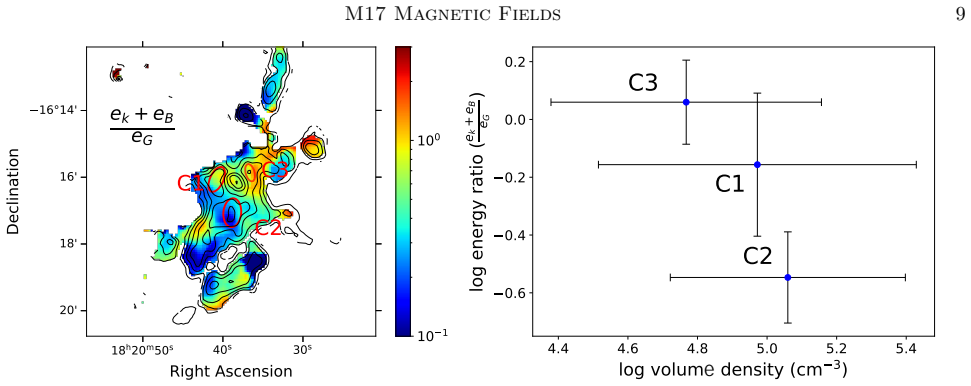
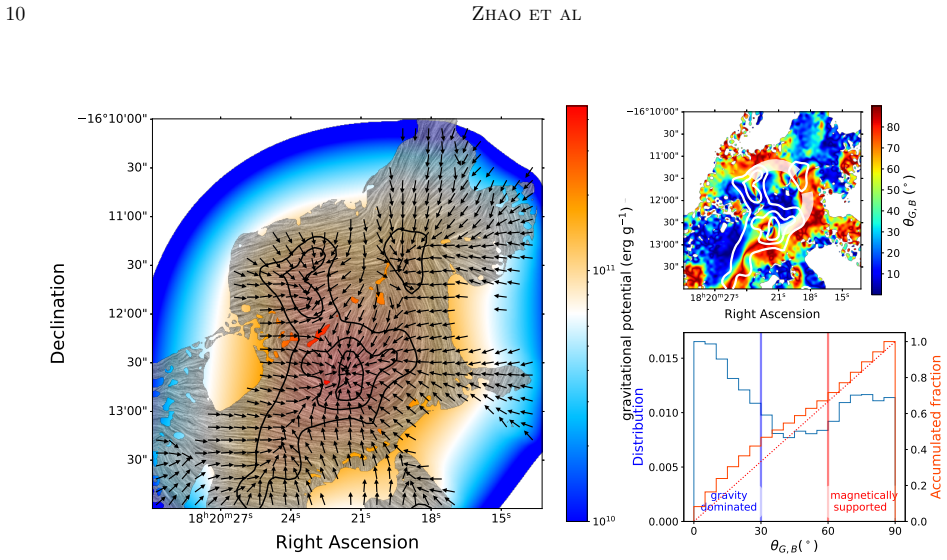
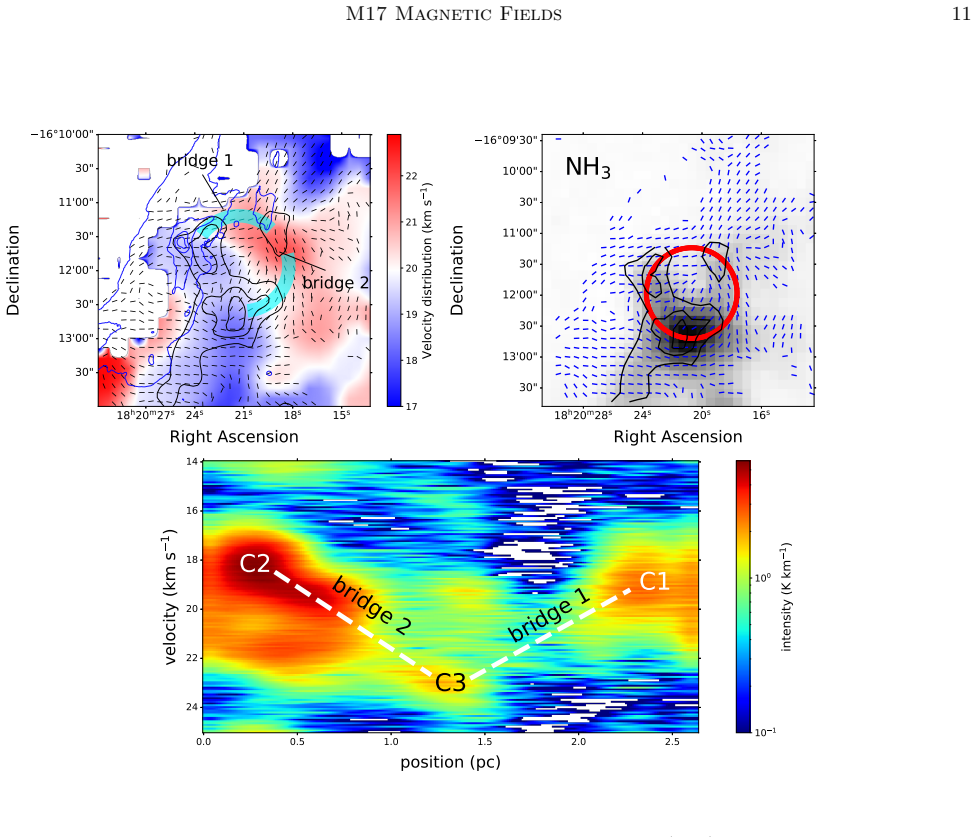
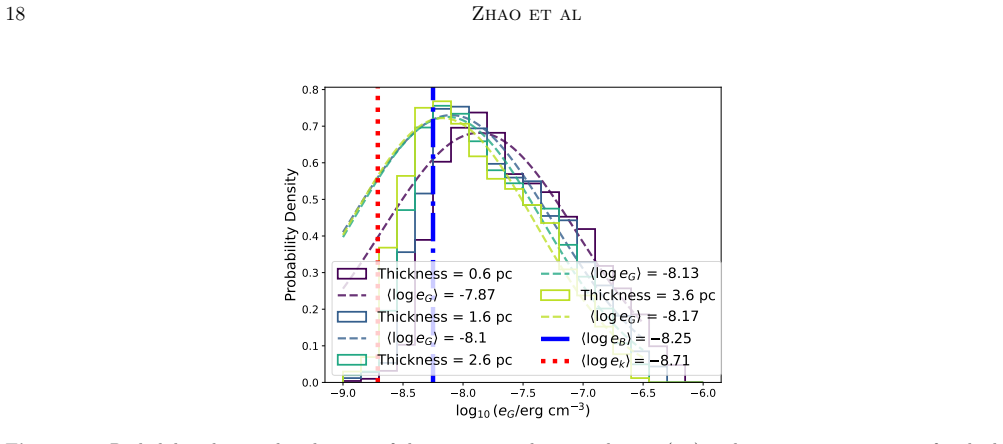
Star formation in M17 SW is globally driven by gravity but locally regulated by the magnetic field structure. The magnetic field forms an arc-like structure encircling three dense clumps. Plane-of-sky field strengths range from 0.1 to 2.4 mG. Gravity energy is highest at about 10^{-7.8} erg cm^{-3}, compared to magnetic at 10^{-8.3} and kinetic at 10^{-8.7}. Field lines are perpendicular to the shock front at the northeastern boundary and align with gravity inside the cloud except in accretion bridges where they are perpendicular to gravity to support against collapse and guide flows from clump C3 to C2.
What carries the argument
The arc-like magnetic field structure from 850 μm dust polarization maps combined with the Skalidis-Tassis method for estimating plane-of-sky field strengths from polarization and ammonia line data, which reveals the alignments that assist or regulate collapse.
If this is right
- Gravity dominates the energy budget but the near-equipartition means magnetic fields can still influence local dynamics.
- The perpendicular field lines in accretion bridges support against radial collapse while guiding gas transport between clumps.
- Kinematic evidence indicates material flows from the smaller Clump C3 onto the massive Clump C2.
- The configuration at the boundary is consistent with compression by the adjacent HII region.
- All three energy densities being within one order of magnitude implies the system is close to equilibrium.
Where Pith is reading between the lines
- If this configuration is common in other massive star-forming regions, it could explain the efficiency of star formation despite magnetic fields.
- Future observations at higher resolution could test whether the field strengths remain in this range or if smaller-scale structures alter the balance.
- Similar energy hierarchies might apply to other clouds where gravity and magnetism compete on different scales.
Load-bearing premise
The Skalidis-Tassis method applied to the polarization and ammonia data accurately measures the plane-of-sky magnetic field strengths without major errors from angle dispersion or unresolved structures.
What would settle it
A measurement showing magnetic field strengths much higher than 2.4 mG or much lower than 0.1 mG in the dense clumps, or kinematic data showing no gas transport from C3 to C2, would challenge the claim of gravitational dominance with local magnetic regulation.
Figures


read the original abstract
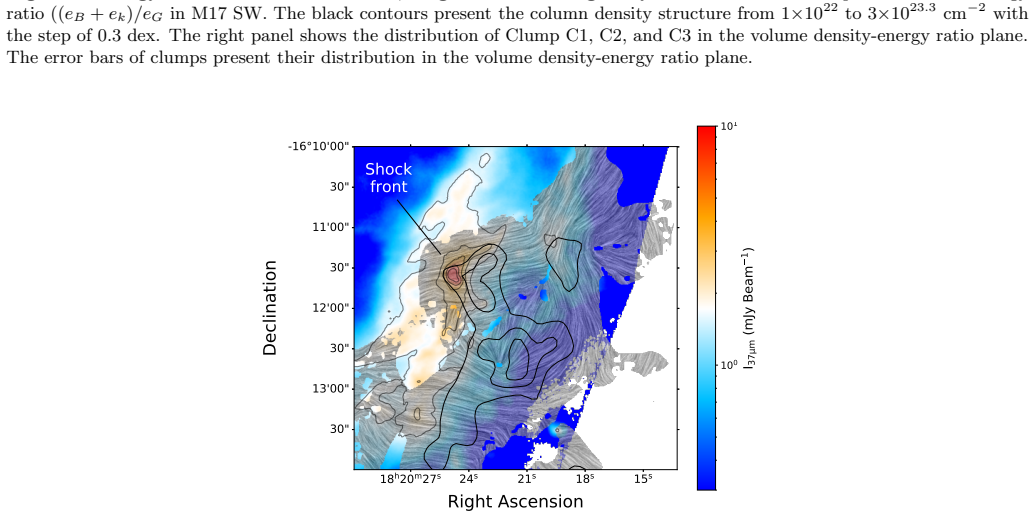
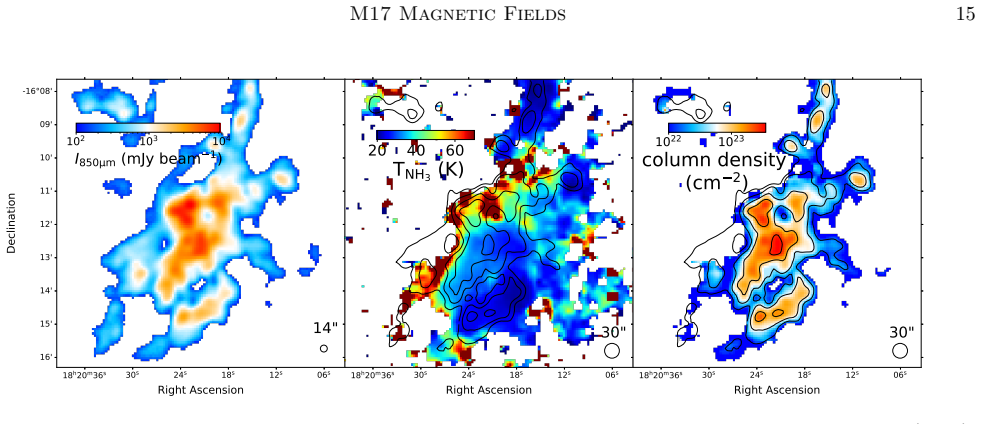
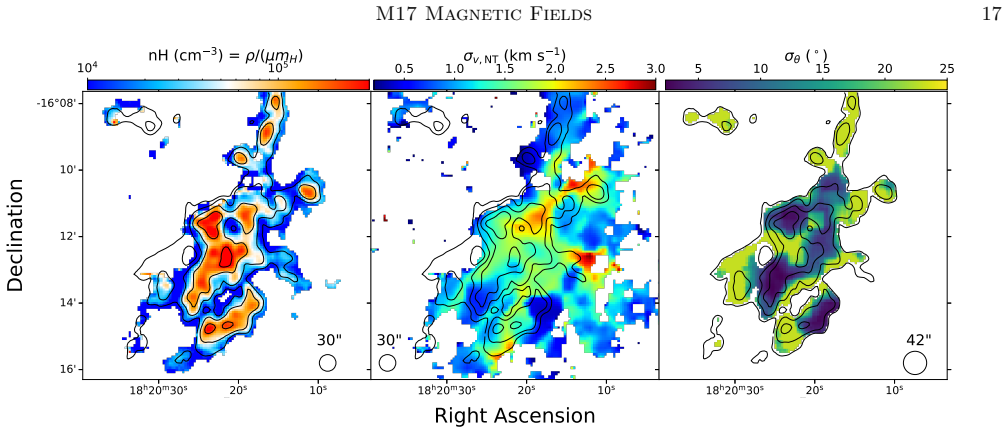
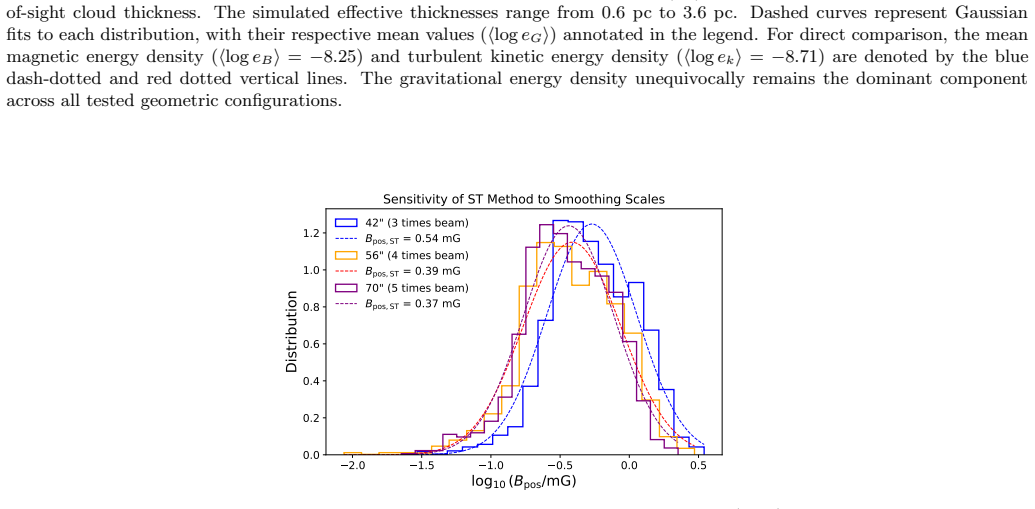
We present high-resolution magnetic field maps of the M17 SW molecular cloud using JCMT 850 $\mu$m dust polarization at a scale of 14$''$. The magnetic field exhibits a distinct arc-like structure that encircles three dense clumps (C1, C2, and C3). By combining polarization data with ammonia line observations, the plane-of-sky magnetic field strength, measured using the Skalidis-Tassis method to minimize angle dispersion errors, ranges from 0.1 to 2.4 mG (mean: 0.54 mG). Energy budget analysis reveals a hierarchy dominated by gravity ($e_G \approx 10^{-7.8}$ erg cm$^{-3}$), which exceeds both magnetic ($e_B \approx 10^{-8.3}$ erg cm$^{-3}$) and turbulent ($e_k \approx 10^{-8.7}$ erg cm$^{-3}$) energies. Since all three energy densities lie within one order of magnitude, gravitational dominance acts primarily as the global driver, while the system remains in a state of near-equipartition. Structurally, the northeastern boundary shows magnetic field lines perpendicular to the shock front, consistent with compression from the adjacent HII region. Within the cloud, magnetic field lines generally align with gravity to assist collapse, but turn perpendicular to gravity within curved accretion bridges. This configuration provides support against radial collapse while guiding gas flow. Kinematic evidence suggests that these channels transport material from Clump C3 onto the massive Clump C2. Star formation in M17 SW is globally driven by gravity but locally regulated by the magnetic field structure.
Editorial analysis
A structured set of objections, weighed in public.
Referee Report
Summary. The manuscript presents high-resolution magnetic field maps of the M17 SW molecular cloud using JCMT 850 μm dust polarization at 14'' resolution. The field exhibits an arc-like structure encircling clumps C1–C3. Combining polarization with NH3 line data, plane-of-sky B-field strengths are derived via the Skalidis-Tassis method (0.1–2.4 mG, mean 0.54 mG). Energy densities show gravitational dominance (e_G ≈ 10^{-7.8} erg cm^{-3}) over magnetic (e_B ≈ 10^{-8.3} erg cm^{-3}) and kinetic (e_k ≈ 10^{-8.7} erg cm^{-3}) terms, though all lie within one order of magnitude. Field lines are perpendicular to the northeastern HII shock front, align with gravity to aid collapse in places, but turn perpendicular within curved accretion bridges. Kinematics indicate material transport from C3 to C2. The central claim is that star formation is globally gravity-driven but locally magnetically regulated.
Significance. If the energy hierarchy and alignment interpretations are robust, the work supplies useful constraints on magnetic regulation of collapse in a massive star-forming region and contributes to the BISTRO survey. The combination of dust polarization with ammonia kinematics for field-strength estimation is a methodological strength that enables direct comparison of energy densities at matched scales.
major comments (2)
- [magnetic field strength derivation] § on magnetic field strength derivation (Skalidis-Tassis application): The method assumes angle dispersion arises primarily from small-scale turbulence with minimal large-scale geometric or shock-induced biases along the line of sight. The reported arc encircling C1–C3 and the northeastern shock front (where B is perpendicular to the front) violate isotropy and small-scale turbulence assumptions, raising the possibility that |B| is underestimated by a factor of 1.5–2. This would increase e_B and could remove the claimed gravitational dominance (e_G > e_B).
- [Energy budget section] Energy budget section: The hierarchy e_G > e_B, e_k is load-bearing for the global-gravity claim. No sensitivity test is described for plausible systematic offsets in the Skalidis-Tassis |B| values arising from the arc geometry or shock compression; such a test is required to confirm the hierarchy remains intact.
minor comments (2)
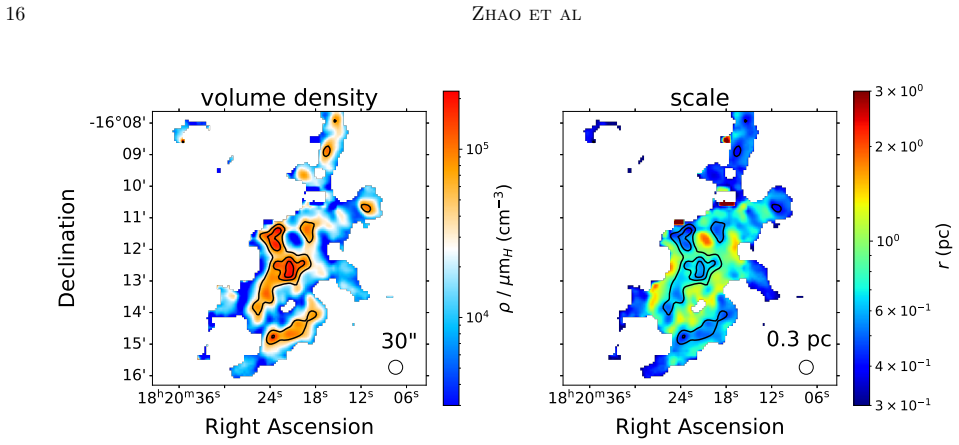
- Ensure all energy-density values are computed on identical spatial scales and that the 14'' beam is explicitly folded into the volume-density and velocity-dispersion inputs.
- The kinematic channel identification (material flow from C3 to C2) would benefit from a quantitative figure or table showing velocity gradients or position-velocity cuts.
Simulated Author's Rebuttal
We thank the referee for their careful and constructive review of our manuscript. We address the major comments point by point below, providing clarifications and indicating the revisions we have made to strengthen the analysis.
read point-by-point responses
-
Referee: [magnetic field strength derivation] § on magnetic field strength derivation (Skalidis-Tassis application): The method assumes angle dispersion arises primarily from small-scale turbulence with minimal large-scale geometric or shock-induced biases along the line of sight. The reported arc encircling C1–C3 and the northeastern shock front (where B is perpendicular to the front) violate isotropy and small-scale turbulence assumptions, raising the possibility that |B| is underestimated by a factor of 1.5–2. This would increase e_B and could remove the claimed gravitational dominance (e_G > e_B).
Authors: We acknowledge that the arc-like magnetic field structure and the shock front introduce large-scale features that could in principle affect the isotropy assumptions underlying the Skalidis-Tassis method. However, this method was specifically adopted because it reduces sensitivity to large-scale field geometry compared with the classical Davis-Chandrasekhar-Fermi approach. In the revised manuscript we have added an explicit discussion of these potential systematics together with a sensitivity test in which the derived plane-of-sky field strengths are scaled upward by factors of 1.5 and 2. Even under the more conservative scaling, the gravitational energy density remains comparable to or marginally larger than the magnetic energy density, preserving the conclusion that star formation is globally gravity-dominated while remaining in near-equipartition with the magnetic field. revision: yes
-
Referee: [Energy budget section] Energy budget section: The hierarchy e_G > e_B, e_k is load-bearing for the global-gravity claim. No sensitivity test is described for plausible systematic offsets in the Skalidis-Tassis |B| values arising from the arc geometry or shock compression; such a test is required to confirm the hierarchy remains intact.
Authors: We agree that a quantitative sensitivity test is necessary to support the robustness of the reported energy hierarchy. As described in our response to the preceding comment, we have now incorporated such a test in the revised Energy budget section. The test shows that the ordering e_G ≳ e_B ≳ e_k is maintained for moderate upward revisions of |B|, consistent with the near-equipartition regime emphasized in the manuscript. revision: yes
Circularity Check
No significant circularity; energy hierarchy follows from independent measurements
full rationale
The derivation chain proceeds from JCMT 850 μm polarization maps combined with NH3 line data, application of the Skalidis-Tassis method to obtain plane-of-sky |B| values (0.1–2.4 mG), and separate computation of gravitational, magnetic, and kinetic energy densities from observed densities, sizes, and velocities. These quantities are then compared to establish the reported hierarchy and alignments. No step reduces by construction to its own inputs, no fitted parameter is relabeled as a prediction, and no load-bearing premise rests on self-citation chains or imported uniqueness theorems. The central claims remain falsifiable against external physical scales and are not equivalent to the input data by definition.
Axiom & Free-Parameter Ledger
axioms (2)
- domain assumption Dust polarization at 850 microns reliably traces the plane-of-sky magnetic field orientation
- domain assumption Skalidis-Tassis method minimizes angle dispersion errors in field strength estimation
Lean theorems connected to this paper
-
IndisputableMonolith/Foundation/RealityFromDistinction.leanreality_from_one_distinction unclear?
unclearRelation between the paper passage and the cited Recognition theorem.
Energy budget analysis reveals a hierarchy dominated by gravity (e_G ≈ 10^{-7.8} erg cm^{-3}), which exceeds both magnetic (e_B ≈ 10^{-8.3} erg cm^{-3}) and turbulent (e_k ≈ 10^{-8.7} erg cm^{-3}) energies.
-
IndisputableMonolith/Cost/FunctionalEquation.leanwashburn_uniqueness_aczel unclear?
unclearRelation between the paper passage and the cited Recognition theorem.
plane-of-sky magnetic field strength, measured using the Skalidis-Tassis method
What do these tags mean?
- matches
- The paper's claim is directly supported by a theorem in the formal canon.
- supports
- The theorem supports part of the paper's argument, but the paper may add assumptions or extra steps.
- extends
- The paper goes beyond the formal theorem; the theorem is a base layer rather than the whole result.
- uses
- The paper appears to rely on the theorem as machinery.
- contradicts
- The paper's claim conflicts with a theorem or certificate in the canon.
- unclear
- Pith found a possible connection, but the passage is too broad, indirect, or ambiguous to say the theorem truly supports the claim.
Reference graph
Works this paper leans on
-
[1]
The Astropy Project: Building an inclusive, open-science project and status of the v2.0 core package
The Astropy Project: Building an Open-science Project and Status of the v2.0 Core Package. , keywords =. doi:10.3847/1538-3881/aabc4f , archivePrefix =. 1801.02634 , primaryClass =
work page internal anchor Pith review Pith/arXiv arXiv doi:10.3847/1538-3881/aabc4f
-
[2]
Astropy: A Community Python Package for Astronomy
Astropy: A community Python package for astronomy. , keywords =. 2013. doi:10.1051/0004-6361/201322068 , archivePrefix =. 1307.6212 , primaryClass =
work page internal anchor Pith review Pith/arXiv arXiv doi:10.1051/0004-6361/201322068 2013
-
[3]
SExtractor: Software for source extraction. , keywords =. 1996. doi:10.1051/aas:1996164 , adsurl =
-
[4]
Quantifying the Observational Effort Required for the Radial Velocity Characterization of TESS Planets. , keywords =. 2018. doi:10.3847/1538-3881/aacea9 , archivePrefix =. 1807.01263 , primaryClass =
work page internal anchor Pith review Pith/arXiv arXiv doi:10.3847/1538-3881/aacea9 2018
-
[5]
X-Ray Scattering Echoes and Ghost Halos from the Intergalactic Medium: Relation to the Nature of AGN Variability. , keywords =. 2015. doi:10.1088/0004-637X/805/1/23 , archivePrefix =. 1503.01475 , primaryClass =
work page internal anchor Pith review Pith/arXiv arXiv doi:10.1088/0004-637x/805/1/23 2015
- [6]
-
[7]
T _ E X and LAT _ E X Macro Definition Files for Astronomical Publications. , year = "1989", month = "Mar", pages =
work page 1989
-
[8]
LaTeX: A Document Preparation System. 1994
work page 1994
-
[9]
Quasi-periodic Fast Propagating Magnetoacoustic Waves during the Magnetic Reconnection Between Solar Coronal Loops. , keywords =. 2018. doi:10.3847/2041-8213/aaf167 , archivePrefix =. 1811.08553 , primaryClass =
work page internal anchor Pith review Pith/arXiv arXiv doi:10.3847/2041-8213/aaf167 2018
-
[10]
Nominal values for selected solar and planetary quantities: IAU 2015 Resolution B3
Nominal Values for Selected Solar and Planetary Quantities: IAU 2015 Resolution B3. , keywords =. 2016. doi:10.3847/0004-6256/152/2/41 , archivePrefix =. 1605.09788 , primaryClass =
work page internal anchor Pith review Pith/arXiv arXiv doi:10.3847/0004-6256/152/2/41 2015
-
[11]
Swift X-Ray Observations of Classical Novae. II. The Super Soft Source Sample. , keywords =. 2011. doi:10.1088/0067-0049/197/2/31 , archivePrefix =. 1110.6224 , primaryClass =
work page internal anchor Pith review Pith/arXiv arXiv doi:10.1088/0067-0049/197/2/31 2011
-
[12]
Galaxy emission line classification using 3D line ratio diagrams
Galaxy Emission Line Classification Using Three-dimensional Line Ratio Diagrams. , keywords =. 2014. doi:10.1088/0004-637X/793/2/127 , archivePrefix =. 1406.5186 , primaryClass =
work page internal anchor Pith review Pith/arXiv arXiv doi:10.1088/0004-637x/793/2/127 2014
- [13]
-
[14]
The Green Bank Ammonia Survey (GAS): First Results of NH3 mapping the Gould Belt
The Green Bank Ammonia Survey: First Results of NH _ 3 Mapping of the Gould Belt. , keywords =. doi:10.3847/1538-4357/aa6d58 , archivePrefix =. 1704.06318 , primaryClass =
work page internal anchor Pith review Pith/arXiv arXiv doi:10.3847/1538-4357/aa6d58
-
[15]
Malicious User Experience Design Research for Cybersecurity
Theory of Star Formation. , keywords =. doi:10.1146/annurev.astro.45.051806.110602 , archivePrefix =. 0707.3514 , primaryClass =
work page internal anchor Pith review Pith/arXiv arXiv doi:10.1146/annurev.astro.45.051806.110602
-
[16]
, year = 2012, month = sep, volume =
Magnetic Fields in Molecular Clouds. , year = 2012, month = sep, volume =. doi:10.1146/annurev-astro-081811-125514 , adsurl =
-
[17]
Turbulence and star formation in molecular clouds. , keywords =. doi:10.1093/mnras/194.4.809 , adsurl =
-
[18]
Star formation in molecular clouds: observation and theory. , keywords =. doi:10.1146/annurev.aa.25.090187.000323 , adsurl =
-
[19]
Magnetic Fields in Molecular Clouds Observation and Interpretation. Galaxies , keywords =. doi:10.3390/galaxies9020041 , archivePrefix =. 2106.08172 , primaryClass =
-
[20]
Protostars and Planets VII , year = 2023, editor =
Magnetic Fields in Star Formation: from Clouds to Cores. Protostars and Planets VII , year = 2023, editor =. doi:10.48550/arXiv.2203.11179 , archivePrefix =. 2203.11179 , primaryClass =
-
[21]
Frontiers in Astronomy and Space Sciences , keywords =
Magnetic field properties in star formation: A review of their analysis methods and interpretation. Frontiers in Astronomy and Space Sciences , keywords =. doi:10.3389/fspas.2022.943556 , archivePrefix =. 2208.06492 , primaryClass =
-
[22]
Towards a comprehensive scenario
Global hierarchical collapse in molecular clouds. Towards a comprehensive scenario. , keywords =. doi:10.1093/mnras/stz2736 , archivePrefix =. 1903.11247 , primaryClass =
-
[23]
Observations of high-order multiplicity in a high-mass stellar protocluster. Nature Astronomy , keywords =. doi:10.1038/s41550-023-02181-9 , archivePrefix =. 2401.06545 , primaryClass =
-
[24]
Density exponent analysis: gravity-driven steepening of the density profiles of star-forming regions. , keywords =. doi:10.1093/mnrasl/slac049 , archivePrefix =. 2205.03215 , primaryClass =
-
[25]
Turbulence in Zeeman Measurements from Molecular Clouds. apjl , keywords =. doi:10.3847/2041-8213/acc5e8 , archivePrefix =. 2303.11614 , primaryClass =
-
[26]
Self-similar Fragmentation Regulated by Magnetic Fields in a Massive Star Forming Filament
Self-similar fragmentation regulated by magnetic fields in a region forming massive stars. nat , keywords =. doi:10.1038/nature14291 , archivePrefix =. 1510.07094 , primaryClass =
work page internal anchor Pith review Pith/arXiv arXiv doi:10.1038/nature14291
-
[27]
, year = 1974, month = apr, volume =
Discovery and CO Observations of a New Molecular Source Near M17. , year = 1974, month = apr, volume =. doi:10.1086/181458 , adsurl =
-
[28]
The Young Massive Stellar Objects of M17. , keywords =. doi:10.1086/304808 , adsurl =
- [29]
- [30]
-
[31]
The Stellar Population of M17. , keywords =. doi:10.1086/591070 , adsurl =
-
[32]
2.3 micron CO emission and absorption from young high-mass stars in M17
2.3 m CO emission and absorption from young high-mass stars in M 17. , keywords =. doi:10.1051/0004-6361:20065946 , archivePrefix =. astro-ph/0608077 , primaryClass =
work page internal anchor Pith review Pith/arXiv arXiv doi:10.1051/0004-6361:20065946
-
[33]
Infrared Images of M17. , keywords =. doi:10.1086/170142 , adsurl =
-
[34]
The Large-Scale J = 3 --> 2 and J = 2 --> 1 CO Emission from M17 and Its Implications for Extragalactic CO Observations. , keywords =. doi:10.1086/307180 , archivePrefix =. astro-ph/9901134 , primaryClass =
work page internal anchor Pith review Pith/arXiv arXiv doi:10.1086/307180
-
[35]
VLA HI Zeeman Observations Toward the W49 Complex
Very Large Array H I Zeeman Observations toward the W49 Complex. , keywords =. doi:10.1086/319787 , archivePrefix =. astro-ph/0011581 , primaryClass =
work page internal anchor Pith review Pith/arXiv arXiv doi:10.1086/319787
-
[36]
A Magnetically-Supported Photodissociation Region in M17
A Magnetically Supported Photodissociation Region in M17. , keywords =. doi:10.1086/511258 , archivePrefix =. astro-ph/0611808 , primaryClass =
work page internal anchor Pith review Pith/arXiv arXiv doi:10.1086/511258
-
[37]
Trigonometric Parallaxes of Massive Star-forming Regions. VIII. G12.89+0.49, G15.03-0.68 (M17), and G27.36-0.16. , keywords =. doi:10.1088/0004-637X/733/1/25 , archivePrefix =. 1103.3139 , primaryClass =
work page internal anchor Pith review Pith/arXiv arXiv doi:10.1088/0004-637x/733/1/25
-
[38]
Surveying the Giant H II Regions of the Milky Way with SOFIA. II. M17. , keywords =. doi:10.3847/1538-4357/ab5fd0 , archivePrefix =. 1912.02855 , primaryClass =
-
[39]
Studying Magnetic Fields and Dust in M17 Using Polarized Thermal Dust Emission Observed by SOFIA/HAWC+. , keywords =. doi:10.3847/1538-4357/ac5abf , archivePrefix =. 2108.10045 , primaryClass =
-
[40]
Gamma-ray observation towards the young massive star cluster NGC 6618 in the M17 region. , keywords =. doi:10.1093/mnras/stac1252 , archivePrefix =. 2205.06430 , primaryClass =
-
[41]
Near-Infrared Imaging Polarization Study of M 17. , keywords =. doi:10.1093/pasj/64.5.110 , adsurl =
-
[42]
VLT near- to mid-IR imaging and spectroscopy of the M17 UC1-IRS5 region
VLT near- to mid-IR imaging and spectroscopy of the M 17 UC1 - IRS5 region. , keywords =. doi:10.1051/0004-6361/201424895 , archivePrefix =. 1502.04959 , primaryClass =
work page internal anchor Pith review Pith/arXiv arXiv doi:10.1051/0004-6361/201424895
-
[43]
M17 MIR: A Massive Protostar with Multiple Accretion Outbursts. , keywords =. doi:10.3847/1538-4357/ac2151 , archivePrefix =. 2108.12554 , primaryClass =
-
[44]
Planck 2018 results. XII. Galactic astrophysics using polarized dust emission. aap , keywords =. doi:10.1051/0004-6361/201833885 , archivePrefix =. 1807.06212 , primaryClass =
-
[45]
Physical Review , year = 1951, month = mar, volume =
The Strength of Interstellar Magnetic Fields. Physical Review , year = 1951, month = mar, volume =. doi:10.1103/PhysRev.81.890.2 , adsurl =
-
[46]
, year = 1953, month = jul, volume =
Magnetic Fields in Spiral Arms. , year = 1953, month = jul, volume =. doi:10.1086/145731 , adsurl =
-
[47]
High-accuracy estimation of magnetic field strength in the interstellar medium from dust polarization. , keywords =. doi:10.1051/0004-6361/202039779 , archivePrefix =. 2010.15141 , primaryClass =
-
[48]
Why take the square root? An assessment of interstellar magnetic field strength estimation methods. , keywords =. doi:10.1051/0004-6361/202142045 , archivePrefix =. 2109.10925 , primaryClass =
-
[49]
First results from BISTRO -- a SCUBA-2 polarimeter survey of the Gould Belt
First Results from BISTRO: A SCUBA-2 Polarimeter Survey of the Gould Belt. , keywords =. doi:10.3847/1538-4357/aa70a0 , archivePrefix =. 1704.08552 , primaryClass =
work page internal anchor Pith review Pith/arXiv arXiv doi:10.3847/1538-4357/aa70a0
-
[50]
Stellar Magnetism: A Workshop in Honour of the Career and Contributions of John D
BISTRO: B-fields In STar-forming Regions Observations, an Overview. Stellar Magnetism: A Workshop in Honour of the Career and Contributions of John D. Landstreet , year = 2020, editor =
work page 2020
-
[51]
POL-2: a polarimeter for the James-Clerk-Maxwell telescope. Millimeter, Submillimeter, and Far-Infrared Detectors and Instrumentation for Astronomy VIII , year = 2016, editor =. doi:10.1117/12.2231943 , adsurl =
-
[52]
SCUBA-2: The 10000 pixel bolometer camera on the James Clerk Maxwell Telescope
SCUBA-2: the 10 000 pixel bolometer camera on the James Clerk Maxwell Telescope. , keywords =. doi:10.1093/mnras/sts612 , archivePrefix =. 1301.3650 , primaryClass =
work page internal anchor Pith review Pith/arXiv arXiv doi:10.1093/mnras/sts612
-
[53]
SMURF: SubMillimeter User Reduction Facility
-
[54]
KAPPA: Kernel Applications Package
-
[55]
Astronomical Data Analysis Software and Systems XXIII , year = 2014, editor =
Starlink Software in 2013. Astronomical Data Analysis Software and Systems XXIII , year = 2014, editor =
work page 2013
-
[56]
SCUBA-2: on-sky calibration using submillimetre standard sources
SCUBA-2: on-sky calibration using submillimetre standard sources. , keywords =. doi:10.1093/mnras/stt090 , archivePrefix =. 1301.3773 , primaryClass =
work page internal anchor Pith review Pith/arXiv arXiv doi:10.1093/mnras/stt090
-
[57]
A Decade of SCUBA-2: A Comprehensive Guide to Calibrating 450 m and 850 m Continuum Data at the JCMT. , keywords =. doi:10.3847/1538-3881/ac18bf , archivePrefix =. 2107.13558 , primaryClass =
-
[58]
Multiscale Decomposition of Astronomical Maps: A Constrained Diffusion Method. , keywords =. doi:10.3847/1538-4365/ac4bc4 , archivePrefix =. 2201.05484 , primaryClass =
-
[59]
SCUBA Polarization Measurements of the Magnetic Field Strengths in the L183, L1544, and L43 Prestellar Cores. , keywords =. doi:10.1086/379705 , archivePrefix =. astro-ph/0305604 , primaryClass =
work page internal anchor Pith review Pith/arXiv arXiv doi:10.1086/379705
-
[60]
Magnetic Fields in Star Formation: A Complete Compilation of All the DCF Estimations. , keywords =. doi:10.3847/1538-4357/ac3911 , archivePrefix =. 2111.05836 , primaryClass =
-
[61]
Gas of 96 Planck Cold Clumps in the Second Quadrant. , keywords =. doi:10.3847/0067-0049/224/2/43 , adsurl =
-
[62]
Slope of Magnetic Field Density Relation as an Indicator of Magnetic Dominance. , keywords =. doi:10.3847/1538-4357/ad8b4d , archivePrefix =. 2409.02786 , primaryClass =
-
[63]
, year = 2015, month = aug, volume =
Interstellar Dust Grain Alignment. , year = 2015, month = aug, volume =. doi:10.1146/annurev-astro-082214-122414 , adsurl =
-
[64]
A unified model for the evolution of galaxies and quasars , volume =
Helical fields and filamentary molecular clouds - I. , keywords =. doi:10.1046/j.1365-8711.2000.03066.x , archivePrefix =. astro-ph/9901096 , primaryClass =
-
[65]
The JCMT BISTRO Survey: The magnetic field strength in the Orion A filament
The JCMT BISTRO Survey: The Magnetic Field Strength in the Orion A Filament. , keywords =. doi:10.3847/1538-4357/aa80e5 , archivePrefix =. 1707.05269 , primaryClass =
work page internal anchor Pith review Pith/arXiv arXiv doi:10.3847/1538-4357/aa80e5
-
[66]
Curvature Mapping Method: Mapping Lorentz Force in Orion A. arXiv e-prints , keywords =. doi:10.48550/arXiv.2408.09690 , archivePrefix =. 2408.09690 , primaryClass =
-
[67]
Submillimeter Array Observations of Magnetic Fields in G240.31+0.07: An Hourglass in a Massive Cluster-forming Core. , keywords =. doi:10.1088/2041-8205/794/1/L18 , archivePrefix =. 1409.5608 , primaryClass =
work page internal anchor Pith review Pith/arXiv arXiv doi:10.1088/2041-8205/794/1/l18 2041
-
[68]
Dense core formation in supersonic turbulent converging flows
Dense Core Formation in Supersonic Turbulent Converging Flows. , keywords =. doi:10.1088/0004-637X/729/2/120 , archivePrefix =. 1101.2650 , primaryClass =
work page internal anchor Pith review Pith/arXiv arXiv doi:10.1088/0004-637x/729/2/120
-
[69]
Magnetic Field of Molecular Gas Measured with the Velocity Gradient Technique. II. Curved Magnetic Field in kpc-scale Bubble of NGC 628. , keywords =. doi:10.3847/1538-4357/ad3a62 , archivePrefix =. 2404.02651 , primaryClass =
-
[70]
Intensity Gradients Technique: Synergy with Velocity Gradients and Polarization Studies. , keywords =. doi:10.3847/1538-4357/ab4b5e , archivePrefix =. 1908.09488 , primaryClass =
-
[71]
On the Formation of Density Filaments in the Turbulent Interstellar Medium. , keywords =. doi:10.3847/1538-4357/ab21be , archivePrefix =. 1905.06341 , primaryClass =
-
[72]
Tracing interstellar magnetic field using the velocity gradient technique in shock and self-gravitating media. arXiv e-prints , keywords =. doi:10.48550/arXiv.1703.03026 , archivePrefix =. 1703.03026 , primaryClass =
work page internal anchor Pith review Pith/arXiv arXiv doi:10.48550/arxiv.1703.03026
-
[73]
Isolating signatures of major cloud-cloud collisions using position-velocity diagrams
Isolating signatures of major cloud-cloud collisions using position-velocity diagrams. , keywords =. doi:10.1093/mnras/stv639 , archivePrefix =. 1503.06795 , primaryClass =
work page internal anchor Pith review Pith/arXiv arXiv doi:10.1093/mnras/stv639
-
[74]
A Curved Magnetic field in the ring-like shell of bubble N4
A Curved Magnetic Field in the Ring-like Shell of Bubble N4. , keywords =. doi:10.3847/1538-4357/aa65d3 , archivePrefix =. 1703.02649 , primaryClass =
work page internal anchor Pith review Pith/arXiv arXiv doi:10.3847/1538-4357/aa65d3
-
[75]
Gravitational collapse of the OMC-1 region
Gravitational collapse of the OMC-1 region. , keywords =. doi:10.1051/0004-6361/201730732 , archivePrefix =. 1703.03464 , primaryClass =
work page internal anchor Pith review Pith/arXiv arXiv doi:10.1051/0004-6361/201730732
-
[76]
Criteria for gravitational instability and quasi-isolated gravitational collapse in turbulent medium
Criteria for gravitational instability and quasi-isolated gravitational collapse in turbulent medium. , keywords =. doi:10.1093/mnras/stw2707 , archivePrefix =. 1610.06577 , primaryClass =
work page internal anchor Pith review Pith/arXiv arXiv doi:10.1093/mnras/stw2707
-
[77]
Calibrating the Davis-Chandrasekhar-Fermi Method with Numerical Simulations: Uncertainties in Estimating the Magnetic Field Strength from Statistics of Field Orientations. , keywords =. doi:10.3847/1538-4357/ac0cec , archivePrefix =. 2106.09934 , primaryClass =
-
[78]
AI: Predict Density and Measure Width of molecular clouds by Multiscale Decomposition
Equation vs. AI: Predict Density and Measure Width of molecular clouds by Multiscale Decomposition. arXiv e-prints , keywords =. doi:10.48550/arXiv.2508.01130 , archivePrefix =. 2508.01130 , primaryClass =
-
[79]
Spatial distributions and kinematics of shocked and ionized gas in M17. , keywords =. doi:10.1093/mnras/stad996 , archivePrefix =. 2306.12128 , primaryClass =
-
[80]
Physics of the Interstellar and Intergalactic Medium
discussion (0)
Sign in with ORCID, Apple, or X to comment. Anyone can read and Pith papers without signing in.